2015 Paper 3 Q11
Year: 2015
Paper: 3
Question Number: 11
Course: UFM Mechanics
Section: Circular Motion 1
Problem
- A horizontal disc of radius \(r\) rotates about a vertical axis through its centre with angular speed \(\omega\). One end of a light rod is fixed by a smooth hinge to the edge of the disc so that it can rotate freely in a vertical plane through the centre of the disc. A particle \(P\) of mass \(m\) is attached to the rod at a distance \(d\) from the hinge. The rod makes a constant angle \(\alpha\) with the upward vertical, as shown in the diagram, and \(d\sin\alpha < r\).
By considering moments about the hinge for the (light) rod, show that the force exerted on the rod by \(P\) is parallel to the rod. Show also that \[ r\cot\alpha = a + d \cos\alpha \,, \] where \(a = \dfrac {g \;} {\omega^2}\,\). State clearly the direction of the force exerted by the hinge on the rod, and find an expression for its magnitude in terms of \(m\), \(g\) and \(\alpha\).
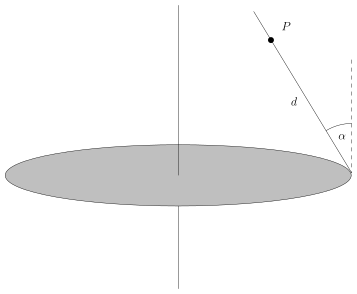
- The disc and rod rotate as in part (i), but two particles (instead of \(P\)) are attached to the rod. The masses of the particles are \(m_1\) and \(m_2\) and they are attached to the rod at distances \(d_1\) and \(d_2\) from the hinge, respectively. The rod makes a constant angle \(\beta\) with the upward vertical and \(d_1\sin\beta < d_2\sin\beta < r\). Show that \(\beta\) satisfies an equation of the form \[ r\cot\beta = a+ b \cos\beta \,, \] where \(b\) should be expressed in terms of \(d_1\), \(d_2\), \(m_1\) and \(m_2\).
Solution
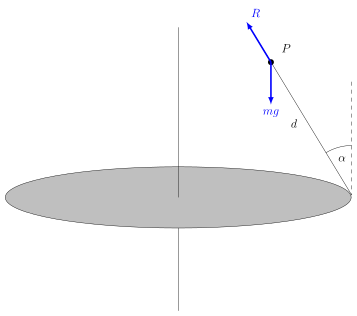
- Since the particle is not moving (relative to the hinge) there is no moment about the hinge and in particular the only forces must be directed towards the hinge, ie parallel to the rod.
\begin{align*} \text{N2}(\uparrow): && R \cos \alpha &= mg \\ \\ \text{N2}(\leftarrow, \text{radially}): && R \sin \alpha &= m (r-d\sin \alpha) \omega^2 \\ \Rightarrow && \cot \alpha &= \frac{g}{(r-d\sin \alpha) \omega^2} \\ \Rightarrow && r\cot \alpha-d \cos \alpha &= a \\ \Rightarrow && r \cot \alpha &= a + d \cos \alpha \end{align*} The force of the hinge is acting in the same direction and magnitude as the rod on the particle (the force \(R\) in the diagram). It has magnitude \(mg \sec \alpha\)
- \(\,\)
\begin{align*} \overset{\curvearrowleft}{\text{hinge}}: && gm_1d_1 \sin \beta+gm_2d_2 \sin \beta &= m_1 (r-d_1 \sin \beta) \omega^2 d_1 \cos \beta + m_2 (r-d_2 \sin \beta) \omega^2 d_2 \cos \beta \\ \Rightarrow && a(m_1d_1+m_2d_2) \tan \beta &= r(m_1d_1+m_2d_2) - (m_1d_1^2+m_2d_2^2) \sin \beta \\ \Rightarrow && r\cot \beta &= a + \frac{m_1d_1^2+m_2d_2^2}{m_1d_1+m_2d_2} \cos \beta \end{align*}

Examiner's report
— 2015 STEP 3, Question 11A very similar number of candidates to 2014 once again ensured that all questions received a decent number of attempts, with seven questions being very popular rather than five being so in 2014, but the most popular questions were attempted by percentages in the 80s rather than 90s. All but one question was answered perfectly at least once, the one exception receiving a number of very close to perfect solutions. About 70% attempted at least six questions, and in those cases where more than six were attempted, the extra attempts were usually fairly superficial.
Rating Information
Difficulty Rating: 1700.0
Difficulty Comparisons: 0
Banger Rating: 1484.0
Banger Comparisons: 1
Show LaTeX source
Problem source
\begin{questionparts}
\item A horizontal disc of radius $r$ rotates about a vertical axis through its centre with angular speed $\omega$. One end of a light rod is fixed by a smooth hinge to the edge of the disc so that it can rotate freely in a vertical plane through the centre of the disc. A particle $P$ of mass $m$ is attached to the rod at a distance $d$ from the hinge. The rod makes a constant angle $\alpha$ with the upward vertical, as shown in the diagram, and $d\sin\alpha < r$.
\begin{center}
\begin{tikzpicture}
    % Dashed vertical line
    \draw[dashed, dash pattern=on 4pt off 4pt] (6.12,4.08) -- (6.12,0.08);
    % The Ellipse
    % PSTricks: fillcolor=black, fillstyle=solid, opacity=0.25
    \filldraw[fill=black, fill opacity=0.25] (0,0) ellipse (6.1 and 1.08);
    % Vertical lines (Bottom and Top)
    \draw (0,-1.08) -- (0,-4);
    \draw (0,6) -- (0,0);
    % Slanted line connecting the side to the top
    \draw (6.12,0.08) -- (2.66,5.78);
    % The Arc (Parametric plot conversion)
    % Center: (6.12, 0.08), Radius: 1.75
    % Start Angle: 1.5707 rad ~= 90 degrees
    % End Angle: 2.1164 rad ~= 121.26 degrees
    \draw (6.12,0.08) + (90:1.75) arc (90:121.26:1.75);
    % The Point P
    % dotsize=6pt (diameter) -> radius=3pt
    \fill (3.27,4.77) circle (3pt);
    % Labels
    % rput[tl] corresponds to anchor=north west
    \node[anchor=north west] at (5.5, 1.6) {$\alpha$};
    \node[anchor=north west] at (3.5, 5.55) {$P$};
    \node[anchor=north west] at (3.83, 2.9) {$d$};
\end{tikzpicture}
\end{center}
By considering moments about the hinge for the (light) rod, show that the force exerted on the rod by $P$ is parallel to the rod.
Show also that
\[
r\cot\alpha = a + d \cos\alpha \,,
\]
where $a = \dfrac {g \;} {\omega^2}\,$. State clearly the direction of the force exerted by the hinge on the rod, and find an expression for its magnitude in terms of $m$, $g$ and $\alpha$.
\item The disc and rod rotate as in part (i), but two particles (instead of $P$) are attached to the rod. The masses of the particles are $m_1$ and $m_2$ and they are attached to the rod at distances $d_1$ and $d_2$ from the hinge, respectively. The rod makes a constant angle $\beta$ with the upward vertical and $d_1\sin\beta < d_2\sin\beta < r$. Show that $\beta$ satisfies an equation of the form
\[
r\cot\beta = a+ b \cos\beta \,,
\]
where  $b$ should be expressed in terms of $d_1$, $d_2$, $m_1$ and $m_2$.
\end{questionparts}
Solution source
\begin{questionparts}
\item Since the particle is not moving (relative to the hinge) there is no moment about the hinge and in particular the only forces must be directed towards the hinge, ie parallel to the rod.
\begin{center}

\begin{tikzpicture}
    % Dashed vertical line
    \draw[dashed, dash pattern=on 4pt off 4pt] (6.12,4.08) -- (6.12,0.08);

    % The Ellipse
    % PSTricks: fillcolor=black, fillstyle=solid, opacity=0.25
    \filldraw[fill=black, fill opacity=0.25] (0,0) ellipse (6.1 and 1.08);

    % Vertical lines (Bottom and Top)
    \draw (0,-1.08) -- (0,-4);
    \draw (0,6) -- (0,0);

    % Slanted line connecting the side to the top
    \draw (6.12,0.08) -- (2.66,5.78);

    % The Arc (Parametric plot conversion)
    % Center: (6.12, 0.08), Radius: 1.75
    % Start Angle: 1.5707 rad ~= 90 degrees
    % End Angle: 2.1164 rad ~= 121.26 degrees
    \draw (6.12,0.08) + (90:1.75) arc (90:121.26:1.75);

    % The Point P
    % dotsize=6pt (diameter) -> radius=3pt
    \fill (3.27,4.77) circle (3pt);

    \draw[-latex, ultra thick, blue] (3.27,4.77) -- ++(0, -1.5) node[below] {$mg$};
    \draw[-latex, ultra thick, blue] (3.27,4.77) -- ++({(2.66-6.12)/4}, {(5.78-0.08)/4} ) node[above right] {$R$};

    % Labels
    % rput[tl] corresponds to anchor=north west
    \node[anchor=north west] at (5.5, 1.6) {$\alpha$};
    \node[anchor=north west] at (3.5, 5.55) {$P$};
    \node[anchor=north west] at (3.83, 2.9) {$d$};

\end{tikzpicture}
\end{center}

\begin{align*}
    \text{N2}(\uparrow): && R \cos \alpha &= mg \\
    \\
    \text{N2}(\leftarrow, \text{radially}): && R \sin \alpha &= m (r-d\sin \alpha)  \omega^2 \\
    \Rightarrow && \cot \alpha &= \frac{g}{(r-d\sin \alpha) \omega^2} \\
    \Rightarrow && r\cot \alpha-d \cos \alpha &= a \\
    \Rightarrow &&  r \cot \alpha &= a + d \cos \alpha
\end{align*}

The force of the hinge is acting in the same direction and magnitude as the rod on the particle (the force $R$ in the diagram). It has magnitude $mg \sec \alpha$

\item $\,$

\begin{center}

\begin{tikzpicture}
    % Dashed vertical line
    \draw[dashed, dash pattern=on 4pt off 4pt] (6.12,4.08) -- (6.12,0.08);

    % The Ellipse
    % PSTricks: fillcolor=black, fillstyle=solid, opacity=0.25
    \filldraw[fill=black, fill opacity=0.25] (0,0) ellipse (6.1 and 1.08);

    % Vertical lines (Bottom and Top)
    \draw (0,-1.08) -- (0,-4);
    \draw (0,6) -- (0,0);

    % Slanted line connecting the side to the top
    \draw (6.12,0.08) -- (2.66,5.78);

    % The Arc (Parametric plot conversion)
    % Center: (6.12, 0.08), Radius: 1.75
    % Start Angle: 1.5707 rad ~= 90 degrees
    % End Angle: 2.1164 rad ~= 121.26 degrees
    \draw (6.12,0.08) + (90:1.75) arc (90:121.26:1.75);


    \coordinate (A) at ({3.27+(2.66-6.12)/(-8)},{4.77+(5.78-0.08)/(-8)} );
    \coordinate (B) at ({3.27+(2.66-6.12)/(8)},{4.77+(5.78-0.08)/(8)} );

    \fill (A) circle (3pt);
    \fill (B) circle (3pt);

    \draw[-latex, ultra thick, blue] (A) -- ++(0, -1.5) node[below] {$m_1g$};
    \draw[-latex, ultra thick, blue] (B) -- ++(0, -1.5) node[below] {$m_2g$};
    \draw[-latex, ultra thick, blue] (A) -- ++({(2.66-6.12)/7}, {(5.78-0.08)/7+0.4} ) node[above] {$R_1$};
    \draw[-latex, ultra thick, blue] (B) -- ++({(2.66-6.12)/4}, {(5.78-0.08)/4-0.4} ) node[above] {$R_2$};

    % Labels
    % rput[tl] corresponds to anchor=north west
    \node[anchor=north west] at (5.5, 1.6) {$\beta$};
    % \node[anchor=north west] at (3.5, 5.55) {$P$};
    % \node[anchor=north west] at (3.83, 2.9) {$d$};

\end{tikzpicture}
\end{center}


\begin{align*}
    \overset{\curvearrowleft}{\text{hinge}}: && gm_1d_1 \sin \beta+gm_2d_2 \sin \beta &= m_1 (r-d_1 \sin \beta) \omega^2 d_1 \cos \beta + m_2 (r-d_2 \sin \beta) \omega^2 d_2 \cos \beta \\
    \Rightarrow && a(m_1d_1+m_2d_2) \tan \beta &= r(m_1d_1+m_2d_2) - (m_1d_1^2+m_2d_2^2) \sin \beta \\
    \Rightarrow && r\cot \beta &= a + \frac{m_1d_1^2+m_2d_2^2}{m_1d_1+m_2d_2} \cos \beta
\end{align*}
\end{questionparts}
Marginally more popular than the Probability and Statistics questions, this was attempted by just over 10% with, on average, slightly less success than question 4, though students either got almost full marks or virtually none. Most did part (i) correctly except the final part, identifying the force from the hinge. The most common mistake was in part (ii) by those that assumed that there were no perpendicular forces acting on the system. Students that correctly considered the total moment for part (ii) obtained the answer. Some students got the direction of centripetal force wrong.