2025 Paper 3 Q10
Year: 2025
Paper: 3
Question Number: 10
Course: UFM Mechanics
Section: Moments
Problem
- Show that the \(x\)-coordinate of \(P\) is \(sL\cos\omega t\), and find a similar expression for its \(y\)-coordinate.
- Find expressions for the \(x\)- and \(y\)-components of the acceleration of the particle.
- \(N\) and \(F\) are the upward normal and frictional components, respectively, of the force of the plank on the particle. Show that $$N = mg(1 - k\sin\omega t)\cos\omega t$$ and that $$F = mgsk\frac{\omega^2}{g}\tan\omega t$$ where \(k = \frac{L\omega^2}{g}\).
- The coefficient of friction between the particle and the plank is \(\tan\alpha\), where \(\alpha\) is an acute angle.
Show that the particle will not slip initially, provided \(sk < \tan\alpha\).
Show further that, in this case, the particle will slip
- while \(N\) is still positive,
- when the plank makes an angle less than \(\alpha\) to the horizontal.
Solution
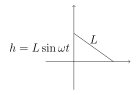
- Since we have \(h'' + \omega^2 h = 0\) we must have that \(h(t) = A \cos \omega t + B \sin \omega t\). The initial conditions tell us that \(A = 0\) and \(B = L\), so \(h(t) = L \sin \omega t\).
Therefore we can see the angle at \(B\) is \(\omega t\) and so \(P\) has \(y\)-coordinate \((1-s)L \sin \omega t\) and \(x\)-coordinate \(sL \cos \omega t\)
- If the position is \(\binom{sL \cos \omega t}{(1-s) L \sin \omega t}\) then the acceleration is \(-\omega^2 \binom{sL \cos \omega t}{(1-s) L \sin \omega t}\)
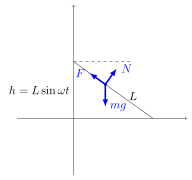
- \begin{align*} \text{N2}(\rightarrow): && - F\cos \omega t + N \sin \omega t &= -m\omega^2 sL \cos \omega t\\ \text{N2}(\uparrow): && -mg + F\sin \omega t + N \cos \omega t &= -m\omega^2 (1-s) L \sin \omega t \\ \Rightarrow && \begin{pmatrix} \cos \omega t & -\sin \omega t \\ \sin \omega t & \cos \omega t \end{pmatrix} \begin{pmatrix} F \\ N \end{pmatrix} &= \begin{pmatrix} m\omega^2 s L \cos \omega t \\ mg - m\omega^2(1-s)L \sin \omega t \end{pmatrix} \\ \Rightarrow && \begin{pmatrix}F \\ N \end{pmatrix} &= \begin{pmatrix} \cos \omega t & \sin \omega t \\ -\sin \omega t & \cos \omega t \end{pmatrix} \begin{pmatrix} m\omega^2 s L \cos \omega t \\ mg - m\omega^2(1-s)L \sin \omega t \end{pmatrix} \\ \Rightarrow && N &= m \omega^2 s L (-\sin \omega t \cos \omega t) + mg \cos \omega t - m \omega^2 (1-s)L \sin \omega t \cos \omega t \\ &&&=mg \cos \omega t - m \omega^2 L \sin \omega t \cos \omega t \\ &&&= mg \cos \omega t \left (1 - \frac{L \omega^2}{g} \sin \omega t \right) \\ &&&= mg (1 - k \sin \omega t) \cos \omega t \\ \Rightarrow && F &= m \omega^2 s L \cos^2 \omega t + mg \sin \omega t - m \omega^2 (1-s) L \sin ^2 \omega t \\ &&&= m \omega^2 s L + mg \sin \omega t - m \omega^2 L \sin^2 \omega t \\ &&&= mg \frac{\omega^2 L}{g} s + mg(1-\frac{\omega^2 L}{g} \sin \omega t)\sin \omega t \\ &&&= mg sk + mg(1-k \sin \omega t) \cos \omega t \tan \omega t \\ &&&= mgsk + N \tan \omega t \end{align*}
- The particle will not slip if \(F < \tan \alpha N\). When \(t = 0\), \(N = mg, F = mgsk\), but clearly \(sk < \tan \alpha \Rightarrow mgsk = F < \tan \alpha mg = \tan \alpha N\). The particle will slip when: \(F > \tan \alpha N\), but we have \(F = mgsk + N \tan \omega t\). Clearly when \(\omega t = \alpha\) we have reached a point where \(F > \tan \alpha N\). Therefore we must slip before we reach this point, ie at a point where the plank makes an angle of less than \(\alpha\) to the horizontal. Notice also that \(N\) changes sign when \(1-k \sin \omega t = 0\), however, to do this \(N\) must become very small, smaller than \(mgsk\), therefore we must slip before this point too. Since we slip before either condition occurs, we must be in a position when \(N\) is positive AND the plank still makes a shallow angle.
Examiner's report
— 2025 STEP 3, Question 10The majority of candidates focused solely on the pure questions, with questions 1, 2 and 8 the most popular. The statistics questions were more popular than the mechanics questions in this exam series. Candidates who did well on this paper generally: were careful to explain and justify the steps in their arguments, explaining what they had done rather than expecting the examiner to infer what had been done from disjointed groups of calculations; paid close attention to what was required by the questions; made fewer unnecessary mistakes with calculations; thought carefully about how to present rigorous arguments involving trig functions and their inverse functions, especially in relation to domain considerations; understood that questions set on the STEP papers require sufficient justification to earn full credit; knew the difference between 'positive' and 'non-negative'; attempted all parts of a question, picking up marks for later parts even when they had not necessarily attempted or completed previous parts. Candidates who did less well on this paper generally: did not pay attention to 'Hence' instructions: this means that you must use the previous part; presented explanations that were not precise enough (e.g. in Question 3 describing the transformations but not in the context of the graphs or in Question 8 not explaining use of trigonometric relationships sufficiently well); made additional assumptions, e.g. that a function was differentiable when this had not been given; tried to present if and only if arguments in a single argument when dealing with each direction separately would have been more appropriate and safer (note that this is not always the case; in general candidates need to consider what is the most appropriate presentation of an if and only if argument); tried to carry out too many steps in one go, resulting in them not justifying the key steps sufficiently; did not take sufficient care with graphs/curve sketching.
Rating Information
Difficulty Rating: 1500.0
Difficulty Comparisons: 0
Banger Rating: 1500.0
Banger Comparisons: 0
Show LaTeX source
Problem source
A plank $AB$ of length $L$ initially lies horizontally at rest along the $x$-axis on a flat surface, with $A$ at the origin.
Point $C$ on the plank is such that $AC$ has length $sL$, where $0 < s < 1$.
End $A$ is then raised vertically along the $y$-axis so that its height above the horizontal surface at time $t$ is $h(t)$, while end $B$ remains in contact with the flat surface and on the $x$-axis.
The function $h(t)$ satisfies the differential equation
$$\frac{d^2h}{dt^2} = -\omega^2 h, \text{ with } h(0) = 0 \text{ and } \frac{dh}{dt} = \omega L \text{ at } t = 0$$
where $\omega$ is a positive constant.
A particle $P$ of mass $m$ remains in contact with the plank at point $C$.
\begin{questionparts}
\item Show that the $x$-coordinate of $P$ is $sL\cos\omega t$, and find a similar expression for its $y$-coordinate.
\item Find expressions for the $x$- and $y$-components of the acceleration of the particle.
\item $N$ and $F$ are the upward normal and frictional components, respectively, of the force of the plank on the particle. Show that
$$N = mg(1 - k\sin\omega t)\cos\omega t$$
and that
$$F = mgsk\frac{\omega^2}{g}\tan\omega t$$
where $k = \frac{L\omega^2}{g}$.
\item The coefficient of friction between the particle and the plank is $\tan\alpha$, where $\alpha$ is an acute angle.
Show that the particle will not slip initially, provided $sk < \tan\alpha$.
Show further that, in this case, the particle will slip
\begin{itemize}
\item while $N$ is still positive,
\item when the plank makes an angle less than $\alpha$ to the horizontal.
\end{itemize}
\end{questionparts}
Solution source
\begin{questionparts}
\item Since we have $h'' + \omega^2 h = 0$ we must have that $h(t) = A \cos \omega t + B \sin \omega t$. The initial conditions tell us that $A = 0$ and $B = L$, so $h(t) = L \sin \omega t$.


\begin{center}
    \begin{tikzpicture}[scale=2]
        \draw[->] (0, -0.5) -- (0, 1);
        \draw[->] (-0.5,0 ) -- (1,0);

        \draw (0, 0.5) -- (0.7, 0);

        \node[left] at (0, 0.25) {$h = L \sin \omega t$};
        \node[above] at (0.35, 0.25) {$L$};

    \end{tikzpicture}
\end{center}

Therefore we can see the angle at $B$ is $\omega t$ and so $P$ has $y$-coordinate $(1-s)L \sin \omega t$ and $x$-coordinate $sL \cos \omega t$

\item If the position is $\binom{sL \cos \omega t}{(1-s) L \sin \omega t}$ then the acceleration is $-\omega^2 \binom{sL \cos \omega t}{(1-s) L \sin \omega t}$

\item
\begin{center}
    \begin{tikzpicture}[scale=4]

        \coordinate (A) at (0, 0.5);
        \coordinate (B) at (0.7, 0);
        \coordinate (P) at ($0.6*(A)+0.4*(B)$);

        \draw[->] (0, -0.5) -- (0, 1);
        \draw[->] (-0.5,0 ) -- (1,0);

        \draw (A) -- (B);
        \draw[dashed] (A) -- ++(0.5, 0);

        \node[left] at ($0.5*(A)$) {$h = L \sin \omega t$};
        \node[above] at ($0.25*(A)+0.75*(B)$) {$L$};
        \filldraw (P) circle (0.3pt);

        \draw[-latex, blue, ultra thick] (P) -- ++(0,-0.2) node[right] {$mg$};
        \draw[-latex, blue, ultra thick] (P) -- ($0.8*(A)+0.2*(B)$) node[left] {$F$};
        \draw[-latex, blue, ultra thick] (P) -- ++({0.5/5}, {0.7/5}) node[right] {$N$};
    \end{tikzpicture}
\end{center}

\begin{align*}
\text{N2}(\rightarrow): && - F\cos \omega t + N \sin \omega t &= -m\omega^2 sL \cos \omega t\\
\text{N2}(\uparrow): && -mg + F\sin \omega t + N \cos \omega t &= -m\omega^2 (1-s) L \sin \omega t \\
\Rightarrow && \begin{pmatrix} \cos \omega t & -\sin \omega t \\ \sin \omega t & \cos \omega t \end{pmatrix} \begin{pmatrix} F \\ N \end{pmatrix} &= \begin{pmatrix} m\omega^2 s L \cos \omega t \\
mg - m\omega^2(1-s)L \sin \omega t \end{pmatrix} \\
\Rightarrow && \begin{pmatrix}F \\ N \end{pmatrix}
 &= \begin{pmatrix} \cos \omega t & \sin \omega t \\ -\sin \omega t & \cos \omega t \end{pmatrix} \begin{pmatrix} m\omega^2 s L \cos \omega t \\
mg - m\omega^2(1-s)L \sin \omega t \end{pmatrix} \\
\Rightarrow && N &= m \omega^2 s L (-\sin \omega t \cos \omega t) + mg \cos \omega t - m \omega^2 (1-s)L \sin \omega t \cos \omega t \\
&&&=mg \cos \omega t - m \omega^2 L \sin \omega t \cos \omega t \\
&&&= mg \cos \omega t \left (1 - \frac{L \omega^2}{g} \sin \omega t \right) \\
&&&= mg (1 - k \sin \omega t) \cos \omega t \\
\Rightarrow && F &= m \omega^2 s L \cos^2 \omega t + mg \sin \omega t - m \omega^2 (1-s) L \sin ^2 \omega t \\
&&&= m \omega^2 s L + mg \sin \omega t - m \omega^2 L \sin^2 \omega t \\
&&&= mg \frac{\omega^2 L}{g} s + mg(1-\frac{\omega^2 L}{g} \sin \omega t)\sin \omega t \\
&&&= mg sk + mg(1-k \sin \omega t) \cos \omega t \tan \omega t \\
&&&= mgsk + N \tan \omega t
\end{align*}

\item The particle will not slip if $F < \tan \alpha N$. When $t = 0$, $N = mg, F = mgsk$, but clearly $sk < \tan \alpha \Rightarrow mgsk = F < \tan \alpha mg = \tan \alpha N$.

The particle will slip when: $F > \tan \alpha N$, but we have $F = mgsk + N \tan \omega t$. Clearly when $\omega t = \alpha$ we have reached a point where $F > \tan \alpha N$. Therefore we must slip before we reach this point, ie at a point where the plank makes an angle of less than $\alpha$ to the horizontal. Notice also that $N$ changes sign when $1-k \sin \omega t = 0$, however, to do this $N$ must become very small, smaller than $mgsk$, therefore we must slip before this point too. Since we slip before either condition occurs, we must be in a position when $N$ is positive AND the plank still makes a shallow angle.
\end{questionparts}
This question did not receive very many attempts. Part (i) was generally done well, although a significant portion of candidates did not draw a diagram and didn't correctly calculate y, i.e. not performing the necessary subtraction. This meant errors followed through to subsequent parts. Part (ii) was generally done well. A good portion of those that attempted part (iii) realised they had to resolve in two directions (either horizontal and vertical or parallel and perpendicular), and made a good attempt to do this. Choosing to resolve horizontally and vertically proved to be more straightforward. Those that chose to resolve parallel and perpendicular often had some difficulties with calculating the resultant acceleration. Part (iv) was not answered successfully on the whole. Considering the equivalent problem when the plank is not moving may have led to considering t = α/ω, leading to the key idea that F < μN when t = 0 and F > μN when t = α/ω.