Differentiation
Product rule, quotient rule, chain rule, differentiating trig, exponentials, logarithm,
- Sketch a graph of \(y = \frac{\ln x}{x}\) for \(x > 0\).
- Use your graph to show the following.
- \(3^{\pi} > \pi^3\)
- \(\left(\frac{9}{4}\right)^{\sqrt{5}} > \sqrt{5}^{\frac{9}{4}}\)
- Given that \(1 < x < 2\), decide, with justification, which is the larger of \(x^{x+2}\) or \((x+2)^x\).
- Show that the inequalities \(9^{\sqrt{2}} > \sqrt{2}^9\) and \(3^{2\sqrt{2}} > (2\sqrt{2})^3\) are equivalent. Given that \(e^2 < 8\), decide, with justification, which is the larger of \(9^{\sqrt{2}}\) and \(\sqrt{2}^9\).
- Decide, with justification, which is the larger of \(8^{\sqrt[4]{3}}\) and \(\sqrt[3]{8}\).

- \begin{enumerate}
- since \(\frac{\ln x}{x}\) is decreasing on \((e, \infty)\) we must have that \(\frac{\ln 3}{3} > \frac{\ln \pi}{\pi} \Rightarrow e^\pi > \pi^3\)
- similarly, since \(\frac{\ln x}{x}\) is increasing on \((0, e)\) we must have that \(\frac{\ln \sqrt{5}}{\sqrt{5}} < \frac{\ln 9/4}{9/4} \Rightarrow \left(\frac{9}{4}\right)^{\sqrt{5}} > \sqrt{5}^{\frac{9}{4}}\)
- Since \(2^4 = 4^2\) notice also that:
from the graph we must have the green area between \(1\) and \(2\) mapping to the (higher) green area between \(3\) and \(4\). Therefore \((x+2)^x > x^{x+2}\) for \(1 < x < 2\)

- \begin{align*} && 9^{\sqrt 2} & \stackrel{?}{>} \sqrt{2}^9 \\ \Leftrightarrow && (3^2)^{\sqrt2} &\stackrel{?}{>} (\sqrt{2}^3)^3 \\ \Leftrightarrow && 3^{2 \sqrt2} &\stackrel{?}{>} (2\sqrt2)^3 \end{align*} Since \(e^2 < 8 < 9\Rightarrow e < 2\sqrt2 < 3\) therefore: \begin{align*} && \frac{\ln 2 \sqrt2}{2 \sqrt 2} &> \frac{\ln 3}{3} \\ \Leftrightarrow && (2 \sqrt{2})^3 &> 3^{2 \sqrt{2}} \\ \Leftrightarrow && \sqrt{2}^9 &> 9^{\sqrt 2} \\ \end{align*}
- \begin{align*} && 8^{\sqrt[3]{3}} & \stackrel{?}{>} \sqrt[3]{3}^8 \\ \Leftrightarrow && 2^{3 \sqrt[3] 3} & \stackrel{?}{>} (\sqrt[3]{3}^4)^2 \\ \Leftrightarrow && 2^{3 \sqrt[3] 3} & \stackrel{?}{>} (3\sqrt[3]{3})^2 \\ \end{align*} Since \(3\sqrt[3]{3} > 4\) we have \begin{align*} && \frac{\ln (3 \sqrt[3]3)}{3 \sqrt[3]3} &< \frac{\ln 4}{4} \\ &&&= \frac{\ln 2}{2}\\ \Rightarrow && (3 \sqrt[3]{3})^2 &< 2^{3 \sqrt[3]{3}} \\ \Rightarrow && \sqrt[3]3^8 &< 8^{\sqrt[3]3} \end{align*}
- The circle \(x^2 + (y-a)^2 = r^2\) touches the parabola \(2ky = x^2\), where \(k > 0\), tangentially at two points. Show that \(r^2 = k(2a - k)\). Show further that if \(r^2 = k(2a - k)\) and \(a > k > 0\), then the circle \(x^2 + (y-a)^2 = r^2\) touches the parabola \(2ky = x^2\) tangentially at two points.
- The lines \(y = c \pm x\) are tangents to the circle \(x^2 + (y-a)^2 = r^2\). Find \(r^2\), and the coordinates of the points of contact, in terms of \(a\) and \(c\).
- \(C_1\) and \(C_2\) are circles with equations \(x^2 + (y-a_1)^2 = r_1^2\) and \(x^2 + (y-a_2)^2 = r_2^2\) respectively, where \(a_1 \neq a_2\) and \(r_1 \neq r_2\).
Each circle touches the parabola \(2ky = x^2\) tangentially at two points and the lines \(y = c \pm x\) are tangents to both circles.
- Show that \(a_1 + a_2 = 2c + 4k\) and that \(a_1^2 + a_2^2 = 2c^2 + 16kc + 12k^2\).
- The circle \(x^2 + (y-d)^2 = p^2\) passes through the four points of tangency of the lines \(y = c \pm x\) to the two circles, \(C_1\) and \(C_2\). Find \(d\) and \(p^2\) in terms of \(k\) and \(c\).
- Show that the circle \(x^2 + (y-d)^2 = p^2\) also touches the parabola \(2ky = x^2\) tangentially at two points.
- By symmetry we can observe that the parabola and circle will intersect \(0, 1\) (at the base), \(2, 4\) times. So setting up our system of equations we have: \begin{align*} &&& \begin{cases} x^2 + (y-a)^2 &= r^2 \\ 2ky &= x^2 \end{cases} \\ \Rightarrow && r^2 &= x^2 + \left (\frac{x^2}{2k} - a \right )^2 \\ \Rightarrow &&r^2 &= x^2 + a^2 - \frac{ax^2}{k} + \frac{x^4}{4k^2} \\ \Rightarrow &&0 &= \frac{1}{4k^2} x^4 + \left ( 1 - \frac{a}{k} \right) x^2 + a^2 - r^2 \\ \Rightarrow && \Delta &= \left ( 1 - \frac{a}{k} \right)^2-4 \cdot \frac{1}{4k^2} (a^2 - r^2) \\ &&&= 1 - \frac{2a}{k} + \frac{a^2}{k^2} - \frac{a^2}{k^2} + \frac{r^2}{k^2} \\ &&&= \frac{k^2-2ka+r^2}{k^2} \end{align*} Since there will be (at most) two solutions if \(\Delta = 0\) we must have if the circle and parabola are tangent \(r^2 - 2ka + k^2 = 0 \Rightarrow r^2 = k(2a-k)\). So long as there is a solution \(x^2 > 0\) there will be two tangent points, so if \(-\left(1 - \frac{a}{k}\right) > 0\) or \(a > k > 0\)

- Since \(y = c \pm x\) are tangent to the circle with radius \(r\) and centre \((0,a)\) we have the following equations: \begin{align*} &&& \begin{cases} x^2 + (y-a)^2 &= r^2 \\ c \pm x &= y \end{cases} \\ \Rightarrow && r^2 &= x^2 + (c -a\pm x)^2 \\ &&&= 2x^2+(c-a)^2 \pm 2x(c-a) \\ \Rightarrow && \Delta &= 4(c-a)^2 -4 \cdot 2 \left ( (c-a)^2 -r^2 \right)\\ &&&= 8r^2-4(c-a)^2 \\ \Rightarrow && x &= \frac{\mp 2(c-a) \pm \sqrt{\Delta}}{4} \\ &&&= \mp \frac12 (c-a) \\ && y &= \pm \frac12 (c+a) \\ && (x,y) &= \left (\frac12 (c-a), \frac12 (c+a)\right), \left (-\frac12 (c-a), -\frac12 (c+a)\right) \end{align*}
Throughout this question, consider only \(x > 0\).
- Let
\[\mathrm{g}(x) = \ln\left(1 + \frac{1}{x}\right) - \frac{x+c}{x(x+1)}\]
where \(c \geqslant 0\).
- Show that \(y = \mathrm{g}(x)\) has positive gradient for all \(x > 0\) when \(c \geqslant \frac{1}{2}\).
- Find the values of \(x\) for which \(y = \mathrm{g}(x)\) has negative gradient when \(0 \leqslant c < \frac{1}{2}\).
- It is given that, for all \(c > 0\), \(\mathrm{g}(x) \to -\infty\) as \(x \to 0\).
Sketch, for \(x > 0\), the graphs of
\[y = \mathrm{g}(x)\]
in the cases
- \(c = \frac{3}{4}\),
- \(c = \frac{1}{4}\).
- The function \(\mathrm{f}\) is defined as
\[\mathrm{f}(x) = \left(1 + \frac{1}{x}\right)^{x+c}.\]
Show that, for \(x > 0\),
- \(\mathrm{f}\) is a decreasing function when \(c \geqslant \frac{1}{2}\);
- \(\mathrm{f}\) has a turning point when \(0 < c < \frac{1}{2}\);
- \(\mathrm{f}\) is an increasing function when \(c = 0\).
A straight line passes through the fixed point \((1 , k)\) and has gradient \(- \tan \theta\), where \(k > 0\) and \(0 < \theta < \frac{1}{2}\pi\). Find, in terms of \(\theta\) and \(k\), the coordinates of the points \(X\) and \(Y\) where the line meets the \(x\)-axis and the \(y\)-axis respectively.
- Find an expression for the area \(A\) of triangle \(OXY\) in terms of \(k\) and \(\theta\). (The point \(O\) is the origin.) You are given that, as \(\theta\) varies, \(A\) has a minimum value. Find an expression in terms of \(k\) for this minimum value.
- Show that the length \(L\) of the perimeter of triangle \(OXY\) is given by $$L = 1 + \tan \theta + \sec \theta + k(1 + \cot \theta + \cosec \theta).$$ You are given that, as \(\theta\) varies, \(L\) has a minimum value. Show that this minimum value occurs when \(\theta = \alpha\) where $$\frac{1 - \cos \alpha}{1 - \sin \alpha} = k.$$ Find and simplify an expression for the minimum value of \(L\) in terms of \(\alpha\).
- \(A = \frac12 (k+\tan \theta)\left ( 1 + \frac{k}{\tan \theta} \right) = k + \frac12 \left (\tan \theta + \frac{k^2}{\tan \theta} \right)\) Notice that \(x + \frac{k^2}{x} \geq 2 k\) by AM-GM, so the minimum is \(k + \frac12 \cdot 2k = 2k\)
- \(\,\) \begin{align*} L &= k + \tan \theta + 1 + k \cot \theta + \sqrt{(k + \tan \theta)^2 + \left (1 + \frac{k}{\tan \theta} \right)^2} \\ &= k + \tan \theta + 1 + k \cot \theta + \sqrt{k^2 + 2 k \tan \theta +\tan^2 \theta + 1 + 2k \cot \theta + k^2\cot^2 \theta} \\ &= k + \tan \theta + 1 + k \cot \theta + \sqrt{\sec^2 \theta+ 2k \sec\theta\cosec \theta + k^2\cosec^2 \theta} \\ &= k + \tan \theta + 1 + k \cot \theta +\sec \theta + k\cosec \theta\\ &= 1 + \tan \theta + \sec \theta + k (1 + \cot \theta + \cosec \theta) \end{align*} \begin{align*} && \frac{\d L}{\d \theta} &= \sec^2 \theta + \tan \theta \sec \theta + k(-\cosec^2 \theta - \cot \theta \cosec \theta ) \\ \Rightarrow && 0 &=\sec^2 \alpha+ \tan \theta \sec \alpha+ k(-\cosec^2 \alpha- \cot \alpha\cosec \alpha) \\ \Rightarrow && k &= \frac{\sec^2 \alpha+ \tan \alpha\sec \alpha}{\cosec^2 \alpha+ \cot \alpha\cosec \alpha} \\ &&&= \frac{\sin^2 \alpha(1 + \sin \alpha)}{\cos^2 \alpha (1+ \cos \alpha)} \\ &&&= \frac{(1-\cos^2 \alpha)(1 + \sin \alpha)}{(1-\sin^2 \alpha )(1+ \cos \alpha)} \\ &&&= \frac{1-\cos \alpha}{1-\sin \alpha} \\ \Rightarrow && L &= 1 + \tan \alpha + \sec \alpha + \frac{1-\cos \alpha}{1-\sin \alpha} \left (1 + \cot \alpha + \cosec \alpha \right) \\ &&&= \frac{1+\tan \alpha + \sec \alpha -\sin \alpha-\sin \alpha \tan \alpha-\tan \alpha}{1-\sin \alpha} + \\ &&&\quad \quad \frac{1+\cot \alpha + \cosec \alpha-\cos \alpha-\cos \alpha \cot \alpha -\cot \alpha}{1-\sin \alpha} \\ &&&= \frac{2+\sec \alpha(1-\sin^2 \alpha)-\sin \alpha + \cosec \alpha(1-\cos^2 \alpha)-\cos \alpha}{1-\sin \alpha} \\ &&&= \frac{2+\cos\alpha-\sin \alpha + \sin\alpha-\cos \alpha}{1-\sin \alpha} \\ &&&= \frac{2}{1-\sin \alpha} \end{align*}
The function f satisfies \(f(0) = 0\) and \(f'(t) > 0\) for \(t > 0\). Show by means of a sketch that, for \(x > 0\), $$\int_0^x f(t) \, dt + \int_0^{f(x)} f^{-1}(y) \, dy = xf(x).$$
- The (real) function g is defined, for all \(t\), by $$(g(t))^3 + g(t) = t.$$ Prove that \(g(0) = 0\), and that \(g'(t) > 0\) for all \(t\). Evaluate \(\int_0^2 g(t) \, dt\).
- The (real) function h is defined, for all \(t\), by $$(h(t))^3 + h(t) = t + 2.$$ Evaluate \(\int_0^8 h(t) \, dt\).

- Suppose \((g(t))^3 + g(t) = t\). Notice that \((g(0))^3 + g(0) =0 \Rightarrow g(0)((g(0))^2 + 1) = 0 \Rightarrow g(0) = 0\).
\begin{align*}
&& t &= (g(t))^3 + g(t) \\
\Rightarrow && 1 &= 3(g(t))^2 g'(t) + g'(t) \\
\Rightarrow && g'(t) &= \frac{1}{1 + 3(g(t))^2} > 0
\end{align*}
From our sketch, we can see we are interested in: \begin{align*} && \int_0^2 g(t) \d t &= 2 - \int_0^1 (x^3 + x) \d x \\ &&&= 2 - \frac14 - \frac12 = \frac54 \end{align*}

- \(\,\)
From our second sketch, we can see that: \begin{align*} && \int_0^8 h(t) \d t &= 16 - \int_1^2 (x^3+x-2) \d x \\ &&&= 16 - \left ( \frac{8}{4} + \frac{2^2}{2} - 2 \cdot 2 \right)+ \left ( \frac{1}{4} + \frac{1}{2} - 2 \right) \\ &&&= \frac{59}{4} \end{align*}

The sequence of functions \(y_0\), \(y_1\), \(y_2\), \(\ldots\,\) is defined by \(y_0=1\) and, for \(n\ge1\,\), \[ y_n = (-1)^n \frac {1}{z} \, \frac{\d^{n} z}{\d x^n} \,, \] where \(z= \e^{-x^2}\!\).
- Show that \(\dfrac{\d y_n}{\hspace{-4.7pt}\d x} = 2x y_n -y_{n+1}\,\) for \(n\ge1\,\).
- Prove by induction that, for \(n\ge1\,\), \[ y_{n+1} = 2x y_n -2ny_{n-1} \,. \] Deduce that, for \(n\ge1\,\), \[ y_{n+1}^2 - {y}_n {y}_{n+2} = 2n (y_n^2 - y_{n-1}y_{n+1}) + 2 y_n^2 \,. \]
- Hence show that $y_{n}^2 - y^2_{n-1} y^2_{n+1} > 0\( for \)n \ge 1$.
- \begin{align*} \frac{\d y_n}{\d x} &= \frac{\d}{\d x} \l (-1)^n e^{x^2} \frac{\d^n}{\d x^{n}} \l e^{-x^2}\r \r \\ &= (-1)^n 2xe^{x^2} \frac{\d^n}{\d x^{n}} \l e^{-x^2}\r + (-1)^n e^{x^2} \frac{\d^{n+1}}{\d x^{n+1}} \l e^{-x^2}\r \\ &= 2xy_n - (-1)^{n+1} e^{x^2} \frac{\d^{n+1}}{\d x^{n+1}} \l e^{-x^2}\r \\ &= 2xy_n - y_{n+1} \end{align*}
- \(y_0 = 1\), \(y_1 = (-1) e^{x^2} \cdot (-2x) \cdot e^{-x^2} = 2x\), \(y_2 = e^{x^2} \frac{\d^2}{\d x^2} \l e^{-x^2}\r = e^{x^2} \frac{\d }{\d x}\l -2xe^{-x^2} \r = e^{x^2} \l -2e^{-x^2}+4x^2e^{-x^2}\r = 4x^2-2\). Therefore \(2xy_1 - 2y_0 = 2x \cdot 2x - 2\cdot1 = 4x^2-2 = y_2\) so our statement is true for \(n=1\). Assume the statement is true for \(n=k\), then \begin{align*} && y_{k+1} &= 2xy_k - 2ky_{k-1} \\ \frac{\d }{\d x}: && \frac{\d y_{k+1}}{\d x} &= 2\frac{\d}{\d x}\l xy_k \r - 2k\frac{\d y_{k-1}}{\d x} \\ \Rightarrow && 2xy_{k+1}-y_{k+2} &= 2y_k+2x \l 2xy_k-y_{k+1}\r - 2k \l 2xy_{k-1}-y_k \r \\ \Rightarrow && y_{k+2} &=2y_k+ 4x \cdot y_{k+1}-(4x^2+2k)y_k+2x \cdot 2k y_{k-1} \\ &&&= 4x \cdot y_{k+1}-(4x^2+2(k+1))y_k+2x \l2xy_k - y_{k+1} \r \\ &&&= 2x \cdot y_{k+1} -2(k+1)y_k \end{align*} Therefore since our statement is true for \(n=1\) and if it is true for \(n=k\) it is true for \(n=k=1\), therefore by the principle of mathematical induction it is true for all \(n \geq 1\). Since \(2x = \frac{y_{n+1}+2ny_{n-1}}{y_n}\) for all \(n\), we must have \begin{align*} && \frac{y_{n+1}+2ny_{n-1}}{y_n} &= \frac{y_{n+2}+2(n+1)y_{n}}{y_{n+1}} \\ \Leftrightarrow && y_{n+1}^2+2ny_{n-1}y_{n+1} &= y_ny_{n+2}+2ny_n^2+2y_n^2 \\ \Leftrightarrow && y_{n+1}^2-y_ny_{n+2} &= 2n(y_n^2-y_{n-1}y_{n+1})+2y_n^2 \end{align*}
- Consider the functions \(f_n(x) = y_{n}^2-y_{n-1}y_{n+1}\) then clearly \(f_{n+1} = 2nf_{n} + 2y_n^2 \geq f_{n}\) so to prove \(f_n(x) > 0\) for \(n \geq 1\) it suffices to prove it for \(n = 1\). But \(f_1 = y_1^2 - y_0y_{2} = (2x)^2-(4x^2-2) = 2 > 0\) so we are done.
A circle of radius \(a\) is centred at the origin \(O\). A rectangle \(PQRS\) lies in the minor sector \(OMN\) of this circle where \(M\) is \((a,0)\) and \(N\) is \((a \cos \beta, a \sin \beta)\), and \(\beta\) is a constant with \(0 < \beta < \frac{\pi}{2}\,\). Vertex \(P\) lies on the positive \(x\)-axis at \((x,0)\); vertex \(Q\) lies on \(ON\); vertex \(R\) lies on the arc of the circle between \(M\) and \(N\); and vertex \(S\) lies on the positive \(x\)-axis at \((s,0)\). Show that the area \(A\) of the rectangle can be written in the form \[ A= x(s-x)\tan\beta \,. \] Obtain an expression for \(s\) in terms of \(a\), \(x\) and \(\beta\), and use it to show that \[ \frac{\d A}{\d x} = (s-2x) \tan \beta - \frac {x^2} s \tan^3\beta \,. \] Deduce that the greatest possible area of rectangle \(PQRS\) occurs when \(s= x(1+\sec\beta)\) and show that this greatest area is \(\tfrac12 a^2 \tan \frac12 \beta\,\). Show also that this greatest area occurs when \(\angle ROS = \frac12\beta\,\).
Show Solution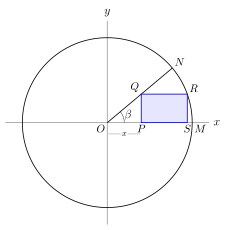
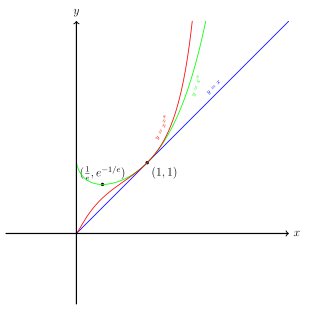
The functions \(\f\) and \(\g\) are defined, for \(x>0\), by \[ \f(x) = x^x\,, \ \ \ \ \ \g(x) = x^{\f(x)}\,. \]
- By taking logarithms, or otherwise, show that \(\f(x) > x\) for \(0 < x < 1\,\). Show further that \(x < \g(x) < \f(x)\) for \(0 < x < 1\,\). Write down the corresponding results for \(x > 1 \,\).
- Find the value of \(x\) for which \(\f'(x)=0\,\).
- Use the result \(x\ln x \to 0\) as \(x\to 0\) to find \(\lim\limits_{x\to0}\f(x)\), and write down \(\lim\limits_{x\to0}\g(x)\,\).
- Show that \( x^{-1}+\, \ln x \ge 1\,\) for \(x>0\). Using this result, or otherwise, show that \(\g'(x) > 0\,\).
- \(\,\) \begin{align*} && \ln f(x) &= x \ln x \\ &&&> \ln x \quad (\text{if } 0 < x < 1)\\ \Rightarrow && f(x) &> x\quad\quad (\text{if } 0 < x < 1)\\ \Rightarrow && x^{f(x)} &< x^x \\ && g(x) &< f(x) \\ && 1&>f(x) \\ \Rightarrow && x &< x^{f(x)} = g(x) \end{align*}
- \(\,\) \begin{align*} && f(x) &= e^{x \ln x} \\ \Rightarrow && f'(x) &= (\ln x + 1)e^{x \ln x} \\ \Rightarrow && f'(x) = 0 &\Leftrightarrow x = \frac1e \end{align*}
- \(\,\) \begin{align*} && \lim_{x \to 0} f(x) &= \lim_{x \to 0} \exp \left ( x \ln x \right ) \\ &&&= \exp \left ( \lim_{x \to 0} \left ( x \ln x \right )\right) \\ &&&= \exp \left ( 0 \right) = 1\\ \\ && \lim_{x \to 0} g(x) &= \lim_{x \to 0} \exp \left ( f(x) \ln x\right) \\ &&&= \exp \left (\lim_{x \to 0} \ln x f(x)\right) \\ &&&= \exp \left (\lim_{x \to 0} \ln x \lim_{x \to 0}f(x)\right) \\ &&&= \exp \left (\lim_{x \to 0} \ln x\right) \\ &&&= 0 \end{align*}
- \(y = x^{-1} + \ln x \Rightarrow y' = -x^{-2} + x^{-1}\) which has roots at \(x =1\), therefore the minimum value is \(1\). (We can see it's a minimum by considering \(x \to 0, x \to \infty\). So \begin{align*} && g'(x) &= x^{f(x)} \cdot (f'(x) \ln x + f(x) x^{-1})\\ &&&= x^{f(x)} \cdot f(x) \cdot ((1+\ln x) \ln x + x^{-1}) \\ &&&= x^{f(x)} \cdot f(x) \cdot (\ln x + x^{-1} + (\ln x)^2) \\ &&&\geq x^{f(x)} \cdot f(x) > 0 \end{align*}
Differentiate, with respect to \(x\), \[ (ax^2+bx+c)\,\ln \big( x+\sqrt{1+x^2}\big) +\big(dx+e\big)\sqrt{1+x^2} \,, \] where \(a\), \(b\), \(c\), \(d\) and \(e\) are constants. You should simplify your answer as far as possible. Hence integrate:
- \( \ln \big( x+\sqrt{1+x^2}\,\big) \,;\)
- \(\sqrt{1+x^2} \,; \)
- \( x\ln \big( x+\sqrt{1+x^2}\,\big) \,.\)
- We want \(a = 0, b = 1, d = 0, e = -1, c =0\), so \begin{align*} I &= \int \ln \big( x+\sqrt{1+x^2}\,\big) \,\d x \\ &= x\ln(x+\sqrt{1+x^2})-\sqrt{1+x^2}+C \end{align*}
- We want \(a = b =0, e = 0, d = \frac12, c = \frac12\), so \begin{align*} I &= \int \sqrt{1+x^2}\, \d x \\ &= \frac12\ln(x+\sqrt{1+x^2}) + \frac12x\sqrt{1+x^2}+C \end{align*}
- We want \(a = \frac12, b = 0, d = -\frac14, e = 0, c = \frac14\), so \begin{align*} I &= \int x \ln (x+\sqrt{1+x^2}) \, \d x \\ &= \left (\frac12 x^2+\frac14 \right)\ln(x+\sqrt{1+x^2}) -\frac14x\sqrt{1+x^2}+C \end{align*}
For each non-negative integer \(n\), the polynomial \(\f_n\) is defined by \[ \f_n(x) = 1 + x + \frac{x^2}{2!} + \frac {x^3}{3!} + \cdots + \frac{x^n}{n!} \]
- Show that \(\f'_{n}(x) = \f_{n-1}(x)\,\) (for \(n\ge1\)).
- Show that, if \(a\) is a real root of the equation \[\f_n(x)=0\,,\tag{\(*\)}\] then \(a<0\).
- Let \(a\) and \(b\) be distinct real roots of \((*)\), for \(n\ge2\). Show that \(\f_n'(a)\, \f_n'(b)>0\,\) and use a sketch to deduce that \(\f_n(c)=0\) for some number \(c\) between \(a\) and \(b\). Deduce that \((*)\) has at most one real root. How many real roots does \((*)\) have if \(n\) is odd? How many real roots does \((*)\) have if \(n\) is even?
- \(\,\) \begin{align*} && f'_n(x) &= 0 + 1 + \frac{2x}{2!} + \frac{3x^2}{3!} + \cdots + \frac{nx^{n-1}}{n!} \\ &&&= 1 + x + \frac{x^2}{2!} + \frac{x^3}{3!} + \cdots + \frac{x^{n-1}}{(n-1)!} \\ &&&= f_{n-1}(x) \end{align*}
- Claim: \(f_n(x) > 0\) for all \(x > 0\) Proof: (By induction) Base case: (\(n = 1\)) \(f_1(x) = 1 + x > 1\) therefore \(f_1(x) > 0\) Suppose it's true for \(n = k\), then consider \(f_{k+1}\), if we differentiate it, we find it is increasing on \((0, \infty)\) by our inductive hypothesis. But then \(f_{k+1}(0) = 1 > 0\). Therefore \(f_{k+1}(x) > 0\) as well. Therefore by the principle of mathematical induction we are done. Since \(f_n(x) > 0\) for non-negative \(x\), if \(a\) is a root it must be negative.
- Suppose \(f_n(a) = f_n(b) = 0\) then \(f'_n(a) = -\frac{a^n}{n!}\) and \(f'_n(b) = -\frac{b^n}{n!}\), but then \(f_n'(a) f_n'(b) = \frac{(-a)^n(-b)^n}{(n!)^2} > 0\) since \(a < 0, b < 0\). \(_n'(a) f_n'(b)\) is positive, the two gradients must have the same sign (and not be zero). Therefore if they are both increasing, at some point the curve must cross the axis in between. Therefore there is some root \(c\) between \(a\) and \(b\). But then there is also a root between \(c\) and \(a\) and \(c\) and \(b\), and very quickly we find more than \(n\) roots which is not possivel. Therefore there must be at most \(1\) root. If \(n\) is odd there must be exactly one root, since \(f_n\) changes sign as \(x \to -\infty\) vs \(x = 0\). If \(n\) is even then there can't be any roots, since if it crossed the \(x\)-axis there would be two roots (not possible) and it cannot touch the axis, since \(f'_n(a) \neq 0\) unless \(a = 0\), and we know \(a < 0\)
An accurate clock has an hour hand of length \(a\) and a minute hand of length \(b\) (where \(b>a\)), both measured from the pivot at the centre of the clock face. Let \(x\) be the distance between the ends of the hands when the angle between the hands is \(\theta\), where \(0\le\theta < \pi\). Show that the rate of increase of \(x\) is greatest when \(x=(b^2-a^2)^\frac12\). In the case when \(b=2a\) and the clock starts at mid-day (with both hands pointing vertically upwards), show that this occurs for the first time a little less than 11 minutes later.
Show SolutionBy simplifying \(\sin(r+\frac12)x - \sin(r-\frac12)x\) or otherwise show that, for \(\sin\frac12 x \ne0\), \[ \cos x + \cos 2x +\cdots + \cos nx = \frac{\sin(n+\frac12)x - \sin\frac12 x}{2\sin\frac12x}\,. \] The functions \(S_n\), for \(n=1, 2, \dots\), are defined by \[ S_n(x) = \sum_{r=1}^n \frac 1 r \sin rx \qquad (0\le x \le \pi). \]
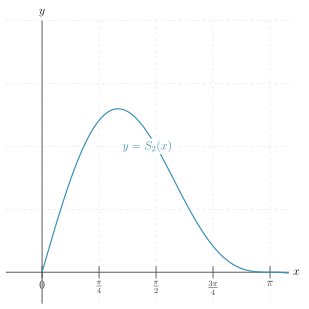
- Find the stationary points of \(S_2(x)\) for \(0\le x\le\pi\), and sketch this function.
- Show that if \(S_n(x)\) has a stationary point at \(x=x_0\), where \(0< x_0 < \pi\), then \[ \sin nx_0 = (1-\cos nx_0) \tan\tfrac12 x_0 \] and hence that \(S_n(x_0) \ge S_{n-1}(x_0)\). Deduce that if \(S_{n-1}(x) > 0\) for all \(x\) in the interval \(0 < x < \pi\), then \(S_{n}(x) > 0\) for all \(x\) in this interval.
- Prove that \(S_n(x)\ge0\) for \(n\ge1\) and \(0\le x\le\pi\).
- \(\,\) \begin{align*}
&& S_2(x) &= \sin x + \tfrac12 \sin 2 x \\
&& S'_2(x) &= \cos x + \cos 2x \\
&&&= \cos x + 2\cos^2 x - 1 \\
&&&= (2\cos x -1)(\cos x + 1) \\
\end{align*}
Therefore the turning points are \(\cos x= \frac12 \Rightarrow x = \frac{\pi}{3}\) and \(\cos x = -1 \Rightarrow x = \pi\)
- Suppose \(S_n(x)\) has a stationary point at \(x_0\), then $$ therefore \begin{align*} &&0 &= S_n'(x_0) \\ &&&= \cos x_0 + \cos 2x_0 + \cdots + \cos n x_0 \\ &&&= \frac{\sin(n+\tfrac12)x_0 - \sin \tfrac12x_0}{2 \sin \tfrac12 x_0} \\ \Rightarrow &&\sin\tfrac12 x_0&= \sin nx_0 \cos \tfrac12 x_0 + \cos nx_0 \sin \tfrac12x_0 \\ \Rightarrow && \sin nx_0 &= (1-\cos nx_0)\tan \tfrac12 x_0 \end{align*} Therefore \(S_n(x_0) -S_{n-1}(x_0) = \tfrac1n \sin n x_0 = \tfrac1n \underbrace{(1-\cos nx_0)}_{\geq 0}\underbrace{\tan\tfrac12 x_0}_{\geq 0} \geq 0\). Therefore if \(S_{n-1}(x) > 0\) for all \(x\) on \(0 < x < \pi\) then since \(S_n(x) > S_{n-1}(x)\) at the turning points and since they agree at the end points, it must be larger at all points inbetween.
- Notice that \(S_1(x) = \sin x \geq 0\) for all \(x \in [0,1]\) and by our previous argument we can show \(S_n > S_{n-1}\) inside the interval and equal on the boundary we must have \(S_n(x) \geq 0\) for \(x \in [0, \pi]\)
- Find the value of \(m\) for which the line \(y = mx\) touches the curve \(y = \ln x\,\). If instead the line intersects the curve when \(x = a\) and \(x = b\), where \(a < b\), show that \(a^b = b^a\). Show by means of a sketch that \(a < \e < b\).
- The line \(y=mx+c\), where \(c>0\), intersects the curve \(y=\ln x\) when \(x=p\) and \(x=q\), where \(p < q\). Show by means of a sketch, or otherwise, that \(p^q > q^p\).
- Show by means of a sketch that the straight line through the points \((p, \ln p)\) and \((q, \ln q)\), where \(\e\le p < q\,\), intersects the \(y\)-axis at a positive value of \(y\). Which is greater, \(\pi^\e\) or \(\e^\pi\)?
- Show, using a sketch or otherwise, that if \(0 < p < q\) and \(\dfrac{\ln q - \ln p}{q-p} = \e^{-1}\), then \(q^p > p^q\).
The line \(L\) has equation \(y=c-mx\), with \(m>0\) and \(c>0\). It passes through the point \(R(a,b)\) and cuts the axes at the points \(P(p,0)\) and \(Q(0,q)\), where \(a\), \(b\), \(p\) and \(q\) are all positive. Find \(p\) and \(q\) in terms of \(a\), \(b\) and \(m\). As \(L\) varies with \(R\) remaining fixed, show that the minimum value of the sum of the distances of \(P\) and \(Q\) from the origin is \((a^{\frac12} + b^{\frac12})^2\), and find in a similar form the minimum distance between \(P\) and \(Q\). (You may assume that any stationary values of these distances are minima.)
Show Solution- Sketch the curve \(y=\f(x)\), where \[ \f(x) = \frac 1 {(x-a)^2 -1} \hspace{2cm}(x\ne a\pm1), \] and \(a\) is a constant.
- The function \(\g(x)\) is defined by \[ \g(x) = \frac 1 {\big( (x-a)^2-1 \big) \big( (x-b)^2 -1\big)} \hspace{1cm}(x\ne a\pm1, \ x\ne b\pm1), \] where \(a\) and \(b\) are constants, and \(b>a\). Sketch the curves \(y=\g(x)\) in the two cases \(b>a+2\) and \(b=a+2\), finding the values of \(x\) at the stationary points.
- \(\,\)

- \(\,\) \begin{align*}
&& \frac{\d}{\d x} \left ( \frac{1}{g(x)} \right) &= \frac{\d }{\d x} \left ( \big( (x-a)^2-1 \big) \big( (x-b)^2 -1\big)\right) \\
&&&= ((x-a)^2-1)(2(x-b))+((x-b)^2-1)(2(x-a)) \\
&&&= 2(2x-a-b)(x^2-(a+b)x+ab-1) \\
\Rightarrow && x &= \frac{a+b}{2}, \frac{a+b \pm \sqrt{(a+b)^2-4ab+4}}{2} \\
&&&= \frac{a+b}{2}, \frac{a+b \pm \sqrt{(a-b)^2+4}}{2}
\end{align*}
If \(b > a+2\):
If \(b = a+2\):


The number \(E\) is defined by $\displaystyle E= \int_0^1 \frac{\e^x}{1+x} \, \d x\,.$ Show that \[ \int_0^1 \frac{x \e^x}{1+x} \, \d x = \e -1 -E\, ,\] and evaluate \(\ds \int_0^1 \frac{x^2\e^x}{1+x} \, \d x\) in terms of \(\e\) and \(E\). Evaluate also, in terms of \(E\) and \(\rm e\) as appropriate:
- \[ \int_0^1 \frac{\e^{\frac{1-x}{1+x}}}{1+x}\, \d x\,\]
- \[ \int_1^{\sqrt2} \frac {\e^{x^2}}x \, \d x \, \]
- Since \(\displaystyle u = \frac{1-x}{1+x},\frac{\d u}{\d x} = \frac{-(1+x)-(1-x)}{(1+x)^2}\), \begin{align*} && \int_0^1 \frac{\e^{\frac{1-x}{1+x}}}{1+x}\, \d x &= \int_{u=1}^{u=0} \frac{e^u}{1+x} \cdot \frac{(1+x)^2}{-2} \d u \\ &&&= \int_0^1 \frac{(1+x) e^u}{2} \d u \\ &&&= \int_0^1 \frac{\left ( 1 + \frac{1-u}{1+u} \right) e^u}{2}\, \d u \\ &&&= \frac12 \int_0^1 \left (e^u + \frac{e^{u}}{1+u} - \frac{ue^u}{1+u} \right) \, \d u \\ &&&= \frac12 \left( \e-1 + E - (\e - 1 - E) \right) \\ &&&= E \end{align*}
- Since \(\displaystyle u = x^2-1, \d u = 2x \d x\)\begin{align*} \int_1^{\sqrt2} \frac {\e^{x^2}}x \, \d x &= \int_{u=0}^{u=1} \frac{e^{u+1}}{x} \frac{1}{2x} \d u \\ &= \int_0^1 \frac{e^{u+1}}{2(u+1)} \d u \\ &= \frac{\e}{2} E \\ &= \frac{E\e}{2} \end{align*}
In this question, you may assume without proof that any function \(\f\) for which \(\f'(x)\ge 0\) is increasing; that is, \(\f(x_2)\ge \f(x_1)\) if \(x_2\ge x_1\,\).
- Let \(\f(x) =\sin x -x\cos x\). Show that \(\f(x)\) is increasing for \(0\le x \le \frac12\pi\,\) and deduce that \(\f(x)\ge 0\,\) for \(0\le x \le \frac12\pi\,\).
- Given that \(\dfrac{\d}{\d x} (\arcsin x) \ge1\) for \(0\le x< 1\), show that \[ \arcsin x\ge x \quad (0\le x < 1). \]
- Let \(\g(x)= x\cosec x\, \text{ for }0< x < \frac12\pi\). Show that \(\g\) is increasing and deduce that \[ ({\arcsin x})\, x^{-1} \ge x\,{\cosec x} \quad (0 < x < 1). \]
- Given that $\dfrac{\d}{\d x} (\arctan x)\le 1\text{ for }x\ge 0$, show by considering the function \(x^{-1} \tan x\) that \[ (\tan x)( \arctan x) \ge x^2 \quad (0< x < \tfrac12\pi). \]
- Given \(\frac{\d}{\d x} (\arctan x) \leq 1\) we must have \(\frac{\d}{ \d x} (x-\arctan x) \geq 0\) for \(x \geq 0\), but since \( 0 - \arctan 0 = 0\) this means that \(x - \arctan x \geq 0\), ie \( \arctan x \geq x\) for \(x \geq 0\) \(g(x) = x^{-1} \tan x \Rightarrow g'(x) = -x^{-2}\tan x +x^{-1} \sec^2 x\). If we can show \(f(x) = x \sec ^2 x - \tan x\) is positive that would be great. However \(f'(x) = x 2 \tan x \sec^2 x \geq 0\) and \(f(0) = 0\) so \(f(x)\) is positive and \(g'(x)\) is positive and hence increasing, therefore \(g(x) \geq g(\arctan x) \Rightarrow \frac{\tan x}{x} \geq \frac{x}{\arctan x}\) from which the result follows.
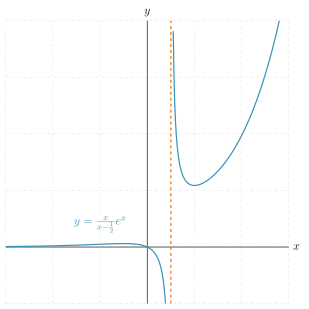
The curve \(\displaystyle y=\Bigl(\frac{x-a}{x-b}\Bigr)\e^{x}\), where \(a\) and \(b\) are constants, has two stationary points. Show that \[ a-b<0 \ \ \ \text{or} \ \ \ a-b>4 \,. \]
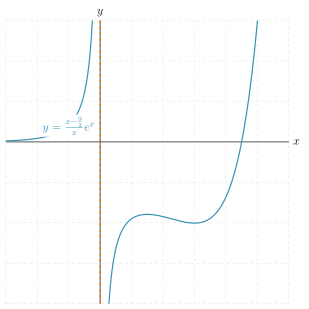
- Show that, in the case \(a=0\) and \(b= \frac12\), there is one stationary point on either side of the curve's vertical asymptote, and sketch the curve.
- Sketch the curve in the case \( a=\tfrac{9}{2}\) and \(b=0\,\).
- If \(a = 0, b = \frac12\), we have \(x^2-\frac12x -\frac12 = 0 \Rightarrow (2x+1)(x-1) = 0 \Rightarrow x = -\frac12, x=1\). The asymptote is at \(x = \frac12\) so they are on either side.
- \(\,\)
Let \(P\) be a given point on a given curve \(C\). The \textit{osculating circle} to \(C\) at \(P\) is defined to be the circle that satisfies the following two conditions at \(P\): it touches \(C\); and the rate of change of its gradient is equal to the rate of change of the gradient of \(C\). Find the centre and radius of the osculating circle to the curve \(y=1-x+\tan x\) at the point on the curve with \(x\)-coordinate \(\frac14 \pi\).
Show SolutionA function \(\f(x)\) is said to be convex in the interval \(a < x < b\) if \(\f''(x)\ge0\) for all \(x\) in this interval.
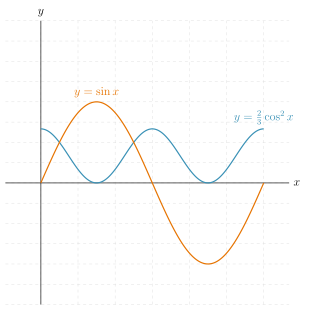
- Sketch on the same axes the graphs of \(y= \frac23 \cos^2 x\) and \(y=\sin x\) in the interval \(0\le x \le 2\pi\). The function \(\f(x)\) is defined for \(0 < x < 2\pi\) by \[\f(x) = \e^{\frac23 \sin x}. \] Determine the intervals in which \(\f(x)\) is convex.
- The function \(\g(x)\) is defined for \(0 < x < \frac12\pi\) by \[\g(x) = \e^{-k \tan x}. \] If \(k=\sin 2 \alpha\) and \(0 < \alpha < \frac{1}{4}\pi\), show that \(\g(x)\) is convex in the interval \(0 < x < \alpha\), and give one other interval in which \(\g(x)\) is convex.
- \begin{align*} && f(x) &= \exp\left (\tfrac23\sin x \right) \\ && f'(x) &= \exp\left (\tfrac23\sin x \right) \cdot \tfrac23 \cos x \\ && f''(x) &= \left ( \exp\left (\tfrac23\sin x \right) \cdot \tfrac23\right) \left ( \tfrac23 \cos^2 x - \sin x \right) \end{align*} Therefore \(f(x)\) is convex when \(\frac23 \cos^2 x \geq \sin x\). Note that we can find the equality points when \begin{align*} && \sin x &= \frac23 \cos^2 x \\ &&&= \frac23 (1- \sin^2 x) \\ \Rightarrow && 0 &= 2\sin^2 x + 3 \sin x - 2 \\ &&&= (2 \sin x -1) (\sin x+2) \end{align*} ie \(\sin x = \frac12 \Rightarrow x = \frac{\pi}{6}, \frac{5\pi}{6}\). Therefore \(f\) is convex on \([0, \frac{\pi}{6}] \cup [\frac{5\pi}{6}, 2\pi]\)
- Suppose \(g(x) = \exp \left ( -k \tan x \right)\) then \begin{align*} && g'(x) &= \exp \left ( -k \tan x \right) \cdot (-k \sec^2 x ) \\ && g''(x) &= \left ( -k \exp \left ( -k \tan x \right) \right) \left ( -k\sec^4 x + 2 \sec x \cdot \sec x \tan x\right) \\ &&&= -k \exp \left ( -k \tan x \right) \sec^4 x \left ( -k + 2\sin x \cos x \right) \\ &&&= -k \exp \left ( -k \tan x \right) \sec^4 x \left ( -k + \sin 2x \right) \\ \end{align*} If \(0 < \alpha < \frac{\pi}{4}\) then \(k > 0\) so \(g\) is convex if \(-k + \sin 2x < 0\), ie \(\sin 2x < \sin 2\alpha\), ie on \((0, \alpha)\) and \((\frac{\pi}{2} - \alpha, \frac{\pi}{2})\)
- The gradient \(y'\) of a curve at a point \((x,y)\) satisfies \[ (y')^2 -xy'+y=0\,. \tag{\(*\)} \] By differentiating \((*)\) with respect to \(x\), show that either \(y''=0\) or \(2y'=x\,\). Hence show that the curve is either a straight line of the form \(y=mx+c\), where \(c=-m^2\), or the parabola \(4y=x^2\).
- The gradient \(y'\) of a curve at a point \((x,y)\) satisfies \[ (x^2-1)(y')^2 -2xyy'+y^2-1=0\,. \] Show that the curve is either a straight line, the form of which you should specify, or a circle, the equation of which you should determine.
- \(\,\) \begin{align*} && 0 &= (y')^2 -xy'+y\\ \Rightarrow && 0 &= 2y' y'' -y' - xy'' + y' \\ &&&= 2y'y'' - xy'' \\ &&&= y'' (2y'-x) \end{align*} Therefore \(y'' = 0 \Rightarrow y = mx + c\) or \(y' = \frac12 x \Rightarrow x = \frac14x^2 + C\). Plugging these into the original equation we have \(m^2 - xm+mx+c = 0 \Rightarrow c = -m^2\) \(\frac14 x^2 - \frac12 x^2 + \frac14x^2 + C = 0 \Rightarrow C = 0\). Therefore \(4y = x^2\)
- \begin{align*} && 0 &= (x^2-1)(y')^2 -2xyy'+y^2-1 \\ \Rightarrow && 0 &= 2x(y')^2 +(x^2-1)2y'y'' - 2yy' - 2x(y')^2-2xyy''+2yy' \\ &&&= (x^2-1)2y'y'' -2xyy'' \\ &&&= 2y'' ((x^2-1)y'-xy) \end{align*} Therefore \(y'' = 0\) so \(y = mx + c\) or \begin{align*} && \frac{\d y}{\d x} &= \frac{xy}{x^2-1} \\ \Rightarrow && \int \frac1y \d y &= \int \frac{x}{x^2-1} \d x \\ \Rightarrow && \ln |y| &= \frac12 \ln |x^2-1| + C \\ \Rightarrow && y^2 &= A(x^2-1) \end{align*} Suppose \(y = mx+c\) then we must have \((x^2-1)m^2-2xm(mx+c)+(mx+c)^2 = -m^2+c^2 \Rightarrow c^2 = m^2\) If \(y^2 = A(x^2-1)\) then \(2yy' = 2xA\) and \begin{align*} && 0 &= \frac{y^2}{A}\left ( \frac{xA}{y} \right)^2 - 2x^2A+A(x^2-1)-1 \\ &&&= x^2A-2x^2A+x^2A-A-1 \\ \Rightarrow && A &= -1 \end{align*} Therefore \(x^2 + y^2 = 1\)
By sketching on the same axes the graphs of \(y=\sin x\) and \(y=x\), show that, for \(x>0\):
- \(x>\sin x\,\);
- \(\dfrac {\sin x} {x} \approx 1\) for small \(x\).
Using the series \[ \e^x = 1 + x +\frac{x^2}{2!} + \frac{x^3}{3!} + \frac{x^4}{4!}+\cdots\,, \] show that \(\e>\frac83\). Show that \(n!>2^n\) for \(n\ge4\) and hence show that \(\e<\frac {67}{24}\). Show that the curve with equation \[ y= 3\e^{2x} +14 \ln (\tfrac43-x)\,, \qquad {x<\tfrac43} \] has a minimum turning point between \(x=\frac12\) and \(x=1\) and give a sketch to show the shape of the curve.
Show Solution
Find the three values of \(x\) for which the derivative of \(x^2 \e^{-x^2}\) is zero. Given that \(a\) and \(b\) are distinct positive numbers, find a polynomial \(\P(x)\) such that the derivative of \(\P(x)\e^{-x^2}\) is zero for \(x=0\), \(x=\pm a\) and \(x=\pm b\,\), but for no other values of \(x\).
Show SolutionLet \(f(x) = x^m(x-1)^n\), where \(m\) and \(n\) are both integers greater than \(1\). Show that the curve \(y=f(x)\) has a stationary point with \(0 < x < 1\). By considering \(f''(x)\), show that this stationary point is a maximum if \(n\) is even and a minimum if \(n\) is odd. Sketch the graphs of \(f(x)\) in the four cases that arise according to the values of \(m\) and \(n\).
Show Solution


