2008 Paper 1 Q4
Year: 2008
Paper: 1
Question Number: 4
Course: LFM Pure
Section: Differentiation
Problem
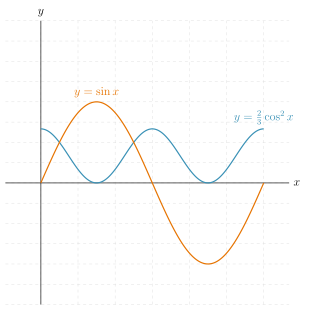
- Sketch on the same axes the graphs of \(y= \frac23 \cos^2 x\) and \(y=\sin x\) in the interval \(0\le x \le 2\pi\). The function \(\f(x)\) is defined for \(0 < x < 2\pi\) by \[\f(x) = \e^{\frac23 \sin x}. \] Determine the intervals in which \(\f(x)\) is convex.
- The function \(\g(x)\) is defined for \(0 < x < \frac12\pi\) by \[\g(x) = \e^{-k \tan x}. \] If \(k=\sin 2 \alpha\) and \(0 < \alpha < \frac{1}{4}\pi\), show that \(\g(x)\) is convex in the interval \(0 < x < \alpha\), and give one other interval in which \(\g(x)\) is convex.
Solution
- \begin{align*} && f(x) &= \exp\left (\tfrac23\sin x \right) \\ && f'(x) &= \exp\left (\tfrac23\sin x \right) \cdot \tfrac23 \cos x \\ && f''(x) &= \left ( \exp\left (\tfrac23\sin x \right) \cdot \tfrac23\right) \left ( \tfrac23 \cos^2 x - \sin x \right) \end{align*} Therefore \(f(x)\) is convex when \(\frac23 \cos^2 x \geq \sin x\). Note that we can find the equality points when \begin{align*} && \sin x &= \frac23 \cos^2 x \\ &&&= \frac23 (1- \sin^2 x) \\ \Rightarrow && 0 &= 2\sin^2 x + 3 \sin x - 2 \\ &&&= (2 \sin x -1) (\sin x+2) \end{align*} ie \(\sin x = \frac12 \Rightarrow x = \frac{\pi}{6}, \frac{5\pi}{6}\). Therefore \(f\) is convex on \([0, \frac{\pi}{6}] \cup [\frac{5\pi}{6}, 2\pi]\)
- Suppose \(g(x) = \exp \left ( -k \tan x \right)\) then \begin{align*} && g'(x) &= \exp \left ( -k \tan x \right) \cdot (-k \sec^2 x ) \\ && g''(x) &= \left ( -k \exp \left ( -k \tan x \right) \right) \left ( -k\sec^4 x + 2 \sec x \cdot \sec x \tan x\right) \\ &&&= -k \exp \left ( -k \tan x \right) \sec^4 x \left ( -k + 2\sin x \cos x \right) \\ &&&= -k \exp \left ( -k \tan x \right) \sec^4 x \left ( -k + \sin 2x \right) \\ \end{align*} If \(0 < \alpha < \frac{\pi}{4}\) then \(k > 0\) so \(g\) is convex if \(-k + \sin 2x < 0\), ie \(\sin 2x < \sin 2\alpha\), ie on \((0, \alpha)\) and \((\frac{\pi}{2} - \alpha, \frac{\pi}{2})\)
Examiner's report
— 2008 STEP 1, Question 4There were significantly more candidates attempting this paper this year (an increase of nearly 25%), but many found it to be very difficult and only achieved low scores. The mean score was significantly lower than last year, although a similar number of candidates achieved very high marks. This may be, in part, due to the phenomenon of students in the Lower Sixth (Year 12) being entered for the examination before attempting papers II and III in the Upper Sixth. This is a questionable practice, as while students have enough technical knowledge to answer the STEP I questions at this stage, they often still lack the mathematical maturity to be able to apply their knowledge to these challenging problems. Again, a key difficulty experienced by most candidates was a lack of the algebraic skill required by the questions. At this level, the fluent, confident and correct handling of mathematical symbols (and numbers) is necessary and is expected; many students were simply unable to progress on some questions because they did not know how to handle the algebra. There were of course some excellent scripts, full of logical clarity and perceptive insight. It was also pleasing that one of the applied questions, question 13, attracted a very large number of attempts. However, the examiners were again left with the overall feeling that some candidates had not prepared themselves well for the examination. The use of past papers and other available resources to ensure adequate preparation is strongly recommended. A student's first exposure to STEP questions can be a daunting, demanding experience; it is a shame if that takes place during a public examination on which so much rides.
Rating Information
Difficulty Rating: 1500.0
Difficulty Comparisons: 0
Banger Rating: 1500.7
Banger Comparisons: 2
Show LaTeX source
Problem source
A function $\f(x)$ is said to be \textit{convex} in the interval $a < x < b$ if $\f''(x)\ge0$ for all $x$ in this interval.
\begin{questionparts}
\item Sketch on the same axes the graphs of $y= \frac23 \cos^2 x$ and $y=\sin x$ in the interval $0\le x \le 2\pi$.
The function $\f(x)$ is defined for $0 < x < 2\pi$ by
\[\f(x) = \e^{\frac23 \sin x}.
\]
Determine the intervals in which $\f(x)$ is convex.
 \item
The function $\g(x)$ is defined for $0 < x < \frac12\pi$ by
\[\g(x) = \e^{-k \tan x}.
\]
If $k=\sin 2 \alpha$ and $0 < \alpha < \frac{1}{4}\pi$, show that $\g(x)$ is convex in the interval $0 < x < \alpha$, and give one other interval in which $\g(x)$ is convex.
\end{questionparts}
Solution source
\begin{questionparts}
\item
\begin{center}
    \begin{tikzpicture}
    \def\functionf(#1){2/3*cos(deg(#1))^2};
    \def\functiong(#1){sin(deg(#1))};
    \def\xl{-1};
    \def\xu{7};
    \def\yl{-1.5}; \def\yu{2};

    % Calculate scaling factors to make the plot square
    \pgfmathsetmacro{\xrange}{\xu-\xl}
    \pgfmathsetmacro{\yrange}{\yu-\yl}
    \pgfmathsetmacro{\xscale}{10/\xrange}
    \pgfmathsetmacro{\yscale}{10/\yrange}

    % Define the reusable styles to keep code clean
    \tikzset{
        x=\xscale cm, y=\yscale cm,
        axis/.style={thick, draw=black!80, -{Stealth[scale=1.2]}},
        grid/.style={thin, dashed, gray!30},
        curveA/.style={very thick, color=cyan!70!black, smooth},
        curveB/.style={very thick, color=orange!90!black, smooth},
        dot/.style={circle, fill=black, inner sep=1.2pt},
        labelbox/.style={fill=white, inner sep=2pt, rounded corners=2pt} % Protects text from lines
    }

    % Draw background grid
    \draw[grid] (\xl,\yl) grid[xstep={pi/3}, ystep=.25] (\xu,\yu);

    % Set up axes
    \draw[axis] (\xl,0) -- (\xu,0) node[right, black] {$x$};
    \draw[axis] (0,\yl) -- (0,\yu) node[above, black] {$y$};

    % Define the bounding region with clip
    \begin{scope}
        \clip (\xl,\yl) rectangle (\xu,\yu);
        \draw[curveA, domain=0:{2*pi}, samples=150] plot(\x, {\functionf(\x)});
        \draw[curveB, domain=0:{2*pi}, samples=150] plot(\x, {\functiong(\x)});

    \end{scope}

        \node[curveB, above] at ({pi/2}, 1) {$y = \sin x$};
        \node[curveA, above] at ({2*pi}, {2/3}) {$y = \frac23\cos^2 x$};

    \end{tikzpicture}
\end{center}


\begin{align*}
&& f(x) &= \exp\left (\tfrac23\sin x \right) \\
&& f'(x) &= \exp\left (\tfrac23\sin x \right) \cdot \tfrac23 \cos x  \\
&& f''(x) &= \left ( \exp\left (\tfrac23\sin x \right) \cdot \tfrac23\right) \left ( \tfrac23 \cos^2 x - \sin x \right)
\end{align*}

Therefore $f(x)$ is convex when $\frac23 \cos^2 x \geq \sin x$.

Note that we can find the equality points when
\begin{align*}
&& \sin x &= \frac23 \cos^2 x \\
&&&= \frac23 (1- \sin^2 x) \\
\Rightarrow && 0 &= 2\sin^2 x + 3 \sin x - 2 \\
&&&= (2 \sin x -1) (\sin x+2)
\end{align*}

ie $\sin x = \frac12 \Rightarrow x = \frac{\pi}{6}, \frac{5\pi}{6}$.

Therefore $f$ is convex on $[0, \frac{\pi}{6}] \cup [\frac{5\pi}{6}, 2\pi]$

\item Suppose $g(x) = \exp \left ( -k \tan x \right)$ then
\begin{align*}
&& g'(x) &= \exp \left ( -k \tan x \right) \cdot (-k \sec^2 x ) \\
&& g''(x) &= \left ( -k \exp \left ( -k \tan x \right) \right) \left ( -k\sec^4 x + 2 \sec x \cdot \sec x \tan x\right) \\
&&&= -k \exp \left ( -k \tan x \right) \sec^4 x \left ( -k  + 2\sin x \cos x \right) \\
&&&= -k \exp \left ( -k \tan x \right) \sec^4 x \left ( -k  + \sin 2x  \right) \\
\end{align*}

If $0 < \alpha < \frac{\pi}{4}$ then $k > 0$ so $g$ is convex if $-k + \sin 2x < 0$, ie $\sin 2x < \sin 2\alpha$, ie on $(0, \alpha)$ and $(\frac{\pi}{2} - \alpha, \frac{\pi}{2})$

\end{questionparts}
The initial graph-sketching part of this question was designed to help candidates solve the quadratic equation which was to come up later in the question. Whilst almost all of the candidates successfully sketched y = sin x, the attempts at y = (2/3)cos²x were significantly poorer. Many candidates sketched curves with cusps at the x-axis, presumably confusing cos²x with |cos x|; others had curves which fell below the x-axis in places. Perhaps few candidates had seen graphs of y = cos²x before or considered that cos²x = ½(cos 2x + 1), making cos²x sinusoidal itself. Also, a large number of candidates appeared to have spent a significant amount of time drawing beautiful and accurate graphs on graph paper; it is important to appreciate the nature of a sketch as a rough drawing which captures the essential features of a situation. In general, STEP questions will not require accurate graphs, only accurate sketches. The first derivative of f(x) was generally computed correctly, though a sizable proportion of candidates failed to correctly apply the product rule to determine the second derivative. Those candidates who obtained f''(x) correctly generally realised that they needed to solve the inequality (2/3)cos²x ≥ sin x. Some appear to have guessed a value of x which makes this an equality - this method is perfectly acceptable as long as some justification of the claimed result is given (such as by explicitly substituting x = π/6 into the two sides). Most candidates who got this far correctly understood the connection with the graph sketch and went on to give the correct intervals. In part (ii), there was a lot of difficulty performing the differentiation. A number of candidates made their life more difficult by substituting k = sin 2α before differentiating g(x); this just made the expressions appear more complex and increased the likelihood of error. Some candidates, for example, tried differentiating with respect to both x and α simultaneously. Nevertheless, most candidates who were able to correctly compute g''(x) went on to solve the resulting trigonometric equation, finding the solution x = α, but many failed to determine the second interval. A sketch of some sort would very likely have been useful.