Circular Motion 1
The origin \(O\) of coordinates lies on a smooth horizontal table and the \(x\)- and \(y\)-axes lie in the plane of the table. A cylinder of radius \(a\) is fixed to the table with its axis perpendicular to the \(x\)--\(y\) plane and passing through \(O\), and with its lower circular end lying on the table. One end, \(P\), of a light inextensible string \(PQ\) of length \(b\) is attached to the bottom edge of the cylinder at \((a, 0)\). The other end, \(Q\), is attached to a particle of mass \(m\), which rests on the table. Initially \(PQ\) is straight and perpendicular to the radius of the cylinder at \(P\), so that \(Q\) is at \((a, b)\). The particle is then given a horizontal impulse parallel to the \(x\)-axis so that the string immediately begins to wrap around the cylinder. At time \(t\), the part of the string that is still straight has rotated through an angle \(\theta\), where \(a\theta < b\).
- Obtain the Cartesian coordinates of the particle at this time. Find also an expression for the speed of the particle in terms of \(\theta\), \(\dot{\theta}\), \(a\) and \(b\).
- Show that \[ \dot{\theta}(b - a\theta) = u, \] where \(u\) is the initial speed of the particle.
- Show further that the tension in the string at time \(t\) is \[ \frac{mu^2}{\sqrt{b^2 - 2aut}}. \]
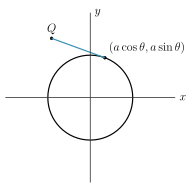
- The line to the circle is tangent, and the point it meets the circle is \((a \cos \theta, a \sin \theta)\) and it will be a distance \(b - a \theta\) away, therefore it is at \((a \cos \theta - (b-a \theta) \sin \theta, a \sin \theta + (b-a \theta) \cos \theta)\)
- The velocity will be \(\displaystyle \binom{-a \dot{\theta}\sin \theta-b \dot{\theta}\cos \theta + a \dot{\theta} \sin \theta + a \theta \dot{\theta} \cos \theta}{ a \dot{\theta} \cos \theta - b \dot{\theta} \sin \theta -a \dot{\theta} \cos \theta + a \theta \dot{\theta} \sin \theta}= \binom{-b \dot{\theta}\cos \theta + a \theta \dot{\theta} \cos \theta}{ - b \dot{\theta} \sin \theta + a \theta \dot{\theta} \sin \theta}\) Therefore the speed will be \(\dot{\theta}(b-a\theta)\)
- Conservation of energy and the fact that the tension is perpendicular to the velocity means no work is being done on the particle and hence it's speed is unchanged. So \(u = \dot{\theta}(b-a\theta)\).
- Note that the acceleration is \begin{align*} && \mathbf{a} &= \frac{\d}{\d t} \left (-\dot{\theta}(b-a\theta) \binom{\cos \theta}{\sin \theta} \right) \\ &&&=-u \dot{\theta}\binom{-\sin \theta}{\cos \theta} \\ \Rightarrow && T &= ma \\ &&&= \frac{mu^2}{b - a \theta} \end{align*} It would be valuable to have \(\theta\) in terms of \(t\), so we want to solve \begin{align*} &&\frac{\d \theta}{\d t} (b-a\theta) &= u \\ \Rightarrow && b \theta - a\frac{\theta^2}{2} + C &= ut \\ t = 0, \theta = 0: && C &= 0 \\ \Rightarrow && b\theta - \frac{a}{2} \theta^2 &= ut \\ \Rightarrow && \theta &= \frac{b \pm \sqrt{b^2-2aut}}{a} \end{align*} At \(t\) increases, \(\theta\) increases so \(a\theta = b -\sqrt{b^2-2aut}\) or \(b-a \theta = \sqrt{b^2-2aut}\) and the result follows
Three particles, \(A\), \(B\) and \(C\), each of mass \(m\), lie on a smooth horizontal table. Particles \(A\) and \(C\) are attached to the two ends of a light inextensible string of length \(2a\) and particle \(B\) is attached to the midpoint of the string. Initially, \(A\), \(B\) and \(C\) are at rest at points \((0,a)\), \((0,0)\) and \((0,-a)\), respectively. An impulse is delivered to \(B\), imparting to it a speed \(u\) in the positive \(x\) direction. The string remains taut throughout the subsequent motion.
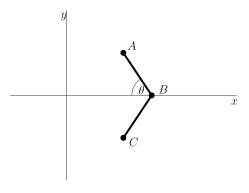
- At time \(t\), the angle between the \(x\)-axis and the string joining \(A\) and \(B\) is \(\theta\), as shown in the diagram, and \(B\) is at \((x,0)\). Write down the coordinates of \(A\) in terms of \(x,a\) and \(\theta\). Given that the velocity of \(B\) is \((v,0)\), show that the velocity of \(A\) is \((\dot x + a\sin\theta \,\dot \theta\,,\, a\cos\theta\, \dot\theta)\), where the dot denotes differentiation with respect to time.
- Show that, before particles \(A\) and \(C\) first collide, \[ 3\dot x + 2a \dot\theta \sin\theta =u \text{ and } \dot \theta^2 = \frac{u^2}{a^2(3-2\sin^2\theta)} \,. \]
- When \(A\) and \(C\) collide, the collision is elastic (no energy is lost). At what value of \(\theta\) does the second collision between particles \(A\) and \(C\) occur? (You should justify your answer.)
- When \(v=0\), what are the possible values of \(\theta\)? Is \(v =0\) whenever \(\theta\) takes these values?
- \(A\) has coordinates \((x-a\cos \theta, a\sin \theta)\). Differentiating with respect to \(t\) the velocity of \(A\) is \((\dot{x}+a\sin \theta \cdot \dot{\theta}, a \cos \theta \cdot \dot{\theta})\)
- By considervation of momentum \(\rightarrow\) we must have \(mu = m(\dot{x}+a\dot{\theta}\sin \theta) + m\dot{x} + m(\dot{x}+a\dot{\theta}\sin \theta) = m(3\dot{x} + 2a \dot{\theta} \sin \theta)\) and the first equation follows. By conservation of energy, we must have \begin{align*} && \frac12 m u^2 &= \frac12 m \dot{x}^2 + \frac12m((\dot{x}+a\dot{\theta}\sin \theta)^2 + a^2 \dot{\theta}^2 \cos^2\theta ) + \frac12m((\dot{x}+a\dot{\theta}\sin \theta)^2 + a^2 \dot{\theta}^2 \cos^2\theta ) \\ &&&= \frac32m\dot{x}^2 + 2m a\dot{x}\dot{\theta}\sin \theta + ma^2\dot{\theta}^2(\sin^2\theta+\cos^2\theta) \\ \Rightarrow && u^2 &= \dot{x}(3\dot{x} + 4a \dot{\theta} \sin \theta) + 2a^2\dot{\theta}^2 \\ &&&= \left ( \frac{u-2a\dot{\theta}\sin \theta}{3}\right)\left ( 3\left ( \frac{u-2a\dot{\theta}\sin \theta}{3}\right)+ 4a \dot{x}\dot{\theta} \sin \theta \right) + 2a^2\dot{\theta}^2 \\ \Rightarrow && 3u^2 &= (u - 2a\dot{\theta} \sin \theta)^2 + 4a(u - 2 a \dot{\theta} \sin \theta) \dot{\theta}\sin \theta + 6a^2 \dot{\theta}^2 \\ &&&= u^2 + 4a^2\dot{\theta}^2 \sin^2 \theta - 8a^2\dot{\theta}^2\sin^2\theta + 6a^2 \dot{\theta}^2 \\ \Rightarrow && \dot{\theta}^2 &= \frac{u^2}{a^2(3-2\sin^2\theta)} \end{align*}
- Since \(\dot{\theta}^2 > 0\) \(\theta\) is strictly increasing or decreasing, therefore the first collision will be when \(\theta = 0\), the second when \(\theta = \pi\)
- If \(v = 0\), from our first equation we have \(2a \dot{\theta} \sin \theta = u \Rightarrow \dot{\theta}^2 = \frac{u^2}{4a^2 \sin^2 \theta} = \frac{u^2}{a^2(3-2\sin^2\theta)}\) so \(4\sin^2 \theta = 3 - 2\sin^2 \theta \Rightarrow \sin^2 \theta = \frac{1}{2}\) therefore the angles are all the multiples of \(\frac{\pi}{4}\).
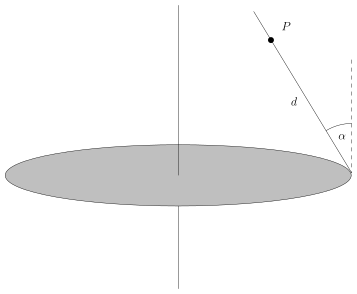
- A horizontal disc of radius \(r\) rotates about a vertical axis through its centre with angular speed \(\omega\). One end of a light rod is fixed by a smooth hinge to the edge of the disc so that it can rotate freely in a vertical plane through the centre of the disc. A particle \(P\) of mass \(m\) is attached to the rod at a distance \(d\) from the hinge. The rod makes a constant angle \(\alpha\) with the upward vertical, as shown in the diagram, and \(d\sin\alpha < r\).
By considering moments about the hinge for the (light) rod, show that the force exerted on the rod by \(P\) is parallel to the rod. Show also that \[ r\cot\alpha = a + d \cos\alpha \,, \] where \(a = \dfrac {g \;} {\omega^2}\,\). State clearly the direction of the force exerted by the hinge on the rod, and find an expression for its magnitude in terms of \(m\), \(g\) and \(\alpha\).
- The disc and rod rotate as in part (i), but two particles (instead of \(P\)) are attached to the rod. The masses of the particles are \(m_1\) and \(m_2\) and they are attached to the rod at distances \(d_1\) and \(d_2\) from the hinge, respectively. The rod makes a constant angle \(\beta\) with the upward vertical and \(d_1\sin\beta < d_2\sin\beta < r\). Show that \(\beta\) satisfies an equation of the form \[ r\cot\beta = a+ b \cos\beta \,, \] where \(b\) should be expressed in terms of \(d_1\), \(d_2\), \(m_1\) and \(m_2\).
- Since the particle is not moving (relative to the hinge) there is no moment about the hinge and in particular the only forces must be directed towards the hinge, ie parallel to the rod.
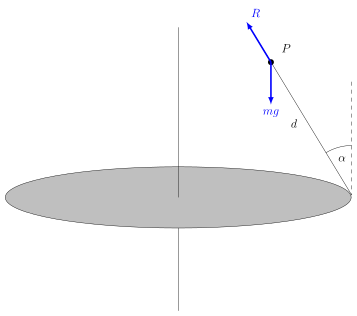
\begin{align*} \text{N2}(\uparrow): && R \cos \alpha &= mg \\ \\ \text{N2}(\leftarrow, \text{radially}): && R \sin \alpha &= m (r-d\sin \alpha) \omega^2 \\ \Rightarrow && \cot \alpha &= \frac{g}{(r-d\sin \alpha) \omega^2} \\ \Rightarrow && r\cot \alpha-d \cos \alpha &= a \\ \Rightarrow && r \cot \alpha &= a + d \cos \alpha \end{align*} The force of the hinge is acting in the same direction and magnitude as the rod on the particle (the force \(R\) in the diagram). It has magnitude \(mg \sec \alpha\)
- \(\,\)
\begin{align*} \overset{\curvearrowleft}{\text{hinge}}: && gm_1d_1 \sin \beta+gm_2d_2 \sin \beta &= m_1 (r-d_1 \sin \beta) \omega^2 d_1 \cos \beta + m_2 (r-d_2 \sin \beta) \omega^2 d_2 \cos \beta \\ \Rightarrow && a(m_1d_1+m_2d_2) \tan \beta &= r(m_1d_1+m_2d_2) - (m_1d_1^2+m_2d_2^2) \sin \beta \\ \Rightarrow && r\cot \beta &= a + \frac{m_1d_1^2+m_2d_2^2}{m_1d_1+m_2d_2} \cos \beta \end{align*}

A particle \(P\) of mass \(m\) is connected by two light inextensible strings to two fixed points \(A\) and \(B\), with \(A\) vertically above \(B\). The string \(AP\) has length \(x\). The particle is rotating about the vertical through \(A\) and \(B\) with angular velocity \(\omega\), and both strings are taut. Angles \(PAB\) and \(PBA\) are \(\alpha\) and \(\beta\), respectively. Find the tensions \(T_A\) and \(T_B\) in the strings \(AP\) and \(BP\) (respectively), and hence show that \(\omega^2 x\cos\alpha \ge g\). Consider now the case that \(\omega^2 x\cos\alpha = g\). Given that \(AB=h\) and \(BP=d\), where \(h>d\), show that \(h\cos\alpha \ge \sqrt{h^2-d^2}\). Show further that \[ mg < T_A \le \frac{mgh}{\sqrt{h^2-d^2}\,}\,. \] Describe the geometry of the strings when \(T_A\) attains its upper bound.
Show Solution

A particle \(P\) moves so that, at time \(t\), its displacement \( \bf r \) from a fixed origin is given by \[ {\bf r} =\left( \e^{t}\cos t \right) {\bf i}+ \left(\e^t \sin t\right) {\bf j}\,.\] Show that the velocity of the particle always makes an angle of \(\frac{\pi}{4}\) with the particle's displacement, and that the acceleration of the particle is always perpendicular to its displacement. Sketch the path of the particle for \(0\le t \le \pi\). A second particle \(Q\) moves on the same path, passing through each point on the path a fixed time \(T\) after \(P\) does. Show that the distance between \(P\) and \(Q\) is proportional to \(\e^{t}\).
Show Solution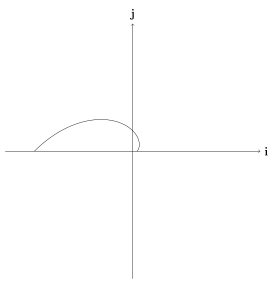
The force of attraction between two stars of masses \(m_{1}\) and \(m_{2}\) a distance \(r\) apart is \(\gamma m_{1}m_{2}/r^{2}\). The Starmakers of Kryton place three stars of equal mass \(m\) at the corners of an equilateral triangle of side \(a\). Show that it is possible for each star to revolve round the centre of mass of the system with angular velocity \((3\gamma m/a^{3})^{1/2}\). Find a corresponding result if the Starmakers place a fourth star, of mass \(\lambda m\), at the centre of mass of the system.
Show Solution
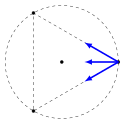
An automated mobile dummy target for gunnery practice is moving anti-clockwise around the circumference of a large circle of radius \(R\) in a horizontal plane at a constant angular speed \(\omega\). A shell is fired from \(O\), the centre of this circle, with initial speed \(V\) and angle of elevation \(\alpha\). Show that if \(V^2 < gR\), then no matter what the value of \(\alpha\), or what vertical plane the shell is fired in, the shell cannot hit the target. Assume now that \(V^2 > gR\) and that the shell hits the target, and let \(\beta\) be the angle through which the target rotates between the time at which the shell is fired and the time of impact. Show that \(\beta\) satisfies the equation $$ g^2{{\beta}^4} - 4{{\omega}^2}{V^2}{{\beta}^2} +4{R^2}{{\omega}^4}=0. $$ Deduce that there are exactly two possible values of \(\beta\). Let \(\beta_1\) and \(\beta_2\) be the possible values of \(\beta\) and let \(P_1\) and \(P_2\) be the corresponding points of impact. By considering the quantities \((\beta_1^2 +\beta_2^2) \) and \(\beta_1^2\beta_2^2\,\), or otherwise, show that the linear distance between \(P_1\) and \(P_2\) is \[ 2R \sin\Big( \frac\omega g \sqrt{V^2-Rg}\Big) \;. \]
Show Solution\(\ \)\vspace{-1.5cm} \noindent
A skater of mass \(M\) is skating inattentively on a smooth frozen canal. She suddenly realises that she is heading perpendicularly towards the straight canal bank at speed \(V\). She is at a distance \(d\) from the bank and can choose one of two methods of trying to avoid it; either she can apply a force of constant magnitude \(F\), acting at right-angles to her velocity, so that she travels in a circle; or she can apply a force of magnitude \(\frac{1}{2}F(V^{2}+v^{2})/V^{2}\) directly backwards, where \(v\) is her instantaneous speed. Treating the skater as a particle, find the set of values of \(d\) for which she can avoid hitting the bank. Comment briefly on the assumption that the skater is a particle.
Show SolutionA small heavy bead can slide smoothly in a vertical plane on a fixed wire with equation \[ y=x-\frac{x^{2}}{4a}, \] where the \(y\)-axis points vertically upwards and \(a\) is a positive constant. The bead is projected from the origin with initial speed \(V\) along the wire.
- Show that for a suitable value of \(V\), to be determined, a motion is possible throughout which the bead exerts no pressure on the wire.
- Show that \(\theta,\) the angle between the particle's velocity at time \(t\) and the \(x\)-axis, satisfies \[ \frac{4a^{2}\dot{\theta}^{2}}{\cos^{6}\theta}+2ga(1-\tan^{2}\theta)=V^{2}. \]
- The condition that the bead exerts no pressure on the wire is equivalent to the condition that the wire exerts no force on the bead. (Newton's Third Law). This is equivalent to the bead being projected under gravity. Notice that the initial projection is at \(45^{\circ}\) since \(\frac{dy}{dx}|_{x=0} = 1\). The position of the particle (under gravity) at time \(t\) is \(x = \frac{1}{\sqrt{2}}Vt\) and \(y = \frac{1}{\sqrt{2}}Vt - \frac12 gt^2 = x - \frac{1}{2}g \frac{2x^2}{V^2} = x - \frac{g}{V^2}x^2\). Therefore they follow the same trajectory if \(\frac{g}{V^2} = \frac{1}{4a} \Leftrightarrow V = 2\sqrt{ag}\)
- First note that the wire does no work as it is perpendicular to the velocity, so it is fine to use conservation of momentum. If we take our \(0\) GPE level to be be \(x = 0\), then we notice the initial energy is \(\frac12mV^2\). Secondly, notice that \(\tan \theta = \frac{\d y}{\d x} = 1- \frac{x}{2a} \Rightarrow x = 2a - 2a \tan \theta\) \begin{align*} y &= 2a(1-\tan \theta) - \frac{4a^2(1-\tan \theta)^2}{4a}\\ &= (1-\tan \theta)(2a-a(1-\tan \theta)) \\ &= a(1-\tan \theta)(1+\tan \theta) \\ &= a(1-\tan^2 \theta) \end{align*} GPE \(mga(1-\tan^2 \theta)\). To calculate the kinetic energy, notice that \(\dot{x} = v \cos \theta \dot{\theta}\) and \(\dot{x} = -2a\sec^2 \theta\dot{\theta} \Rightarrow v = -\frac{2a\dot{\theta} }{\cos^{3} \theta}\). Therefore, energy at time \(t\) is: \begin{align*} && \frac12 m V^2 &= \frac12 m \l - \frac{2a\dot{\theta}}{\cos^3 \theta} \r^2 + mga(1-\tan^2 \theta) \\ \Rightarrow && V^2 &= \frac{4a^2\dot{\theta}^2}{\cos^6 \theta} + 2ag(1-\tan^2 \theta) \end{align*}