1999 Paper 1 Q11
Year: 1999
Paper: 1
Question Number: 11
Course: UFM Mechanics
Section: Circular Motion 1
Difficulty: 1500.0
Banger: 1486.1
circular motion
gravitation
inverse square law
equilateral triangle
centre of mass
angular velocity
three-body problem
symmetry
Problem
The force of attraction between two stars of masses \(m_{1}\) and \(m_{2}\) a distance \(r\) apart is \(\gamma m_{1}m_{2}/r^{2}\).
The Starmakers of Kryton place three stars of equal mass \(m\) at the corners of an equilateral triangle of side \(a\).
Show that it is possible for each star to revolve
round the centre of mass of the system with angular velocity \((3\gamma m/a^{3})^{1/2}\).
Find a corresponding result if the Starmakers place a fourth star, of mass \(\lambda m\), at the centre of mass of the system.
Solution
The net force on the planets will always be towards the centre of mass (by symmetry or similar arguments). Therefore it suffices to check whether we can find a speed where the planets follow uniform circular motion, ie \(F = mr \omega^2\). (But clearly this is possible, we just need to find the speed)
 \begin{align*}
&& F &= m r \omega^2 \\
&& 2\frac{\gamma m^2}{a^2} \cos 30^{\circ} &= m \frac{a}{\sqrt{3}} \omega^2 \\
\Rightarrow && \frac{\sqrt{3}\gamma m^2}{a^2} &= \frac{ma \omega^2}{\sqrt{3}} \\
\Rightarrow && \omega^2 &= \frac{3\gamma m}{a^3} \\
\Rightarrow && \omega &= \left ( \frac{3\gamma m}{a^3}\right)^{1/2}
\end{align*}
\begin{align*}
&& F &= m r \omega^2 \\
&& 2\frac{\gamma m^2}{a^2} \cos 30^{\circ} &= m \frac{a}{\sqrt{3}} \omega^2 \\
\Rightarrow && \frac{\sqrt{3}\gamma m^2}{a^2} &= \frac{ma \omega^2}{\sqrt{3}} \\
\Rightarrow && \omega^2 &= \frac{3\gamma m}{a^3} \\
\Rightarrow && \omega &= \left ( \frac{3\gamma m}{a^3}\right)^{1/2}
\end{align*}
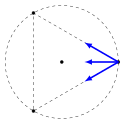 In the second scenario, we are interested in when:
\begin{align*}
&& F &= m r \omega^2 \\
&& \underbrace{2\frac{\gamma m^2}{a^2} \cos 30^{\circ}}_{\text{to other symmetric planets}} + \underbrace{\frac{\gamma \lambda m^2}{a^2}}_{\text{central planet}} &= m \frac{a}{\sqrt{3}} \omega^2 \\
\Rightarrow && \frac{(\sqrt{3}+\lambda)\gamma m^2}{a^2} &= \frac{ma \omega^2}{\sqrt{3}} \\
\Rightarrow && \omega^2 &= \frac{(3+\sqrt{3}\lambda)\gamma m}{a^3} \\
\Rightarrow && \omega &= \left ( \frac{(3+\sqrt{3}\lambda)\gamma m}{a^3}\right)^{1/2}
\end{align*}
In the second scenario, we are interested in when:
\begin{align*}
&& F &= m r \omega^2 \\
&& \underbrace{2\frac{\gamma m^2}{a^2} \cos 30^{\circ}}_{\text{to other symmetric planets}} + \underbrace{\frac{\gamma \lambda m^2}{a^2}}_{\text{central planet}} &= m \frac{a}{\sqrt{3}} \omega^2 \\
\Rightarrow && \frac{(\sqrt{3}+\lambda)\gamma m^2}{a^2} &= \frac{ma \omega^2}{\sqrt{3}} \\
\Rightarrow && \omega^2 &= \frac{(3+\sqrt{3}\lambda)\gamma m}{a^3} \\
\Rightarrow && \omega &= \left ( \frac{(3+\sqrt{3}\lambda)\gamma m}{a^3}\right)^{1/2}
\end{align*}
Rating Information
Difficulty Rating: 1500.0
Difficulty Comparisons: 0
Banger Rating: 1486.1
Banger Comparisons: 1
Show LaTeX source
Problem source
The force of attraction between two stars of masses $m_{1}$ and $m_{2}$ a distance $r$ apart is $\gamma m_{1}m_{2}/r^{2}$.
The Starmakers of Kryton place three stars of equal mass $m$ at the corners of an equilateral triangle of side $a$.
Show that it is possible for each star to revolve
round the centre of mass of the system with angular velocity $(3\gamma m/a^{3})^{1/2}$.
Find a corresponding result if the Starmakers place a fourth star, of mass $\lambda m$, at the centre of mass of the system.
Solution source
The net force on the planets will always be towards the centre of mass (by symmetry or similar arguments). Therefore it suffices to check whether we can find a speed where the planets follow uniform circular motion, ie $F = mr \omega^2$. (But clearly this is possible, we just need to find the speed)


\begin{center}
    \begin{tikzpicture}
        \coordinate (A) at ({2*cos(0)},{2*sin(0)});
        \coordinate (B) at ({2*cos(120)},{2*sin(120)});
        \coordinate (C) at ({2*cos(240)},{2*sin(240)});
        \draw[dashed] (0,0) circle (2);

        \filldraw (A) circle (1.5pt);
        \filldraw (B) circle (1.5pt);
        \filldraw (C) circle (1.5pt);
        \draw (0,0) circle (1pt);
        \draw[dashed] (A) -- (B) -- (C) -- cycle;

        \draw[-latex, ultra thick, blue] (A) -- ($0.6*(A)+0.4*(B)$);
        \draw[-latex, ultra thick, blue] (A) -- ($0.6*(A)+0.4*(C)$);


    \end{tikzpicture}
\end{center}

\begin{align*}
&& F &= m r \omega^2 \\
&& 2\frac{\gamma m^2}{a^2} \cos 30^{\circ} &= m \frac{a}{\sqrt{3}} \omega^2 \\
\Rightarrow && \frac{\sqrt{3}\gamma m^2}{a^2} &= \frac{ma \omega^2}{\sqrt{3}} \\
\Rightarrow && \omega^2 &= \frac{3\gamma m}{a^3} \\
\Rightarrow && \omega &= \left (  \frac{3\gamma m}{a^3}\right)^{1/2}
\end{align*}


\begin{center}
    \begin{tikzpicture}
        \coordinate (A) at ({2*cos(0)},{2*sin(0)});
        \coordinate (B) at ({2*cos(120)},{2*sin(120)});
        \coordinate (C) at ({2*cos(240)},{2*sin(240)});
        \draw[dashed] (0,0) circle (2);

        \filldraw (A) circle (1.5pt);
        \filldraw (B) circle (1.5pt);
        \filldraw (C) circle (1.5pt);
        \filldraw (0,0) circle (1.5pt);
        \draw[dashed] (A) -- (B) -- (C) -- cycle;

        \draw[-latex, ultra thick, blue] (A) -- ($0.6*(A)+0.4*(B)$);
        \draw[-latex, ultra thick, blue] (A) -- ($0.6*(A)+0.4*(C)$);
        \draw[-latex, ultra thick, blue] (A) -- ($0.4*(A)$);


    \end{tikzpicture}
\end{center}

In the second scenario, we are interested in when:

\begin{align*}
&& F &= m r \omega^2 \\
&& \underbrace{2\frac{\gamma m^2}{a^2} \cos 30^{\circ}}_{\text{to other symmetric planets}} + \underbrace{\frac{\gamma \lambda m^2}{a^2}}_{\text{central planet}} &= m \frac{a}{\sqrt{3}} \omega^2 \\
\Rightarrow && \frac{(\sqrt{3}+\lambda)\gamma m^2}{a^2} &= \frac{ma \omega^2}{\sqrt{3}} \\
\Rightarrow && \omega^2 &= \frac{(3+\sqrt{3}\lambda)\gamma m}{a^3} \\
\Rightarrow && \omega &= \left (  \frac{(3+\sqrt{3}\lambda)\gamma m}{a^3}\right)^{1/2}
\end{align*}