Parametric equations
Parametric differentiation, parametric integration
Let \(C_1\) be the curve given by the parametric equations \[ x = ct\,, \quad y = \frac{c}{t}\,, \] where \(c > 0\) and \(t \neq 0\), and let \(C_2\) be the circle \[ (x-a)^2 + (y-b)^2 = r^2\,. \] \(C_1\) and \(C_2\) intersect at the four points \(P_i\) (\(i = 1,2,3,4\)), and the corresponding values of the parameter \(t\) at these points are \(t_i\).
- Show that \(t_i\) are the roots of the equation \[ c^2 t^4 - 2act^3 + (a^2 + b^2 - r^2)t^2 - 2bct + c^2 = 0\,. \qquad (*) \]
- Show that \[ \sum_{i=1}^{4} t_i^2 = \frac{2}{c^2}(a^2 - b^2 + r^2) \] and find a similar expression for \(\displaystyle\sum_{i=1}^{4} \frac{1}{t_i^2}\).
- Hence show that \(\displaystyle\sum_{i=1}^{4} OP_i^2 = 4r^2\), where \(OP_i\) denotes the distance of the point \(P_i\) from the origin.
- Suppose that the curves \(C_1\) and \(C_2\) touch at two distinct points. By considering the product of the roots of \((*)\), or otherwise, show that the centre of circle \(C_2\) must lie on either the line \(y = x\) or \(y = -x\).
- Suppose \((ct, c/t)\) is on \(C_2\) then \begin{align*} && r^2 &= \left ( ct - a \right)^2 + \left ( \frac{c}{t} - b \right)^2 \\ &&&= c^2t^2 - 2cta + a^2 + \frac{c^2}{t^2} - \frac{2cb}{t} + b^2 \\ \Rightarrow && 0 &= c^2t^4 - 2act^3 + (a^2+b^2-r^2)t^2 - 2bct + c^2 \end{align*}
- Notice that \(\displaystyle \sum t_i = \frac{2a}{c}\) and \(\displaystyle \sum t_it_j = \frac{a^2+b^2-r^2}{c^2}\) so \begin{align*} && \sum t_i^2 &= \left ( \sum t_i \right)^2 - 2 \sum t_it_j \\ &&&= \frac{4a^2}{c^2} - \frac{2a^2+2b^2-2r^2}{c^2} \\ &&&= \frac{2}{c^2} \left (a^2 - b^2 + r^2 \right) \end{align*} Note that \(\frac{1}{t}\) are roots of the \(c^2 - 2act + (a^2+b^2-r^2)t^2 - 2bct^3 + c^2t^4 = 0\) which is the same equation but with \(a \leftrightarrow b\) so \(\displaystyle \sum \frac{1}{t_i^2} = \frac{2}{c^2} (b^2 - a^2 + r^2)\)
- Therefore \begin{align*} && \sum_{i=1}^4 OP_i^2 &= \sum_{i=1}^4 \left (c^2t_i^2 + \frac{c^2}{t_i^2} \right) \\ &&&= 2(a^2-b^2+r^2) + 2(b^2-a^2+r^2) \\ &&&= 4r^2 \end{align*}
- If they touch at two distinct points it must be the case that \(t_1 = t_2\) and \(t_3 = t_4\). We must also have \(t_1t_2t_3t_4 = t_1^2t_3^2 = 1\) so \(t_1t_3 = \pm 1\). Therefore our points are \((ct_1, \frac{c}{t_1})\) and \(\pm(\frac{c}{t_1}, ct_1)\) but these are reflections in \(y = \pm x\). But if these two points are reflections of one another the line of reflection is the perpendicular bisector, which must run through the centre of the circle.
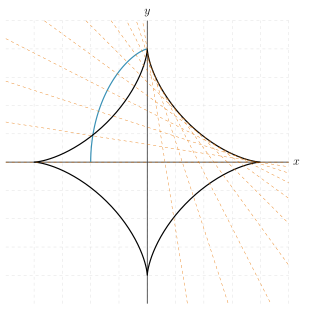
- A curve has parametric equations \[ x = -4\cos^3 t, \qquad y = 12\sin t - 4\sin^3 t. \] Find the equation of the normal to this curve at the point \[ \bigl(-4\cos^3\phi,\; 12\sin\phi - 4\sin^3\phi\bigr), \] where \(0 < \phi < \tfrac{1}{2}\pi\). Verify that this normal is a tangent to the curve \[ x^{2/3} + y^{2/3} = 4 \] at the point \((8\cos^3\phi,\; 8\sin^3\phi)\).
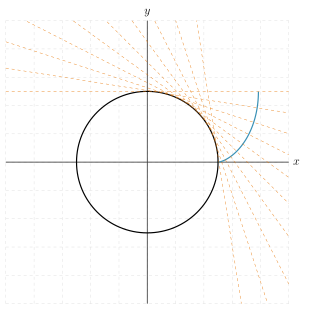
- A curve has parametric equations \[ x = \cos t + t\sin t, \qquad y = \sin t - t\cos t. \] Find the equation of the normal to this curve at the point \[ \bigl(\cos\phi + \phi\sin\phi,\; \sin\phi - \phi\cos\phi\bigr), \] where \(0 < \phi < \tfrac{1}{2}\pi\). Determine the perpendicular distance from the origin to this normal, and hence find the equation of a curve, independent of \(\phi\), to which this normal is a tangent.
- \(\,\) \begin{align*}
&& \dot{x} &=12 \cos^2 t \sin t \\
&& \dot{y} &= 12 \cos t - 12 \sin^2 t \cos t \\
&& \frac{\d y}{\d x} &= \frac{12 \cos t - 12 \sin^2 t \cos t}{12 \cos^2 t \sin t} \\
&&&= \frac{1 - \sin^2 t}{\cos t \sin t} \\
&&&= \cot t \\
\\
&& \frac{y - (12\sin\phi - 4\sin^3\phi)}{x - (-4 \cos^3 \phi)} &= - \tan \phi \\
&& y &= -\tan \phi x -4 \cos^3 \phi \tan \phi + 12 \sin \phi -4\sin^3 \phi \\
&&&= -\tan \phi x -4 \cos^2 \phi \sin \phi + 12 \sin \phi -4\sin^3 \phi \\
&&&= -\tan \phi x - 4\sin \phi+12 \sin \phi \\
&&y&= -\tan \phi x + 8 \sin \phi
\end{align*}
Note that when \(x = 8\cos^3 \phi\) we have \(y =-8 \cos^2 \phi \sin \phi + 8 \sin \phi = 8 \sin^3 \phi\). So the point lies on the curve. Notice also that \((8\cos^3 \phi, 8 \sin^ 3\phi)\) is a parametrisation of \(x^{2/3} + y^{2/3} = 4\) and so we can use parametric differentiation to see the gradient is \(\frac{24\sin^2 \phi \cos \phi}{-24\cos^2 \phi\sin\phi} = - \tan \phi\) so it also has the same gradient as required.
- \(\,\) \begin{align*}
&& \dot{x} &= -\sin t + \sin t + t \cos t \\
&&&= t \cos t \\
&& \dot{y} &= \cos t - \cos t + t \sin t \\
&&&= t \sin t \\
&& \frac{\d y}{\d x} &= \frac{t \sin t}{t \cos t} = \tan t \\
\\
&& \frac{y - (\sin \phi - \phi \cos \phi)}{x - (\cos \phi + \phi \sin \phi)} &= -\cot \phi \\
\Rightarrow && y &= -\cot \phi x + (\cos \phi + \phi \sin \phi) \cot \phi + \sin \phi - \phi \cos \phi \\
&&&= -\cot \phi x + \cos \phi \cot \phi + \phi \cos \phi + \sin \phi - \phi \cos \phi \\
&&&= -\cot \phi x + \frac{\cos^2 \phi + \sin^2 \phi}{\sin \phi} \\
&&&= -\cot \phi x + \cosec \phi
\end{align*}
The distance to the origin is \(\displaystyle \frac{|\cosec \phi|}{\sqrt{1 + \cot^2 \phi}} = 1\) so this normal is a tangent to \(x^2 + y^2 = 1\)
The points \(P(ap^2, 2ap)\) and \(Q(aq^2, 2aq)\), where \(p>0\) and \(q<0\), lie on the curve \(C\) with equation $$y^2= 4ax\,,$$ where \(a>0\,\). Show that the equation of the tangent to \(C\) at \(P\) is $$y= \frac 1 p \, x +ap\,.$$ The tangents to the curve at \(P\) and at \(Q \) meet at \(R\). These tangents meet the \(y\)-axis at \(S\) and \(T\) respectively, and \(O\) is the origin. Prove that the area of triangle \(OPQ\) is twice the area of triangle \(RST\).
Show Solution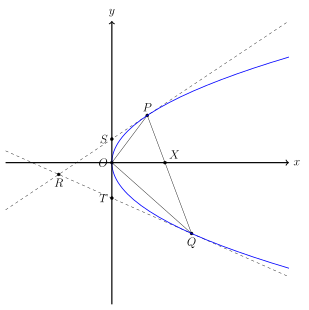
A curve \(C\) is determined by the parametric equations \[ x=at^2 \, , \; y = 2at\,, \] where \(a > 0\).
- Show that the normal to \(C\) at a point \(P\), with non-zero parameter \(p\), meets \(C\) again at a point \(N\), with parameter \(n\), where \[ n= - \left( p + \frac{2}{p} \right). \]
- Show that the distance \(\left| PN \right|\) is given by \[ \vert PN\vert^2 = 16a^2\frac{(p^2+1)^3}{p^4} \] and that this is minimised when \(p^2=2\,\).
- The point \(Q\), with parameter \(q\), is the point at which the circle with diameter \(PN\) cuts \(C\) again. By considering the gradients of \(QP\) and \(QN\), show that \[ 2 = p^2-q^2 + \frac{2q}p. \] Deduce that \(\left| PN \right|\) is at its minimum when \(Q\) is at the origin.
- \(\,\) \begin{align*} && \frac{\d x}{\d t} &= 2at \\ && \frac{\d y}{\d t} &= 2a \\ \Rightarrow && \frac{\d y}{\d x} &= \frac1t \\ && -p &= \text{grad of normal} \\ &&&= \frac{y-2ap}{x-ap^2} \\ \Rightarrow && y &= -px + ap^3+2ap \\ && 2an &= -pan^2 + ap^3 + 2ap \\ \Rightarrow && 0 &= pan^2+2an-ap(2+p^2) \\ \Rightarrow && n &= p, -\left ( p + \frac2{p}\right) \\ \Rightarrow && n &= -\left ( p + \frac2{p}\right) \end{align*}
- \(\,\) \begin{align*} && |PN|^2 &= (ap^2-an^2)^2 +(2ap-2an)^2 \\ &&&= a^2(p-n)^2(p+n)^2+4a^2(p-n)^2 \\ &&&= a^2(p-n)^2((p+n)^2+4) \\ &&&= a^2\left(p+p+\frac2p \right)^2 \left ( \left ( -\frac2p\right)^2+4\right)\\ &&&= a^2\left(\frac{2p^2+2}p \right)^2 \left ( \frac{4}{p^2}+4\right)\\ &&&= 16a^2 \frac{(p^2+1)^3}{p^4} \\ \\ && \frac{\d |PN|^2}{\d p^2} &= 16a^2\frac{3(p^2+1)^2p^4-2(p^2+1)^3p^2}{p^8} \\ &&&= 16a^2(p^2+1)^2 \frac{3p^2-2(p^2+1)}{p^6} \\ &&&= 16a^2(p^2+1)^2 \frac{p^2-2}{p^6} \end{align*} Therefore minimized when \(p^2=2\) (clearly a minimum by considering behaviour as \(p^2 \to 0, \infty\))
- If \(PN\) is the diameter of \(PNQ\) then \(QP\) and \(QN\) are perpendicular, ie \begin{align*} && -1 &= \frac{2ap-2aq}{ap^2-aq^2} \cdot \frac{2aq-2an}{aq^2-an^2} \\ &&&= \frac{2}{p+q} \cdot \frac{2}{q+n} \\ &&&= \frac{2}{p+q} \cdot \frac{2}{q - p -\frac{2}{p}} \\ \Rightarrow && 4 &= (p+q)(p+\frac2{p}-q) \\ &&&= p^2-q^2 + \frac{2q}{p} + 2 \\ \Rightarrow && 2 &= p^2 - q^2 + \frac{2q}{p} \end{align*} Therefore \(q = 0 \Rightarrow p^2 = 2 \Rightarrow |PN|\) is at it's minimum.
Show that the point \(T\) with coordinates \[ \left( \frac{a(1-t^2)}{1+t^2} \; , \; \frac{2bt}{1+t^2}\right) \tag{\(*\)} \] (where \(a\) and \(b\) are non-zero) lies on the ellipse \[ \frac{x^2}{a^2} + \frac{y^2}{b^2} =1 \,. \]
- The line \(L\) is the tangent to the ellipse at \(T\). The point \((X,Y)\) lies on \(L\), and \(X^2\ne a^2\). Show that \[ (a+X)bt^2 -2aYt +b(a-X) =0 \,.\] Deduce that if \(a^2Y^2>(a^2-X^2)b^2\), then there are two distinct lines through \((X,Y)\) that are tangents to the ellipse. Interpret this result geometrically. Show, by means of a sketch, that the result holds also if \(X^2=a^2\,\).
- The distinct points \(P\) and \(Q\) are given by \((*)\), with \(t=p\) and \(t=q\), respectively. The tangents to the ellipse at \(P\) and \(Q\) meet at the point with coordinates \((X,Y)\), where \(X^2\ne a^2\,\). Show that \[ (a+X)pq = a-X\] and find an expression for \(p+q\) in terms of \(a\), \(b\), \(X\) and \(Y\). Given that the tangents meet the \(y\)-axis at points \((0,y_1)\) and \((0,y_2)\), where \(y_1+y_2 = 2b\,\), show that \[ \frac{X^2}{a^2} +\frac{Y}{b}= 1 \,. \]
- The tangent has equation:
\begin{align*}
&& 0 &= \frac{Xx}{a^2} + \frac{Yy}{b^2} -1 \\
\Rightarrow &&&= \frac{Xa(1-t^2)}{a^2(1+t^2)} + \frac{Y2bt}{b^2(1+t^2)} - 1 \\
\Rightarrow &&0&= Xb(1-t^2) + Y2at - ab(1+t^2)\\
&&&= -(b(a+X)t^2 -2aYt +b(a-X)) \\
\Rightarrow && 0 &= (a+X)bt^2-2aYt+b(a-X) \\
\\
&& 0 <\Delta &= 4a^2Y^2 - 4(a+X)b(a-X)b \\
&&&= 4(a^2Y^2-b^2(a^2-X^2)) \\
\Leftrightarrow && a^2Y^2 &> (a^2-X^2)b^2
\end{align*}
Therefore there are two roots to the quadratic, ie two values of the parameter \(t\) which works. The condition is equivalent to \(\frac{X^2}{a^2} + \frac{Y^2}{b^2} > 1\). ie from any point outside the ellipse there are two tangent lies.
Clearly there are two tangents when \(X = \pm a\) (except \((X,Y) = (\pm a, 0)\).
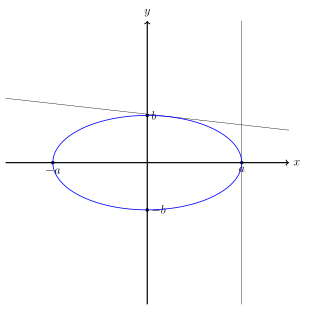
- We must have \(p\) and \(q\) are roots of \(0 = (a+X)bt^2-2aYt+b(a-X)\), ie \(pq = \frac{b(a-X)}{(a+X)b} \Rightarrow (a+X)pq = a-X\). Similarly \(p+q = \frac{2aY}{(a+X)b}\) Given that the tangents meet the \(y\)-axis at \((0, y_i)\) we must have \(abt^2-2ay_it + ab = 0\), so \begin{align*} && 0 &= abp^2-2ay_1p + ab \\ && 0 &= abq^2-2ay_2q + ab \\ \Rightarrow && y_1 &= \frac{ab(p^2+1)}{2ap} \\ && y_2 &= \frac{ab(q^2+1)}{2aq} \\ \Rightarrow && 2b &= \frac{ab(p^2+1)}{2ap} +\frac{ab(q^2+1)}{2aq} \\ &&&= \frac{ab(pq(p+q)+p+q)}{2apq} \\ \Rightarrow && 4pq &= pq(p+q)+p+q \\ \Rightarrow && 4 \frac{b(a-X)}{(a+X)b} &= \frac{2aY}{(a+X)b} \left ( \frac{b(a-X)}{(a+X)b} + 1 \right) \\ && &= \frac{2aY}{(a+X)b} \frac{2ab}{(a+X)b} \\ \Rightarrow && 4b^2(a^2-X^2) &= 4a^2bY \\ \Rightarrow && 1 &= \frac{Y}{b} + \frac{X^2}{a^2} \end{align*} as required.
The curve \(C_1\) has parametric equations \(x=t^2\), \(y= t^3\), where \(-\infty < t < \infty\,\). Let \(O\) denote the point \((0,0)\). The points \(P\) and \(Q\) on \(C_1\) are such that \(\angle POQ\) is a right angle. Show that the tangents to \(C_1\) at \(P\) and \(Q\) intersect on the curve \(C_2\) with equation \(4y^2=3x-1\). Determine whether \(C_1\) and \(C_2\) meet, and sketch the two curves on the same axes.
Show Solution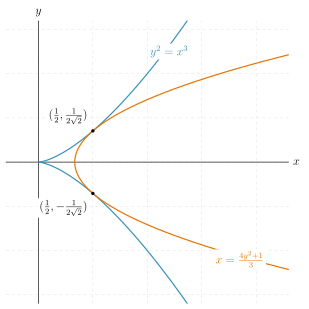
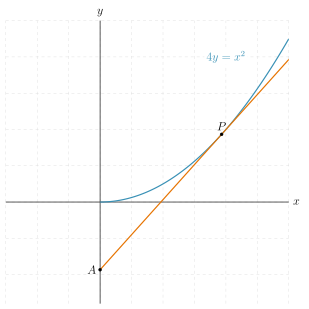
The midpoint of a rod of length \(2b\) slides on the curve \(y =\frac14 x^2\), \(x\ge0\), in such a way that the rod is always tangent, at its midpoint, to the curve. Show that the curve traced out by one end of the rod can be written in the form \begin{align*} x& = 2 \tan\theta - b \cos\theta \\ y& = \tan^2\theta - b \sin\theta \end{align*} for some suitably chosen angle \(\theta\) which satisfies \(0\le \theta < \frac12\pi\,\). When one end of the rod is at a point \(A\) on the \(y\)-axis, the midpoint is at point \(P\) and \(\theta = \alpha\). Let \(R\) be the region bounded by the following:
- the curve \(y=\frac14x^2\) between the origin and \(P\);
- the \(y\)-axis between \(A\) and the origin;
- the half-rod \(AP\).
The curve \(C\) has equation \(xy = \frac12\). The tangents to \(C\) at the distinct points \(P\big(p, \frac1{2p}\big)\) and \(Q\big(q, \frac1{2q}\big)\) where \(p\) and \(q\) are positive, intersect at \(T\) and the normals to \(C\) at these points intersect at \(N\). Show that \(T\) is the point \[ \left( \frac{2pq}{p+q}\,,\, \frac 1 {p+q}\right)\!. \] In the case \(pq=\frac12\), find the coordinates of \(N\). Show (in this case) that \(T\) and \(N\) lie on the line \(y=x\) and are such that the product of their distances from the origin is constant.
Show SolutionThe distinct points \(P\) and \(Q\), with coordinates \((ap^2,2ap)\) and \((aq^2,2aq)\) respectively, lie on the curve \(y^2=4ax\). The tangents to the curve at \(P\) and \(Q\) meet at the point \(T\). Show that \(T\) has coordinates \(\big(apq, a(p+q)\big)\). You may assume that \(p\ne0\) and \(q\ne0\). The point \(F\) has coordinates \((a,0)\) and \(\phi\) is the angle \(TFP\). Show that \[ \cos\phi = \frac{pq+1}{\sqrt{(p^2+1)(q^2+1)}\ } \] and deduce that the line \(FT\) bisects the angle \(PFQ\).
Show SolutionA curve is given parametrically by \begin{align*} x&= a\big( \cos t +\ln \tan \tfrac12 t\big)\,,\\ y&= a\sin t\,, \end{align*} where \(0 < t < \frac12 \pi\) and \(a\) is a positive constant. Show that \(\ds \frac{\d y}{\d x} = \tan t\) and sketch the curve. Let \(P\) be the point with parameter \(t\) and let \(Q\) be the point where the tangent to the curve at \(P\) meets the \(x\)-axis. Show that \(PQ=a\). The {\sl radius of curvature}, \(\rho\), at \(P\) is defined by \[ \rho= \frac {\big(\dot x ^2+\dot y^2\big)^{\frac32}} {\vert \dot x \ddot y - \dot y \ddot x\vert \ \ } \,, \] where the dots denote differentiation with respect to \(t\). Show that \(\rho =a\cot t\). The point \(C\) lies on the normal to the curve at \(P\), a distance \(\rho\) from \(P\) and above the curve. Show that \(CQ\) is parallel to the \(y\)-axis.
An ellipse has equation $\dfrac{x^2}{a^2} +\dfrac {y^2}{b^2} = 1$. Show that the equation of the tangent at the point \((a\cos\alpha, b\sin\alpha)\) is \[ y=- \frac {b \cot \alpha} a \, x + b\, {\rm cosec\,}\alpha\,. \] The point \(A\) has coordinates \((-a,-b)\), where \(a\) and \(b\) are positive. The point \(E\) has coordinates \((-a,0)\) and the point \(P\) has coordinates \((a,kb)\), where \(0 < k < 1\). The line through \(E\) parallel to \(AP\) meets the line \(y=b\) at the point \(Q\). Show that the line \(PQ\) is tangent to the above ellipse at the point given by \(\tan(\alpha/2)=k\). Determine by means of sketches, or otherwise, whether this result holds also for \(k=0\) and \(k=1\).
A curve is defined parametrically by \[ x=t^2 \;, \ \ \ y=t (1 + t^2 ) \;. \] The tangent at the point with parameter \(t\), where \(t\ne0\,\), meets the curve again at the point with parameter \(T\), where \(T\ne t\,\). Show that \[ T = \frac{1 - t^2 }{2t} \mbox { \ \ \ and \ \ \ } 3t^2\ne 1\;. \] Given a point \(P_0\,\) on the curve, with parameter \(t_0\,\), a sequence of points \(P_0 \, , \; P_1 \, , \; P_2 \, , \ldots\) on the curve is constructed such that the tangent at \(P_i\) meets the curve again at \(P_{i+1}\). If \(t_0 = \tan \frac{ 7 } {18}\pi\,\), show that \(P_3 = P_0\) but \(P_1\ne P_0\,\). Find a second value of \(t_0\,\), with \(t_0>0\,\), for which \(P_3 = P_0\) but \(P_1\ne P_0\,\).
Show that the equation \(x^3 + px + q=0\) has exactly one real solution if \(p \ge 0\,\). A parabola \(C\) is given parametrically by \[ x = at^2, \: \ \ y = 2at \: \: \: \ \ \ \ \ \ \l a > 0 \r \;. \] Find an equation which must be satisfied by \(t\) at points on \(C\) at which the normal passes through the point \(\l h , \; k \r\,\). Hence show that, if \(h \le 2a \,\), exactly one normal to \(C\) will pass through \(\l h , \; k \r \, \). Find, in Cartesian form, the equation of the locus of the points from which exactly two normals can be drawn to \(C\,\). Sketch the locus.
Show Solution
A closed curve is given by the equation $$ x^{2/n} + y^{2/n} = a^{2/n} \eqno(*) $$ where \(n\) is an odd integer and \(a\) is a positive constant. Find a parametrization \(x=x(t)\), \(y=y(t)\) which describes the curve anticlockwise as \(t\) ranges from \(0\) to \(2\pi\). Sketch the curve in the case \(n=3\), justifying the main features of your sketch. The area \(A\) enclosed by such a curve is given by the formula $$ A= {1\over 2} \int_0^{2\pi} \left[ x(t) {\d y(t)\over \d t} - y(t) {\d x(t)\over \d t} \right] \,\d t \,. $$ Use this result to find the area enclosed by (\(*\)) for \(n=3\).
Two curves are given parametrically by \[ x_{1}=(\theta+\sin\theta),\qquad y_{1}=(1+\cos\theta),\tag{1} \]and \[ x_{2}=(\theta-\sin\theta),\qquad y_{1}=-(1+\cos\theta),\tag{2} \] Find the gradients of the tangents to the curves at the points where \(\theta= \pi/2\) and \(\theta=3\pi/2\). Sketch, using the same axes, the curves for \(0\le\theta \le 2\pi\). Find the equation of the normal to the curve (1) at the point with parameter \(\theta\). Show that this normal is a tangent to the curve (2).
Sketch the curve \(C_{1}\) whose parametric equations are \(x=t^{2},\) \(y=t^{3}.\) The circle \(C_{2}\) passes through the origin \(O\). The points \(R\) and \(S\) with real non-zero parameters \(r\) and \(s\) respectively are other intersections of \(C_{1}\) and \(C_{2}.\) Show that \(r\) and \(s\) are roots of an equation of the form \[ t^{4}+t^{2}+at+b=0, \] where \(a\) and \(b\) are real constants. By obtaining a quadratic equation, with coefficients expressed in terms of \(r\) and \(s\), whose roots would be the parameters of any further intersections of \(C_{1}\) and \(C_{2},\) or otherwise, show that \(O\), \(R\) and \(S\) are the only real intersections of \(C_{1}\) and \(C_{2}.\)
Show Solution