1992 Paper 3 Q3
Year: 1992
Paper: 3
Question Number: 3
Course: LFM Pure and Mechanics
Section: Parametric equations
Difficulty: 1700.0
Banger: 1484.0
Problem
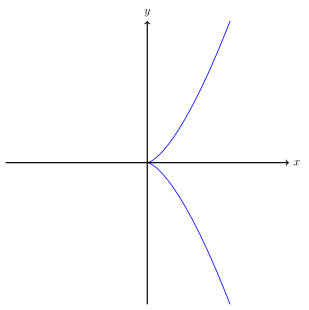
Sketch the curve \(C_{1}\) whose parametric equations are \(x=t^{2},\) \(y=t^{3}.\)
The circle \(C_{2}\) passes through the origin \(O\). The points \(R\) and \(S\) with real non-zero parameters \(r\) and \(s\) respectively are other intersections of \(C_{1}\) and \(C_{2}.\) Show that \(r\) and \(s\) are roots of an equation of the form \[
t^{4}+t^{2}+at+b=0,
\]
where \(a\) and \(b\) are real constants.
By obtaining a quadratic equation, with coefficients expressed in terms of \(r\) and \(s\), whose roots would be the parameters of any further intersections of \(C_{1}\) and \(C_{2},\) or otherwise, show that \(O\), \(R\) and \(S\) are the only real intersections of \(C_{1}\) and \(C_{2}.\)
Solution
Rating Information
Difficulty Rating: 1700.0
Difficulty Comparisons: 0
Banger Rating: 1484.0
Banger Comparisons: 1
Show LaTeX source
Problem source
Sketch the curve $C_{1}$ whose parametric equations are $x=t^{2},$ $y=t^{3}.$
The circle $C_{2}$ passes through the origin $O$. The points $R$ and $S$ with real non-zero parameters $r$ and $s$ respectively are other intersections of $C_{1}$ and $C_{2}.$ Show that $r$ and $s$ are roots of an equation of the form \[
t^{4}+t^{2}+at+b=0,
\]
where $a$ and $b$ are real constants.
By obtaining a quadratic equation, with coefficients expressed in terms of $r$ and $s$, whose roots would be the parameters of any further intersections of $C_{1}$ and $C_{2},$ or otherwise, show that $O$, $R$ and $S$ are the only real intersections of $C_{1}$ and $C_{2}.$
Solution source
\begin{center}
    \begin{tikzpicture}
    \def\functionf(#1){1/(1+(#1)^2)};
    \def\xl{-5};
    \def\xu{5};
    \def\yl{-5};
    \def\yu{5};

    % Calculate scaling factors to make the plot square
    \pgfmathsetmacro{\xrange}{\xu-\xl}
    \pgfmathsetmacro{\yrange}{\yu-\yl}
    \pgfmathsetmacro{\xscale}{10/\xrange}
    \pgfmathsetmacro{\yscale}{10/\yrange}

    % Define the styles for the axes and grid
    \tikzset{
        axis/.style={very thick, ->},
        grid/.style={thin, gray!30},
        x=\xscale cm,
        y=\yscale cm
    }

    % Define the bounding region with clip
    \begin{scope}
        % You can modify these values to change your plotting region
        \clip (\xl,\yl) rectangle (\xu,\yu);

        % Draw a grid (optional)
        % \draw[grid] (-5,-3) grid (5,3);

        \draw[thick, blue, smooth, domain=-5:5, samples=100]
            plot ({(\x)^2}, {(\x)^3});


    \end{scope}

    % Set up axes
    \draw[axis] (\xl,0) -- (\xu,0) node[right] {$x$};
    \draw[axis] (0,\yl) -- (0,\yu) node[above] {$y$};

    \end{tikzpicture}
\end{center}

Suppose the circle has centre $(c,d)$, then
\begin{align*}
&& c^2+d^2 &= (t^2-c)^2+(t^3-d)^2 \\
\Rightarrow && 0 &= t^4-2ct^2+t^6-2t^3d \\
\Rightarrow && 0 &= t^4+t^2-2td-2c
\end{align*}

So by setting $a = -2d$ and $b = -2c$ we have the desired equation.

By matching the coefficients of $t^4, t^3, t^2$ we must have:
\begin{align*}
&& 0 &= (t^2-(r+s)t+rs)(t^2+t(r+s)-rs+(r+s)^2+1) \\
\Rightarrow && 0 &= t^2+(r+s)t-rs+(r+s)^2+1 \\
&& \Delta &= (r+s)^2 -4(1-rs+(r+s)^2) \\
&&&= -4+4rs-3(r+s)^2 \\
&&&=-4-2(r+s)^2-(r-s)^2 < 0
\end{align*}

Therefore there are no further (real) solutions. Hence $O, R, S$ are the only solutions.