2021 Paper 3 Q1
Year: 2021
Paper: 3
Question Number: 1
Course: LFM Pure and Mechanics
Section: Parametric equations
Problem
- A curve has parametric equations \[ x = -4\cos^3 t, \qquad y = 12\sin t - 4\sin^3 t. \] Find the equation of the normal to this curve at the point \[ \bigl(-4\cos^3\phi,\; 12\sin\phi - 4\sin^3\phi\bigr), \] where \(0 < \phi < \tfrac{1}{2}\pi\). Verify that this normal is a tangent to the curve \[ x^{2/3} + y^{2/3} = 4 \] at the point \((8\cos^3\phi,\; 8\sin^3\phi)\).
- A curve has parametric equations \[ x = \cos t + t\sin t, \qquad y = \sin t - t\cos t. \] Find the equation of the normal to this curve at the point \[ \bigl(\cos\phi + \phi\sin\phi,\; \sin\phi - \phi\cos\phi\bigr), \] where \(0 < \phi < \tfrac{1}{2}\pi\). Determine the perpendicular distance from the origin to this normal, and hence find the equation of a curve, independent of \(\phi\), to which this normal is a tangent.
Solution
- \(\,\) \begin{align*}
&& \dot{x} &=12 \cos^2 t \sin t \\
&& \dot{y} &= 12 \cos t - 12 \sin^2 t \cos t \\
&& \frac{\d y}{\d x} &= \frac{12 \cos t - 12 \sin^2 t \cos t}{12 \cos^2 t \sin t} \\
&&&= \frac{1 - \sin^2 t}{\cos t \sin t} \\
&&&= \cot t \\
\\
&& \frac{y - (12\sin\phi - 4\sin^3\phi)}{x - (-4 \cos^3 \phi)} &= - \tan \phi \\
&& y &= -\tan \phi x -4 \cos^3 \phi \tan \phi + 12 \sin \phi -4\sin^3 \phi \\
&&&= -\tan \phi x -4 \cos^2 \phi \sin \phi + 12 \sin \phi -4\sin^3 \phi \\
&&&= -\tan \phi x - 4\sin \phi+12 \sin \phi \\
&&y&= -\tan \phi x + 8 \sin \phi
\end{align*}
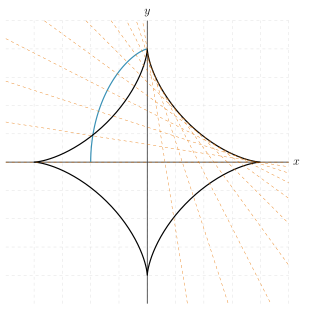
Note that when \(x = 8\cos^3 \phi\) we have \(y =-8 \cos^2 \phi \sin \phi + 8 \sin \phi = 8 \sin^3 \phi\). So the point lies on the curve. Notice also that \((8\cos^3 \phi, 8 \sin^ 3\phi)\) is a parametrisation of \(x^{2/3} + y^{2/3} = 4\) and so we can use parametric differentiation to see the gradient is \(\frac{24\sin^2 \phi \cos \phi}{-24\cos^2 \phi\sin\phi} = - \tan \phi\) so it also has the same gradient as required.
- \(\,\) \begin{align*}
&& \dot{x} &= -\sin t + \sin t + t \cos t \\
&&&= t \cos t \\
&& \dot{y} &= \cos t - \cos t + t \sin t \\
&&&= t \sin t \\
&& \frac{\d y}{\d x} &= \frac{t \sin t}{t \cos t} = \tan t \\
\\
&& \frac{y - (\sin \phi - \phi \cos \phi)}{x - (\cos \phi + \phi \sin \phi)} &= -\cot \phi \\
\Rightarrow && y &= -\cot \phi x + (\cos \phi + \phi \sin \phi) \cot \phi + \sin \phi - \phi \cos \phi \\
&&&= -\cot \phi x + \cos \phi \cot \phi + \phi \cos \phi + \sin \phi - \phi \cos \phi \\
&&&= -\cot \phi x + \frac{\cos^2 \phi + \sin^2 \phi}{\sin \phi} \\
&&&= -\cot \phi x + \cosec \phi
\end{align*}
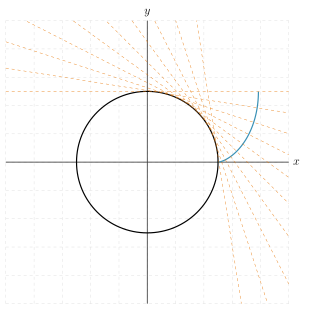
The distance to the origin is \(\displaystyle \frac{|\cosec \phi|}{\sqrt{1 + \cot^2 \phi}} = 1\) so this normal is a tangent to \(x^2 + y^2 = 1\)
Examiner's report
— 2021 STEP 3, Question 1The total entry was a marginal increase from that of 2019, that of 2020 having been artificially reduced. Comfortably more than 90% attempted one of the questions, four others were very popular, and a sixth was attempted by 70%. Every question was attempted by at least 10% of the candidature. 85% of candidates attempted no more than 7 questions, though very nearly all the candidates made genuine attempts on at most six questions (the extra attempts being at times no more than labelling a page or writing only the first line or two). Generally, candidates should be aware that when asked to "Show that" they must provide enough working to fully substantiate their working, and that they should follow the instructions in a question, so if it says "Hence", they should be using the previous work in the question in order to complete the next part. Likewise, candidates should be careful when dividing or multiplying, that things are positive, or at other times non-zero.
Rating Information
Difficulty Rating: 1500.0
Difficulty Comparisons: 0
Banger Rating: 1500.0
Banger Comparisons: 0
Show LaTeX source
Problem source
\begin{questionparts}
    \item A curve has parametric equations
    \[
        x = -4\cos^3 t, \qquad y = 12\sin t - 4\sin^3 t.
    \]
    Find the equation of the normal to this curve at the point
    \[
        \bigl(-4\cos^3\phi,\; 12\sin\phi - 4\sin^3\phi\bigr),
    \]
    where $0 < \phi < \tfrac{1}{2}\pi$.

    Verify that this normal is a tangent to the curve
    \[
        x^{2/3} + y^{2/3} = 4
    \]
    at the point $(8\cos^3\phi,\; 8\sin^3\phi)$.

    \item A curve has parametric equations
    \[
        x = \cos t + t\sin t, \qquad y = \sin t - t\cos t.
    \]
    Find the equation of the normal to this curve at the point
    \[
        \bigl(\cos\phi + \phi\sin\phi,\; \sin\phi - \phi\cos\phi\bigr),
    \]
    where $0 < \phi < \tfrac{1}{2}\pi$.

    Determine the perpendicular distance from the origin to this normal, and hence find the equation of a curve, independent of $\phi$, to which this normal is a tangent.
\end{questionparts}
Solution source
\begin{questionparts}
\item $\,$ \begin{align*}
&& \dot{x} &=12 \cos^2 t \sin t \\
&& \dot{y} &= 12 \cos t - 12 \sin^2 t \cos t \\
&& \frac{\d y}{\d x} &= \frac{12 \cos t - 12 \sin^2 t \cos t}{12 \cos^2 t \sin t} \\
&&&= \frac{1 - \sin^2 t}{\cos t \sin t} \\
&&&= \cot t \\
\\
&& \frac{y - (12\sin\phi - 4\sin^3\phi)}{x - (-4 \cos^3 \phi)} &= - \tan \phi \\
&& y &= -\tan \phi x -4 \cos^3 \phi \tan \phi + 12 \sin \phi -4\sin^3 \phi \\
&&&= -\tan \phi x -4 \cos^2 \phi \sin \phi + 12 \sin \phi -4\sin^3 \phi \\
&&&= -\tan \phi x - 4\sin \phi+12 \sin \phi \\
&&y&= -\tan \phi x + 8 \sin \phi
\end{align*}
Note that when $x = 8\cos^3 \phi$ we have $y =-8 \cos^2 \phi \sin \phi + 8 \sin \phi = 8 \sin^3 \phi$. So the point lies on the curve. Notice also that $(8\cos^3 \phi, 8 \sin^ 3\phi)$ is a parametrisation of $x^{2/3} + y^{2/3} = 4$ and so we can use parametric differentiation to see the gradient is $\frac{24\sin^2 \phi \cos \phi}{-24\cos^2 \phi\sin\phi} = - \tan \phi$ so it also has the same gradient as required.


\begin{center}
    \begin{tikzpicture}
    \def\functionf(#1){((#1)*exp(-(#1)^2))};
    \def\xl{-10};
    \def\xu{10};
    \def\yl{-10};
    \def\yu{10};

    % Calculate scaling factors to make the plot square
    \pgfmathsetmacro{\xrange}{\xu-\xl}
    \pgfmathsetmacro{\yrange}{\yu-\yl}
    \pgfmathsetmacro{\xscale}{10/\xrange}
    \pgfmathsetmacro{\yscale}{10/\yrange}

    % Define the reusable styles to keep code clean
    \tikzset{
        x=\xscale cm, y=\yscale cm,
        axis/.style={thick, draw=black!80, -{Stealth[scale=1.2]}},
        grid/.style={thin, dashed, gray!30},
        curveA/.style={very thick, color=cyan!70!black, smooth},
        curveB/.style={very thick, color=orange!90!black, smooth},
        curveC/.style={very thick, color=green!90!black, smooth},
        curveBlack/.style={very thick, color=black, smooth},
        dot/.style={circle, fill=black, inner sep=1.2pt},
        labelbox/.style={fill=white, inner sep=2pt, rounded corners=2pt} % Protects text from lines
    }

    % Draw background grid
    \draw[grid] (\xl,\yl) grid (\xu,\yu);

    % Set up axes
    \draw[axis] (\xl,0) -- (\xu,0) node[right, black] {$x$};
    \draw[axis] (0,\yl) -- (0,\yu) node[above, black] {$y$};

    % Define the bounding region with clip
    \begin{scope}
        \clip (\xl,\yl) rectangle (\xu,\yu);

        \draw[curveA, domain=0:{pi/2}, samples=150]
            plot ({-4*(cos(deg(\x))^3)},{12*sin(deg(\x))-4*(sin(deg(\x))^3)});
        \draw[curveBlack, domain=0:{2*pi}, samples=150]
            plot ({8*(cos(deg(\x))^3)}, {8*(sin(deg(\x))^3)});

        \foreach \x in {0, ..., 9} {
            \draw[color=orange!90!black, smooth, dashed] (\xl, {-tan(deg(\x*pi/2/10))*\xl + 8 * sin(deg(\x*pi/2/10))}) -- (\xu, {-tan(deg(\x*pi/2/10))*\xu + 8 * sin(deg(\x*pi/2/10))});
        }
    \end{scope}


    \end{tikzpicture}
\end{center}


\item $\,$ \begin{align*}
&& \dot{x} &= -\sin t + \sin t + t \cos t \\
&&&= t \cos t \\
&& \dot{y} &= \cos t - \cos t + t \sin t \\
&&&= t \sin t \\
&& \frac{\d y}{\d x} &= \frac{t \sin t}{t \cos t} = \tan t \\
\\
&& \frac{y - (\sin \phi - \phi \cos \phi)}{x - (\cos \phi + \phi \sin \phi)} &= -\cot \phi \\
\Rightarrow && y &= -\cot \phi x + (\cos \phi + \phi \sin \phi) \cot \phi + \sin \phi - \phi \cos \phi \\
&&&= -\cot \phi x + \cos \phi \cot \phi + \phi \cos \phi + \sin \phi - \phi \cos \phi \\
&&&= -\cot \phi x + \frac{\cos^2 \phi + \sin^2 \phi}{\sin \phi} \\
&&&= -\cot \phi x + \cosec \phi
\end{align*}

The distance to the origin is $\displaystyle \frac{|\cosec \phi|}{\sqrt{1 + \cot^2 \phi}} = 1$ so this normal is a tangent to $x^2 + y^2 = 1$


\begin{center}
    \begin{tikzpicture}
    \def\functionf(#1){((#1)*exp(-(#1)^2))};
    \def\xl{-2};
    \def\xu{2};
    \def\yl{-2};
    \def\yu{2};

    % Calculate scaling factors to make the plot square
    \pgfmathsetmacro{\xrange}{\xu-\xl}
    \pgfmathsetmacro{\yrange}{\yu-\yl}
    \pgfmathsetmacro{\xscale}{10/\xrange}
    \pgfmathsetmacro{\yscale}{10/\yrange}

    % Define the reusable styles to keep code clean
    \tikzset{
        x=\xscale cm, y=\yscale cm,
        axis/.style={thick, draw=black!80, -{Stealth[scale=1.2]}},
        grid/.style={thin, dashed, gray!30},
        curveA/.style={very thick, color=cyan!70!black, smooth},
        curveB/.style={very thick, color=orange!90!black, smooth},
        curveC/.style={very thick, color=green!90!black, smooth},
        curveBlack/.style={very thick, color=black, smooth},
        dot/.style={circle, fill=black, inner sep=1.2pt},
        labelbox/.style={fill=white, inner sep=2pt, rounded corners=2pt} % Protects text from lines
    }

    % Draw background grid
    \draw[grid] (\xl,\yl) grid (\xu,\yu);

    % Set up axes
    \draw[axis] (\xl,0) -- (\xu,0) node[right, black] {$x$};
    \draw[axis] (0,\yl) -- (0,\yu) node[above, black] {$y$};

    % Define the bounding region with clip
    \begin{scope}
        \clip (\xl,\yl) rectangle (\xu,\yu);

        \draw[curveA, domain=0:{pi/2}, samples=150]
            plot ({cos(deg(\x))+\x*sin(deg(\x)))},{sin(deg(\x))-\x*cos(deg(\x)))});
        \draw[curveBlack] (0,0) circle (1);

        \foreach \x in {1, ..., 10} {
            \draw[color=orange!90!black, smooth, dashed] (\xl, {-cot(deg(\x*pi/2/10))*\xl + 1/sin(deg(\x*pi/2/10))}) -- (\xu, {-cot(deg(\x*pi/2/10))*\xu + 1/sin(deg(\x*pi/2/10))});
        }
    \end{scope}


    \end{tikzpicture}
\end{center}
\end{questionparts}

This is an interesting question because many years ago this question of finding involutes and envelopes of questions would be considered extremely standard. (Particularing finding the involute of a circle). (It also seems to make sense mechanically imagine unwinding (or winding) a piece of string from a circle!)
This was the most popular question by a fair margin, being attempted by 93%, and equally was comfortably the most successful with a mean mark of slightly over 15/20. Generally, most found the equation of the normal in part (i) correctly, though the more successful candidates simplified their answer sensibly at this point and similarly with other results in the question. A number of candidates forgot the negative sign when obtaining a perpendicular gradient and merely attempted to use the reciprocal. Most used implicit differentiation in order to arrive at an expression for the gradient of the tangent to the second curve in part (i), though parametric differentiation was probably simpler. There was an equal split between those that obtained the equation of the tangent to the second curve and demonstrated that it was the same as that for the normal to the first curve, and those that demonstrated that the point given parametrically was on the normal and that the gradient of the normal and the tangent were the same. In part (ii), surprisingly, some candidates made errors with the initial differentiation. Those that simplified their equation of the normal profited from the easier working, whichever way they then tried to obtain the perpendicular distance. About three quarters of the candidates found this distance by first finding the intersection of the normal with a perpendicular line through the origin. However, using the formula for the perpendicular distance of a point from a line was simpler. A range of other methods for this distance were seen; briefly, these were (a) simple trigonometry having sketched the normal, the axes and line's intercepts, (b) expressing the normal equation as the scalar product of vectors, (c) minimising by differentiation, or completing the square, of the distance of a general point on the normal from the origin or (d) by equating two expressions for the area of the triangle formed by the normal and the two axes. Errors in this part arose from unsimplified working complicating the issue (as already mentioned), overlooking the modulus sign in the distance formula, or calculating the distance from the origin to a point on the curve. The final requirement for the equation of a curve to which the normal found is a tangent was either not spotted by some candidates who had otherwise answered the question perfectly, or the requirement was overlooked.