2017 Paper 3 Q7
Year: 2017
Paper: 3
Question Number: 7
Course: LFM Pure and Mechanics
Section: Parametric equations
Problem
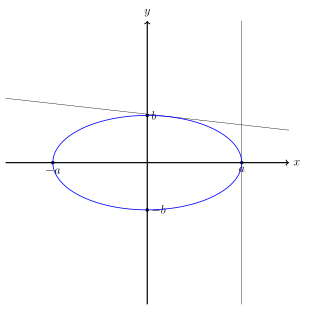
- The line \(L\) is the tangent to the ellipse at \(T\). The point \((X,Y)\) lies on \(L\), and \(X^2\ne a^2\). Show that \[ (a+X)bt^2 -2aYt +b(a-X) =0 \,.\] Deduce that if \(a^2Y^2>(a^2-X^2)b^2\), then there are two distinct lines through \((X,Y)\) that are tangents to the ellipse. Interpret this result geometrically. Show, by means of a sketch, that the result holds also if \(X^2=a^2\,\).
- The distinct points \(P\) and \(Q\) are given by \((*)\), with \(t=p\) and \(t=q\), respectively. The tangents to the ellipse at \(P\) and \(Q\) meet at the point with coordinates \((X,Y)\), where \(X^2\ne a^2\,\). Show that \[ (a+X)pq = a-X\] and find an expression for \(p+q\) in terms of \(a\), \(b\), \(X\) and \(Y\). Given that the tangents meet the \(y\)-axis at points \((0,y_1)\) and \((0,y_2)\), where \(y_1+y_2 = 2b\,\), show that \[ \frac{X^2}{a^2} +\frac{Y}{b}= 1 \,. \]
Solution
- The tangent has equation:
\begin{align*}
&& 0 &= \frac{Xx}{a^2} + \frac{Yy}{b^2} -1 \\
\Rightarrow &&&= \frac{Xa(1-t^2)}{a^2(1+t^2)} + \frac{Y2bt}{b^2(1+t^2)} - 1 \\
\Rightarrow &&0&= Xb(1-t^2) + Y2at - ab(1+t^2)\\
&&&= -(b(a+X)t^2 -2aYt +b(a-X)) \\
\Rightarrow && 0 &= (a+X)bt^2-2aYt+b(a-X) \\
\\
&& 0 <\Delta &= 4a^2Y^2 - 4(a+X)b(a-X)b \\
&&&= 4(a^2Y^2-b^2(a^2-X^2)) \\
\Leftrightarrow && a^2Y^2 &> (a^2-X^2)b^2
\end{align*}
Therefore there are two roots to the quadratic, ie two values of the parameter \(t\) which works. The condition is equivalent to \(\frac{X^2}{a^2} + \frac{Y^2}{b^2} > 1\). ie from any point outside the ellipse there are two tangent lies.
Clearly there are two tangents when \(X = \pm a\) (except \((X,Y) = (\pm a, 0)\).
- We must have \(p\) and \(q\) are roots of \(0 = (a+X)bt^2-2aYt+b(a-X)\), ie \(pq = \frac{b(a-X)}{(a+X)b} \Rightarrow (a+X)pq = a-X\). Similarly \(p+q = \frac{2aY}{(a+X)b}\) Given that the tangents meet the \(y\)-axis at \((0, y_i)\) we must have \(abt^2-2ay_it + ab = 0\), so \begin{align*} && 0 &= abp^2-2ay_1p + ab \\ && 0 &= abq^2-2ay_2q + ab \\ \Rightarrow && y_1 &= \frac{ab(p^2+1)}{2ap} \\ && y_2 &= \frac{ab(q^2+1)}{2aq} \\ \Rightarrow && 2b &= \frac{ab(p^2+1)}{2ap} +\frac{ab(q^2+1)}{2aq} \\ &&&= \frac{ab(pq(p+q)+p+q)}{2apq} \\ \Rightarrow && 4pq &= pq(p+q)+p+q \\ \Rightarrow && 4 \frac{b(a-X)}{(a+X)b} &= \frac{2aY}{(a+X)b} \left ( \frac{b(a-X)}{(a+X)b} + 1 \right) \\ && &= \frac{2aY}{(a+X)b} \frac{2ab}{(a+X)b} \\ \Rightarrow && 4b^2(a^2-X^2) &= 4a^2bY \\ \Rightarrow && 1 &= \frac{Y}{b} + \frac{X^2}{a^2} \end{align*} as required.
Examiner's report
— 2017 STEP 3, Question 7The total entry was only very slightly smaller than that of 2016, which was a record entry, but was still over 10% more than 2015. No question was attempted by in excess of 90%, although two were very popular and also five others were attempted by 60% or more. No question was generally avoided with even the least popular one attracting more than 10% of the entry. Less than 10% of candidates attempted more than 7 questions, and, apart from 18 exceptions, those doing so did not achieve very good totals and seemed to be 'casting around' to find things they could do: the 18 exceptions were very strong candidates who were generally achieving close to full marks on all the questions they attempted. The general trend was that those with six attempts fared better than those with more than six.
Rating Information
Difficulty Rating: 1700.0
Difficulty Comparisons: 0
Banger Rating: 1500.0
Banger Comparisons: 0
Show LaTeX source
Problem source
Show that the point $T$ with coordinates
\[
\left( \frac{a(1-t^2)}{1+t^2} \; , \; \frac{2bt}{1+t^2}\right)
\tag{$*$}
\]
(where $a$ and $b$ are non-zero) lies on the ellipse
\[
\frac{x^2}{a^2} + \frac{y^2}{b^2} =1
\,.
\]
\begin{questionparts}
\item The line $L$ is the tangent to the ellipse at $T$. The point $(X,Y)$ lies on $L$,  and $X^2\ne a^2$. Show that
\[ (a+X)bt^2 -2aYt +b(a-X) =0 \,.\]
Deduce that if $a^2Y^2>(a^2-X^2)b^2$, then there are two distinct lines through $(X,Y)$ that are tangents to the ellipse.  Interpret this result geometrically. Show, by means of a sketch, that the result  holds also  if $X^2=a^2\,$.
\item The distinct points  $P$ and $Q$ are given by $(*)$, with $t=p$ and $t=q$, respectively. The tangents to the ellipse at
$P$ and $Q$ meet at the point   with coordinates $(X,Y)$, where $X^2\ne a^2\,$.
Show that
\[ (a+X)pq = a-X\]
 and find an expression for $p+q$ in terms of $a$, $b$, $X$ and $Y$.
Given that the tangents meet the $y$-axis
at points $(0,y_1)$ and $(0,y_2)$, where $y_1+y_2 = 2b\,$, show that
\[
\frac{X^2}{a^2} +\frac{Y}{b}= 1
\,.
\]
\end{questionparts}
Solution source
\begin{questionparts}
\item The tangent has equation:

\begin{align*}
&& 0 &= \frac{Xx}{a^2} + \frac{Yy}{b^2} -1 \\
\Rightarrow &&&= \frac{Xa(1-t^2)}{a^2(1+t^2)} + \frac{Y2bt}{b^2(1+t^2)} - 1 \\
\Rightarrow &&0&= Xb(1-t^2) + Y2at - ab(1+t^2)\\
&&&= -(b(a+X)t^2 -2aYt +b(a-X)) \\
\Rightarrow && 0 &= (a+X)bt^2-2aYt+b(a-X) \\
\\
&& 0  <\Delta &= 4a^2Y^2 - 4(a+X)b(a-X)b \\
&&&= 4(a^2Y^2-b^2(a^2-X^2)) \\
\Leftrightarrow && a^2Y^2 &> (a^2-X^2)b^2
\end{align*}

Therefore there are two roots to the quadratic, ie two values of the parameter $t$ which works.  The condition is equivalent to $\frac{X^2}{a^2} + \frac{Y^2}{b^2} > 1$. ie from any point outside the ellipse there are two tangent lies.


\begin{center}
    \begin{tikzpicture}
    \def\functionf(#1){((#1)+.5)*((#1)-1)*((#1)-2.1)};
    \def\xl{-3};
    \def\xu{3};
    \def\yl{-3};
    \def\yu{3};

    % Calculate scaling factors to make the plot square
    \pgfmathsetmacro{\xrange}{\xu-\xl}
    \pgfmathsetmacro{\yrange}{\yu-\yl}
    \pgfmathsetmacro{\xscale}{10/\xrange}
    \pgfmathsetmacro{\yscale}{10/\yrange}

    % Define the styles for the axes and grid
    \tikzset{
        axis/.style={very thick, ->},
        grid/.style={thin, gray!30},
        x=\xscale cm,
        y=\yscale cm
    }

    % Define the bounding region with clip
    \begin{scope}
        % You can modify these values to change your plotting region
        \clip (\xl,\yl) rectangle (\xu,\yu);

        % Draw a grid (optional)
        % \draw[grid] (-5,-3) grid (5,3);

        % \filldraw (-0.5, 0) circle (1.5pt) node[below]{$p$};
        % \filldraw (1, 0) circle (1.5pt) node[below]{$q$};
        % \filldraw (2.1, 0) circle (1.5pt) node[below]{$r$};

        \def\a{2};
        \def\b{1};

        \filldraw (\a, 0) circle (1.5pt) node[below]{$a$};
        \filldraw (-\a, 0) circle (1.5pt) node[below]{$-a$};
        \filldraw (0, \b) circle (1.5pt) node[right]{$b$};
        \filldraw (0, -\b) circle (1.5pt) node[right]{$-b$};

        \draw (\a, \yl) -- (\a, \yu);
        \draw (\xl, {((\a+\xl)*\b*(0.8)^2+\b*(\a-\xl))/2/\a/(0.8)}) -- (\xu,   {((\a+\xu)*\b*(0.8)^2+\b*(\a-\xu))/2/\a/(0.8)});
        %  (a+X)bt^2-2aYt+b(a-X)

        \draw[thick, blue, smooth, domain=0:360, samples=100]
            plot ({\a*cos(\x)}, {\b*sin(\x)});

    \end{scope}

    % Set up axes
    \draw[axis] (\xl,0) -- (\xu,0) node[right] {$x$};
    \draw[axis] (0,\yl) -- (0,\yu) node[above] {$y$};

    \end{tikzpicture}
\end{center}

Clearly there are two tangents when $X = \pm a$ (except $(X,Y) = (\pm a, 0)$.

\item We must have $p$ and $q$ are roots of $0 = (a+X)bt^2-2aYt+b(a-X)$, ie $pq = \frac{b(a-X)}{(a+X)b} \Rightarrow (a+X)pq = a-X$. Similarly $p+q = \frac{2aY}{(a+X)b}$

Given that the tangents meet the $y$-axis at $(0, y_i)$ we must have $abt^2-2ay_it + ab = 0$, so

\begin{align*}
&& 0 &= abp^2-2ay_1p + ab \\
&& 0 &= abq^2-2ay_2q + ab \\
\Rightarrow && y_1 &= \frac{ab(p^2+1)}{2ap} \\
&& y_2 &=  \frac{ab(q^2+1)}{2aq} \\
\Rightarrow && 2b &= \frac{ab(p^2+1)}{2ap} +\frac{ab(q^2+1)}{2aq} \\
&&&= \frac{ab(pq(p+q)+p+q)}{2apq} \\
\Rightarrow && 4pq &= pq(p+q)+p+q \\
\Rightarrow && 4 \frac{b(a-X)}{(a+X)b} &= \frac{2aY}{(a+X)b}
 \left ( \frac{b(a-X)}{(a+X)b}  + 1 \right) \\
 &&  &=  \frac{2aY}{(a+X)b}
  \frac{2ab}{(a+X)b} \\
\Rightarrow && 4b^2(a^2-X^2) &= 4a^2bY \\
\Rightarrow && 1 &= \frac{Y}{b} + \frac{X^2}{a^2}
\end{align*}
as required.
\end{questionparts}
With popularity between that of questions 4 and 5, the mean score was about 8/20, making it one of the least successful pure questions. Most candidates attempting this question did the stem correctly and then scored about half the marks on (i) before stopping, either due to mistakes in the gradient computation or commonly not identifying the 1 in the constant term of the line equation. A common slip was to differentiate 1 implicitly as 1. The geometric interpretation in (i) was frequently omitted, and there were numerous and varied incorrect suggestions for the case . Few continued to (ii), though it should be observed that some courted disaster by labelling the coefficients of the quadratic in (i) as , , and .