Problems
Filters
124 problems found
2025 Paper 2 Q6
- The circle \(x^2 + (y-a)^2 = r^2\) touches the parabola \(2ky = x^2\), where \(k > 0\), tangentially at two points. Show that \(r^2 = k(2a - k)\). Show further that if \(r^2 = k(2a - k)\) and \(a > k > 0\), then the circle \(x^2 + (y-a)^2 = r^2\) touches the parabola \(2ky = x^2\) tangentially at two points.
- The lines \(y = c \pm x\) are tangents to the circle \(x^2 + (y-a)^2 = r^2\). Find \(r^2\), and the coordinates of the points of contact, in terms of \(a\) and \(c\).
- \(C_1\) and \(C_2\) are circles with equations \(x^2 + (y-a_1)^2 = r_1^2\) and \(x^2 + (y-a_2)^2 = r_2^2\) respectively, where \(a_1 \neq a_2\) and \(r_1 \neq r_2\).
Each circle touches the parabola \(2ky = x^2\) tangentially at two points and the lines \(y = c \pm x\) are tangents to both circles.
- Show that \(a_1 + a_2 = 2c + 4k\) and that \(a_1^2 + a_2^2 = 2c^2 + 16kc + 12k^2\).
- The circle \(x^2 + (y-d)^2 = p^2\) passes through the four points of tangency of the lines \(y = c \pm x\) to the two circles, \(C_1\) and \(C_2\). Find \(d\) and \(p^2\) in terms of \(k\) and \(c\).
- Show that the circle \(x^2 + (y-d)^2 = p^2\) also touches the parabola \(2ky = x^2\) tangentially at two points.
Solution:
- By symmetry we can observe that the parabola and circle will intersect \(0, 1\) (at the base), \(2, 4\) times. So setting up our system of equations we have: \begin{align*} &&& \begin{cases} x^2 + (y-a)^2 &= r^2 \\ 2ky &= x^2 \end{cases} \\ \Rightarrow && r^2 &= x^2 + \left (\frac{x^2}{2k} - a \right )^2 \\ \Rightarrow &&r^2 &= x^2 + a^2 - \frac{ax^2}{k} + \frac{x^4}{4k^2} \\ \Rightarrow &&0 &= \frac{1}{4k^2} x^4 + \left ( 1 - \frac{a}{k} \right) x^2 + a^2 - r^2 \\ \Rightarrow && \Delta &= \left ( 1 - \frac{a}{k} \right)^2-4 \cdot \frac{1}{4k^2} (a^2 - r^2) \\ &&&= 1 - \frac{2a}{k} + \frac{a^2}{k^2} - \frac{a^2}{k^2} + \frac{r^2}{k^2} \\ &&&= \frac{k^2-2ka+r^2}{k^2} \end{align*} Since there will be (at most) two solutions if \(\Delta = 0\) we must have if the circle and parabola are tangent \(r^2 - 2ka + k^2 = 0 \Rightarrow r^2 = k(2a-k)\). So long as there is a solution \(x^2 > 0\) there will be two tangent points, so if \(-\left(1 - \frac{a}{k}\right) > 0\) or \(a > k > 0\)

- Since \(y = c \pm x\) are tangent to the circle with radius \(r\) and centre \((0,a)\) we have the following equations: \begin{align*} &&& \begin{cases} x^2 + (y-a)^2 &= r^2 \\ c \pm x &= y \end{cases} \\ \Rightarrow && r^2 &= x^2 + (c -a\pm x)^2 \\ &&&= 2x^2+(c-a)^2 \pm 2x(c-a) \\ \Rightarrow && \Delta &= 4(c-a)^2 -4 \cdot 2 \left ( (c-a)^2 -r^2 \right)\\ &&&= 8r^2-4(c-a)^2 \\ \Rightarrow && x &= \frac{\mp 2(c-a) \pm \sqrt{\Delta}}{4} \\ &&&= \mp \frac12 (c-a) \\ && y &= \pm \frac12 (c+a) \\ && (x,y) &= \left (\frac12 (c-a), \frac12 (c+a)\right), \left (-\frac12 (c-a), -\frac12 (c+a)\right) \end{align*}
2025 Paper 3 Q5
Three points, \(A\), \(B\) and \(C\), lie in a horizontal plane, but are not collinear. The point \(O\) lies above the plane. Let \(\overrightarrow{OA} = \mathbf{a}\), \(\overrightarrow{OB} = \mathbf{b}\) and \(\overrightarrow{OC} = \mathbf{c}\). \(P\) is a point with \(\overrightarrow{OP} = \alpha\mathbf{a} + \beta\mathbf{b} + \gamma\mathbf{c}\), where \(\alpha\), \(\beta\) and \(\gamma\) are all positive and \(\alpha + \beta + \gamma < 1\). Let \(k = 1 - (\alpha + \beta + \gamma)\).
- The point \(L\) is on \(OA\), the point \(X\) is on \(BC\) and \(LX\) passes through \(P\). Determine \(\overrightarrow{OX}\) in terms of \(\beta\), \(\gamma\), \(\mathbf{b}\) and \(\mathbf{c}\) and show that \(\overrightarrow{OL} = \frac{\alpha}{k+\alpha}\mathbf{a}\).
- Let \(M\) and \(Y\) be the unique pair of points on \(OB\) and \(CA\) respectively such that \(MY\) passes through \(P\), and let \(N\) and \(Z\) be the unique pair of points on \(OC\) and \(AB\) respectively such that \(NZ\) passes through \(P\). Show that the plane \(LMN\) is also horizontal if and only if \(OP\) intersects plane \(ABC\) at the point \(G\), where \(\overrightarrow{OG} = \frac{1}{3}(\mathbf{a} + \mathbf{b} + \mathbf{c})\). Where do points \(X\), \(Y\) and \(Z\) lie in this case?
- State what the condition \(\alpha + \beta + \gamma < 1\) tells you about the position of \(P\) relative to the tetrahedron \(OABC\).
2023 Paper 2 Q8
A tetrahedron is called isosceles if each pair of edges which do not share a vertex have equal length.
- Prove that a tetrahedron is isosceles if and only if all four faces have the same perimeter.
- By considering the lengths of \(OA\) and \(BC\), show that \[2\mathbf{b}.\mathbf{c} = |\mathbf{b}|^2 + |\mathbf{c}|^2 - |\mathbf{a}|^2.\] Show that \[\mathbf{a}.(\mathbf{b}+\mathbf{c}) = |\mathbf{a}|^2.\]
- Let \(G\) be the centroid of the tetrahedron, defined by \(\overrightarrow{OG} = \frac{1}{4}(\mathbf{a}+\mathbf{b}+\mathbf{c})\). Show that \(G\) is equidistant from all four vertices of the tetrahedron.
- By considering the length of the vector \(\mathbf{a}-\mathbf{b}-\mathbf{c}\), or otherwise, show that, in an isosceles tetrahedron, none of the angles between pairs of edges which share a vertex can be obtuse. Can any of them be right angles?
2019 Paper 1 Q5
- The four points \(P\), \(Q\), \(R\) and \(S\) are the vertices of a plane quadrilateral. What is the geometrical shape of \(PQRS\) if \(\vec{PQ} = \vec{SR}\)? What is the geometrical shape of \(PQRS\) if \(\vec{PQ} = \vec{SR}\) and \(|\vec{PQ}| = |\vec{PS}|\)?
- A cube with edges of unit length has opposite vertices at \((0,0,0)\) and \((1,1,1)\). The points
$$P(p,0,0), \quad Q(1,q,0), \quad R(r,1,1) \quad \text{and} \quad S(0,s,1)$$
lie on edges of the cube. Given that the four points lie in the same plane, show that
$$rq = (1-s)(1-p).$$
- Show that \(\vec{PQ} = \vec{SR}\) if and only if the centroid of the quadrilateral \(PQRS\) is at the centre of the cube. Note: the centroid of the quadrilateral \(PQRS\) is the point with position vector $$\frac{1}{4}(\vec{OP} + \vec{OQ} + \vec{OR} + \vec{OS}),$$ where \(O\) is the origin.
- Given that \(\vec{PQ} = \vec{SR}\) and \(|\vec{PQ}| = |\vec{PS}|\), express \(q\), \(r\) and \(s\) in terms of \(p\). Show that $$\cos PQR = \frac{4p-1}{5-4p+8p^2}.$$ Write down the values of \(p\), \(q\), \(r\) and \(s\) if \(PQRS\) is a square, and show that the length of each side of this square is greater than \(\frac{21}{20}\).
Solution:
- If \(\vec{PQ} = \vec{SR}\) we have a parallelogram. \(\vec{PQ} = \vec{SR}\) and \(|\vec{PQ}| = |\vec{PS}|\) then we have a rhombus.
- If the four points lie in a plane then
\((\vec{RS} \times \vec{RP}) \cdot \vec{RQ} =0\), so
\begin{align*}
&& 0 &=\left ( \begin{pmatrix}-r\\ s-1 \\ 0 \end{pmatrix} \times \begin{pmatrix}p-r\\ -1 \\ -1 \end{pmatrix}\right) \cdot \begin{pmatrix}1-r\\ q-1 \\ -1 \end{pmatrix} \\
&& &= \begin{pmatrix}1-s \\ -r \\r+(p-r)(1-s) \end{pmatrix} \cdot \begin{pmatrix}1-r\\ q-1 \\ -1 \end{pmatrix} \\
&&&= (1-s)(1-r)-r(q-1)-r-(p-r)(1-s) \\
&&&=(1-s)(1-r-p+r)-rq \\
\Rightarrow && rq &= (1-s)(1-p)
\end{align*}
- \(\,\) \begin{align*} && \vec{PQ} &= \vec{SR} \\ \Leftrightarrow && \begin{pmatrix}1-p\\q \\ 0 \end{pmatrix} &= \begin{pmatrix}r\\1-s \\ 0 \end{pmatrix} \\ \Leftrightarrow && 1-p = r & \quad ; \quad q = 1-s\\ \Leftrightarrow && 1= r+p & \quad ; \quad 1 = q+s\\ \end{align*} The centroid is \(\frac14 (p+1+r, q+s+1, 2)\) which is clearly \(\frac12(1,1,1)\) iff those equations are true.
- \(\,\) \begin{align*} && |\vec{PQ}| &= |\vec{PS}| \\ \Leftrightarrow && (1-p)^2+q^2+ 0^2 &= p^2+s^2+1)\\ \Leftrightarrow && 1-2p+p^2+q^2 &= p^2 + s^2 + 1 \\ \Leftrightarrow && -2p+q^2 &= s^2 \end{align*} From the previous equations we have \(r = 1-p\), and \(-2p+(1-s)^2 = s^2 \Rightarrow -2p + 1 -2s = 0 \Rightarrow s = \frac12 - p\) and \(q = \frac12 + p\) \begin{align*} && \cos PQR &= \frac{\vec{QP}\cdot \vec{QR}}{|\vec{QP}||\vec{QR}|} \\ &&&= \frac{ \begin{pmatrix}p-1\\ -q \\ 0 \end{pmatrix} \cdot \begin{pmatrix}r-1\\ 1-q \\ 1 \end{pmatrix}}{\sqrt{(p-1)^2+q^2}\sqrt{(r-1)^2+(1-q)^2+1^2}} \\ &&&= \frac{ \begin{pmatrix}p-1\\ -\frac12-p \\ 0 \end{pmatrix} \cdot \begin{pmatrix}-p\\ \frac12-p \\ 1 \end{pmatrix}}{\sqrt{(p-1)^2+(-\frac12-p)^2}\sqrt{p^2+(\frac12-p)^2+1^2}} \\ &&&= \frac{ p-p^2-\frac14+p^2}{\sqrt{p^2-2p+1+\frac14+p+p^2}\sqrt{p^2+\frac14-p+p^2+1}} \\ &&&= \frac{4p-1}{\sqrt{8p^2-4p+5}\sqrt{8p^2-4p+5}}\\ &&&= \frac{4p-1}{8p^2-4p+5}\\ \end{align*} For \(PQRS\) to be a square \(\cos PQR = 0\), ie \(p = \frac14\) and so \((p,q,r,s) = (\frac14, \frac34, \frac34, \frac14)\) and \(|PQ| = \sqrt{(1-p)^2+q^2} = \sqrt{\left ( \frac34 \right)^2 + \left ( \frac34 \right)^2 } = \frac{3\sqrt{2}}4\), notice that \(\left ( \frac{21}{20} \right)^2 = \frac{441}{400} < \frac{9}{8}\) (\(441 < 450\)) therefore the sides are at least as long as \(\frac{21}{20}\)
2019 Paper 2 Q2
The function f satisfies \(f(0) = 0\) and \(f'(t) > 0\) for \(t > 0\). Show by means of a sketch that, for \(x > 0\), $$\int_0^x f(t) \, dt + \int_0^{f(x)} f^{-1}(y) \, dy = xf(x).$$
- The (real) function g is defined, for all \(t\), by $$(g(t))^3 + g(t) = t.$$ Prove that \(g(0) = 0\), and that \(g'(t) > 0\) for all \(t\). Evaluate \(\int_0^2 g(t) \, dt\).
- The (real) function h is defined, for all \(t\), by $$(h(t))^3 + h(t) = t + 2.$$ Evaluate \(\int_0^8 h(t) \, dt\).
Solution:

- Suppose \((g(t))^3 + g(t) = t\). Notice that \((g(0))^3 + g(0) =0 \Rightarrow g(0)((g(0))^2 + 1) = 0 \Rightarrow g(0) = 0\).
\begin{align*}
&& t &= (g(t))^3 + g(t) \\
\Rightarrow && 1 &= 3(g(t))^2 g'(t) + g'(t) \\
\Rightarrow && g'(t) &= \frac{1}{1 + 3(g(t))^2} > 0
\end{align*}
From our sketch, we can see we are interested in: \begin{align*} && \int_0^2 g(t) \d t &= 2 - \int_0^1 (x^3 + x) \d x \\ &&&= 2 - \frac14 - \frac12 = \frac54 \end{align*}

- \(\,\)
From our second sketch, we can see that: \begin{align*} && \int_0^8 h(t) \d t &= 16 - \int_1^2 (x^3+x-2) \d x \\ &&&= 16 - \left ( \frac{8}{4} + \frac{2^2}{2} - 2 \cdot 2 \right)+ \left ( \frac{1}{4} + \frac{1}{2} - 2 \right) \\ &&&= \frac{59}{4} \end{align*}

2019 Paper 2 Q7
- The points \(A\), \(B\) and \(C\) have position vectors \(\mathbf{a}\), \(\mathbf{b}\) and \(\mathbf{c}\), respectively. Each of these vectors is a unit vector (so \(\mathbf{a} \cdot \mathbf{a} = 1\), for example) and $$\mathbf{a} + \mathbf{b} + \mathbf{c} = \mathbf{0}.$$ Show that \(\mathbf{a} \cdot \mathbf{b} = -\frac{1}{2}\). What can be said about the triangle ABC? You should justify your answer.
- The four distinct points \(A_i\) (\(i = 1, 2, 3, 4\)) have unit position vectors \(\mathbf{a}_i\) and
$$\sum_{i=1}^{4} \mathbf{a}_i = \mathbf{0}.$$
Show that \(\mathbf{a}_1 \cdot \mathbf{a}_2 = \mathbf{a}_3 \cdot \mathbf{a}_4\).
- Given that the four points lie in a plane, determine the shape of the quadrilateral with vertices \(A_1\), \(A_2\), \(A_3\) and \(A_4\).
- Given instead that the four points are the vertices of a regular tetrahedron, find the length of the sides of this tetrahedron.
Solution:
- Given \(\mathbf{a} + \mathbf{b} + \mathbf{c} = \mathbf{0}\), we can form the following results: \begin{align*} && \begin{cases} \mathbf{a} \cdot (\mathbf{a} + \mathbf{b} + \mathbf{c}) &= 0 \\ \mathbf{b} \cdot (\mathbf{a} + \mathbf{b} + \mathbf{c}) &= 0 \\ \mathbf{c} \cdot (\mathbf{a} + \mathbf{b} + \mathbf{c}) &= 0 \\ \end{cases} \\ \Rightarrow && \begin{cases} \mathbf{a} \cdot \mathbf{a} + \mathbf{a} \cdot\mathbf{b} + \mathbf{a} \cdot\mathbf{c} &= 0 \\ \mathbf{b} \cdot \mathbf{a} + \mathbf{b} \cdot \mathbf{b} + \mathbf{b} \cdot \mathbf{c} &= 0 \\ \mathbf{c} \cdot \mathbf{a} + \mathbf{c} \cdot \mathbf{b} + \mathbf{c} \cdot \mathbf{c} &= 0 \\ \end{cases} \\ \Rightarrow && \begin{cases} \mathbf{a} \cdot\mathbf{b} + \mathbf{a} \cdot\mathbf{c} &= -1 \\ \mathbf{a} \cdot \mathbf{b} + \mathbf{b} \cdot \mathbf{c} &= -1 \\ \mathbf{a} \cdot \mathbf{c} + \mathbf{b} \cdot \mathbf{c} &= -1 \\ \end{cases} \\ \Rightarrow && \begin{cases} \mathbf{a} \cdot\mathbf{b} + \mathbf{a} \cdot\mathbf{c} &= -1 \\ \mathbf{a} \cdot \mathbf{b} + \mathbf{b} \cdot \mathbf{c} &= -1 \\ \mathbf{a} \cdot \mathbf{c} + \mathbf{b} \cdot \mathbf{c} &= -1 \\ \mathbf{a} \cdot \mathbf{b} +\mathbf{a} \cdot \mathbf{c} + \mathbf{b} \cdot \mathbf{c} &= -\frac12 \\ \end{cases} \\ \Rightarrow && \begin{cases} \mathbf{a} \cdot \mathbf{b} = -\frac12 \\ \mathbf{a} \cdot \mathbf{c} = -\frac12 \\ \mathbf{b} \cdot \mathbf{c} = -\frac12 \\ \end{cases} \end{align*} The triangle must be equilateral since the angles between each vertex are the same.
- We have \(\displaystyle \sum_{i=1}^{4} \mathbf{a}_i = \mathbf{0}\) so \(\displaystyle \mathbf{a}_i \cdot \sum_{i=1}^{4} \mathbf{a}_i = 0\) or for each \(i\), \(\displaystyle \sum_{j \neq i} \mathbf{a}_i \cdot \mathbf{a}_j = -1\).
\begin{align*}
&& \begin{cases}
\mathbf{a}_1 \cdot \mathbf{a}_2 + \mathbf{a}_1 \cdot \mathbf{a}_3 + \mathbf{a}_1 \cdot \mathbf{a}_4 = -1 \\
\mathbf{a}_1 \cdot \mathbf{a}_2 + \mathbf{a}_2 \cdot \mathbf{a}_3 + \mathbf{a}_2 \cdot \mathbf{a}_4 = -1 \\
\mathbf{a}_1 \cdot \mathbf{a}_3 + \mathbf{a}_2 \cdot \mathbf{a}_3 + \mathbf{a}_3 \cdot \mathbf{a}_4 = -1 \\
\mathbf{a}_2 \cdot \mathbf{a}_4 + \mathbf{a}_2 \cdot \mathbf{a}_4 + \mathbf{a}_3 \cdot \mathbf{a}_4 = -1 \\
\end{cases} \\
&& \text{adding the first two, subtracting the last two} \\
\Rightarrow && \begin{cases}
\mathbf{a}_1 \cdot \mathbf{a}_2 +\cancel{\mathbf{a}_1 \cdot \mathbf{a}_3} + \cancel{\mathbf{a}_1 \cdot \mathbf{a}_4} = -1 \\
\mathbf{a}_1 \cdot \mathbf{a}_2 + \cancel{\mathbf{a}_2 \cdot \mathbf{a}_3} + \cancel{\mathbf{a}_2 \cdot \mathbf{a}_4} = -1 \\
\cancel{\mathbf{a}_1 \cdot \mathbf{a}_3} + \cancel{\mathbf{a}_2 \cdot \mathbf{a}_3} + \mathbf{a}_3 \cdot \mathbf{a}_4 = -1 \\
\cancel{\mathbf{a}_1 \cdot \mathbf{a}_4} + \cancel{\mathbf{a}_2 \cdot \mathbf{a}_4} + \mathbf{a}_3 \cdot \mathbf{a}_4 = -1 \\
\end{cases} \\
\Rightarrow && 2 (\mathbf{a}_1 \cdot \mathbf{a}_2) - 2(\mathbf{a}_3 \cdot \mathbf{a}_4) = 0
\end{align*}
Rather than adding the first two and last two, we could have done any pair, resulting in the relations:
\begin{align*}
\mathbf{a}_1 \cdot \mathbf{a}_2 &= \mathbf{a}_3 \cdot \mathbf{a}_4 \\
\mathbf{a}_1 \cdot \mathbf{a}_3 &= \mathbf{a}_2 \cdot \mathbf{a}_4 \\
\mathbf{a}_1 \cdot \mathbf{a}_4 &= \mathbf{a}_2 \cdot \mathbf{a}_3
\end{align*}
- The shape must be a parallelogram (from the angle requirement, but also cyclic quadrilateral (since all vectors are unit length), therefore it must be a rectangle
- Given it's a regular tetrahedron, \(\mathbf{a}_i \cdot \mathbf{a}_j\) must be the same for all \(i \neq j\), ie \(-\frac13\). We are interested in \(|\mathbf{a}_i - \mathbf{a}_j|\) so consider, \begin{align*} |\mathbf{a}_i - \mathbf{a}_j|^2 &= (\mathbf{a}_i - \mathbf{a}_j) \cdot (\mathbf{a}_i - \mathbf{a}_j) \\ &= \mathbf{a}_i \cdot \mathbf{a}_i - 2 \mathbf{a}_i \cdot \mathbf{a}_j + \mathbf{a}_j \cdot \mathbf{a}_j \\ &= 1 - \frac23 + 1 \\ &= \frac43 \end{align*} Therefore the unit side lengths are \(\frac{2}{\sqrt{3}}\)
2019 Paper 3 Q3
The matrix A is given by $$\mathbf{A} = \begin{pmatrix} a & b \\ c & d \end{pmatrix}.$$
- You are given that the transformation represented by A has a line \(L_1\) of invariant points (so that each point on \(L_1\) is transformed to itself). Let \((x, y)\) be a point on \(L_1\). Show that \(((a - 1)(d - 1) - bc)xy = 0\). Show further that \((a - 1)(d - 1) = bc\). What can be said about A if \(L_1\) does not pass through the origin?
- By considering the cases \(b \neq 0\) and \(b = 0\) separately, show that if \((a - 1)(d - 1) = bc\) then the transformation represented by A has a line of invariant points. You should identify the line in the different cases that arise.
- You are given instead that the transformation represented by A has an invariant line \(L_2\) (so that each point on \(L_2\) is transformed to a point on \(L_2\)) and that \(L_2\) does not pass through the origin. If \(L_2\) has the form \(y = mx + k\), show that \((a - 1)(d - 1) = bc\).
Solution:
- Suppose \((x,y)\) is on the line of invariant points, then \begin{align*} &&\begin{pmatrix} x \\ y \end{pmatrix} &= \begin{pmatrix} a & b \\ c & d \end{pmatrix} \begin{pmatrix} x \\ y \end{pmatrix} \\ &&&= \begin{pmatrix} ax + by \\ cx + dy \end{pmatrix} \\ \Rightarrow && \begin{cases} (a-1)x + by = 0 \\ (cx + (d-1)y = 0 \end{cases} \tag{*} \end{align*} Therefore either \(x = 0, y = 0\) or \((a-1)(d-1)-bc = 0\) \(\Rightarrow ((a-1)(d-1)-bc)xy = 0\). We also know this is true for all values \(x,y\) on the line of invariant points. If there is one where both \(x \neq 0, y \neq 0\) we are done, otherwise the line of invariant points must be one of the axes. ie but then one of \(\begin{pmatrix} a \\ c \end{pmatrix} = \begin{pmatrix} 1 \\ 0 \end{pmatrix}\) or \(\begin{pmatrix} b \\ d \end{pmatrix} = \begin{pmatrix} 0 \\ 1 \end{pmatrix}\) is true and we'd also be done. If the line doesn't go through the origin then there are points on every line, not equal to the origin which are fixed. But then every point on those lines is fixed (since \(\mathbf{A}\) is a linear operator) and so every point is fixed. ie \(\mathbf{A} = \mathbf{I}\).
- Suppose \((a-1)(d-1) -bc = 0\) and \(b \neq 0\) then I claim that \(y = \frac{1-a}{b}x\) is a line of invariant points. It's clear that the first equation will be satisfied in \((*)\) so it suffices to check the second, but the first condition is equivalent to the equations being linearly dependent, ie both equations are satisfied. If \(b = 0\) then \((a-1)(d-1) = 0\), so our matrix must look like \(\begin{pmatrix} 1 & 0 \\ c & d\end{pmatrix}\) (if \(d \neq 1\))or \(\begin{pmatrix} * & 0 \\ * & 1\end{pmatrix}\). In the first case, the line \(y = \frac{c}{1-d}x\) and in the second \(x = 0\) is an invariant line.
- Suppose the invariant line is \(y = mx+k\) then we must have that \begin{align*} \begin{pmatrix} a & b \\ c & d \end{pmatrix} \begin{pmatrix} x \\ mx + k \end{pmatrix} &= \begin{pmatrix} (a + mb)x + bk \\ (c+dm)x + dk \end{pmatrix} \end{align*} and \((c+dm)x + dk = m((a + mb)x + bk) +k \Rightarrow k(d-mb-1) = x(-c+(a-d)m+m^2b)\) Since this equation must be true for all values of \(x\), and \(k \neq 0\) we can say that \(mb = d-1\) and \(-c+(a-d)m+m^2b = 0\), ie \(-c + (a-d)m + m(d-1) = 0 \Rightarrow (a-1)m-c = 0\) if \(m \neq 0\) then \((a-1)\frac{(d-1)}{b} - c = 0\) ie our desired relation is true. If \(m = 0\) then we must have that \(y = k\) is an invariant line, ie \(d-1=0\) and \(c=0\) which also satisfies our relation.
2019 Paper 3 Q6
The point \(P\) in the Argand diagram is represented by the the complex number \(z\), which satisfies $$zz^* - az^* - a^*z + aa^* - r^2 = 0.$$ Here, \(r\) is a positive real number and \(r^2 \neq a^*a\). By writing \(|z - a|^2\) as \((z - a)(z - a)^*\), show that the locus of \(P\) is a circle, \(C\), the radius and the centre of which you should give.
- The point \(Q\) is represented by \(\omega\), and is related to \(P\) by \(\omega = \frac{1}{z}\). Let \(C'\) be the locus of \(Q\). Show that \(C'\) is also a circle, and give its radius and centre. If \(C\) and \(C'\) are the same circle, show that $$(|a|^2 - r^2)^2 = 1$$ and that either \(a\) is real or \(a\) is imaginary. Give sketches to indicate the position of \(C\) in these two cases.
- Suppose instead that the point \(Q\) is represented by \(\omega\), where \(\omega = \frac{1}{z^*}\). If the locus of \(Q\) is \(C\), is it the case that either \(a\) is real or \(a\) is imaginary?
Solution: \begin{align*} && |z-a|^2 &= (z-a)(z-a)^* \\ &&&= (z-a)(z^*-a^*) \\ &&&= zz^*-az^*-a^*z+aa^* \\ &&&= r^2 \end{align*} Therefore the locus of \(P\) is a circle centre \(a\) radius \(r\).
- \begin{align*} && 0 &= zz^* - az^* - a^*z + aa^* - r^2 \\ &&&= \frac{1}{\omega \omega^{*}} - \frac{a}{\omega^*} - \frac{a^*}{\omega} + aa^*-r^2 \\ \Rightarrow && 0 &= 1-a\omega-a^*\omega^*+(|a|^2-r^2)\omega\omega^* \\ \Rightarrow && 0 &= \omega\omega^* - \left ( \frac{a^*}{|a|^2-r^2}\right)^*\omega - \left ( \frac{a^*}{|a|^2-r^2}\right)\omega^*+\left ( \frac{a^*}{|a|^2-r^2}\right)\left ( \frac{a}{|a|^2-r^2}\right)-\left ( \frac{a^*}{|a|^2-r^2}\right)\left ( \frac{a}{|a|^2-r^2}\right)+ \frac{1}{|a|^2-r^2} \\ &&&= \omega\omega^* - \left ( \frac{a^*}{|a|^2-r^2}\right)^*\omega - \left ( \frac{a^*}{|a|^2-r^2}\right)\omega^*+\frac{|a|^2}{(|a|^2-r^2)^2}-\frac{|a|^2}{(|a|^2-r^2)^2}+ \frac{1}{|a|^2-r^2} \\ &&&=\omega\omega^* - \left ( \frac{a^*}{|a|^2-r^2}\right)^*\omega - \left ( \frac{a^*}{|a|^2-r^2}\right)\omega^*+\frac{|a|^2}{(|a|^2-r^2)^2}- \frac{r^2}{(|a|^2-r^2)^2} \end{align*} Therefore \(\displaystyle \left|\omega-\left ( \frac{a^*}{|a|^2-r^2}\right)\right|^2 = \frac{r^2}{(|a|^2-r^2)^2}\) ie \(\omega\) lies on a circle centre \(\frac{a^*}{|a|^2-r^2}\), radius \(\frac{r}{||a|^2-r^2|}\). If these are the same circle then \(r = \frac{r}{||a|^2-r^2|} \Rightarrow (|a|^2-r^2)^2 = 1\) and \(a = \frac{a^*}{|a|^2-r^2} \Rightarrow a = \pm a^*\), ie \(a\) is purely real or imaginary.
- This is the same story, except we end up with centre \(\frac{a}{|a|^2-r^2}\), so we do not end up with the same conditions
2019 Paper 3 Q8
A pyramid has a horizontal rectangular base \(ABCD\) and its vertex \(V\) is vertically above the centre of the base. The acute angle between the face \(AVB\) and the base is \(\alpha\), the acute angle between the face \(BVC\) and the base is \(\beta\) and the obtuse angle between the faces \(AVB\) and \(BVC\) is \(\pi - \theta\).
- The edges \(AB\) and \(BC\) are parallel to the unit vectors \(\mathbf{i}\) and \(\mathbf{j}\), respectively, and the unit vector \(\mathbf{k}\) is vertical. Find a unit vector that is perpendicular to the face \(AVB\). Show that $$\cos \theta = \cos \alpha \cos \beta.$$
- The edge \(BV\) makes an angle \(\phi\) with the base. Show that $$\cot^2 \phi = \cot^2 \alpha + \cot^2 \beta.$$ Show also that $$\cos^2 \phi = \frac{\cos^2 \alpha + \cos^2 \beta - 2 \cos^2 \theta}{1 - \cos^2 \theta} \geq \frac{2 \cos \theta - 2 \cos^2 \theta}{1 - \cos^2 \theta}$$ and deduce that \(\phi < \theta\).
Solution:
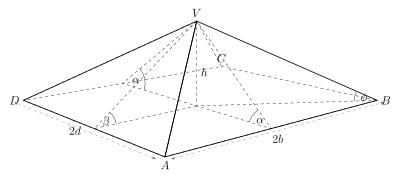
- Let \(A = (0,0,0)\) and then \(B = 22b \mathbf{i}, D = 2d\mathbf{j}, C = 2b\mathbf{i}+2d\mathbf{j}\) and \(V = b \mathbf{i} + d\mathbf{j} + h\mathbf{k}\) We also have \begin{align*} && \tan \alpha &= \frac{h}{d}\\ && \tan \beta &= \frac{d}{b} \\ && \vec{AV} \times \vec{VB} &= \begin{pmatrix} b \\ d \\ h \end{pmatrix} \times \begin{pmatrix} -b \\ d \\ h \end{pmatrix} \\ &&&= \begin{pmatrix} 0 \\ -2bh \\ 2db \end{pmatrix} \\ &&&= 2b \begin{pmatrix} 0 \\ -d \tan \alpha \\ d \end{pmatrix} \\ &&&= k \begin{pmatrix} 0 \\ - \sin \alpha \\ \cos \alpha \end{pmatrix} \end{align*} similarly for the vector perpendicular to the other face it must be \(\begin{pmatrix}-\sin \beta \\ 0 \\ \cos \beta \end{pmatrix}\) Looking at the angle between these perpendicular (to find the angles between the faces we see: \begin{align*} \begin{pmatrix} 0 \\ - \sin \alpha \\ \cos \alpha \end{pmatrix} \cdot \begin{pmatrix}-\sin \beta \\ 0 \\ \cos \beta \end{pmatrix} &= \cos \alpha \cos \beta \end{align*} But this is also \(\pi -\) the angle between the planes, ie \(\cos \theta = \cos \alpha \cos \beta\)
- \(\,\) \begin{align*} && \cot^2 \phi &= \frac{b^2+d^2}{h^2} \\ && \cot^2 \alpha &= \frac{d^2}{h^2} \\ && \cot^2 \beta &= \frac{b^2}{h^2} \\ \Rightarrow && cot^2 \phi &= \cot^2 \beta+\cot^2 \alpha \end{align*} \begin{align*} && \cos^2 \phi &= \frac{b^2+d^2}{b^2+d^2+h^2} \\ && \cos^2 \alpha &= \frac{d^2}{d^2+h^2} \\ && \cos^2 \beta &= \frac{b^2}{b^2+h^2} \\ && \frac{\cos^2 \alpha + \cos^2 \beta - 2 \cos^2 \theta}{1-\cos^2 \theta} &= \frac{\frac{d^2}{d^2+h^2}+\frac{b^2}{b^2+h^2}-2\cdot \frac{d^2}{d^2+h^2} \cdot \frac{b^2}{b^2+h^2}}{1 - \frac{d^2}{d^2+h^2} \cdot\frac{b^2}{b^2+h^2}} \\ &&&= \frac{d^2(b^2+h^2)+b^2(d^2+h^2)-2d^2b^2}{(d^2+h^2)(b^2+h^2)-d^2b^2} \\ &&&= \frac{h^2(b^2+d^2)}{h^2(b^2+d^2+h^2)} \\ &&&= \frac{b^2+d^2}{b^2+d^2+h^2} \\ &&&= \cos^2\phi \end{align*} Also notice that \begin{align*} && \cos^2 \alpha + \cos^2 \beta &\underbrace{\geq}_{AM-GM} 2 \cos \alpha \cos \beta \\ &&&= 2 \cos \theta \\ \Rightarrow && \frac{\cos^2 \alpha + \cos^2 \beta - 2 \cos^2 \theta}{1-\cos^2 \theta} &\geq \frac{2 \cos \theta - 2\cos^2 \theta}{1-\cos^2 \theta} \\ &&&= \frac{2\cos \theta}{1+\cos \theta} = \cos \theta \frac{2}{1+\cos \theta} \\ &&&> \cos^2 \theta \\ \Rightarrow && \phi &< \theta \end{align*}
2018 Paper 2 Q7
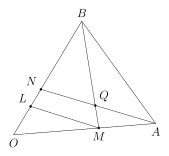
The points \(O\), \(A\) and \(B\) are the vertices of an acute-angled triangle. The points \(M\) and \(N\) lie on the sides \(OA\) and \(OB\) respectively, and the lines \(AN\) and \(BM\) intersect at \(Q\). The position vector of \(A\) with respect to \(O\) is \(\bf a\), and the position vectors of the other points are labelled similarly. Given that \(\vert MQ \vert = \mu \vert QB\vert \), and that \(\vert NQ \vert = \nu \vert QA\vert \), where \(\mu\) and \(\nu\) are positive and \(\mu \nu <1\), show that \[ {\bf m} = \frac {(1+\mu)\nu}{1+\nu} \, {\bf a} \,. \] The point \(L\) lies on the side \(OB\), and \(\vert OL \vert = \lambda \vert OB \vert \,\). Given that \(ML\) is parallel to \(AN\), express \(\lambda\) in terms of \(\mu\) and \(\nu\). What is the geometrical significance of the condition \(\mu\nu<1\,\)?
Solution:
2018 Paper 3 Q6
- The distinct points \(A\), \(Q\) and \(C\) lie on a straight line in the Argand diagram, and represent the distinct complex numbers \(a\), \(q\) and \(c\), respectively. Show that \(\dfrac {q-a}{c-a}\) is real and hence that \((c-a)(q^*-a^*) = (c^*-a^*)(q-a)\,\). Given that \(aa^* = cc^* = 1\), show further that \[ q+ ac q^* = a+c \,. \]
- The distinct points \(A\), \(B\), \(C\) and \(D\) lie, in anticlockwise order, on the circle of unit radius with centre at the origin (so that, for example, \(aa^* =1\)). The lines \(AC\) and \(BD\) meet at \(Q\). Show that \[ (ac-bd)q^* = (a+c)-(b+d) \,, \] where \(b\) and \(d\) are complex numbers represented by the points \(B\) and \(D\) respectively, and show further that \[ (ac-bd) (q+q^*) = (a-b)(1+cd) +(c-d)(1+ab) \,. \]
- The lines \(AB\) and \(CD\) meet at \(P\), which represents the complex number \(p\). Given that \(p\) is real, show that \(p(1+ab)=a+b\,\). Given further that \(ac-bd \ne 0\,\), show that \[ p(q+q^*) = 2 \,. \]
Solution:
- \(A\), \(Q\), \(C\) lie on a straight line if \(q = \lambda a + (1-\lambda)c\) for some \(\lambda \in \mathbb{R}\), \begin{align*} && q &= \lambda a + (1-\lambda)c \\ \Leftrightarrow && q - a &= (\lambda - 1)a + (1-\lambda)c \\ \Leftrightarrow && q - a &= (\lambda - 1)(a-c) \\ \Leftrightarrow && \frac{q - a}{c-a} &= 1-\lambda \\ \end{align*} therefore \(\frac{q-a}{c-a} \in \mathbb{R}\) \begin{align*} && \frac{q-a}{c-a} & \in \mathbb{R} \\ \Leftrightarrow && \left (\frac{q-a}{c-a} \right)^* &= \frac{q-a}{c-a} \\ \Leftrightarrow && (q^*-a^*)(c-a) &= (q-a)(c^*-a^*) \\ \end{align*} Given \(aa^* = cc^* = 1\), \begin{align*} && (q^*-a^*)(c-a) &= (q-a)(c^*-a^*) \\ \Leftrightarrow && q^*(c-a) - \frac{c}{a}+1 &= q \frac{a-c}{ca} - \frac{a}{c}+1 \\ \Leftrightarrow && (c-a)\l q^* +\frac{q}{ca}\r &= \frac{c}{a} - \frac{a}{c} \\ &&&= \frac{c^2-a^2}{ac} \\ \Leftrightarrow && q^* +\frac{q}{ca} &= \frac{c+a}{ac} \\ \Leftrightarrow && q^*ac +q &= a+c \end{align*}
- Since \(Q\) lies on \(AC\) and \(BD\) we must have \begin{align*} &&& \begin{cases} q^*ac +q &= a+c \\ q^*bd +q &= b+d \\ \end{cases} \\ \Rightarrow && q^*(ac-bd) &= (a+c)-(b+d) \\ \Rightarrow && q(ac-bd) &= (b+d)ac-(a+c)bd \\ \Rightarrow && (q+q^*)(ac-bd) &= (a+c)(1-bd)+(b+d)(ac-1) \\ &&&=a-abd+c-bcd+abc-b+acd-d \\ &&&= a(1+cd)-b(1+cd)+c(1+ab)-d(1+ab) \\ &&&= (a-b)(1+cd)+(c-d)(1+ab) \end{align*}
- If \(AB\) and \(CD\) meet at \(p\) we must have \(p^*ab + p = a+b\), ie \(p(1+ab) = a+b\) amd \(p(1+cd) = c+d\), so \begin{align*} && (q+q^*)(ac-bd) &= (a-b) \frac{c+d}{p} + (c-d) \frac{a+b}{p} \\ \Leftrightarrow && p(q+q^*)(ac-bd) &= (a-b)(c+d)+(c-d)(a+b) \\ &&&= ac+ad-bc-bd+ac+bc-ad-bd \\ &&&= 2(ac-bd) \\ \Leftrightarrow && p(q+q^*) &= 2 \end{align*}
2017 Paper 1 Q3
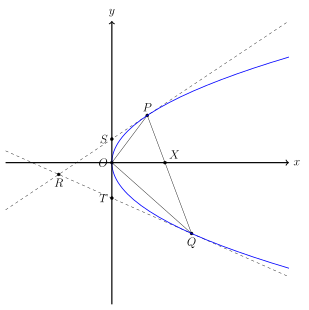
The points \(P(ap^2, 2ap)\) and \(Q(aq^2, 2aq)\), where \(p>0\) and \(q<0\), lie on the curve \(C\) with equation $$y^2= 4ax\,,$$ where \(a>0\,\). Show that the equation of the tangent to \(C\) at \(P\) is $$y= \frac 1 p \, x +ap\,.$$ The tangents to the curve at \(P\) and at \(Q \) meet at \(R\). These tangents meet the \(y\)-axis at \(S\) and \(T\) respectively, and \(O\) is the origin. Prove that the area of triangle \(OPQ\) is twice the area of triangle \(RST\).
Solution: \begin{align*} && 2yy' &= 4a \\ \Rightarrow && y' &= \frac{2a}{y} = \frac{2a}{2ap} = \frac1p \\ \Rightarrow && \frac{y-2ap}{x-ap^2} &= \frac1p \\ \Rightarrow && y &= \frac1p x +ap \end{align*} The other tangent will be \(y = \frac1qx+aq\) \begin{align*} &&& \begin{cases} py-x &= ap^2 \\ qy - x &= aq^2 \end{cases} \\ \Rightarrow && y(p-q) &= a(p^2-q^2) \\ \Rightarrow && y &= a(p+q) \\ && x &= apq \end{align*} Therefore \(R(apq, a(p+q)), S(0, ap), T(0, aq)\).
2017 Paper 1 Q5
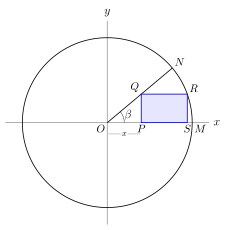
A circle of radius \(a\) is centred at the origin \(O\). A rectangle \(PQRS\) lies in the minor sector \(OMN\) of this circle where \(M\) is \((a,0)\) and \(N\) is \((a \cos \beta, a \sin \beta)\), and \(\beta\) is a constant with \(0 < \beta < \frac{\pi}{2}\,\). Vertex \(P\) lies on the positive \(x\)-axis at \((x,0)\); vertex \(Q\) lies on \(ON\); vertex \(R\) lies on the arc of the circle between \(M\) and \(N\); and vertex \(S\) lies on the positive \(x\)-axis at \((s,0)\). Show that the area \(A\) of the rectangle can be written in the form \[ A= x(s-x)\tan\beta \,. \] Obtain an expression for \(s\) in terms of \(a\), \(x\) and \(\beta\), and use it to show that \[ \frac{\d A}{\d x} = (s-2x) \tan \beta - \frac {x^2} s \tan^3\beta \,. \] Deduce that the greatest possible area of rectangle \(PQRS\) occurs when \(s= x(1+\sec\beta)\) and show that this greatest area is \(\tfrac12 a^2 \tan \frac12 \beta\,\). Show also that this greatest area occurs when \(\angle ROS = \frac12\beta\,\).
Solution:
2017 Paper 2 Q8
All vectors in this question lie in the same plane. The vertices of the non-right-angled triangle \(ABC\) have position vectors \(\bf a\), \(\bf b\) and \(\bf c\), respectively. The non-zero vectors \(\bf u\) and \(\bf v\) are perpendicular to \(BC\) and \(CA\), respectively. Write down the vector equation of the line through \(A\) perpendicular to \(BC\), in terms of \(\bf u\), \(\bf a\) and a parameter \(\lambda \). The line through \(A\) perpendicular to \(BC\) intersects the line through \(B\) perpendicular to \(CA\) at \(P\). Find the position vector of \(P\) in terms of \(\bf a\), \(\bf b\), \(\bf c\) and \(\bf u\). Hence show that the line \(CP\) is perpendicular to the line \(AB\).
Solution: The line through \(A\) perpendicular to \(BC\) is \(\mathbf{a} + \lambda\mathbf{u}\). The line through \(B\) perpendicular to \(CA\) is \(\mathbf{b} + \mu \mathbf{v}\). They intersect when \(\mathbf{a} + \lambda\mathbf{u} = \mathbf{b} + \mu \mathbf{v}\). Since \(\mathbf{v}\) is perpendicular to \(CA\), we must have \begin{align*} && \mathbf{a} + \lambda\mathbf{u} &= \mathbf{b} + \mu \mathbf{v} \\ \Rightarrow && \mathbf{a}\cdot(\mathbf{c}-\mathbf{a}) + \lambda\mathbf{u}\cdot(\mathbf{c}-\mathbf{a}) &= \mathbf{b}\cdot(\mathbf{c}-\mathbf{a}) + \mu \mathbf{v}\cdot(\mathbf{c}-\mathbf{a}) \\ \\ \Rightarrow && \lambda &= \frac{\mathbf{b}\cdot(\mathbf{c}-\mathbf{a}) -\mathbf{a}\cdot(\mathbf{c}-\mathbf{a})}{\mathbf{u}\cdot(\mathbf{c}-\mathbf{a})} \\ &&&= \frac{(\mathbf{b}-\mathbf{a})\cdot(\mathbf{c}-\mathbf{a})}{\mathbf{u} \cdot(\mathbf{c}-\mathbf{a})} \end{align*} Therefore the point is \(\mathbf{a} + \frac{(\mathbf{b}-\mathbf{a})\cdot(\mathbf{c}-\mathbf{a})}{\mathbf{u} \cdot(\mathbf{c}-\mathbf{a})} \mathbf{u}\). The line \(CP\) is \(\mathbf{c} + \nu \left (\mathbf{p} - \mathbf{c} \right)\), to check this is perpendicular with \(AB\) we should dot \(\mathbf{p}-\mathbf{c}\) with \(\mathbf{a}-\mathbf{b}\), ie \begin{align*} && (\mathbf{p}-\mathbf{c}) \cdot (\mathbf{a}-\mathbf{b}) &= \left ( \mathbf{a} + \frac{(\mathbf{b}-\mathbf{a})\cdot(\mathbf{c}-\mathbf{a})}{\mathbf{u} \cdot(\mathbf{c}-\mathbf{a})} \mathbf{u} - \mathbf{c}\right) \cdot ( \mathbf{a}-\mathbf{b}) \\ &&&= \left ( \mathbf{a}- \mathbf{c} + \frac{(\mathbf{b}-\mathbf{a})\cdot(\mathbf{c}-\mathbf{a})}{\mathbf{u} \cdot(\mathbf{c}-\mathbf{a})} \mathbf{u} \right) \cdot ( \mathbf{a}-\mathbf{c}+(\mathbf{c}-\mathbf{b})) \\ &&&= (\mathbf{a}-\mathbf{c})\cdot(\mathbf{a}-\mathbf{c}) + \frac{(\mathbf{b}-\mathbf{a})\cdot(\mathbf{c}-\mathbf{a})}{\mathbf{u} \cdot(\mathbf{c}-\mathbf{a})}\mathbf{u} \cdot (\mathbf{a}-\mathbf{c}) + \\ &&&\quad (\mathbf{a}-\mathbf{c})\cdot(\mathbf{c}-\mathbf{b}) + \lambda \underbrace{\mathbf{u} \cdot (\mathbf{c}-\mathbf{b})}_{=0} \\ &&&=(\mathbf{a}-\mathbf{c})\cdot(\mathbf{a}-\mathbf{c}) -(\mathbf{b}-\mathbf{a})\cdot(\mathbf{c}-\mathbf{a})+ (\mathbf{a}-\mathbf{c})\cdot(\mathbf{c}-\mathbf{b}) \\ &&&= (\mathbf{a}-\mathbf{c})\cdot(\mathbf{a}-\mathbf{c}+\mathbf{b}-\mathbf{a}+\mathbf{c}-\mathbf{b}) \\ &&&= 0 \end{align*} as required.
2017 Paper 3 Q2
The transformation \(R\) in the complex plane is a rotation (anticlockwise) by an angle \(\theta\) about the point represented by the complex number \(a\). The transformation \(S\) in the complex plane is a rotation (anticlockwise) by an angle \(\phi\) about the point represented by the complex number \(b\).
- The point \(P\) is represented by the complex number~\(z\). Show that the image of \(P\) under \(R\) is represented by \[ \e^{{\mathrm i} \theta}z + a(1-\e^{{\rm i} \theta})\,. \]
- Show that the transformation \(SR\) (equivalent to \(R\) followed by \(S\)) is a rotation about the point represented by \(c\), where \[ %\textstyle c\,\sin \tfrac12 (\theta+\phi) = a\,\e^{ {\mathrm i}\phi/2}\sin \tfrac12\theta + b\,\e^{-{\mathrm i} \theta/2}\sin \tfrac12 \phi \,, \] provided \(\theta+\phi \ne 2n\pi\) for any integer \(n\). What is the transformation \(SR\) if \(\theta +\phi = 2\pi\)?
- Under what circumstances is \(RS =SR\)?
Solution:
- We can map \(a \mapsto 0\), rotate the whole plane, then shift the plane back to \(a\), so \(z \mapsto (z-a) \mapsto e^{i \theta}(z-a) \mapsto a + e^{i \theta}(z-a) = e^{i \theta}z + a(1 - e^{i\theta})\)
- \(z \mapsto e^{i \theta}z + a(1 - e^{i\theta}) \mapsto e^{i \phi} \l e^{i \theta}z + a(1 - e^{i\theta}) \r + b(1 - e^{i \phi})\) \begin{align*} e^{i \phi} \l e^{i \theta}z + a(1 - e^{i\theta}) \r + b(1 - e^{i \phi}) &= e^{i(\phi + \theta)}z + ae^{i\phi} - ae^{i (\theta + \phi)} + b(1 - e^{i \phi}) \\ \end{align*} Therefore this is rotation by angle \(\phi + \theta\) and about \begin{align*} \frac{ae^{i\phi} - ae^{i (\theta + \phi)} + b(1 - e^{i \phi})}{1 - e^{i(\phi + \theta)}} &= \frac{e^{-i\frac{(\phi + \theta)}{2}} \l ae^{i\phi} - ae^{i (\theta + \phi)} + b(1 - e^{i \phi}) \r}{e^{-i\frac{(\phi + \theta)}{2}} - e^{i\frac{(\phi + \theta)}2}} \\ &= \frac{\l ae^{i\frac{\phi-\theta}{2}} - ae^{i \frac{(\theta + \phi)}{2}} + b(e^{-i\frac{(\phi + \theta)}{2}} -e^{i\frac{(\phi - \theta)}{2}}) \r}{e^{-i\frac{(\phi + \theta)}{2}} - e^{i\frac{(\phi + \theta)}2}} \\ &= \frac{ae^{i\frac{\phi}{2}} 2i\sin(\frac{\theta}{2}) + be^{-i\frac{\theta}{2}}2i\sin\frac{\phi}{2} }{2i \sin(\frac{\phi + \theta}2)} \\ \end{align*} as required. If \(\phi + \theta = 2\pi\), then \(z \mapsto z + (b-a)(1 - e^{i\phi})\) which is a translation.
- If \(\phi + \theta \neq 2 \pi\) then \(RS = ST\) if \begin{align*} && a\,\e^{ {\mathrm i}\phi/2}\sin \tfrac12\theta + b\,\e^{-{\mathrm i} \theta/2}\sin \tfrac12 \phi &= b\,\e^{ {\mathrm i}\theta/2}\sin \tfrac12\phi + a\,\e^{-{\mathrm i} \phi/2}\sin \tfrac12 \theta \\ && a\,(\e^{ {\mathrm i}\phi/2}-\e^{-{\mathrm i}\phi/2})\sin \tfrac12\theta + b\,(\e^{-{\mathrm i} \theta/2}-\e^{+{\mathrm i} \theta/2})\sin \tfrac12 \phi &= 0 \\ && a \sin \frac{\phi}{2} \sin \frac{\theta}{2}-b \sin \frac{\theta}{2} \sin \frac{\phi}{2} &= 0 \\ \Leftrightarrow && a = b \text{ or } \sin \frac{\theta}{2} = 0 \text{ or } \sin \frac{\phi}{2} = 0 \\ \Leftrightarrow && a = b \text{ or } \theta = 0 \text{ or } \phi = 0 \\ \end{align*} If \(\phi + \theta \neq 2 \pi\) then \(RS = ST\) if \(b = a\) or \(e^{i\phi} = e^{i \theta}\) ie rotation through the same angle.