2018 Paper 2 Q7
Year: 2018
Paper: 2
Question Number: 7
Course: UFM Pure
Section: Vectors
Problem
Solution
Examiner's report
— 2018 STEP 2, Question 7The pure questions were again the most popular of the paper, with only two of those questions being attempted by fewer than half of the candidates (none of the other questions was attempted by more than half of the candidates). Good responses were seen to all of the questions, but in many cases, explanations lacked sufficient detail to be awarded full marks. Candidates should ensure that they are demonstrating that the results that they are attempting to apply are valid in the cases being considered. In several of the questions, later parts involve finding solutions to situations that are similar to earlier parts of the question. In general candidates struggled to recognise these similarities and therefore spent a lot of time repeating work that had already been done, rather than simply observing what the result must be.
Rating Information
Difficulty Rating: 1600.0
Difficulty Comparisons: 0
Banger Rating: 1500.0
Banger Comparisons: 0
Show LaTeX source
Problem source
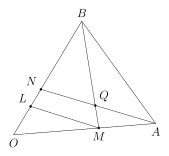
The points $O$, $A$ and $B$ are the vertices
of an acute-angled triangle. The points $M$ and $N$
lie on the sides $OA$ and $OB$ respectively, and the lines
$AN$ and $BM$
intersect at $Q$. The position vector of $A$ with respect to
$O$ is $\bf a$,  and the position vectors of the
 other points are labelled similarly.
Given that $\vert MQ \vert = \mu \vert QB\vert $, and that
$\vert NQ \vert = \nu \vert QA\vert $, where $\mu$ and $\nu$ are positive and
 $\mu \nu <1$, show that
\[
{\bf m} =
\frac {(1+\mu)\nu}{1+\nu} \,
{\bf a}
\,.
\]
The point $L$ lies
on
the
 side $OB$, and $\vert OL \vert = \lambda \vert OB \vert \,$.
Given that $ML$ is parallel to  $AN$,
express $\lambda$ in terms of $\mu$ and $\nu$.
What is the geometrical significance of the condition $\mu\nu<1\,$?
Solution source
\begin{center}
    \begin{tikzpicture}
        \coordinate (O) at (0,0);
        \coordinate (A) at (5, .4);
        \coordinate (B) at (2.4, 4);

        \coordinate (M) at ($(O)!0.6!(A)$);
        \coordinate (N) at ($(O)!0.4!(B)$);

        \coordinate (L) at ($(O)!0.25!(B)$);

        \coordinate (Q) at (intersection of  A--N and B--M);

        \filldraw (M) circle (1pt) node[below] {$M$};
        \filldraw (N) circle (1pt) node[above left] {$N$};
        \filldraw (Q) circle (1pt) node[above right] {$Q$};
        \filldraw (L) circle (1pt) node[above left] {$L$};

        \draw (O) -- (A) -- (B) -- cycle;

        \draw (A) -- (N);
        \draw (B) -- (M);
        \draw (M) -- (L);

        \node[below] at (O) {$O$};
        \node[below] at (A) {$A$};
        \node[above] at (B) {$B$};
    \end{tikzpicture}
\end{center}

The line $AN$ is $\mathbf{a} + \alpha (\mathbf{n}-\mathbf{a})$ \\
The line $BM$ is $\mathbf{b} + \beta (\mathbf{m} - \mathbf{b})$

The point $OQ = OB + BQ = \mathbf{b} + \frac{1}{\mu+1} (\mathbf{m}-\mathbf{b})$

It is also $OQ = OA + AQ = \mathbf{a} + \frac{1}{\nu+1} ( \mathbf{n} - \mathbf{a})$

\begin{align*}
    && \mathbf{q} &= \mathbf{a} + \frac{1}{\nu+1} ( n\mathbf{b} - \mathbf{a}) \\
    && \mathbf{q} &= \mathbf{b} + \frac{1}{\mu+1} ( m\mathbf{a} - \mathbf{b}) \\
    \Rightarrow && \frac{\nu}{\nu+1} &= \frac{m}{\mu+1} \\
    \Rightarrow && m &= \frac{(1+\mu)\nu}{1+\nu} \\
    \Rightarrow && \mathbf{m} &= \frac{(1+\mu)\nu}{1+\nu} \mathbf{a}
\end{align*}

By similar triangles ($\triangle OAN \sim \triangle OML$, we can observe that $\lambda = \mu \nu$. The significance of $\mu \nu < 1$ $L$ lies on the side $OB$ and both $M$ and $N$ lie between $O$ and $A$ and $B$ respectively.
This was an unpopular question among the pure questions, with slightly less than two fifths of the candidates attempting it. Many of the responses did not progress far through the problem, although there were some excellent solutions seen. As a result, attempts at this question generally received either very few or most of the marks. A range of different methods were used, such as consideration of ratios of areas, or parallel lines to the diagram and the use of similar triangles. The most common difficulties arose from candidates not recognising that was parallel to and was parallel to .