Problems
Filters
218 problems found
2025 Paper 2 Q1
The function \(\mathrm{Min}\) is defined as \[ \mathrm{Min}(a, b) = \begin{cases} a & \text{if } a \leq b \\ b & \text{if } a > b \end{cases} \]
- Sketch the graph \(y = \mathrm{Min}(x^2, 2x)\).
- Solve the equation \(2\mathrm{Min}(x^2, 2x) = 5x - 3\).
- Solve the equation \(\mathrm{Min}(x^2, 2x) + \mathrm{Min}(x^3, 4x) = mx\) in the cases \(m = 2\) and \(m = 6\).
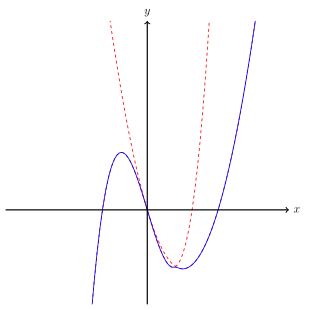
- Show that \((1, -3)\) is a local maximum point on the curve \(y = 2\mathrm{Min}(x^2, x^3) - 5x\) and find the other three local maxima and minima on this curve. Sketch the curve.
Solution:
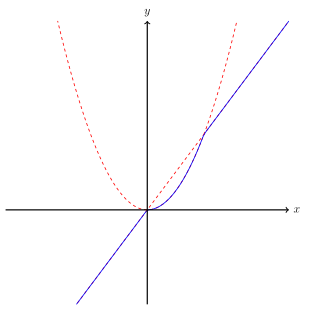
- \(2 \textrm{Min}(x^2,2x) = 5x-3\) tells us either \(2x^2 = 5x-3 \Rightarrow 2x^2 - 5x +3 = 0 \Rightarrow (2x-3)(x-1) \Rightarrow x = 1, \frac32\) and \(0 \leq x \leq 2\) or \(4x = 5x-3 \Rightarrow x= 3\) and \(x < 0\) or \(2 > x\), therefore our solutions are \(x = 1, \frac32, 3\)
- We have different cases based on \(x\) vs \(-2, 0, 2\), ie Case \(x \leq -2\): \begin{align*} && mx &= \mathrm{Min}(x^2, 2x) + \mathrm{Min}(x^3, 4x) \\ &&&= 2x + x^3 \end{align*} So \(2x = 2x + x^3 \Rightarrow x^3 = 0\), but \(x \leq -2\) so no solutions. or \(6x = 2x + x^3 \Rightarrow 0 = x(x^2-4) \Rightarrow x = 0, 2, -2\) so \(x = -2\). Case \(-2 < x \leq 0\): \begin{align*} && mx &= \mathrm{Min}(x^2, 2x) + \mathrm{Min}(x^3, 4x) \\ &&&= 2x + 4x \end{align*} So \(2x = 2x + 4x\) ie \(x = 0\) which is valid. Or \(6x = 2x + 4x\) ie valid for all values in \(-2 \leq x \leq 0\) Case \(0 < x \leq 2\): \begin{align*} && mx &= \mathrm{Min}(x^2, 2x) + \mathrm{Min}(x^3, 4x) \\ &&&= x^2 + x^3 \end{align*} So \(2x = x^2 + x^3 \Rightarrow 0 = x(x^2+x-2) = x(x-1)(x+2)\) so \(x = 0, 1, -2\), but the range means \(x = 0\) or \(x = 1\) Or \(6x = x^2 + x^3 \Rightarrow 0 = x(x^2+x-6) = x(x-2)(x+3)\) so \(x = 0, 2, -3\), but the range means \(x = 0\) or \(x = 2\) Case \(2 \leq x \): \begin{align*} && mx &= \mathrm{Min}(x^2, 2x) + \mathrm{Min}(x^3, 4x) \\ &&&=2x + 4x \end{align*} So \(2x = 2x + 4x \Rightarrow x = 0\) so no solutions. Or \(6x = 2x + 4x\) so a range of solutions. Therefore the final solutions for \(m = 2\) are \(x = 0, x = 1\) and for \(m = 2\) are \(x \in [-2,0] \cup [2, \infty)\)
- \(\mathrm{Min}(x^2, x^3)\) switches when \(x = 1\), so we must consider both limits:
\begin{align*}
&& \frac{\d y}{\d x}\vert_{x > 1} &= 4x - 5 \\
\\
&& \frac{\d y}{\d x}\vert_{x < 1} &= 6x^2 - 5 \\
\end{align*}
so when \(x = 1\) the sign of the derivative changes from positive to negative, hence a local maximum.
The other local maxima and minima will be when \(x = \frac54\) or \(x = \pm \sqrt{5/6}\)
2025 Paper 2 Q3
- Sketch a graph of \(y = \frac{\ln x}{x}\) for \(x > 0\).
- Use your graph to show the following.
- \(3^{\pi} > \pi^3\)
- \(\left(\frac{9}{4}\right)^{\sqrt{5}} > \sqrt{5}^{\frac{9}{4}}\)
- Given that \(1 < x < 2\), decide, with justification, which is the larger of \(x^{x+2}\) or \((x+2)^x\).
- Show that the inequalities \(9^{\sqrt{2}} > \sqrt{2}^9\) and \(3^{2\sqrt{2}} > (2\sqrt{2})^3\) are equivalent. Given that \(e^2 < 8\), decide, with justification, which is the larger of \(9^{\sqrt{2}}\) and \(\sqrt{2}^9\).
- Decide, with justification, which is the larger of \(8^{\sqrt[4]{3}}\) and \(\sqrt[3]{8}\).
Solution:

- \begin{enumerate}
- since \(\frac{\ln x}{x}\) is decreasing on \((e, \infty)\) we must have that \(\frac{\ln 3}{3} > \frac{\ln \pi}{\pi} \Rightarrow e^\pi > \pi^3\)
- similarly, since \(\frac{\ln x}{x}\) is increasing on \((0, e)\) we must have that \(\frac{\ln \sqrt{5}}{\sqrt{5}} < \frac{\ln 9/4}{9/4} \Rightarrow \left(\frac{9}{4}\right)^{\sqrt{5}} > \sqrt{5}^{\frac{9}{4}}\)
- Since \(2^4 = 4^2\) notice also that:
from the graph we must have the green area between \(1\) and \(2\) mapping to the (higher) green area between \(3\) and \(4\). Therefore \((x+2)^x > x^{x+2}\) for \(1 < x < 2\)

- \begin{align*} && 9^{\sqrt 2} & \stackrel{?}{>} \sqrt{2}^9 \\ \Leftrightarrow && (3^2)^{\sqrt2} &\stackrel{?}{>} (\sqrt{2}^3)^3 \\ \Leftrightarrow && 3^{2 \sqrt2} &\stackrel{?}{>} (2\sqrt2)^3 \end{align*} Since \(e^2 < 8 < 9\Rightarrow e < 2\sqrt2 < 3\) therefore: \begin{align*} && \frac{\ln 2 \sqrt2}{2 \sqrt 2} &> \frac{\ln 3}{3} \\ \Leftrightarrow && (2 \sqrt{2})^3 &> 3^{2 \sqrt{2}} \\ \Leftrightarrow && \sqrt{2}^9 &> 9^{\sqrt 2} \\ \end{align*}
- \begin{align*} && 8^{\sqrt[3]{3}} & \stackrel{?}{>} \sqrt[3]{3}^8 \\ \Leftrightarrow && 2^{3 \sqrt[3] 3} & \stackrel{?}{>} (\sqrt[3]{3}^4)^2 \\ \Leftrightarrow && 2^{3 \sqrt[3] 3} & \stackrel{?}{>} (3\sqrt[3]{3})^2 \\ \end{align*} Since \(3\sqrt[3]{3} > 4\) we have \begin{align*} && \frac{\ln (3 \sqrt[3]3)}{3 \sqrt[3]3} &< \frac{\ln 4}{4} \\ &&&= \frac{\ln 2}{2}\\ \Rightarrow && (3 \sqrt[3]{3})^2 &< 2^{3 \sqrt[3]{3}} \\ \Rightarrow && \sqrt[3]3^8 &< 8^{\sqrt[3]3} \end{align*}
2025 Paper 2 Q12
Let \(X\) be a Poisson random variable with mean \(\lambda\) and let \(p_r = P(X = r)\), for \(r = 0, 1, 2, \ldots\). Neither \(\lambda\) nor \(\lambda + \frac{1}{2} + \sqrt{\lambda + \frac{1}{4}}\) is an integer.
- Show, by considering the sequence \(d_r \equiv p_r - p_{r-1}\) for \(r = 1, 2, \ldots\), that there is a unique integer \(m\) such that \(P(X = r) \leq P(X = m)\) for all \(r = 0, 1, 2, \ldots\), and that \[\lambda - 1 < m < \lambda.\]
- Show that the minimum value of \(d_r\) occurs at \(r = k\), where \(k\) is such that \[k < \lambda + \frac{1}{2} + \sqrt{\lambda + \frac{1}{4}} < k + 1.\]
- Show that the condition for the maximum value of \(d_r\) to occur at \(r = 1\) is \[1 < \lambda < 2 + \sqrt{2}.\]
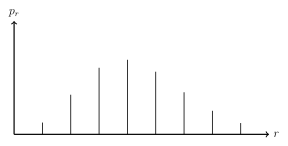
- In the case \(\lambda = 3.36\), sketch a graph of \(p_r\) against \(r\) for \(r = 0, 1, 2, \ldots, 6, 7\).
Solution:
- Suppose \(d_r = p_r - p_{r-1}\) then \begin{align*} d_r &= p_r - p_{r-1} \\ &= \mathbb{P}(X = r) - \mathbb{P}(X = r-1) \\ &= e^{-\lambda} \left ( \frac{\lambda^r}{r!} - \frac{\lambda^{r-1}}{(r-1)!} \right) \\ &= e^{-\lambda} \frac{\lambda^{r-1}}{(r-1)!} \left ( \frac{\lambda}{r} - 1\right) \end{align*} Therefore \(d_r > 0 \Leftrightarrow \lambda > r\)ie, \(p_r\) is increasing while \(r < \lambda\) and reaches a (unique) maximum when \(r = \lfloor \lambda \rfloor\).
- Let \(dd_r = d_r - d_{r-1}\), so: \begin{align*} dd_r &= d_r - d_{r-1} \\ &= p_r - 2p_{r-1} + p_{r-2} \\ &= e^{-\lambda} \frac{\lambda^{r-2}}{r!} \left ( \lambda^2 - 2 \lambda r + r(r-1)\right ) \end{align*} Therefore \(dd_r < 0 \Leftrightarrow \lambda^2 - 2\lambda r +r(r-1) < 0 \Leftrightarrow r^2 -(1+2\lambda)r + \lambda^2 < 0\), but this has roots \(r = \frac{(1+2\lambda) \pm \sqrt{(1+2\lambda)^2-4\lambda^2}}{2} = \lambda + \frac12 \pm \sqrt{\lambda + \frac14}\). Therefore \(d_r\) is decreasing when \(r \in \left (\lambda + \frac12 -\sqrt{\lambda + \frac14},\lambda + \frac12 + \sqrt{\lambda + \frac14} \right)\), therefore the possible minimums are \(d_1\) and \(d_k\) where \(k < \lambda + \frac{1}{2} + \sqrt{\lambda + \frac{1}{4}} < k + 1\). \(d_1 = e^{-\lambda}(\lambda - 1)\), \(d_k = e^{-\lambda} \frac{\lambda^{k-1}}{(k-1)!}(\frac{\lambda}{k}-1)\)
- If the maximum value of \(d_r\) is \(r = 1\) then \(d_r\) must be decreasing, ie considering \(dd_2\) we have \(\lambda^2 -4\lambda + 2< 0 \Leftrightarrow 2 - \sqrt{2} < \lambda < 2 + \sqrt{2}\). It must also be the case that it doesn't get beaten as \(\lambda \to \infty\). In this case \(d_r \to 0\), so we need \(d_1 > 0\), ie \(\lambda > 1\). Therefore \(1 < \lambda < 2 + \sqrt{2}\)
2025 Paper 3 Q2
Let \(f(x) = 7 - 2|x|\). A sequence \(u_0, u_1, u_2, \ldots\) is defined by \(u_0 = a\) and \(u_n = f(u_{n-1})\) for \(n > 0\).
- Sketch, on the same axes, the graphs with equations \(y = f(x)\) and \(y = f(f(x))\).
- Find all solutions of the equation \(f(f(x)) = x\).
- Find the values of \(a\) for which the sequence \(u_0, u_1, u_2, \ldots\) has period 2.
- Show that, if \(a = \frac{28}{5}\), then the sequence \(u_2, u_3, u_4, \ldots\) has period 2, but neither \(u_0\) or \(u_1\) is equal to either of \(u_2\) or \(u_3\).
- Sketch, on the same axes, the graphs with equations \(y = f(x)\) and \(y = f(f(f(x)))\).
- Consider the sequence \(u_0, u_1, u_2, \ldots\) in the cases \(a = 1\) and \(a = -\tfrac79\). Hence find all the solutions of the equation \(f(f(f(x))) = x\).
- Find a value of \(a\) such that the sequence \(u_3, u_4, u_5, \ldots\) has period 3, but where none of \(u_0, u_1\) or \(u_2\) is equal to any of \(u_3, u_4\) or \(u_5\).
Solution:

- If \(a = 1\) then \(u_1 = f(a) = 7-2 = 5\), \(u_2 = f(5) = -3\), \(u_3 = f(-3) = 7-6 = 1\). Therefore it must be the case that \(f(f(f(x))) = x\) for \(x = 1, 5, -3\). Similarly, if \(a = -\tfrac79\) then \(u_1 = f(-\tfrac79) = \tfrac{49}{9}\), \(u_2 = f(\tfrac{49}{9}) = -\tfrac{35}{9}\) and \(u_3 = f(-\tfrac{35}{9}) = -\tfrac79\). Therefore we must also have roots \(x = -\tfrac79, \tfrac{49}{9}, -\tfrac{35}9\). We also have the roots \(x = -7, \tfrac73\) from the first part so we have found all \(8\) roots.
- We need \(f(f(f(x))) = 1\) but \(f(f(x)) \neq -3, f(x) \neq 5, x \neq 1\). Suppose \(f(y) = 1 \Rightarrow 7-2|y| = 1 \Rightarrow y = \pm 3\). So \(y = 3\), ie \(f(f(x)) = 3\). Suppose \(f(z) = 3 \Rightarrow 7-2|z| = 3 \Rightarrow z = \pm 2\). Finally we need \(f(x) = \pm 2\), so say \(7-2|x| = 2 \Rightarrow x = \tfrac52\), so we have the sequence \(\tfrac52, 2, 3, 1, 5, -3, 1, \cdots\)as required.
2025 Paper 3 Q4
- \(x_2\) and \(y_2\) are defined in terms of \(x_1\) and \(y_1\) by the equation $$\begin{pmatrix} x_2 \\ y_2 \end{pmatrix} = \begin{pmatrix} \frac{1}{\sqrt{2}} & -\frac{1}{\sqrt{2}} \\ \frac{1}{\sqrt{2}} & \frac{1}{\sqrt{2}} \end{pmatrix} \begin{pmatrix} x_1 \\ y_1 \end{pmatrix}$$ \(G_1\) is the graph with equation $$\frac{x^2}{9} + \frac{y^2}{4} = 1$$ and \(G_2\) is the graph with equation $$\frac{\left(\frac{x}{\sqrt{2}} + \frac{y}{\sqrt{2}}\right)^2}{9} + \frac{\left(-\frac{x}{\sqrt{2}} + \frac{y}{\sqrt{2}}\right)^2}{4} = 1$$ Show that, if \((x_1, y_1)\) is a point on \(G_1\), then \((x_2, y_2)\) is a point on \(G_2\). Show that \(G_2\) is an anti-clockwise rotation of \(G_1\) through \(45^\circ\) about the origin.
- The matrix $$\begin{pmatrix} -0.6 & 0.8 \\ 0.8 & 0.6 \end{pmatrix}$$ represents a reflection. Find the line of invariant points of this matrix.
- Sketch, on the same axes, the graphs with equations $$y = 2^x \text{ and } 0.8x + 0.6y = 2^{-0.6x+0.8y}$$
- Sketch, on the same axes, for \(0 \leq x \leq 2\pi\), the graphs with equations $$y = \sin x \text{ and } y = \sin(x - 2y)$$ You should determine the exact co-ordinates of the points on the graph with equation \(y = \sin(x - 2y)\) where the tangent is horizontal and those where it is vertical.
Solution:
- Suppose \begin{align*} && \begin{pmatrix} x_2 \\ y_2 \end{pmatrix} &= \begin{pmatrix} \frac{1}{\sqrt{2}} & -\frac{1}{\sqrt{2}} \\ \frac{1}{\sqrt{2}} & \frac{1}{\sqrt{2}} \end{pmatrix} \begin{pmatrix} x_1 \\ y_1 \end{pmatrix} \\ \Rightarrow && \binom{x_1}{y_1} &= \begin{pmatrix} \frac{1}{\sqrt{2}} & \frac{1}{\sqrt{2}} \\ -\frac{1}{\sqrt{2}} & \frac{1}{\sqrt{2}} \end{pmatrix} \binom{x_2}{y_2} \end{align*} Therefore if \(\frac{x_1^2}9+\frac{y_1^2}{4} = 1\) we must have \begin{align*} \frac{(\frac{x_2}{\sqrt{2}}+\frac{y_2}{\sqrt{2}})^2 }{9} + \frac{(-\frac{x_2}{\sqrt{2}}+\frac{y_2}{\sqrt{2}})^2}{4} = 1 \end{align*} but this is precisely the statement that \((x_1, y_1)\) is on \(G_1\) is equivalent to \((x_2,y_2)\) being on the \(G_2\). Since the point \((x_2,y_2)\) is a \(45^{\circ}\) rotation of \((x_1,y_1)\) anticlockwise about the origin, this means \(G_2\) is a \(45^{\circ}\) anticlockwise rotation of \(G_1\).
- \begin{align*} && \begin{pmatrix} -0.6 & 0.8 \\ 0.8 & 0.6 \end{pmatrix} \begin{pmatrix} x \\ y \end{pmatrix} &= \begin{pmatrix} x \\ y \end{pmatrix} \\ \Rightarrow && \begin{pmatrix} -0.6 x + 0.8y \\ 0.8x + 0.6y \end{pmatrix} &= \begin{pmatrix} x \\ y \end{pmatrix} \\ \Rightarrow && \begin{pmatrix} -1.6 x + 0.8y \\ 0.8x -0.4y \end{pmatrix} &= \begin{pmatrix} 0 \\ 0 \end{pmatrix} \\ \Rightarrow && y &=2 x \end{align*}

- Consider the transformation \(\begin{pmatrix} 1 & 2 \\ 0 & 1 \end{pmatrix}\) which is a shear, leaving the \(x\)-axis invariant. Then we must have:
Since the shear leaves lines of the form \(y = k\) invariant, the points where \(\frac{\d y}{\d x} = 0\) must also map to points where this is true, ie \((\tfrac{\pi}{2}, 1), (\tfrac{3\pi}{2}, -1)\) map to points \((\tfrac{\pi}{2}+2,1), (\tfrac{3\pi}{2} -2,-1)\) where the tangent is horizontal. The line \(x = c\) map back to lines \(\begin{pmatrix} 1 & -2 \\ 0 & 1\end{pmatrix} \begin{pmatrix} c \\ t\end{pmatrix} = \begin{pmatrix}c - 2t \\ t \end{pmatrix}\), ie \(y = -\frac12 x- \frac{c}{2}\). Therefore we are interested in points on the original curve where the gradient is \(-\frac12\), ie \((\frac{2\pi}{3}, \frac{\sqrt{3}}{2}), (\frac{4\pi}{3}, -\frac{\sqrt{3}}{2})\), these map to \((\frac{2\pi}{3}+\sqrt{3},\frac{\sqrt{3}}{2}), (\frac{4\pi}{3}-\sqrt{3}, -\frac{\sqrt{3}}{2})\)

2025 Paper 3 Q7
Let \(f(x) = \sqrt{x^2 + 1} - x\).
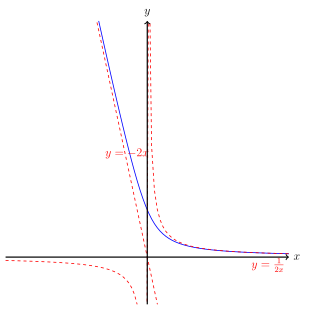
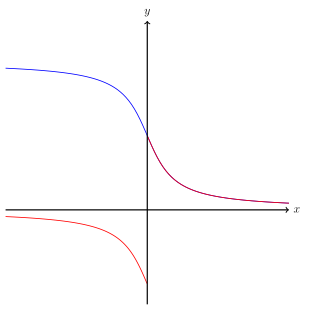
- Using a binomial series, or otherwise, show that, for large \(|x|\), \(\sqrt{x^2 + 1} \approx |x| + \frac{1}{2|x|}\). Sketch the graph \(y = f(x)\).
- Let \(g(x) = \tan^{-1} f(x)\) and, for \(x \neq 0\), let \(k(x) = \frac{1}{2}\tan^{-1}\frac{1}{x}\).
- Show that \(g(x) + g(-x) = \frac{1}{2}\pi\).
- Show that \(k(x) + k(-x) = 0\).
- Show that \(\tan k(x) = \tan g(x)\) for \(x > 0\).
- Sketch the graphs \(y = g(x)\) and \(y = k(x)\) on the same axes.
- Evaluate \(\int_0^1 k(x) \, dx\) and hence write down the value of \(\int_{-1}^0 g(x) \, dx\).
Solution:
- \begin{align*}
\sqrt{x^2+1} &= |x|\sqrt{1+\frac{1}{x^2}} \\
&=|x| \left (1 + \frac12 \frac{1}{x^2} + \cdots \right) & \text{if } \left (\frac{1}{x^2} < 1 \right) \\
&= |x| + \frac12 \frac{1}{|x|} + \cdots \\
&\approx |x| + \frac{1}{2|x|}
\end{align*}
- \begin{align*} && \tan( g(x) + g(-x)) &= \tan \left ( \tan^{-1}(\sqrt{x^2+1}-x) + \tan^{-1}(\sqrt{x^2+1}+x) \right) \\ &&&= \frac{\sqrt{x^2+1}-x+\sqrt{x^2+1}+x}{1-1} \\ \Rightarrow && g(x) + g(-x) &\in \left \{\cdots, -\frac{\pi}{2}, \frac{\pi}{2}, \cdots \right\} \end{align*} But \(g(x), g(-x) > 0\) and \(g(x), g(-x) \in (-\frac{\pi}{2}, \frac{\pi}{2})\), therefore it must be \(\frac{\pi}{2}\).
- \begin{align*} && \tan(2(k(x) + k(-x))) &= \tan(\tan^{-1}x + \tan^{-1}(-x)) \\ &&&= 0 \\ \Rightarrow && k(x)+k(-x) &\in \left \{\cdots, -\frac{\pi}{2}, 0, \frac{\pi}{2}, \cdots \right\} \\ \end{align*} But \(k(x) \in (-\frac{\pi}{4}, \frac{\pi}{4})\), therefore \(k(x) + k(-x) = 0\).
- Let \(t = \tan k(x)\). \begin{align*} && \tan \left ( \tan^{-1} \frac{1}{x} \right) &= \frac{2 \tan\left ( \frac12 \tan^{-1} \frac1x \right)}{ 1-\tan^2\left ( \frac12 \tan^{-1} \frac1x \right)} \\ \Rightarrow && \frac1x &= \frac{2t}{1-t^2} \\ \Rightarrow && 1-t^2 &= 2tx \\ \Rightarrow && 0 &= t^2+2tx - 1 \\ \Rightarrow && 0 &= (t+x)^2 - 1-x^2 \\ \Rightarrow && t &= -x \pm \sqrt{1+x^2} \end{align*} Since \(t > 0\), \(t = \sqrt{1+x^2}-x = f(x) = \tan g(x)\)
- \begin{align*} \int_0^1 k(x) \d x &= \int_0^1 \frac12 \tan^{-1} \left ( \frac1x \right) \d x \\ &= \left [ \frac{x}{2} \tan^{-1}\left ( \frac1x \right) \right]_0^1 - \int_0^1 \frac{x}{2} \frac{-1/x^2}{1+1/x^2} \d x \\ &= \left [ \frac{x}{2} \tan^{-1}\left ( \frac1x \right) \right]_0^1 + \frac14 \int_0^1 \frac{2x}{1+x^2} \d x \\ &= \frac12 \frac{\pi}{4} + \frac14 \ln(2) \\ &= \frac{\pi + \ln 4}{8}\end{align*} Therefore \(\displaystyle \int_{-1}^0 g(x) \d x = -\frac{\pi + \ln 4}{8}\)
2025 Paper 3 Q9
In this question, \(n \geq 2\).
- A solid, of uniform density, is formed by rotating through \(360°\) about the \(y\)-axis the region bounded by the part of the curve \(r^{n-1}y = r^n - x^n\) with \(0 \leq x \leq r\), and the \(x\)- and \(y\)-axes. Show that the \(y\)-coordinate of the centre of mass of this solid is \(\frac{nr}{2(n+1)}\).
- Show that the normal to the curve \(r^{n-1}y = r^n - x^n\) at the point \((rp, r(1-p^n))\), where \(0 < p < 1\), meets the \(y\)-axis at \((0, Y)\), where \(Y = r\left(1 - p^n - \frac{1}{np^{n-2}}\right)\). In the case \(n = 4\), show that the greatest value of \(Y\) is \(\frac{1}{4}r\).
- A solid is formed by rotating through \(360°\) about the \(y\)-axis the region bounded by the curves \(r^3y = r^4 - x^4\) and \(ry = -(r^2 - x^2)\), both for \(0 \leq x \leq r\). \(A\) and \(B\) are the points \((0, -r)\) and \((0, r)\), respectively, on the surface of the solid. Show that the solid can rest in equilibrium on a horizontal surface with the vector \(\overrightarrow{AB}\) at three different, non-zero, angles to the upward vertical. You should not attempt to find these angles.
Solution:
- By symmetry, the centre of mass will lie on the \(y\) axis. Notice that a single slice (when revolved around the \(y\)-axis) has volume \(y \cdot \pi \cdot ((x+ \delta x)^2 - x^2) = 2 \pi x y \delta x\), and COM at height \(\frac12 y\) so we can conclude: \[ \overline{y} \sum_{\delta x} 2 \pi x y \delta x = \sum_{\delta x} \pi xy^2 \delta x\] \begin{align*} && \overline{y} \int_0^r 2xy \d x &= \int_0^r y^2 x \d x \\ \Rightarrow && \overline{y} 2\int_0^r \left (r - \frac{x^n}{r^{n-1}} \right)x \d x &= \int_0^r \left (r - \frac{x^n}{r^{n-1}} \right)^2 x \d x \\ \Rightarrow && \overline{y} \left [r \frac{x^2}{2} - \frac{1}{r^{n-1}} \frac{x^{n+2}}{n+2} \right]_0^r &= \left [r^2 \frac{x^2}{2} - \frac{2}{r^{n-2}} \frac{x^{n+2}}{n+2} + \frac{1}{r^{2n-2}} \frac{x^{2n+2}}{2n+2} \right]_0^r \\ \Rightarrow && 2\overline{y} \left (\frac{r^3}{2} - \frac{r^3}{n+2} \right) &= \left (\frac12 r^4 - \frac{2}{n+2}r^4 + \frac{1}{2n+2}r^4 \right) \\ \Rightarrow && \overline{y}r^3 \frac{n}{(n+2)} &= r^4\frac{(n+1)(n+2)-2\cdot2\cdot(n+1)+(n+2)}{2(n+1)(n+2)} \\ \Rightarrow && \overline{y} \frac{n}{(n+2)} &= r \left ( \frac{n^2}{2(n+1)(n+2)} \right) \\ \Rightarrow && \overline{y} &= \frac{nr}{2(n+1)} \\ &&&= r \left (1 -p^n \right) \end{align*} as required.

- \begin{align*} && r^{n-1}y &= r^n - x^n \\ \frac{\d}{\d x}: && r^{n-1} \frac{\d y}{\d x} &= -n x^{n-1} \\ && \frac{\d y}{\d x} &= -np^{n-1} \end{align*} Therefor the normal has the equation: \begin{align*} && \frac{y-r(1-p^n)}{x-rp} &= \frac{1}{np^{n-1}} \\ \Rightarrow && Y &= \frac{-rp}{np^{n-1}} + r(1-p^n) \\ &&&= r \left (1 - p^n - \frac{1}{np^{n-2}} \right) \end{align*} If \(n = 4\) then \begin{align*} && Y &= r\left (1 - p^4 - \frac{1}{4p^{2}} \right) \\ \Rightarrow && \frac{\d Y}{\d p} &= r \left (-4p^3 + \frac{1}{2p^3} \right) \end{align*} Therefore there is a stationary point if \(p^6 = \frac18 \Rightarrow p =2^{-1/2}\). Clearly this will be a maximum (sketch or second derivative) therefore, \(Y = r(1 - \frac14 - \frac{2}{4}) = \frac14 r\)
- The centre of mass of this shape can be found using this table: \begin{array}{|c|c|c|} \hline \text{} & \overline{y} & \text{mass} \\ \hline r^3y = r^4 - x^4 & \frac{2r}{5} & \frac{4\pi r^3}{6} = \frac23 \pi r^3\\ ry = -(r^2 - x^2) & -\frac{r}{3}& \frac{2 \pi r^3}{4}=\frac12\pi r^3 \\ \text{combined} & \frac{(\frac25 \cdot \frac23-\frac13 \cdot \frac12)r^4}{\frac76 r^3} = \frac3{35}r & \frac76 \pi r^3\\ \hline \end{array} Normals to the surface through points on the upper surface will meet the \(y\)-axis between \((-\infty, \frac14 r)\), and since \(p = 0 \to -\infty\) and \(p = 1 \to -\frac14 r\), so normals will pass through \((0, \frac3{35}r)\) from two different points. Normals to the surface through points on the lower surface will go through \(-r(1 - p^2 - \frac12) =- r(\frac12 -p^2)\) which ranges monotonically from \(\frac12 r \to -\frac12 r\) so there will be one point where the normal goes through \(\frac3{35}r\). Therefore there are three angles where the vector \(\overrightarrow{AB}\) is not vertical but the normal to the surfaces runs through the centre of mass (ie the the solid can rest in equilibrium)
2024 Paper 2 Q7
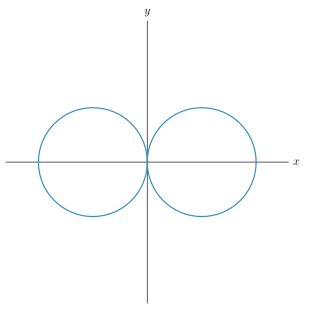
- Sketch the curve \(C_1\) with equation \[ \left(y^2 + (x-1)^2 - 1\right)\left(y^2 + (x+1)^2 - 1\right) = 0. \]
- Consider the curve \(C_2\) with equation
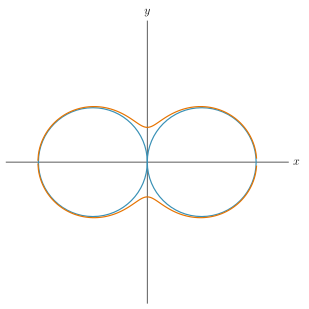
\[ \left(y^2 + (x-1)^2 - 1\right)\left(y^2 + (x+1)^2 - 1\right) = \tfrac{1}{16}. \]
- Show that the line \(y = k\) meets the curve \(C_2\) at points for which \[ x^4 + 2(k^2 - 2)x^2 + \left(k^4 - \tfrac{1}{16}\right) = 0. \] Hence determine the number of intersections between curve \(C_2\) and the line \(y = k\) for each positive value of \(k\).
- Determine whether the points on curve \(C_2\) with the greatest possible \(y\)-coordinate are further from, or closer to, the \(y\)-axis than those on curve \(C_1\).
- Show that it is not possible for both \(y^2 + (x-1)^2 - 1\) and \(y^2 + (x+1)^2 - 1\) to be negative, and deduce that curve \(C_2\) lies entirely outside curve \(C_1\).
- Sketch the curves \(C_1\) and \(C_2\) on the same axes.
Solution:
- \(\,\)
- Suppose \(y=k\) meets the curve \(C_2\) then \begin{align*} && \tfrac1{16} &= (k^2+(x-1)^2-1)(k^2+(x+1)^2-1) \\ &&&= (k^2+x^2-2x)(k^2+x^2+2x) \\ &&&= k^4+2k^2x^2+x^4-4x^2 \\ &&&= x^4+(2k^2-4)x^2+k^4 \\ \Rightarrow && 0 &= x^4+(2k^2-4)x^2+(k^4-\tfrac1{16}) \\ \\ && \Delta &= 4(k^2-2)^2 - 4 \cdot 1 \cdot (k^4-\tfrac1{16}) \\ &&&= 4(k^4-4k^2+4 - k^4 +\tfrac{1}{16}) \\ &&&= 16(1+\tfrac{1}{64} - k^2) \\ &&&= 16(\tfrac{65}{64} - k^2) \end{align*} Therefore if \(|k| < \frac{\sqrt{65}}{8}\) there are \(4\) intersections. If \(|k| = \frac{\sqrt{65}}{8}\) there are \(2\) intersections, otherwise there are \(0\).
- The greatest possible \(y\) value is \( \frac{\sqrt{65}}{8}\) and at this point \(x^2 = \frac{2(2-\frac{65}{64}}{2} =1 - \frac{1}{64} < 1\) so they are close to the \(y\)-axis.
- The regions where \(y^2+(x-1)^2-1 < 0\) and \(y^2+(x+1)^2-1 < 0\) is the interior of the two circles from the first part. However, since they don't overlap they can never both be negative. Therefore in our equation both are positive and therefore \(C_2\) is entirely outside \(C_1\)
- \(\,\)
2024 Paper 2 Q11
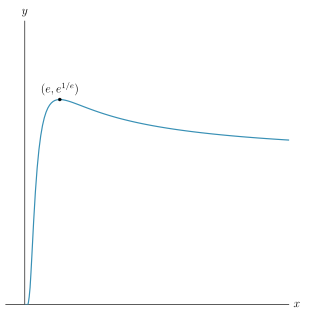
- Sketch a graph of \(y = x^{\frac{1}{x}}\) for \(x > 0\), showing the location of any turning points. Find the maximum value of \(n^{\frac{1}{n}}\), where \(n\) is a positive integer.
- The people to be tested are split into \(r\) groups of size \(k\), with \(k > 1\) and \(rk = N\).
- In every group, a sample from each person in that group is mixed into one large sample, which is then tested.
- If the enzyme is not present in the combined sample from a group, no further testing of the people in that group is needed.
- If the enzyme is present in the combined sample from a group, a second sample from each person in that group is tested separately.
- Find, in terms of \(N\), \(k\) and \(p\), the expected number of tests.
- Given that \(N\) is a multiple of \(3\), find the largest value of \(p\) for which it is possible to find an integer value of \(k\) such that \(k > 1\) and the expected number of tests is at most \(N\). Show that this value of \(p\) is greater than \(\frac{1}{4}\).
- Show that, if \(pk\) is sufficiently small, the expected number of tests is approximately \[ N\!\left(\frac{1}{k} + pk\right). \] In the case where \(p = 0.01\), show that choosing \(k = 10\) gives an expected number of tests which is only about \(20\%\) of \(N\).
Solution:
- \(\,\)
\begin{align*} && y & = x^{1/x} = \exp \left ( \tfrac1x \ln x \right ) \\ \Rightarrow && y' &= \exp \left ( \tfrac1x \ln x \right ) \cdot \left ( \frac{1}{x^2} - \frac{\ln x}{x^2} \right ) \\ &&&= \frac{\exp \left ( \tfrac1x \ln x \right ) }{x^2}(1 - \ln x) \\ y' =0: && x &= e \end{align*} Therefore the largest integer values will be \(2\) or \(3\). Comparing \((2^{\frac12})^6 = 8 < 9 = (3^{1/3})^6\) we see the maximum value of \(n^{1/n}\) where \(n\) is an integer is \(\sqrt[3]{3}\)
- The number of tests is \(r\) plus however many groups fail times \(k\). The probability of a group failing is \(g = 1-(1-p)^k\) and the number of failing groups is \(\sim B(r, g)\) so the expected number of additional groups is \(rg\) and the expected total number of tests is \[ \frac{N}{k} + N(1-(1-p)^k) \]
- \(\,\) \begin{align*} && N &\geq E = \frac{N}{k} + N(1-(1-p)^k) \\ \Rightarrow && 1 &\geq \frac{1}{k} + 1-(1-p)^k \\ \Rightarrow && (1-p)^k &\geq \frac1k \\ \Rightarrow && k \ln(1-p) &\geq - \ln k \\ \Rightarrow && \ln(1 - p) &\geq -\frac{1}{k} \ln k \geq -\frac13 \ln 3 \\ \Rightarrow && 1-p &\geq \frac{1}{\sqrt[3]{3}} \\ \Rightarrow && p &\leq 1-\frac{1}{\sqrt[3]{3}} \end{align*} (taking \(k=3\)) Claim: \(1 - \frac{1}{\sqrt[3]{3}} > \frac14\) Proof: This is equivalent to \(\sqrt[3]{3} > \frac43\) or \(81 > 4^3 = 64\) which is clearly true.
- If \(pk\) is small then \((1-p)^k \approx 1 - pk\) and so we obtain \(N \left ( \frac1k +pk \right)\) as required. If \(p = 0.01\) and \(k = 10\) then \(\frac{1}{10} + 0.01 \cdot 10 = 0.2\) so the expected number of tests is \(\sim 20\%\) of \(N\)
2024 Paper 3 Q2
- Solve the inequalities
- \(\sqrt{4x^2 - 8x + 64} \leqslant |x+8|\,\),
- \(\sqrt{4x^2 - 8x + 64} \leqslant |3x-8|\,\).
- Let \(\mathrm{f}(x) = \sqrt{4x^2 - 8x + 64} - 2(x-1)\). Show, by considering \(\bigl(\sqrt{4x^2 - 8x + 64} + 2(x-1)\bigr)\mathrm{f}(x)\) or otherwise, that \(\mathrm{f}(x) \to 0\) as \(x \to \infty\).
- Sketch \(y = \sqrt{4x^2 - 8x + 64}\) and \(y = 2(x-1)\) on the same axes.
- Find a value of \(m\) and the corresponding value of \(c\) such that the solution set of the inequality \[\sqrt{4x^2 - 5x + 4} \leqslant |mx + c|\] is \(\{x : x \geqslant 3\}\).
- Find values of \(p\), \(q\), \(m\) and \(c\) such that the solution set of the inequality \[|x^2 + px + q| \leqslant mx + c\] is \(\{x : -5 \leqslant x \leqslant 1\} \cup \{x : 5 \leqslant x \leqslant 7\}\).
2024 Paper 3 Q3
Throughout this question, consider only \(x > 0\).
- Let
\[\mathrm{g}(x) = \ln\left(1 + \frac{1}{x}\right) - \frac{x+c}{x(x+1)}\]
where \(c \geqslant 0\).
- Show that \(y = \mathrm{g}(x)\) has positive gradient for all \(x > 0\) when \(c \geqslant \frac{1}{2}\).
- Find the values of \(x\) for which \(y = \mathrm{g}(x)\) has negative gradient when \(0 \leqslant c < \frac{1}{2}\).
- It is given that, for all \(c > 0\), \(\mathrm{g}(x) \to -\infty\) as \(x \to 0\).
Sketch, for \(x > 0\), the graphs of
\[y = \mathrm{g}(x)\]
in the cases
- \(c = \frac{3}{4}\),
- \(c = \frac{1}{4}\).
- The function \(\mathrm{f}\) is defined as
\[\mathrm{f}(x) = \left(1 + \frac{1}{x}\right)^{x+c}.\]
Show that, for \(x > 0\),
- \(\mathrm{f}\) is a decreasing function when \(c \geqslant \frac{1}{2}\);
- \(\mathrm{f}\) has a turning point when \(0 < c < \frac{1}{2}\);
- \(\mathrm{f}\) is an increasing function when \(c = 0\).
2024 Paper 3 Q4
- Show that if the acute angle between straight lines with gradients \(m_1\) and \(m_2\) is \(45^\circ\), then \[\frac{m_1 - m_2}{1 + m_1 m_2} = \pm 1.\]
- If \(p \neq q\), show that the tangents to the curve \(C\) at the points with \(x\)-coordinates \(p\) and \(q\) meet at a point with \(x\)-coordinate \(\frac{1}{2}(p+q)\). Find the \(y\)-coordinate of this point in terms of \(p\) and \(q\). Show further that any two tangents to the curve \(C\) which are at \(45^\circ\) to each other meet on the curve \((y+3a)^2 = 8a^2 + x^2\).
- Show that the acute angle between any two tangents to the curve \(C\) which meet on the curve \((y+7a)^2 = 48a^2 + 3x^2\) is constant. Find this acute angle.
2024 Paper 3 Q8
- Explain why the equation \((y - x + 3)(y + x - 5) = 0\) represents a pair of straight lines with gradients \(1\) and \(-1\). Show further that the equation \[y^2 - x^2 + py + qx + r = 0\] represents a pair of straight lines with gradients \(1\) and \(-1\) if and only if \(p^2 - q^2 = 4r\).
- Explain why the coordinates of any point which lies on both of the curves \(C_1\) and \(C_2\) also satisfy the equation \[y^2 + 2sy + s(s+1) - x + k(y - x^2) = 0\] for any real number \(k\). Given that \(s\) is such that \(C_1\) and \(C_2\) intersect at four distinct points, show that choosing \(k = 1\) gives an equation representing a pair of straight lines, with gradients \(1\) and \(-1\), on which all four points of intersection lie.
- Show that if \(C_1\) and \(C_2\) intersect at four distinct points, then \(s < -\frac{3}{4}\).
- Show that if \(s < -\frac{3}{4}\), then \(C_1\) and \(C_2\) intersect at four distinct points.
2023 Paper 2 Q10
In this question, the \(x\)- and \(y\)-axes are horizontal and the \(z\)-axis is vertically upwards.
- A particle \(P_\alpha\) is projected from the origin with speed \(u\) at an acute angle \(\alpha\) above the positive \(x\)-axis. The curve \(E\) is given by \(z = A - Bx^2\) and \(y = 0\). If \(E\) and the trajectory of \(P_\alpha\) touch exactly once, show that \[u^2 - 2gA = u^2(1 - 4AB)\cos^2\alpha\,.\] \(E\) and the trajectory of \(P_\alpha\) touch exactly once for all \(\alpha\) with \(0 < \alpha < \frac{1}{2}\pi\). Write down the values of \(A\) and \(B\) in terms of \(u\) and \(g\).
- Describe the set of points which can be hit by particles from the explosion, explaining your answer.
- Show that, at a time \(t\) after the explosion, the particles lie on a sphere whose centre and radius you should find.
- Another particle \(Q\) is projected horizontally from the point \((0, 0, A)\) with speed \(u\) in the positive \(x\) direction. Show that, at all times, \(Q\) lies on the curve \(E\).
- Show that for particles \(Q\) and \(P_\alpha\) to collide, \(Q\) must be projected a time \(\dfrac{u(1-\cos\alpha)}{g\sin\alpha}\) after the explosion.
2023 Paper 3 Q2
The polar curves \(C_1\) and \(C_2\) are defined for \(0 \leqslant \theta \leqslant \pi\) by \[r = k(1 + \sin\theta)\] \[r = k + \cos\theta\] respectively, where \(k\) is a constant greater than \(1\).
- Sketch the curves on the same diagram. Show that if \(\theta = \alpha\) at the point where the curves intersect, \(\tan\alpha = \dfrac{1}{k}\).
- The region A is defined by the inequalities \[0 \leqslant \theta \leqslant \alpha \quad \text{and} \quad r \leqslant k(1+\sin\theta)\,.\] Show that the area of A can be written as \[\frac{k^2}{4}(3\alpha - \sin\alpha\cos\alpha) + k^2(1 - \cos\alpha)\,.\]
- The region B is defined by the inequalities \[\alpha \leqslant \theta \leqslant \pi \quad \text{and} \quad r \leqslant k + \cos\theta\,.\] Find an expression in terms of \(k\) and \(\alpha\) for the area of B.
- The total area of regions A and B is denoted by \(R\). The area of the region enclosed by \(C_1\) and the lines \(\theta = 0\) and \(\theta = \pi\) is denoted by \(S\). The area of the region enclosed by \(C_2\) and the lines \(\theta = 0\) and \(\theta = \pi\) is denoted by \(T\). Show that as \(k \to \infty\), \[\frac{R}{T} \to 1\] and find the limit of \[\frac{R}{S}\] as \(k \to \infty\).