2025 Paper 2 Q1
Year: 2025
Paper: 2
Question Number: 1
Course: LFM Stats And Pure
Section: Curve Sketching
Problem
- Sketch the graph \(y = \mathrm{Min}(x^2, 2x)\).
- Solve the equation \(2\mathrm{Min}(x^2, 2x) = 5x - 3\).
- Solve the equation \(\mathrm{Min}(x^2, 2x) + \mathrm{Min}(x^3, 4x) = mx\) in the cases \(m = 2\) and \(m = 6\).
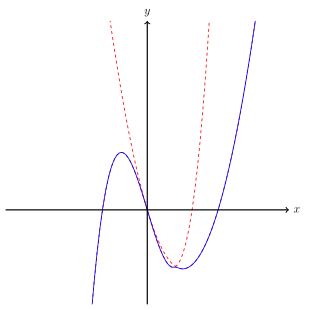
- Show that \((1, -3)\) is a local maximum point on the curve \(y = 2\mathrm{Min}(x^2, x^3) - 5x\) and find the other three local maxima and minima on this curve. Sketch the curve.
Solution
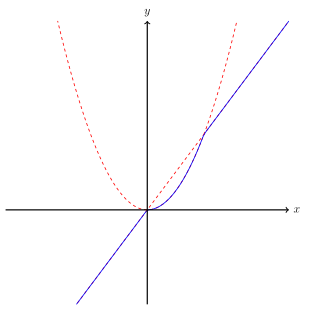
- \(2 \textrm{Min}(x^2,2x) = 5x-3\) tells us either \(2x^2 = 5x-3 \Rightarrow 2x^2 - 5x +3 = 0 \Rightarrow (2x-3)(x-1) \Rightarrow x = 1, \frac32\) and \(0 \leq x \leq 2\) or \(4x = 5x-3 \Rightarrow x= 3\) and \(x < 0\) or \(2 > x\), therefore our solutions are \(x = 1, \frac32, 3\)
- We have different cases based on \(x\) vs \(-2, 0, 2\), ie Case \(x \leq -2\): \begin{align*} && mx &= \mathrm{Min}(x^2, 2x) + \mathrm{Min}(x^3, 4x) \\ &&&= 2x + x^3 \end{align*} So \(2x = 2x + x^3 \Rightarrow x^3 = 0\), but \(x \leq -2\) so no solutions. or \(6x = 2x + x^3 \Rightarrow 0 = x(x^2-4) \Rightarrow x = 0, 2, -2\) so \(x = -2\). Case \(-2 < x \leq 0\): \begin{align*} && mx &= \mathrm{Min}(x^2, 2x) + \mathrm{Min}(x^3, 4x) \\ &&&= 2x + 4x \end{align*} So \(2x = 2x + 4x\) ie \(x = 0\) which is valid. Or \(6x = 2x + 4x\) ie valid for all values in \(-2 \leq x \leq 0\) Case \(0 < x \leq 2\): \begin{align*} && mx &= \mathrm{Min}(x^2, 2x) + \mathrm{Min}(x^3, 4x) \\ &&&= x^2 + x^3 \end{align*} So \(2x = x^2 + x^3 \Rightarrow 0 = x(x^2+x-2) = x(x-1)(x+2)\) so \(x = 0, 1, -2\), but the range means \(x = 0\) or \(x = 1\) Or \(6x = x^2 + x^3 \Rightarrow 0 = x(x^2+x-6) = x(x-2)(x+3)\) so \(x = 0, 2, -3\), but the range means \(x = 0\) or \(x = 2\) Case \(2 \leq x \): \begin{align*} && mx &= \mathrm{Min}(x^2, 2x) + \mathrm{Min}(x^3, 4x) \\ &&&=2x + 4x \end{align*} So \(2x = 2x + 4x \Rightarrow x = 0\) so no solutions. Or \(6x = 2x + 4x\) so a range of solutions. Therefore the final solutions for \(m = 2\) are \(x = 0, x = 1\) and for \(m = 2\) are \(x \in [-2,0] \cup [2, \infty)\)
- \(\mathrm{Min}(x^2, x^3)\) switches when \(x = 1\), so we must consider both limits:
\begin{align*}
&& \frac{\d y}{\d x}\vert_{x > 1} &= 4x - 5 \\
\\
&& \frac{\d y}{\d x}\vert_{x < 1} &= 6x^2 - 5 \\
\end{align*}
so when \(x = 1\) the sign of the derivative changes from positive to negative, hence a local maximum.
The other local maxima and minima will be when \(x = \frac54\) or \(x = \pm \sqrt{5/6}\)
Examiner's report
— 2025 STEP 2, Question 1As is commonly the case, the vast majority of candidates focused on the Pure questions in Section A of the paper, with a good number of attempts made on all of those questions. Candidates that attempted the Mechanics questions in Section B generally answered both questions. More candidates attempted Question 11 in Section C than either Mechanics question, but very few attempted Question 12 in that section. There were a large number of good responses seen for all the questions, but a significant number of responses lacked sufficient detail in the presentation, particularly when asked to prove a given result or provide an explanation. Candidates who did well on this paper generally: gave careful explanations of each step within their solutions; indicated all points of interest on graphs and other diagrams clearly; made clear comments about the approach that needed to be taken, particularly when having to explore a number of cases as part of the solution to a question; used mathematical terminology accurately within their solutions. Candidates who did less well on this paper generally: made errors with basic algebraic manipulation, such as incorrect processing of indices; produced sketches of graphs in which significant points were difficult to see clearly because of the chosen scale; skipped important lines within lengthy sections of algebraic reasoning.
Rating Information
Difficulty Rating: 1500.0
Difficulty Comparisons: 0
Banger Rating: 1500.0
Banger Comparisons: 0
Show LaTeX source
Problem source
The function $\mathrm{Min}$ is defined as
\[
\mathrm{Min}(a, b) = \begin{cases}
a & \text{if } a \leq b \\
b & \text{if } a > b
\end{cases}
\]
\begin{questionparts}
\item Sketch the graph $y = \mathrm{Min}(x^2, 2x)$.
\item Solve the equation $2\mathrm{Min}(x^2, 2x) = 5x - 3$.
\item Solve the equation $\mathrm{Min}(x^2, 2x) + \mathrm{Min}(x^3, 4x) = mx$ in the cases $m = 2$ and $m = 6$.
\item Show that $(1, -3)$ is a local maximum point on the curve $y = 2\mathrm{Min}(x^2, x^3) - 5x$ and find the other three local maxima and minima on this curve.
Sketch the curve.
\end{questionparts}
Solution source
\begin{questionparts}

\item \begin{center}
    \begin{tikzpicture}
    \def\functionf(#1){2*(#1)*((#1)^2 - 5)/((#1)^2-4)};
    \def\xl{-5};
    \def\xu{5};
    \def\yl{-5};
    \def\yu{10};

    % Calculate scaling factors to make the plot square
    \pgfmathsetmacro{\xrange}{\xu-\xl}
    \pgfmathsetmacro{\yrange}{\yu-\yl}
    \pgfmathsetmacro{\xscale}{10/\xrange}
    \pgfmathsetmacro{\yscale}{10/\yrange}

    % Define the styles for the axes and grid
    \tikzset{
        axis/.style={very thick, ->},
        grid/.style={thin, gray!30},
        x=\xscale cm,
        y=\yscale cm
    }

    % Define the bounding region with clip
    \begin{scope}
        % You can modify these values to change your plotting region
        \clip (\xl,\yl) rectangle (\xu,\yu);

        % Draw a grid (optional)
        % \draw[grid] (-5,-3) grid (5,3);

        \draw[thick, red, dashed, domain=-5:5, samples=100]
            plot (\x, {2*\x});
        \draw[thick, red, dashed, domain=-5:5, samples=100]
            plot (\x, {\x*\x});
        \draw[thick, blue, smooth, domain=-5:5, samples=100]
            plot (\x, {min(\x*\x, 2*\x)});
        % \draw[thick, red, dashed] (-2, \yl) -- (-2, \yu) node [below] {$x = -2$};
        % \draw[thick, red, dashed] (2, \yl) -- (2, \yu) node [below] {$x = 2$};
        % \draw[thick, red, dashed] (-5, -10) -- (5, 10) node [below left] {$y = 2x$};
    \end{scope}

    % Set up axes
    \draw[axis] (\xl,0) -- (\xu,0) node[right] {$x$};
    \draw[axis] (0,\yl) -- (0,\yu) node[above] {$y$};

    \end{tikzpicture}
\end{center}

\item $2 \textrm{Min}(x^2,2x) = 5x-3$ tells us either $2x^2 = 5x-3 \Rightarrow 2x^2 - 5x +3 = 0 \Rightarrow (2x-3)(x-1) \Rightarrow x = 1, \frac32$ and $0 \leq x \leq 2$ or $4x = 5x-3 \Rightarrow x= 3$ and $x < 0$ or $2 > x$, therefore our solutions are $x = 1, \frac32, 3$

\item We have different cases based on $x$ vs $-2, 0, 2$, ie

Case $x \leq -2$:
\begin{align*}
&& mx &= \mathrm{Min}(x^2, 2x) + \mathrm{Min}(x^3, 4x) \\
&&&= 2x + x^3
\end{align*}

So $2x = 2x + x^3 \Rightarrow x^3 = 0$, but $x \leq -2$ so no solutions.

or $6x = 2x + x^3 \Rightarrow 0 = x(x^2-4) \Rightarrow x = 0, 2, -2$ so $x = -2$.

Case $-2  < x \leq 0$:
\begin{align*}
&& mx &= \mathrm{Min}(x^2, 2x) + \mathrm{Min}(x^3, 4x) \\
&&&= 2x + 4x
\end{align*}

So $2x = 2x + 4x$ ie $x = 0$ which is valid.

Or $6x = 2x + 4x$ ie valid for all values in $-2 \leq x \leq 0$

Case $0  < x \leq 2$:
\begin{align*}
&& mx &= \mathrm{Min}(x^2, 2x) + \mathrm{Min}(x^3, 4x) \\
&&&= x^2 + x^3
\end{align*}

So $2x = x^2 + x^3 \Rightarrow 0 = x(x^2+x-2) = x(x-1)(x+2)$ so $x = 0, 1, -2$, but the range means $x = 0$ or $x = 1$

Or $6x = x^2 + x^3 \Rightarrow 0 = x(x^2+x-6) = x(x-2)(x+3)$ so $x = 0, 2, -3$, but the range means $x = 0$ or $x = 2$

Case $2  \leq  x $:
\begin{align*}
&& mx &= \mathrm{Min}(x^2, 2x) + \mathrm{Min}(x^3, 4x) \\
&&&=2x + 4x
\end{align*}

So $2x = 2x + 4x \Rightarrow x = 0$ so no solutions.

Or $6x = 2x + 4x$ so a range of solutions.


Therefore the final solutions for $m = 2$ are $x = 0, x = 1$ and for $m = 2$ are $x \in [-2,0] \cup [2, \infty)$

\item $\mathrm{Min}(x^2, x^3)$ switches when $x = 1$, so we must consider both limits:

\begin{align*}
&& \frac{\d y}{\d x}\vert_{x > 1} &= 4x - 5 \\
\\
&& \frac{\d y}{\d x}\vert_{x < 1} &= 6x^2 - 5 \\
\end{align*}

so when $x = 1$ the sign of the derivative changes from positive to negative, hence a local maximum.

The other local maxima and minima will be when $x = \frac54$ or $x = \pm \sqrt{5/6}$


\begin{center}
    \begin{tikzpicture}
    \def\functionf(#1){2*(#1)*((#1)^2 - 5)/((#1)^2-4)};
    \def\xl{-5};
    \def\xu{5};
    \def\yl{-5};
    \def\yu{10};

    % Calculate scaling factors to make the plot square
    \pgfmathsetmacro{\xrange}{\xu-\xl}
    \pgfmathsetmacro{\yrange}{\yu-\yl}
    \pgfmathsetmacro{\xscale}{10/\xrange}
    \pgfmathsetmacro{\yscale}{10/\yrange}

    % Define the styles for the axes and grid
    \tikzset{
        axis/.style={very thick, ->},
        grid/.style={thin, gray!30},
        x=\xscale cm,
        y=\yscale cm
    }

    % Define the bounding region with clip
    \begin{scope}
        % You can modify these values to change your plotting region
        \clip (\xl,\yl) rectangle (\xu,\yu);

        % Draw a grid (optional)
        % \draw[grid] (-5,-3) grid (5,3);

        \draw[thick, red, dashed, domain=-5:5, samples=100]
            plot (\x, {2*\x*\x-5*\x});
        \draw[thick, red, dashed, domain=-5:5, samples=100]
            plot (\x, {2*\x*\x*\x-5*\x});
        \draw[thick, blue, smooth, domain=-5:5, samples=100]
            plot (\x, {2*min(\x*\x, \x*\x*\x) - 5*\x});
        % \draw[thick, red, dashed] (-2, \yl) -- (-2, \yu) node [below] {$x = -2$};
        % \draw[thick, red, dashed] (2, \yl) -- (2, \yu) node [below] {$x = 2$};
        % \draw[thick, red, dashed] (-5, -10) -- (5, 10) node [below left] {$y = 2x$};
    \end{scope}

    % Set up axes
    \draw[axis] (\xl,0) -- (\xu,0) node[right] {$x$};
    \draw[axis] (0,\yl) -- (0,\yu) node[above] {$y$};

    \end{tikzpicture}
\end{center}

\end{questionparts}
This was a popular question and there were many very good responses seen, with a small number of candidates scoring full marks. Almost all responses included attempts at all parts of the question. Part (i) was generally answered well, although many candidates did not make clear that the gradient of the quadratic section was zero at the origin. Additionally, while most sketches showed two straight line sections for the parts that should show the line y = 2x, it was not always clear that these two straight line sections were parts of the same straight line. Part (ii) was well answered, but many candidates omitted the coefficient of 2 when solving the equation and therefore were not able to reach the correct points. Additionally, many solutions did not show sufficient evidence of checking that the solutions fell within the required ranges. There was a small, but significant, number of candidates that struggled to factorise their correct quadratic equation. Part (iii) was well answered, with most candidates able to identify the correct function for each of the ranges and solve the corresponding equations. A common error, however, was to solve the equation 6x = 6x either as x = 0 or as x = 0 or 1, rather than noting that it is valid for any value of x within the relevant range. Some candidates did not combine all of their results from the different ranges correctly but were awarded the marks provided that all of the correct values were seen somewhere within the solution. Many candidates struggled with the explanation that (1, −3) is a local maximum of the curve, although there were some very good explanations seen. Candidates were generally good at identifying the other maxima and minima on the curve, although numerical errors, particularly in the simplification of the y coordinates, were common. When sketching the graphs, many candidates were able to draw the quadratic and cubic sections, although there were several examples where the symmetry of the curves was not evident. Many candidates tried to smooth the graph around the point where the two sections join, rather than having a clear change of gradient at that point. There were also several cases where points of significance were not marked on the graph. Almost no candidates attempted to justify the relative positioning of the two minimum points on the graph.