2025 Paper 3 Q7
Year: 2025
Paper: 3
Question Number: 7
Course: UFM Pure
Section: Integration using inverse trig and hyperbolic functions
Problem
- Using a binomial series, or otherwise, show that, for large \(|x|\), \(\sqrt{x^2 + 1} \approx |x| + \frac{1}{2|x|}\). Sketch the graph \(y = f(x)\).
- Let \(g(x) = \tan^{-1} f(x)\) and, for \(x \neq 0\), let \(k(x) = \frac{1}{2}\tan^{-1}\frac{1}{x}\).
- Show that \(g(x) + g(-x) = \frac{1}{2}\pi\).
- Show that \(k(x) + k(-x) = 0\).
- Show that \(\tan k(x) = \tan g(x)\) for \(x > 0\).
- Sketch the graphs \(y = g(x)\) and \(y = k(x)\) on the same axes.
- Evaluate \(\int_0^1 k(x) \, dx\) and hence write down the value of \(\int_{-1}^0 g(x) \, dx\).
Solution
- \begin{align*}
\sqrt{x^2+1} &= |x|\sqrt{1+\frac{1}{x^2}} \\
&=|x| \left (1 + \frac12 \frac{1}{x^2} + \cdots \right) & \text{if } \left (\frac{1}{x^2} < 1 \right) \\
&= |x| + \frac12 \frac{1}{|x|} + \cdots \\
&\approx |x| + \frac{1}{2|x|}
\end{align*}
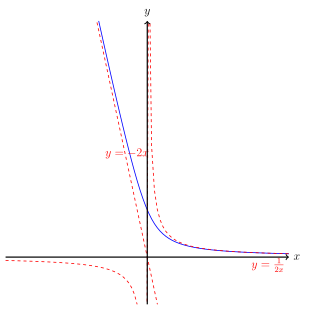
- \begin{align*} && \tan( g(x) + g(-x)) &= \tan \left ( \tan^{-1}(\sqrt{x^2+1}-x) + \tan^{-1}(\sqrt{x^2+1}+x) \right) \\ &&&= \frac{\sqrt{x^2+1}-x+\sqrt{x^2+1}+x}{1-1} \\ \Rightarrow && g(x) + g(-x) &\in \left \{\cdots, -\frac{\pi}{2}, \frac{\pi}{2}, \cdots \right\} \end{align*} But \(g(x), g(-x) > 0\) and \(g(x), g(-x) \in (-\frac{\pi}{2}, \frac{\pi}{2})\), therefore it must be \(\frac{\pi}{2}\).
- \begin{align*} && \tan(2(k(x) + k(-x))) &= \tan(\tan^{-1}x + \tan^{-1}(-x)) \\ &&&= 0 \\ \Rightarrow && k(x)+k(-x) &\in \left \{\cdots, -\frac{\pi}{2}, 0, \frac{\pi}{2}, \cdots \right\} \\ \end{align*} But \(k(x) \in (-\frac{\pi}{4}, \frac{\pi}{4})\), therefore \(k(x) + k(-x) = 0\).
- Let \(t = \tan k(x)\). \begin{align*} && \tan \left ( \tan^{-1} \frac{1}{x} \right) &= \frac{2 \tan\left ( \frac12 \tan^{-1} \frac1x \right)}{ 1-\tan^2\left ( \frac12 \tan^{-1} \frac1x \right)} \\ \Rightarrow && \frac1x &= \frac{2t}{1-t^2} \\ \Rightarrow && 1-t^2 &= 2tx \\ \Rightarrow && 0 &= t^2+2tx - 1 \\ \Rightarrow && 0 &= (t+x)^2 - 1-x^2 \\ \Rightarrow && t &= -x \pm \sqrt{1+x^2} \end{align*} Since \(t > 0\), \(t = \sqrt{1+x^2}-x = f(x) = \tan g(x)\)
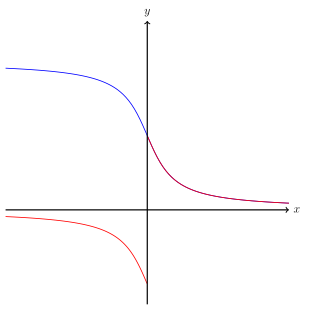
- \begin{align*} \int_0^1 k(x) \d x &= \int_0^1 \frac12 \tan^{-1} \left ( \frac1x \right) \d x \\ &= \left [ \frac{x}{2} \tan^{-1}\left ( \frac1x \right) \right]_0^1 - \int_0^1 \frac{x}{2} \frac{-1/x^2}{1+1/x^2} \d x \\ &= \left [ \frac{x}{2} \tan^{-1}\left ( \frac1x \right) \right]_0^1 + \frac14 \int_0^1 \frac{2x}{1+x^2} \d x \\ &= \frac12 \frac{\pi}{4} + \frac14 \ln(2) \\ &= \frac{\pi + \ln 4}{8}\end{align*} Therefore \(\displaystyle \int_{-1}^0 g(x) \d x = -\frac{\pi + \ln 4}{8}\)
Examiner's report
— 2025 STEP 3, Question 7The majority of candidates focused solely on the pure questions, with questions 1, 2 and 8 the most popular. The statistics questions were more popular than the mechanics questions in this exam series. Candidates who did well on this paper generally: were careful to explain and justify the steps in their arguments, explaining what they had done rather than expecting the examiner to infer what had been done from disjointed groups of calculations; paid close attention to what was required by the questions; made fewer unnecessary mistakes with calculations; thought carefully about how to present rigorous arguments involving trig functions and their inverse functions, especially in relation to domain considerations; understood that questions set on the STEP papers require sufficient justification to earn full credit; knew the difference between 'positive' and 'non-negative'; attempted all parts of a question, picking up marks for later parts even when they had not necessarily attempted or completed previous parts. Candidates who did less well on this paper generally: did not pay attention to 'Hence' instructions: this means that you must use the previous part; presented explanations that were not precise enough (e.g. in Question 3 describing the transformations but not in the context of the graphs or in Question 8 not explaining use of trigonometric relationships sufficiently well); made additional assumptions, e.g. that a function was differentiable when this had not been given; tried to present if and only if arguments in a single argument when dealing with each direction separately would have been more appropriate and safer (note that this is not always the case; in general candidates need to consider what is the most appropriate presentation of an if and only if argument); tried to carry out too many steps in one go, resulting in them not justifying the key steps sufficiently; did not take sufficient care with graphs/curve sketching.
Rating Information
Difficulty Rating: 1500.0
Difficulty Comparisons: 0
Banger Rating: 1500.0
Banger Comparisons: 0
Show LaTeX source
Problem source
Let $f(x) = \sqrt{x^2 + 1} - x$.
\begin{questionparts}
\item Using a binomial series, or otherwise, show that, for large $|x|$, $\sqrt{x^2 + 1} \approx |x| + \frac{1}{2|x|}$.
Sketch the graph $y = f(x)$.
\item Let $g(x) = \tan^{-1} f(x)$ and, for $x \neq 0$, let $k(x) = \frac{1}{2}\tan^{-1}\frac{1}{x}$.
\begin{enumerate}
\item Show that $g(x) + g(-x) = \frac{1}{2}\pi$.
\item Show that $k(x) + k(-x) = 0$.
\item Show that $\tan k(x) = \tan g(x)$ for $x > 0$.
\item Sketch the graphs $y = g(x)$ and $y = k(x)$ on the same axes.
\item Evaluate $\int_0^1 k(x) \, dx$ and hence write down the value of $\int_{-1}^0 g(x) \, dx$.
\end{enumerate}
\end{questionparts}
Solution source
\begin{questionparts}
\item \begin{align*}
\sqrt{x^2+1} &= |x|\sqrt{1+\frac{1}{x^2}} \\
&=|x| \left (1 + \frac12 \frac{1}{x^2} + \cdots \right) & \text{if } \left (\frac{1}{x^2} < 1 \right) \\
&= |x| + \frac12 \frac{1}{|x|} + \cdots \\
&\approx |x| + \frac{1}{2|x|}
\end{align*}


\begin{center}
    \begin{tikzpicture}
    \def\functionf(#1){sqrt((#1)^2+1)-(#1)};
    \def\xl{-7};
    \def\xu{7};
    \def\yl{-1};
    \def\yu{5};

    % Calculate scaling factors to make the plot square
    \pgfmathsetmacro{\xrange}{\xu-\xl}
    \pgfmathsetmacro{\yrange}{\yu-\yl}
    \pgfmathsetmacro{\xscale}{10/\xrange}
    \pgfmathsetmacro{\yscale}{10/\yrange}

    % Define the styles for the axes and grid
    \tikzset{
        axis/.style={very thick, ->},
        grid/.style={thin, gray!30},
        x=\xscale cm,
        y=\yscale cm
    }

    % Define the bounding region with clip
    \begin{scope}
        % You can modify these values to change your plotting region
        \clip (\xl,\yl) rectangle (\xu,\yu);

        % Draw a grid (optional)
        % \draw[grid] (-5,-3) grid (5,3);

        \draw[thick, blue, smooth, domain=\xl:\xu, samples=100]
            plot (\x, {\functionf(\x)});

        \draw[thick, red, dashed, domain=\xl:\xu, samples=100]
            plot (\x, {1/(2*\x)}) node[below left] {$y=\frac{1}{2x}$};
        \draw[thick, red, dashed, domain=\xl:\xu, samples=100]
            plot (\x, {-2*\x});
        \node[red, above] at (-1,2) {$y=-2x$};
        % \draw[thick, red, dashed] (2, \yl) -- (2, \yu) node [below] {$x = 2$};
        % \draw[thick, red, dashed] (-5, -10) -- (5, 10) node [below left] {$y = 2x$};
    \end{scope}

    % Set up axes
    \draw[axis] (\xl,0) -- (\xu,0) node[right] {$x$};
    \draw[axis] (0,\yl) -- (0,\yu) node[above] {$y$};

    \end{tikzpicture}
\end{center}

\item \begin{enumerate}
\item \begin{align*}
&& \tan( g(x) + g(-x)) &= \tan \left ( \tan^{-1}(\sqrt{x^2+1}-x) + \tan^{-1}(\sqrt{x^2+1}+x) \right) \\
&&&= \frac{\sqrt{x^2+1}-x+\sqrt{x^2+1}+x}{1-1} \\
\Rightarrow && g(x) + g(-x) &\in \left \{\cdots, -\frac{\pi}{2}, \frac{\pi}{2}, \cdots  \right\}
\end{align*}
But $g(x), g(-x) > 0$ and $g(x), g(-x) \in (-\frac{\pi}{2}, \frac{\pi}{2})$, therefore it must be $\frac{\pi}{2}$.

\item \begin{align*}
&& \tan(2(k(x) + k(-x))) &= \tan(\tan^{-1}x + \tan^{-1}(-x)) \\
&&&= 0 \\
\Rightarrow && k(x)+k(-x) &\in \left \{\cdots, -\frac{\pi}{2}, 0, \frac{\pi}{2}, \cdots  \right\} \\
\end{align*}
But $k(x) \in (-\frac{\pi}{4}, \frac{\pi}{4})$, therefore $k(x) + k(-x) = 0$.

\item Let $t = \tan k(x)$. \begin{align*}
&& \tan \left ( \tan^{-1} \frac{1}{x} \right) &= \frac{2 \tan\left ( \frac12 \tan^{-1} \frac1x \right)}{ 1-\tan^2\left ( \frac12 \tan^{-1} \frac1x \right)} \\
\Rightarrow && \frac1x &= \frac{2t}{1-t^2} \\
\Rightarrow && 1-t^2 &= 2tx \\
\Rightarrow && 0 &= t^2+2tx - 1 \\
\Rightarrow && 0 &= (t+x)^2 - 1-x^2 \\
\Rightarrow && t &= -x \pm \sqrt{1+x^2}
\end{align*}
Since $t > 0$, $t = \sqrt{1+x^2}-x = f(x) = \tan g(x)$

\item

\begin{center}
    \begin{tikzpicture}
    \def\functionf(#1){rad(atan(sqrt((#1)^2+1)-(#1)))};
    \def\functiong(#1){1/2*rad(atan(1/(#1)))};
    \def\xl{-7};
    \def\xu{7};
    \def\yl{-1};
    \def\yu{2};

    % Calculate scaling factors to make the plot square
    \pgfmathsetmacro{\xrange}{\xu-\xl}
    \pgfmathsetmacro{\yrange}{\yu-\yl}
    \pgfmathsetmacro{\xscale}{10/\xrange}
    \pgfmathsetmacro{\yscale}{10/\yrange}

    % Define the styles for the axes and grid
    \tikzset{
        axis/.style={very thick, ->},
        grid/.style={thin, gray!30},
        x=\xscale cm,
        y=\yscale cm
    }

    % Define the bounding region with clip
    \begin{scope}
        % You can modify these values to change your plotting region
        \clip (\xl,\yl) rectangle (\xu,\yu);

        % Draw a grid (optional)
        % \draw[grid] (-5,-3) grid (5,3);

        \draw[thick, blue, smooth, domain=\xl:\xu, samples=100]
            plot (\x, {\functionf(\x)});
        \draw[thick, red, smooth, domain=\xl:-0.01, samples=100]
            plot (\x, {\functiong(\x)});
        \draw[thick, red, smooth, domain=0.01:\xu, samples=100]
            plot (\x, {\functiong(\x)});


        % \draw[thick, red, dashed] (2, \yl) -- (2, \yu) node [below] {$x = 2$};
        % \draw[thick, red, dashed] (-5, -10) -- (5, 10) node [below left] {$y = 2x$};
    \end{scope}

    % Set up axes
    \draw[axis] (\xl,0) -- (\xu,0) node[right] {$x$};
    \draw[axis] (0,\yl) -- (0,\yu) node[above] {$y$};

    \end{tikzpicture}
\end{center}

\item \begin{align*}
\int_0^1 k(x) \d x &= \int_0^1 \frac12 \tan^{-1} \left ( \frac1x \right) \d x  \\
&= \left [ \frac{x}{2} \tan^{-1}\left ( \frac1x \right) \right]_0^1 - \int_0^1 \frac{x}{2} \frac{-1/x^2}{1+1/x^2} \d x \\
&= \left [ \frac{x}{2} \tan^{-1}\left ( \frac1x \right) \right]_0^1 + \frac14 \int_0^1  \frac{2x}{1+x^2} \d x \\
&= \frac12 \frac{\pi}{4} + \frac14 \ln(2) \\
&= \frac{\pi + \ln 4}{8}\end{align*}

Therefore $\displaystyle \int_{-1}^0 g(x) \d x = -\frac{\pi + \ln 4}{8}$
\end{enumerate}

\end{questionparts}
In part (i), some candidates tried to expand √(1 + x²) as a series in increasing powers of x², not appreciating that they needed |x| to be small for such an expansion to be valid. A lot of candidates used the expansion to correctly identify the asymptotes of f(x). In part (ii) (a), the most common approach was to consider tan(g(x) + g(−x)), which, using the tan double angle formula, '= ∞'. Only a small number justified their answer by using the positivity of f(x) to get 0 < g(x) + g(−x) < π. Many candidates then simply stated the answer, or wrote g(x) + g(−x) = tan⁻¹∞, stating that this is π/2. A common theme in this question was a lack of consideration of ranges/domains of the trigonometric functions which meant there were marks that were unavailable. Part (ii) (b) was done well in general, with many candidates knowing that y = arctan x is an odd function. Some overcomplicated it, using the double angle formula again, and not gaining a mark for justifying the range of k(x), i.e. tan(k(x) + k(−x)) = 0 ⇏ k(x) + k(−x) = 0 in general. In part (ii) (c), the most common approach was again to use the tan double angle formula, realising that tan 2k(x) = x⁻¹, and arriving at a quadratic for tan k(x). Marks were again unavailable for those candidates that either did not attempt to solve the quadratic or did solve for the two roots but then not explaining why tan k(x) = f(x) was the correct root to choose. There were also some nice geometric arguments for (c), drawing a right-angled triangle with angle 2k(x), then bisecting the angle and finding the side lengths of the smaller right-angled triangle with angle k(x) to find tan k(x). The sketches in part (ii) (d) were good in general, although some candidates' sketches contradicted the relations for g(x), k(x), given in the question, for example sketching k(x) as an even function, or not using tan k(x) = tan g(x) for x > 0. Part (ii) (e) was done well by candidates who attempted it. Some overcomplicated the integral by changing variables, but the majority realised they could integrate by parts directly. For the last part, candidates either used their sketches to find the right area or integrated the relation in part (a) directly using part (c).