2024 Paper 2 Q11
Year: 2024
Paper: 2
Question Number: 11
Course: LFM Stats And Pure
Section: Binomial Distribution
Problem
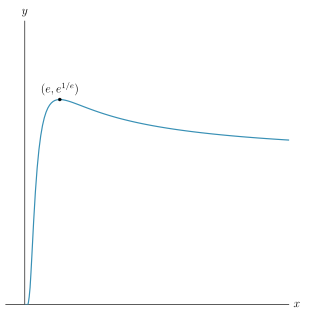
- Sketch a graph of \(y = x^{\frac{1}{x}}\) for \(x > 0\), showing the location of any turning points. Find the maximum value of \(n^{\frac{1}{n}}\), where \(n\) is a positive integer.
- The people to be tested are split into \(r\) groups of size \(k\), with \(k > 1\) and \(rk = N\).
- In every group, a sample from each person in that group is mixed into one large sample, which is then tested.
- If the enzyme is not present in the combined sample from a group, no further testing of the people in that group is needed.
- If the enzyme is present in the combined sample from a group, a second sample from each person in that group is tested separately.
- Find, in terms of \(N\), \(k\) and \(p\), the expected number of tests.
- Given that \(N\) is a multiple of \(3\), find the largest value of \(p\) for which it is possible to find an integer value of \(k\) such that \(k > 1\) and the expected number of tests is at most \(N\). Show that this value of \(p\) is greater than \(\frac{1}{4}\).
- Show that, if \(pk\) is sufficiently small, the expected number of tests is approximately \[ N\!\left(\frac{1}{k} + pk\right). \] In the case where \(p = 0.01\), show that choosing \(k = 10\) gives an expected number of tests which is only about \(20\%\) of \(N\).
Solution
- \(\,\)
\begin{align*} && y & = x^{1/x} = \exp \left ( \tfrac1x \ln x \right ) \\ \Rightarrow && y' &= \exp \left ( \tfrac1x \ln x \right ) \cdot \left ( \frac{1}{x^2} - \frac{\ln x}{x^2} \right ) \\ &&&= \frac{\exp \left ( \tfrac1x \ln x \right ) }{x^2}(1 - \ln x) \\ y' =0: && x &= e \end{align*} Therefore the largest integer values will be \(2\) or \(3\). Comparing \((2^{\frac12})^6 = 8 < 9 = (3^{1/3})^6\) we see the maximum value of \(n^{1/n}\) where \(n\) is an integer is \(\sqrt[3]{3}\)
- The number of tests is \(r\) plus however many groups fail times \(k\). The probability of a group failing is \(g = 1-(1-p)^k\) and the number of failing groups is \(\sim B(r, g)\) so the expected number of additional groups is \(rg\) and the expected total number of tests is \[ \frac{N}{k} + N(1-(1-p)^k) \]
- \(\,\) \begin{align*} && N &\geq E = \frac{N}{k} + N(1-(1-p)^k) \\ \Rightarrow && 1 &\geq \frac{1}{k} + 1-(1-p)^k \\ \Rightarrow && (1-p)^k &\geq \frac1k \\ \Rightarrow && k \ln(1-p) &\geq - \ln k \\ \Rightarrow && \ln(1 - p) &\geq -\frac{1}{k} \ln k \geq -\frac13 \ln 3 \\ \Rightarrow && 1-p &\geq \frac{1}{\sqrt[3]{3}} \\ \Rightarrow && p &\leq 1-\frac{1}{\sqrt[3]{3}} \end{align*} (taking \(k=3\)) Claim: \(1 - \frac{1}{\sqrt[3]{3}} > \frac14\) Proof: This is equivalent to \(\sqrt[3]{3} > \frac43\) or \(81 > 4^3 = 64\) which is clearly true.
- If \(pk\) is small then \((1-p)^k \approx 1 - pk\) and so we obtain \(N \left ( \frac1k +pk \right)\) as required. If \(p = 0.01\) and \(k = 10\) then \(\frac{1}{10} + 0.01 \cdot 10 = 0.2\) so the expected number of tests is \(\sim 20\%\) of \(N\)
Examiner's report
— 2024 STEP 2, Question 11Many candidates produced good solutions to the questions, with the majority of candidates opting to focus on the pure questions of the paper. Candidates demonstrated very good ability, particularly in the area of manipulating algebra. Many candidates produced clear diagrams which in many cases meant that they were more successful in their attempts at their questions than those who did not do so. The paper also contained a number of places where the answer to be reached was given in the question. In such cases, candidates must be careful to ensure that they provide sufficient evidence of the method used to reach the result in order to gain full credit.
Rating Information
Difficulty Rating: 1500.0
Difficulty Comparisons: 0
Banger Rating: 1500.0
Banger Comparisons: 0
Show LaTeX source
Problem source
\begin{questionparts}
\item Sketch a graph of $y = x^{\frac{1}{x}}$ for $x > 0$, showing the location of any turning points.
Find the maximum value of $n^{\frac{1}{n}}$, where $n$ is a positive integer.
\end{questionparts}
$N$ people are to have their blood tested for the presence or absence of an enzyme. Each person, independently of the others, has a probability $p$ of having the enzyme present in a sample of their blood, where $0 < p < 1$. The blood test always correctly determines whether the enzyme is present or absent in a sample.
The following method is used.
\begin{itemize}
\item The people to be tested are split into $r$ groups of size $k$, with $k > 1$ and $rk = N$.
\item In every group, a sample from each person in that group is mixed into one large sample, which is then tested.
\item If the enzyme is not present in the combined sample from a group, no further testing of the people in that group is needed.
\item If the enzyme is present in the combined sample from a group, a second sample from each person in that group is tested separately.
\end{itemize}
\begin{questionparts}
\setcounter{enumi}{1}
\item Find, in terms of $N$, $k$ and $p$, the expected number of tests.
\item Given that $N$ is a multiple of $3$, find the largest value of $p$ for which it is possible to find an integer value of $k$ such that $k > 1$ and the expected number of tests is at most $N$.
Show that this value of $p$ is greater than $\frac{1}{4}$.
\item Show that, if $pk$ is sufficiently small, the expected number of tests is approximately
\[ N\!\left(\frac{1}{k} + pk\right). \]
In the case where $p = 0.01$, show that choosing $k = 10$ gives an expected number of tests which is only about $20\%$ of $N$.
\end{questionparts}
Solution source
\begin{questionparts}
\item $\,$
\begin{center}
    \begin{tikzpicture}
    \def\functionf(#1){exp(1/(#1)*ln(#1))};
    \def\xl{-1.5};
    \def\xu{20.5};
    \def\yl{0};
    \def\yu{2};

    % Calculate scaling factors to make the plot square
    \pgfmathsetmacro{\xrange}{\xu-\xl}
    \pgfmathsetmacro{\yrange}{\yu-\yl}
    \pgfmathsetmacro{\xscale}{10/\xrange}
    \pgfmathsetmacro{\yscale}{10/\yrange}

    % Define the reusable styles to keep code clean
    \tikzset{
        x=\xscale cm, y=\yscale cm,
        axis/.style={thick, draw=black!80, -{Stealth[scale=1.2]}},
        grid/.style={thin, dashed, gray!30},
        curveA/.style={very thick, color=cyan!70!black, smooth},
        curveB/.style={very thick, color=orange!90!black, smooth},
        curveC/.style={very thick, color=green!90!black, smooth},
        curveBlack/.style={very thick, color=black, smooth},
        dot/.style={circle, fill=black, inner sep=1.2pt},
        labelbox/.style={fill=white, inner sep=2pt, rounded corners=2pt} % Protects text from lines
    }

    % Draw background grid
    \draw[grid] (\xl,\yl) (\xu,\yu);

    % Set up axes
    \draw[axis] (\xl,0) -- (\xu,0) node[right, black] {$x$};
    \draw[axis] (0,\yl) -- (0,\yu) node[above, black] {$y$};

    % Define the bounding region with clip
    \begin{scope}
        \clip (\xl,\yl) rectangle (\xu,\yu);


        \draw[curveA, domain=.001:\xu, samples=150]
            (0,0) -- plot ({\x},{\functionf(\x)});

        \filldraw ({exp(1)}, {exp(1/exp(1))}) circle (1.5pt) node[above] {$(e, e^{1/e})$};

    \end{scope}

    % Annotate Function Names
    % \node[curveB, labelbox] at (1.85, -1.1) {$x = \frac{4y^2+1}{3}$};


    \end{tikzpicture}
\end{center}


\begin{align*}
&& y & = x^{1/x} = \exp \left ( \tfrac1x \ln x \right ) \\
\Rightarrow && y' &= \exp \left ( \tfrac1x \ln x \right ) \cdot \left ( \frac{1}{x^2} - \frac{\ln x}{x^2} \right ) \\
&&&= \frac{\exp \left ( \tfrac1x \ln x \right ) }{x^2}(1 - \ln x) \\
y' =0: && x &= e
\end{align*}
Therefore the largest integer values will be $2$ or $3$. Comparing $(2^{\frac12})^6 = 8 < 9 = (3^{1/3})^6$ we see the maximum value of $n^{1/n}$ where $n$ is an integer is $\sqrt[3]{3}$

\item The number of tests is $r$ plus however many groups fail times $k$. The probability of a group failing is $g = 1-(1-p)^k$ and the number of failing groups is $\sim B(r, g)$ so the expected number of additional groups is $rg$ and the expected total number of tests is
\[ \frac{N}{k} + N(1-(1-p)^k) \]

\item $\,$ \begin{align*}
&& N &\geq E = \frac{N}{k} + N(1-(1-p)^k) \\
\Rightarrow && 1 &\geq \frac{1}{k} + 1-(1-p)^k \\
\Rightarrow && (1-p)^k &\geq \frac1k \\
\Rightarrow && k \ln(1-p) &\geq - \ln k \\
\Rightarrow && \ln(1 - p) &\geq -\frac{1}{k} \ln k \geq -\frac13 \ln 3 \\
\Rightarrow && 1-p &\geq \frac{1}{\sqrt[3]{3}} \\
\Rightarrow && p &\leq 1-\frac{1}{\sqrt[3]{3}}
\end{align*}
(taking $k=3$)

Claim: $1 - \frac{1}{\sqrt[3]{3}} > \frac14$

Proof: This is equivalent to $\sqrt[3]{3} > \frac43$ or $81 > 4^3 = 64$ which is clearly true.

\item If $pk$ is small then $(1-p)^k \approx 1 - pk$ and so we obtain $N \left ( \frac1k +pk \right)$ as required.

If $p = 0.01$ and $k = 10$ then $\frac{1}{10} + 0.01 \cdot 10 = 0.2$ so the expected number of tests is $\sim 20\%$ of $N$
\end{questionparts}
This question received one of the lowest numbers of responses and many of the responses did not achieve many marks. In part (i) candidates were generally able to complete the differentiation correctly and identify the location of the stationary point of the curve. Most were also able to identify the correct behaviour of the course as x → 0, but several incorrectly believed that the function also approached 0 as x → ∞. Some candidates were not able to justify why the maximum value when taking the function over integers must occur when n = 2 or n = 3. Many candidates were however able to explain clearly that the value is greater when n = 3 compared to n = 2. Part (ii) proved to be difficult for many candidates, with many incorrectly calculating the probability that a combined test is found to be negative or omitting the first test when counting the number of tests required if a group did test positive. Those candidates who had successfully solved part (ii) were able to produce good solutions to part (iii) as well. Part (iv) was also answered well, although several candidates did not justify the exclusion of higher order terms in the expansion of (1 − p)^k.