2025 Paper 2 Q12
Year: 2025
Paper: 2
Question Number: 12
Course: UFM Statistics
Section: Poisson Distribution
Problem
- Show, by considering the sequence \(d_r \equiv p_r - p_{r-1}\) for \(r = 1, 2, \ldots\), that there is a unique integer \(m\) such that \(P(X = r) \leq P(X = m)\) for all \(r = 0, 1, 2, \ldots\), and that \[\lambda - 1 < m < \lambda.\]
- Show that the minimum value of \(d_r\) occurs at \(r = k\), where \(k\) is such that \[k < \lambda + \frac{1}{2} + \sqrt{\lambda + \frac{1}{4}} < k + 1.\]
- Show that the condition for the maximum value of \(d_r\) to occur at \(r = 1\) is \[1 < \lambda < 2 + \sqrt{2}.\]
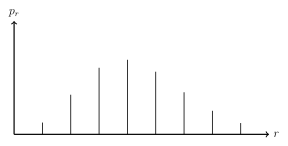
- In the case \(\lambda = 3.36\), sketch a graph of \(p_r\) against \(r\) for \(r = 0, 1, 2, \ldots, 6, 7\).
Solution
- Suppose \(d_r = p_r - p_{r-1}\) then \begin{align*} d_r &= p_r - p_{r-1} \\ &= \mathbb{P}(X = r) - \mathbb{P}(X = r-1) \\ &= e^{-\lambda} \left ( \frac{\lambda^r}{r!} - \frac{\lambda^{r-1}}{(r-1)!} \right) \\ &= e^{-\lambda} \frac{\lambda^{r-1}}{(r-1)!} \left ( \frac{\lambda}{r} - 1\right) \end{align*} Therefore \(d_r > 0 \Leftrightarrow \lambda > r\)ie, \(p_r\) is increasing while \(r < \lambda\) and reaches a (unique) maximum when \(r = \lfloor \lambda \rfloor\).
- Let \(dd_r = d_r - d_{r-1}\), so: \begin{align*} dd_r &= d_r - d_{r-1} \\ &= p_r - 2p_{r-1} + p_{r-2} \\ &= e^{-\lambda} \frac{\lambda^{r-2}}{r!} \left ( \lambda^2 - 2 \lambda r + r(r-1)\right ) \end{align*} Therefore \(dd_r < 0 \Leftrightarrow \lambda^2 - 2\lambda r +r(r-1) < 0 \Leftrightarrow r^2 -(1+2\lambda)r + \lambda^2 < 0\), but this has roots \(r = \frac{(1+2\lambda) \pm \sqrt{(1+2\lambda)^2-4\lambda^2}}{2} = \lambda + \frac12 \pm \sqrt{\lambda + \frac14}\). Therefore \(d_r\) is decreasing when \(r \in \left (\lambda + \frac12 -\sqrt{\lambda + \frac14},\lambda + \frac12 + \sqrt{\lambda + \frac14} \right)\), therefore the possible minimums are \(d_1\) and \(d_k\) where \(k < \lambda + \frac{1}{2} + \sqrt{\lambda + \frac{1}{4}} < k + 1\). \(d_1 = e^{-\lambda}(\lambda - 1)\), \(d_k = e^{-\lambda} \frac{\lambda^{k-1}}{(k-1)!}(\frac{\lambda}{k}-1)\)
- If the maximum value of \(d_r\) is \(r = 1\) then \(d_r\) must be decreasing, ie considering \(dd_2\) we have \(\lambda^2 -4\lambda + 2< 0 \Leftrightarrow 2 - \sqrt{2} < \lambda < 2 + \sqrt{2}\). It must also be the case that it doesn't get beaten as \(\lambda \to \infty\). In this case \(d_r \to 0\), so we need \(d_1 > 0\), ie \(\lambda > 1\). Therefore \(1 < \lambda < 2 + \sqrt{2}\)
Examiner's report
— 2025 STEP 2, Question 12As is commonly the case, the vast majority of candidates focused on the Pure questions in Section A of the paper, with a good number of attempts made on all of those questions. Candidates that attempted the Mechanics questions in Section B generally answered both questions. More candidates attempted Question 11 in Section C than either Mechanics question, but very few attempted Question 12 in that section. There were a large number of good responses seen for all the questions, but a significant number of responses lacked sufficient detail in the presentation, particularly when asked to prove a given result or provide an explanation. Candidates who did well on this paper generally: gave careful explanations of each step within their solutions; indicated all points of interest on graphs and other diagrams clearly; made clear comments about the approach that needed to be taken, particularly when having to explore a number of cases as part of the solution to a question; used mathematical terminology accurately within their solutions. Candidates who did less well on this paper generally: made errors with basic algebraic manipulation, such as incorrect processing of indices; produced sketches of graphs in which significant points were difficult to see clearly because of the chosen scale; skipped important lines within lengthy sections of algebraic reasoning.
Rating Information
Difficulty Rating: 1500.0
Difficulty Comparisons: 0
Banger Rating: 1500.0
Banger Comparisons: 0
Show LaTeX source
Problem source
Let $X$ be a Poisson random variable with mean $\lambda$ and let $p_r = P(X = r)$, for $r = 0, 1, 2, \ldots$.
Neither $\lambda$ nor $\lambda + \frac{1}{2} + \sqrt{\lambda + \frac{1}{4}}$ is an integer.
\begin{questionparts}
\item Show, by considering the sequence $d_r \equiv p_r - p_{r-1}$ for $r = 1, 2, \ldots$, that there is a unique integer $m$ such that $P(X = r) \leq P(X = m)$ for all $r = 0, 1, 2, \ldots$, and that
\[\lambda - 1 < m < \lambda.\]
\item Show that the minimum value of $d_r$ occurs at $r = k$, where $k$ is such that
\[k < \lambda + \frac{1}{2} + \sqrt{\lambda + \frac{1}{4}} < k + 1.\]
\item Show that the condition for the maximum value of $d_r$ to occur at $r = 1$ is
\[1 < \lambda < 2 + \sqrt{2}.\]
\item In the case $\lambda = 3.36$, sketch a graph of $p_r$ against $r$ for $r = 0, 1, 2, \ldots, 6, 7$.
\end{questionparts}
Solution source
\begin{questionparts}
\item Suppose $d_r = p_r - p_{r-1}$ then

\begin{align*}
d_r &= p_r - p_{r-1} \\
&= \mathbb{P}(X = r) - \mathbb{P}(X = r-1) \\
&= e^{-\lambda} \left ( \frac{\lambda^r}{r!} - \frac{\lambda^{r-1}}{(r-1)!} \right) \\
&= e^{-\lambda} \frac{\lambda^{r-1}}{(r-1)!} \left ( \frac{\lambda}{r} - 1\right)
\end{align*}

Therefore $d_r > 0 \Leftrightarrow \lambda > r$ie, $p_r$ is increasing while $r < \lambda$ and reaches a (unique) maximum when $r = \lfloor \lambda \rfloor$.

\item Let $dd_r = d_r - d_{r-1}$, so:

\begin{align*}
dd_r &= d_r - d_{r-1} \\
&= p_r - 2p_{r-1} + p_{r-2} \\
&= e^{-\lambda} \frac{\lambda^{r-2}}{r!} \left ( \lambda^2 - 2 \lambda r + r(r-1)\right )
\end{align*}

Therefore $dd_r < 0 \Leftrightarrow \lambda^2 - 2\lambda r +r(r-1) < 0 \Leftrightarrow r^2 -(1+2\lambda)r + \lambda^2 < 0$, but this has roots $r = \frac{(1+2\lambda) \pm \sqrt{(1+2\lambda)^2-4\lambda^2}}{2} = \lambda + \frac12 \pm \sqrt{\lambda + \frac14}$. Therefore $d_r$ is decreasing when $r \in \left (\lambda + \frac12 -\sqrt{\lambda + \frac14},\lambda + \frac12 + \sqrt{\lambda + \frac14} \right)$, therefore the possible minimums are $d_1$ and $d_k$ where $k < \lambda + \frac{1}{2} + \sqrt{\lambda + \frac{1}{4}} < k + 1$. $d_1 = e^{-\lambda}(\lambda - 1)$, $d_k = e^{-\lambda} \frac{\lambda^{k-1}}{(k-1)!}(\frac{\lambda}{k}-1)$


\item If the maximum value of $d_r$ is $r = 1$ then $d_r$ must be decreasing, ie considering $dd_2$ we have $\lambda^2 -4\lambda + 2< 0 \Leftrightarrow 2 - \sqrt{2} < \lambda < 2 + \sqrt{2}$. It must also be the case that it doesn't get beaten as $\lambda \to \infty$. In this case $d_r \to 0$, so we need $d_1 > 0$, ie $\lambda > 1$.

Therefore $1 < \lambda < 2 + \sqrt{2}$

\item


\begin{center}
    \begin{tikzpicture}
        \draw[very thick, ->] (0,0) --(9,0) node[right] {$r$};
        \draw[very thick, ->] (0,0) --(0,4) node[above] {$p_r$};

        \draw[thick] (1,0) -- (1, {12*exp(-3.36)});
        \draw[thick] (2,0) -- (2, {12*exp(-3.36)*3.36});
        \draw[thick] (3,0) -- (3, {12*exp(-3.36)*3.36^2/2});
        \draw[thick] (4,0) -- (4, {12*exp(-3.36)*3.36^3/6});
        \draw[thick] (5,0) -- (5, {12*exp(-3.36)*3.36^4/24});
        \draw[thick] (6,0) -- (6, {12*exp(-3.36)*3.36^5/120});
        \draw[thick] (7,0) -- (7, {12*exp(-3.36)*3.36^6/720});
        \draw[thick] (8,0) -- (8, {12*exp(-3.36)*3.36^7/5040});

    \end{tikzpicture}
\end{center}

\end{questionparts}
This was the least popular question on the paper. Most candidates were able to make good progress with parts (i) and (ii), but many then struggled with the remaining parts. In part (i) many candidates did not justify their handling of the inequalities or to deal properly with the fact that λ was not an integer. Part (ii) similarly involved a number of attempts that did not justify the handling of the inequalities sufficiently well. Additionally, some showed that a minimum would satisfy the given conditions if it exists, but did not show that there must be a minimum. Most of the candidates who reached part (iii) were able to derive the bound λ < 2 + √2, but almost none were able to prove that λ > 1. A number of good sketches of the graph were produced for part (iv), but a significant number sketched it as a continuous curve.