Problems
Filters
1531 problems found
2021 Paper 2 Q10
A train moves westwards on a straight horizontal track with constant acceleration \(a\), where \(a > 0\). Axes are chosen as follows: the origin is fixed in the train; the \(x\)-axis is in the direction of the track with the positive \(x\)-axis pointing to the East; and the positive \(y\)-axis points vertically upwards. A smooth wire is fixed in the train. It lies in the \(x\)--\(y\) plane and is bent in the shape given by \(ky = x^2\), where \(k\) is a positive constant. A small bead is threaded onto the wire. Initially, the bead is held at the origin. It is then released.
- Explain why the bead cannot remain stationary relative to the train at the origin.
- Show that, in the subsequent motion, the coordinates \((x, y)\) of the bead satisfy \[ \dot{x}(\ddot{x} - a) + \dot{y}(\ddot{y} + g) = 0 \] and deduce that \(\tfrac{1}{2}(\dot{x}^2 + \dot{y}^2) - ax + gy\) is constant during the motion.
- Find an expression for the maximum vertical displacement, \(b\), of the bead from its initial position in terms of \(a\), \(k\) and \(g\).
- Find the value of \(x\) for which the speed of the bead relative to the train is greatest and give this maximum speed in terms of \(a\), \(k\) and \(g\).
2021 Paper 2 Q11
A train has \(n\) seats, where \(n \geqslant 2\). For a particular journey, all \(n\) seats have been sold, and each of the \(n\) passengers has been allocated a seat. The passengers arrive one at a time and are labelled \(T_1, \ldots, T_n\) according to the order in which they arrive: \(T_1\) arrives first and \(T_n\) arrives last. The seat allocated to \(T_r\) (\(r = 1, \ldots, n\)) is labelled \(S_r\). Passenger \(T_1\) ignores their allocation and decides to choose a seat at random (each of the \(n\) seats being equally likely). However, for each \(r \geqslant 2\), passenger \(T_r\) sits in \(S_r\) if it is available or, if \(S_r\) is not available, chooses from the available seats at random.
- Let \(P_n\) be the probability that, in a train with \(n\) seats, \(T_n\) sits in \(S_n\). Write down the value of \(P_2\) and find the value of \(P_3\).
- Explain why, for \(k = 2, 3, \ldots, n-1\), \[ \mathrm{P}\bigl(T_n \text{ sits in } S_n \mid T_1 \text{ sits in } S_k\bigr) = P_{n-k+1}, \] and deduce that, for \(n \geqslant 3\), \[ P_n = \frac{1}{n}\Biggl(1 + \sum_{r=2}^{n-1} P_r\Biggr). \]
- Give the value of \(P_n\) in its simplest form and prove your result by induction.
- Let \(Q_n\) be the probability that, in a train with \(n\) seats, \(T_{n-1}\) sits in \(S_{n-1}\). Determine \(Q_n\) for \(n \geqslant 2\).
2021 Paper 2 Q12
- A game for two players, \(A\) and \(B\), can be won by player \(A\), with probability \(p_A\), won by player \(B\), with probability \(p_B\), where \(0 < p_A + p_B < 1\), or drawn. A match consists of a series of games and is won by the first player to win a game. Show that the probability that \(A\) wins the match is \[ \frac{p_A}{p_A + p_B}. \]
- A second game for two players, \(A\) and \(B\), can be won by player \(A\), with probability~\(p\), or won by player \(B\), with probability \(q = 1 - p\). A match consists of a series of games and is won by the first player to have won two more games than the other. Show that the match is won after an even number of games, and that the probability that \(A\) wins the match is \[ \frac{p^2}{p^2 + q^2}. \]
- A third game, for only one player, consists of a series of rounds. The player starts the game with one token, wins the game if they have four tokens at the end of a round and loses the game if they have no tokens at the end of a round. There are two versions of the game. In the cautious version, in each round where the player has any tokens, the player wins one token with probability \(p\) and loses one token with probability \(q = 1 - p\). In the bold version, in each round where the player has any tokens, the player's tokens are doubled in number with probability \(p\) and all lost with probability \(q = 1 - p\). In each of the two versions of the game, find the probability that the player wins. Hence show that the player is more likely to win in the cautious version if \(1 > p > \tfrac{1}{2}\) and more likely to win in the bold version if \(0 < p < \tfrac{1}{2}\).
2021 Paper 3 Q1
- A curve has parametric equations \[ x = -4\cos^3 t, \qquad y = 12\sin t - 4\sin^3 t. \] Find the equation of the normal to this curve at the point \[ \bigl(-4\cos^3\phi,\; 12\sin\phi - 4\sin^3\phi\bigr), \] where \(0 < \phi < \tfrac{1}{2}\pi\). Verify that this normal is a tangent to the curve \[ x^{2/3} + y^{2/3} = 4 \] at the point \((8\cos^3\phi,\; 8\sin^3\phi)\).
- A curve has parametric equations \[ x = \cos t + t\sin t, \qquad y = \sin t - t\cos t. \] Find the equation of the normal to this curve at the point \[ \bigl(\cos\phi + \phi\sin\phi,\; \sin\phi - \phi\cos\phi\bigr), \] where \(0 < \phi < \tfrac{1}{2}\pi\). Determine the perpendicular distance from the origin to this normal, and hence find the equation of a curve, independent of \(\phi\), to which this normal is a tangent.
Solution:
- \(\,\) \begin{align*}
&& \dot{x} &=12 \cos^2 t \sin t \\
&& \dot{y} &= 12 \cos t - 12 \sin^2 t \cos t \\
&& \frac{\d y}{\d x} &= \frac{12 \cos t - 12 \sin^2 t \cos t}{12 \cos^2 t \sin t} \\
&&&= \frac{1 - \sin^2 t}{\cos t \sin t} \\
&&&= \cot t \\
\\
&& \frac{y - (12\sin\phi - 4\sin^3\phi)}{x - (-4 \cos^3 \phi)} &= - \tan \phi \\
&& y &= -\tan \phi x -4 \cos^3 \phi \tan \phi + 12 \sin \phi -4\sin^3 \phi \\
&&&= -\tan \phi x -4 \cos^2 \phi \sin \phi + 12 \sin \phi -4\sin^3 \phi \\
&&&= -\tan \phi x - 4\sin \phi+12 \sin \phi \\
&&y&= -\tan \phi x + 8 \sin \phi
\end{align*}
Note that when \(x = 8\cos^3 \phi\) we have \(y =-8 \cos^2 \phi \sin \phi + 8 \sin \phi = 8 \sin^3 \phi\). So the point lies on the curve. Notice also that \((8\cos^3 \phi, 8 \sin^ 3\phi)\) is a parametrisation of \(x^{2/3} + y^{2/3} = 4\) and so we can use parametric differentiation to see the gradient is \(\frac{24\sin^2 \phi \cos \phi}{-24\cos^2 \phi\sin\phi} = - \tan \phi\) so it also has the same gradient as required.
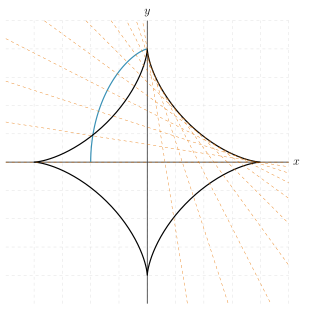
- \(\,\) \begin{align*}
&& \dot{x} &= -\sin t + \sin t + t \cos t \\
&&&= t \cos t \\
&& \dot{y} &= \cos t - \cos t + t \sin t \\
&&&= t \sin t \\
&& \frac{\d y}{\d x} &= \frac{t \sin t}{t \cos t} = \tan t \\
\\
&& \frac{y - (\sin \phi - \phi \cos \phi)}{x - (\cos \phi + \phi \sin \phi)} &= -\cot \phi \\
\Rightarrow && y &= -\cot \phi x + (\cos \phi + \phi \sin \phi) \cot \phi + \sin \phi - \phi \cos \phi \\
&&&= -\cot \phi x + \cos \phi \cot \phi + \phi \cos \phi + \sin \phi - \phi \cos \phi \\
&&&= -\cot \phi x + \frac{\cos^2 \phi + \sin^2 \phi}{\sin \phi} \\
&&&= -\cot \phi x + \cosec \phi
\end{align*}
The distance to the origin is \(\displaystyle \frac{|\cosec \phi|}{\sqrt{1 + \cot^2 \phi}} = 1\) so this normal is a tangent to \(x^2 + y^2 = 1\)
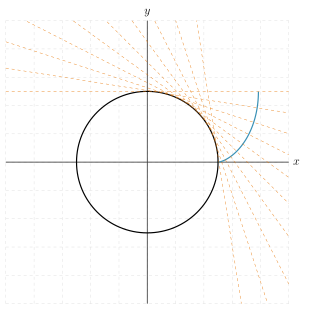
2021 Paper 3 Q2
- Let \[ x = \frac{a}{b - c}, \qquad y = \frac{b}{c - a} \qquad \text{and} \qquad z = \frac{c}{a - b}, \] where \(a\), \(b\) and \(c\) are distinct real numbers. Show that \[ \begin{pmatrix} 1 & -x & x \\ y & 1 & -y \\ -z & z & 1 \end{pmatrix} \begin{pmatrix} a \\ b \\ c \end{pmatrix} = \begin{pmatrix} 0 \\ 0 \\ 0 \end{pmatrix} \] and use this result to deduce that \(yz + zx + xy = -1\). Hence show that \[ \frac{a^2}{(b-c)^2} + \frac{b^2}{(c-a)^2} + \frac{c^2}{(a-b)^2} \geqslant 2. \]
- Let \[ x = \frac{2a}{b+c}, \qquad y = \frac{2b}{c+a} \qquad \text{and} \qquad z = \frac{2c}{a+b}, \] where \(a\), \(b\) and \(c\) are positive real numbers. Using a suitable matrix, show that \(xyz + yz + zx + xy = 4\). Hence show that \[ (2a + b + c)(a + 2b + c)(a + b + 2c) > 5(b+c)(c+a)(a+b). \] Show further that \[ (2a + b + c)(a + 2b + c)(a + b + 2c) > 7(b+c)(c+a)(a+b). \]
Solution:
- \(\,\) \begin{align*} && \begin{pmatrix} 1 & -x & x \\ y & 1 & -y \\ -z & z & 1 \end{pmatrix} \begin{pmatrix} a \\ b \\ c \end{pmatrix} &= \begin{pmatrix} a-xb+xc \\ ay+b-yc \\ -za+zb+c \end{pmatrix} \\ &&&= \begin{pmatrix} a-x(b-c) \\ b-y(c-a) \\ c-z(a-b) \end{pmatrix} \\ &&&= \begin{pmatrix} 0 \\ 0 \\ 0 \end{pmatrix} \end{align*} Notice since \(a,b\) and \(c\) are distinct real numbers the vector \(\langle a,b,c \rangle\) cannot be the zero vector, so the determinant of the matrix is zero, ie \(0= 1(1+yz)+x(y-yz)+x(yz+z) = 1 +yz+yx+zx\). Notice also then that \begin{align*} && \frac{a^2}{(b-c)^2} + \frac{b^2}{(c-a)^2} + \frac{c^2}{(a-b)^2} &= x^2+y^2+z^2 \\ &&&= (x+y+z)^2 - 2(xy+yz+zx) \\ &&&= 2 + (x+y+z)^2 \geq 2 \end{align*}
- \(\,\) \begin{align*} && \begin{pmatrix} 2 & -x & -x \\ -y & 2 & -y \\ -z & -z & 2 \end{pmatrix} \begin{pmatrix} a \\ b \\ c \end{pmatrix} &= \begin{pmatrix} 2a-xb-xc \\ -ay+2b-yc \\ -za-zb+2c \end{pmatrix} \\ &&&= \begin{pmatrix} 2a-x(b+c) \\ 2b-y(c+a) \\ 2c-z(a+b) \end{pmatrix} \\ &&&= \begin{pmatrix} 0 \\ 0 \\ 0 \end{pmatrix} \\ \Rightarrow && 0 &= \det \begin{pmatrix} 2 & -x & -x \\ -y & 2 & -y \\ -z & -z & 2 \end{pmatrix} \\ &&&= 2(4 -yz)+x(-2y-yz)-x(yz+2z) \\ &&&= 8 - 2yz-2yx-2xyz-2zx\\ \Rightarrow && 4 &= xyz+xy+yz+zx \end{align*} \begin{align*} && (2a + b + c)(a + 2b + c)(a + b + 2c) &> 5(b+c)(c+a)(a+b) \\ \Leftrightarrow && \left ( \frac{2a}{b+c}+1 \right)\left ( \frac{2b}{c+a}+1 \right)\left ( \frac{2c}{a+b}+1 \right) &> 5 \\ \Leftrightarrow && \left ( x+1 \right)\left ( y+1 \right)\left ( x+1 \right) &> 5 \\ \Leftrightarrow && xyz+xy+yz+zx+x+y+z+1 &> 5 \\ \Leftrightarrow && 5+x+y+z&> 5 \\ \end{align*} Which is clearly true since if \(a,b,c\) are positve real numbers so are \(x,y,z\). This final inequality is equivalent to showing \(x+y+z > 2\) ie \begin{align*} && x+y+z &> 2 \\ \Leftrightarrow && \frac{a}{b+c} + \frac{b}{c+a} + \frac{c}{a+b} &> 1 \\ \\ && \frac{a}{b+c} + \frac{b}{c+a} + \frac{c}{a+b} & > \frac{a}{a+b+c} + \frac{b}{a+b+c} + \frac{c}{a+b+c} = 1 \end{align*} So we're done.
2021 Paper 3 Q3
- Let \(\displaystyle I_n = \int_0^{\beta} (\sec x + \tan x)^n \, dx\), where \(n\) is a non-negative integer and \(0 < \beta < \dfrac{\pi}{2}\). For \(n \geqslant 1\), show that \[ \tfrac{1}{2}(I_{n+1} + I_{n-1}) = \frac{1}{n}\bigl[(\sec\beta + \tan\beta)^n - 1\bigr]. \] Show also that \[ I_n < \frac{1}{n}\bigl[(\sec\beta + \tan\beta)^n - 1\bigr]. \]
- Let \(\displaystyle J_n = \int_0^{\beta} (\sec x \cos\beta + \tan x)^n \, dx\), where \(n\) is a non-negative integer and \(0 < \beta < \dfrac{\pi}{2}\). For \(n \geqslant 1\), show that \[ J_n < \frac{1}{n}\bigl[(1 + \tan\beta)^n - \cos^n\beta\bigr]. \]
Solution: \begin{questionparts} \item \(\,\) \begin{align*} && I_n &= \int_0^{\beta} (\sec x + \tan x)^n \, \d x \\ && \tfrac12(I_{n+1}+I_{n-1}) &= \tfrac12\int_0^{\beta} \left ( (\sec x + \tan x)^{n+1}+(\sec x + \tan x)^{n-1}\right) \, \d x \\ && \tfrac12(I_{n+1}+I_{n-1}) &= \tfrac12\int_0^{\beta} (\sec x + \tan x)^{n-1}\left ( (\sec x + \tan x)^{2}+1\right) \, \d x \\ && \tfrac12(I_{n+1}+I_{n-1}) &= \tfrac12\int_0^{\beta} (\sec x + \tan x)^{n-1}\left ( \sec^2 x + \tan^2 x + 2\sec x \tan x + 1\right) \, \d x \\ && \tfrac12(I_{n+1}+I_{n-1}) &= \tfrac12\int_0^{\beta} (\sec x + \tan x)^{n-1}\left ( 2\sec x \tan x +2\sec^2 x \right) \, \d x \\ &&& = \left [\frac1n(\sec x + \tan x)^{n} \right]_0^{\beta} \\ &&&= \frac1n[(\sec \beta + \tan \beta)^n - 1] \end{align*} Notice that by AM-GM \(\tfrac12( ( (\sec x + \tan x)^{n+1}+(\sec x + \tan x)^{n-1}) \geq (\sec x + \tan x)^{n}\) with equality not holding most of the time. Integrating we obtain our result. \item \(\,\) \begin{align*} && J_n &= \int_0^{\beta} (\sec x \cos \beta + \tan x )^n \d x \\ && \tfrac12( J_{n+1} + J_{n-1}) &= \tfrac12 \int_0^{\beta} \left ( (\sec x \cos \beta + \tan x )^{n+1} +(\sec x \cos \beta + \tan x )^{n-1}\right ) \d x \\ && &= \tfrac12 \int_0^{\beta}(\sec x \cos \beta + \tan x )^{n-1} \left ( (\sec x \cos \beta + \tan x )^{2} + \right ) \d x \\ && &= \tfrac12 \int_0^{\beta}(\sec x \cos \beta + \tan x )^{n-1} \left ( \sec^2 x \cos^2 \beta + \tan^2 x+ 2\sec x \tan x \cos \beta +1 \right ) \d x \\ && &= \int_0^{\beta}(\sec x \cos \beta + \tan x )^{n-1} \left ( \sec x \tan x \cos \beta +\tfrac12(\cos^2 \beta +1)\sec^2 x \right ) \d x \\ && &< \int_0^{\beta}(\sec x \cos \beta + \tan x )^{n-1} \left ( \sec x \tan x \cos \beta +\sec^2 x \right ) \d x \\ &&&= \left [\frac1n (\sec x \cos \beta + \tan x)^{n} \right]_0^{\beta} \\ &&&= \frac1n[ (1 + \tan \beta)^n - \cos^n \beta] \end{align*} But notice we can use the same AM-GM argument from before to show that \(J_n < \tfrac12( J_{n+1} + J_{n-1}) < \frac1n[ (1 + \tan \beta)^n - \cos^n \beta]\)
2021 Paper 3 Q4
Let \(\mathbf{n}\) be a vector of unit length and \(\Pi\) be the plane through the origin perpendicular to \(\mathbf{n}\). For any vector \(\mathbf{x}\), the projection of \(\mathbf{x}\) onto the plane \(\Pi\) is defined to be the vector \(\mathbf{x} - (\mathbf{x} \cdot \mathbf{n})\,\mathbf{n}\). The vectors \(\mathbf{a}\) and \(\mathbf{b}\) each have unit length and the angle between them is \(\theta\), which satisfies \(0 < \theta < \pi\). The vector \(\mathbf{m}\) is given by \(\mathbf{m} = \tfrac{1}{2}(\mathbf{a} + \mathbf{b})\).
- Show that \(\mathbf{m}\) bisects the angle between \(\mathbf{a}\) and \(\mathbf{b}\).
- The vector \(\mathbf{c}\) also has unit length. The angle between \(\mathbf{a}\) and \(\mathbf{c}\) is \(\alpha\), and the angle between \(\mathbf{b}\) and \(\mathbf{c}\) is \(\beta\). Both angles are acute and non-zero. Let \(\mathbf{a}_1\) and \(\mathbf{b}_1\) be the projections of \(\mathbf{a}\) and \(\mathbf{b}\), respectively, onto the plane through the origin perpendicular to \(\mathbf{c}\). Show that \(\mathbf{a}_1 \cdot \mathbf{c} = 0\) and, by considering \(|\mathbf{a}_1|^2 = \mathbf{a}_1 \cdot \mathbf{a}_1\), show that \(|\mathbf{a}_1| = \sin\alpha\). Show also that the angle \(\varphi\) between \(\mathbf{a}_1\) and \(\mathbf{b}_1\) satisfies \[ \cos\varphi = \frac{\cos\theta - \cos\alpha\cos\beta}{\sin\alpha\sin\beta}. \]
- Let \(\mathbf{m}_1\) be the projection of \(\mathbf{m}\) onto the plane through the origin perpendicular to \(\mathbf{c}\). Show that \(\mathbf{m}_1\) bisects the angle between \(\mathbf{a}_1\) and \(\mathbf{b}_1\) if and only if \[ \alpha = \beta \qquad \text{or} \qquad \cos\theta = \cos(\alpha - \beta). \]
Solution:
- \(\,\) \begin{align*} && \cos \angle MOB &= \frac{\mathbf{m} \cdot \mathbf{b}}{|\mathbf{m}||\mathbf{b}|} \\ &&&= \frac{\cos \theta + 1}{2\sqrt{\frac14(\mathbf{a}+\mathbf{b})\cdot(\mathbf{a}+\mathbf{b})}} \\ &&&= \frac{\cos \theta + 1}{\sqrt{1+1+2\cos \theta}} \\ &&&= \frac{1 + \cos \theta}{\sqrt{2(1+\cos \theta})} \\ &&&= \frac1{\sqrt{2}} \sqrt{1+\cos \theta} \\ &&&= \cos \tfrac{\theta}{2} \end{align*} Since \(0 < \theta < \pi\) we must have \(\angle MOB = \tfrac{\theta}{2}\) ie it is the angle bisector.
- The plane through the origin perpendicular to \(\mathbf{c}\) has \(\mathbf{x} \cdot \mathbf{c} = 0\), so \begin{align*} && \mathbf{a}_1 \cdot \mathbf{c} &= (\mathbf{a} - (\mathbf{a} \cdot \mathbf{c}) \mathbf{c}) \cdot \mathbf{c} \\ &&&= \mathbf{a} \cdot \mathbf{c} - \mathbf{a} \cdot \mathbf{c} \\ &&&= 0 \\ \\ && |\mathbf{a}_1|^2 &= \mathbf{a}_1 \cdot \mathbf{a}_1 \\ &&&= (\mathbf{a} - (\mathbf{a} \cdot \mathbf{c}) \mathbf{c}) \cdot (\mathbf{a} - (\mathbf{a} \cdot \mathbf{c}) \mathbf{c}) \\ &&&= 1 - 2(\mathbf{a} \cdot \mathbf{c})^2 + \mathbf{a} \cdot \mathbf{c} \\ &&&= (1-\cos^2 \alpha) \\ &&&= \sin^2 \alpha \\ \Rightarrow && |\mathbf{a}_1| &= \sin \alpha \\ \Rightarrow && |\mathbf{b}_1| &= \sin \beta \tag{changing a and b} \\ \\ && \cos \phi &= \frac{\mathbf{a}_1 \cdot \mathbf{b}_1}{|\mathbf{a}_1||\mathbf{b}_1|} \\ &&&= \frac{(\mathbf{a} - (\mathbf{a} \cdot \mathbf{c}) \mathbf{c}) \cdot (\mathbf{b} - (\mathbf{b} \cdot \mathbf{c}) \mathbf{c})}{\sin \alpha \sin \beta} \\ &&&= \frac{\mathbf{a} \cdot \mathbf{b} - 2(\mathbf{a} \cdot \mathbf{c}) \cdot (\mathbf{b} \cdot \mathbf{c})+(\mathbf{a} \cdot \mathbf{c}) \cdot (\mathbf{b} \cdot \mathbf{c})}{\sin \alpha \sin \beta} \\ &&&= \frac{\cos \theta - \cos \alpha \cos \beta}{\sin \alpha \sin \beta} \end{align*}
- Note that \(\mathbf{m}_1 = \tfrac12(\mathbf{a}_1 + \mathbf{b}_1)\) either by expanding or by noting that projection is linear \begin{align*} && \cos \angle M_1OB_1 &= \frac{\mathbf{m}_1 \cdot \mathbf{b}_1}{|\mathbf{m}_1||\mathbf{b}_1|} \\ &&&= \frac{(\mathbf{a}_1 + \mathbf{b}_1) \cdot \mathbf{b}_1}{2|\mathbf{m}_1||\mathbf{b}_1|} \\ &&&= \frac{\mathbf{a}_1 \cdot \mathbf{b}_1 + |\mathbf{b}_1|^2}{2|\mathbf{m}_1||\mathbf{b}_1|} \\ &&&= \frac{|\mathbf{a}_1 || \mathbf{b}_1| \cos \phi + |\mathbf{b}_1|^2}{2|\mathbf{m}_1||\mathbf{b}_1|} \\ &&&= \frac{|\mathbf{a}_1 |\cos \phi + |\mathbf{b}_1|}{2|\mathbf{m}_1|} \\ &&&= \frac{\sin \alpha \cos \phi + \sin \beta}{2\sin \frac{\theta}{2}} \\ &&&= \frac{\sin \alpha \frac{\cos \theta - \cos \alpha \cos \beta}{\sin \alpha \sin \beta} + \sin \beta}{2\sin \frac{\theta}{2}} \\ &&&= \frac{\cos \theta - \cos \alpha \cos \beta+ \sin^2 \beta}{2\sin \frac{\theta}{2} \sin \beta} \\ \Rightarrow && \cos \angle M_1OA_1 &= \frac{\cos \theta - \cos \beta \cos \alpha+ \sin^2 \alpha}{2\sin \frac{\theta}{2} \sin \alpha} \end{align*} \(M_1\) is a bisector iff these two cosines are equal, ie \begin{align*} && \cos \angle M_1OB_1 &= \cos \angle M_1OA_1 \\ \Leftrightarrow && \frac{\cos \theta - \cos \alpha \cos \beta+ \sin^2 \beta}{2\sin \frac{\theta}{2} \sin \beta} &= \frac{\cos \theta - \cos \beta \cos \alpha+ \sin^2 \alpha}{2\sin \frac{\theta}{2} \sin \alpha} \\ \Leftrightarrow && \cos \theta (\sin \alpha - \sin \beta) &= \cos \alpha \cos \beta(\sin \alpha - \sin \beta) + \sin \alpha \sin \beta (\sin \alpha - \sin \beta) \\ \Leftrightarrow &&0 &= (\sin \alpha - \sin \beta)( \cos \theta - (\cos \alpha \cos \beta + \sin \alpha \sin \beta)) \\ &&&= (\sin \alpha - \sin \beta) (\cos \theta - \cos (\alpha - \beta)) \end{align*} From which the result immediately follows
2021 Paper 3 Q5
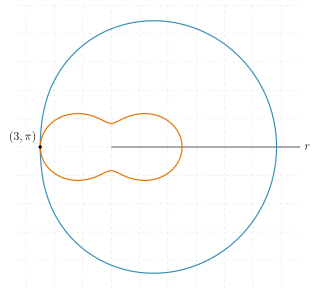
Two curves have polar equations \(r = a + 2\cos\theta\) and \(r = 2 + \cos 2\theta\), where \(r \geqslant 0\) and \(a\) is a constant.
- Show that these curves meet when \[ 2\cos^2\theta - 2\cos\theta + 1 - a = 0. \] Hence show that these curves touch if \(a = \tfrac{1}{2}\) and find the other two values of \(a\) for which the curves touch.
- Sketch the curves \(r = a + 2\cos\theta\) and \(r = 2 + \cos 2\theta\) on the same diagram in the case \(a = \tfrac{1}{2}\). Give the values of \(r\) and \(\theta\) at the points at which the curves touch and justify the other features you show on your sketch.
- On two further diagrams, one for each of the other two values of \(a\), sketch both the curves \(r = a + 2\cos\theta\) and \(r = 2 + \cos 2\theta\). Give the values of \(r\) and \(\theta\) at the points at which the curves touch and justify the other features you show on your sketch.
Solution:
- The curves meet when they have the same radius for a given \(\theta\) ie \begin{align*} && a + 2 \cos \theta &= 2 + \cos 2 \theta \\ &&&= 2 + 2\cos^2 \theta - 1 \\ \Rightarrow && 0 &= 2 \cos ^2 \theta - 2 \cos \theta + 1 - a \end{align*} The curves touch if this has a repeated root, ie \(0 = \Delta = 4 - 8(1-a) \Rightarrow a = \frac12\). The second way the curves can touch is if there is a single root, but it's at an extreme value of \(\cos \theta = \pm 1\) ie \(0 = 2 - 2\cdot(\pm1) + 1 - a \Rightarrow a = 3 \pm 2 = 1, 5\)
- Suppose \(a = \frac12\) then the curves touch when \(0 = 2\cos^2 \theta - 2 \cos \theta + \frac12 = (2 \cos \theta-1 )(\cos \theta -\frac12) \Rightarrow \theta = \pm \frac{\pi}{3}\)
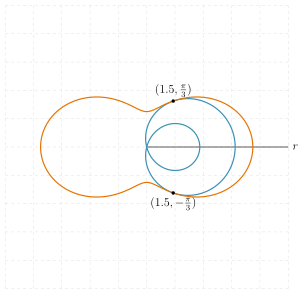
- \(a = 1\)
\(a = 5\)
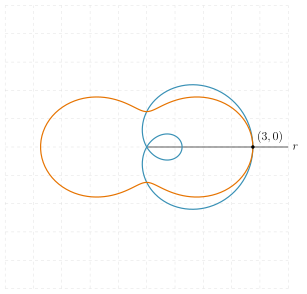
2021 Paper 3 Q6
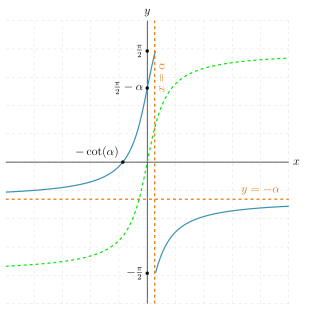
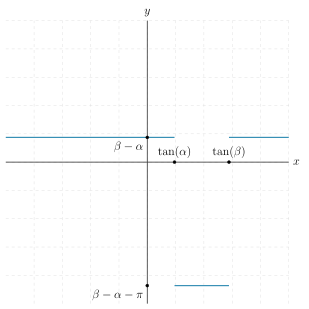
- For \(x \neq \tan\alpha\), the function \(f_\alpha\) is defined by \[ f_\alpha(x) = \tan^{-1}\!\left(\frac{x\tan\alpha + 1}{\tan\alpha - x}\right) \] where \(0 < \alpha < \tfrac{1}{2}\pi\). Show that \(f_\alpha'(x) = \dfrac{1}{1 + x^2}\). Hence sketch \(y = f_\alpha(x)\). On a separate diagram, sketch \(y = f_\alpha(x) - f_\beta(x)\) where \(0 < \alpha < \beta < \tfrac{1}{2}\pi\).
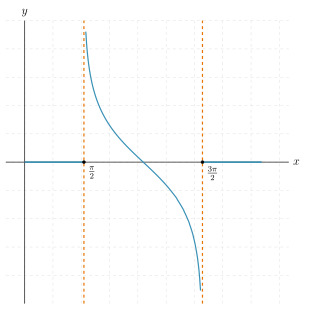
- For \(0 \leqslant x \leqslant 2\pi\) and \(x \neq \tfrac{1}{2}\pi,\, \tfrac{3}{2}\pi\), the function \(g(x)\) is defined by \[ g(x) = \tanh^{-1}(\sin x) - \sinh^{-1}(\tan x). \] For \(\tfrac{1}{2}\pi < x < \tfrac{3}{2}\pi\), show that \(g'(x) = 2\sec x\). Use this result to sketch \(y = g(x)\) for \(0 \leqslant x \leqslant 2\pi\).
Solution:
- \(\,\) \begin{align*}
&& f_\alpha(x) &= \tan^{-1}\!\left(\frac{x\tan\alpha + 1}{\tan\alpha - x}\right) \\
&& f'_\alpha(x) &= \frac{1}{1 + \left(\frac{x\tan\alpha + 1}{\tan\alpha - x}\right) ^2} \cdot \frac{\tan \alpha \cdot (\tan \alpha - x) - (x \tan \alpha + 1) \cdot (-1)}{(\tan \alpha - x)^2} \\
&&&= \frac{\tan^2 \alpha -1}{(\tan \alpha - x)^2 + (x \tan \alpha +1)^2} \\
&&&= \frac{\tan^2 \alpha +1}{\tan^2 \alpha - 2x \tan \alpha + x^2 + x^2 \tan^2 \alpha + 2 x \tan \alpha + 1} \\
&&&= \frac{1+\tan^2 \alpha}{(1+\tan^2 \alpha(x^2 + 1)} = \frac{1}{1+x^2}
\end{align*}
- Let \(g(x) = \tanh^{-1}(\sin x) - \sinh^{-1}(\tan x)\) then
\begin{align*}
&& g'(x) &= \frac{1}{1-\sin^2 x} \cdot \cos x - \frac{1}{\sqrt{\tan^2 +1}} \cdot \sec^2 x \\
&&&= \sec x - \frac{\sec^2 x}{|\sec x|} \\
&&& = \begin{cases} 0 &\text{if } \sec x \geq 0 \\
2 \sec x &\text{ otherwise}
\end{cases}
\end{align*}
Therefore \(g'(x) = 2\sec x\) if \(\tfrac12 \pi < x < \tfrac32\pi\)
Therefore $\displaystyle g(x) = \begin{cases} 0 & \text{if } x \in [0, \frac{\pi}{2}] \cup [\frac{3\pi}{2}, 2\pi] \\
\ln( (\tan x + \sec x)^2) + C &\text{otherwise} \end{cases}$
2021 Paper 3 Q7
- Let \[ z = \frac{e^{i\theta} + e^{i\phi}}{e^{i\theta} - e^{i\phi}}, \] where \(\theta\) and \(\phi\) are real, and \(\theta - \phi \neq 2n\pi\) for any integer \(n\). Show that \[ z = i\cot\!\bigl(\tfrac{1}{2}(\phi - \theta)\bigr) \] and give expressions for the modulus and argument of \(z\).
- The distinct points \(A\) and \(B\) lie on a circle with radius \(1\) and centre \(O\). In the complex plane, \(A\) and \(B\) are represented by the complex numbers \(a\) and \(b\), and \(O\) is at the origin. The point \(X\) is represented by the complex number \(x\), where \(x = a + b\) and \(a + b \neq 0\). Show that \(OX\) is perpendicular to \(AB\). If the distinct points \(A\), \(B\) and \(C\) in the complex plane, which are represented by the complex numbers \(a\), \(b\) and \(c\), lie on a circle with radius \(1\) and centre \(O\), and \(h = a + b + c\) represents the point \(H\), then \(H\) is said to be the orthocentre of the triangle \(ABC\).
- The distinct points \(A\), \(B\) and \(C\) lie on a circle with radius \(1\) and centre \(O\). In the complex plane, \(A\), \(B\) and \(C\) are represented by the complex numbers \(a\), \(b\) and \(c\), and \(O\) is at the origin. Show that, if the point \(H\), represented by the complex number \(h\), is the orthocentre of the triangle \(ABC\), then either \(h = a\) or \(AH\) is perpendicular to \(BC\).
- The distinct points \(A\), \(B\), \(C\) and \(D\) (in that order, anticlockwise) all lie on a circle with radius \(1\) and centre \(O\). The points \(P\), \(Q\), \(R\) and \(S\) are the orthocentres of the triangles \(ABC\), \(BCD\), \(CDA\) and \(DAB\), respectively. By considering the midpoint of \(AQ\), show that there is a single transformation which maps the quadrilateral \(ABCD\) onto the quadrilateral \(QRSP\) and describe this transformation fully.
Solution:
- \(\,\) \begin{align*} && z &= \frac{e^{i \theta} + e^{i \phi}}{e^{i \theta} - e^{i \phi}} \\ &&&= \frac{e^{i\frac12(\theta +\phi)}(e^{i \frac12(\theta-\phi)} + e^{-i\frac12(\theta- \phi)})}{e^{i\frac12(\theta +\phi)}(e^{i \frac12(\theta-\phi)} - e^{-i\frac12(\theta- \phi)})} \\ &&&= \frac{(e^{i \frac12(\theta-\phi)} + e^{-i\frac12(\theta- \phi)})/2}{i(e^{i \frac12(\theta-\phi)} - e^{-i\frac12(\theta- \phi)})/2i} \\ &&&= \frac{\cos \frac12(\theta-\phi)}{i \sin \frac12(\theta-\phi)} \\ &&&= -i \cot \tfrac12(\theta-\phi) \end{align*} Therefore \(|z| = \cot \tfrac12(\theta-\phi)\) and \(\arg z = \frac{\pi}{2}\)
- Since \(a,b\) lie on the unit circle, wlog \(a = e^{i \theta}, b = e^{i\phi}\). Not that the line \(OX\) has vector \(a+b\) and \(AB\) has vector \(b-a\) and not their ratio has argument \(\frac{\pi}{2}\) and hence they are perpendicular.
- \(AH\) has vector \(h - a = (a+b+c) - a = b+c\) which we've already established is perpendicular to \(c-b\) which is the vector for \(BC\) (unless \(b+c = 0\) in which case \(h = a\)).
- \(p = a +b+c, q = b+c+d\) etc. The midpoint of \(AQ = \frac12(a+b+c+d)\) which is the same as the midpoint of \(BR\), \(CS\) and \(DP\). Therefore we could say the transformation is reflection in the point \(\frac12(a+b+c+d)\)
2021 Paper 3 Q8
A sequence \(x_1, x_2, \ldots\) of real numbers is defined by \(x_{n+1} = x_n^2 - 2\) for \(n \geqslant 1\) and \(x_1 = a\).
- Show that if \(a > 2\) then \(x_n \geqslant 2 + 4^{n-1}(a-2)\).
- Show also that \(x_n \to \infty\) as \(n \to \infty\) if and only if \(|a| > 2\).
- When \(a > 2\), a second sequence \(y_1, y_2, \ldots\) is defined by \[ y_n = \frac{Ax_1 x_2 \cdots x_n}{x_{n+1}}, \] where \(A\) is a positive constant and \(n \geqslant 1\). Prove that, for a certain value of \(a\), with \(a > 2\), which you should find in terms of \(A\), \[ y_n = \frac{\sqrt{x_{n+1}^2 - 4}}{x_{n+1}} \] for all \(n \geqslant 1\). Determine whether, for this value of \(a\), the second sequence converges.
Solution:
- Claim \(x_n \geqslant 2 + 4^{n-1}(a-2)\) Proof: (By induction) Base case: Note that when \(n = 1\), \(x_1 = a = 2 + 1 \cdot(a - 2)\). Inductive step, suppose true for some \(n\), then \begin{align*} && x_{n+1} &= x_n^2 - 2 \\ &&&\geq (2+4^{n-1}(a-2))^2 - 2 \\ &&&= 4 + 4^{2n-2}(a-2)^2 + 4^n(a-2) - 2 \\ &&&= 2 + 4^{n}(a-2) + 4^{2n-2}(a-2)^2 \\ &&&\geq 2 + 4^{n+1-1}(a-2) \end{align*} as required,
- (\(\Leftarrow\)) Suppose \(a > 2\) then \(x_n \geq 2+4^{n-1}(a-2) \to \infty\) as required. Suppose \(a < -2\) then \(x_2 > 4 -2 = 2\) so the sequence starting from \(x_2\) clearly diverges for the same reason. (\(\Rightarrow\)) suppose \(|x_n| \leq 2\) then \(x_{n+1} = x_n^2 - 2 \leq 2\) so the sequence is bounded and cannot tend to \(\infty\).
- Suppose \(y_n = \frac{Ax_1x_2 \cdots x_n}{x_{n+1}}\) and notice that \(x_{n+1}^2 - 4 = (x_n^2 -2)^2 - 4 = x_n^4 - 4x_n^2 = x_n^2(x_n^2-4)\). In particular, \(\frac{\sqrt{x_{n+1}^2-4}}{x_{n+1}} = \frac{x_n\sqrt{x_n^2-4}}{x_{n+1}} = \frac{x_n x_{n-1} \cdots x_1 \sqrt{x_1^2-4}}{x_{n+1}}\) Therefore if \(A = \sqrt{a^2-4}\) \(y_{n+1} = \frac{\sqrt{x_{n+1}^2-4}}{x_{n+1}}\). Notice that \begin{align*} && y_n &= \frac{\sqrt{x_{n+1}^2-4}}{x_{n+1}} \\ &&&= \sqrt{1 - \frac{4}{x_{n+1}^2}} \to 1 \end{align*}
2021 Paper 3 Q9
An equilateral triangle \(ABC\) has sides of length \(a\). The points \(P\), \(Q\) and \(R\) lie on the sides \(BC\), \(CA\) and \(AB\), respectively, such that the length \(BP\) is \(x\) and \(QR\) is parallel to \(CB\). Show that \[ (\sqrt{3}\cot\phi + 1)(\sqrt{3}\cot\theta + 1)x = 4(a - x), \] where \(\theta = \angle CPQ\) and \(\phi = \angle BRP\). A horizontal triangular frame with sides of length \(a\) and vertices \(A\), \(B\) and \(C\) is fixed on a smooth horizontal table. A small ball is placed at a point \(P\) inside the frame, in contact with side \(BC\) at a distance \(x\) from \(B\). It is struck so that it moves round the triangle \(PQR\) described above, bouncing off the frame at \(Q\) and then \(R\) before returning to point \(P\). The frame is smooth and the coefficient of restitution between the ball and the frame is \(e\). Show that \[ x = \frac{ae}{1 + e}. \] Show further that if the ball continues to move round \(PQR\) after returning to \(P\), then \(e = 1\).
Solution:
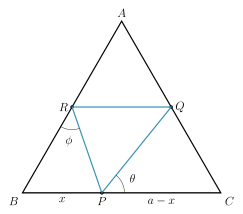
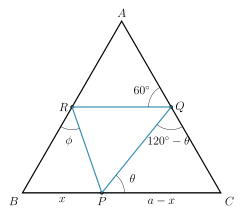
2021 Paper 3 Q10
The origin \(O\) of coordinates lies on a smooth horizontal table and the \(x\)- and \(y\)-axes lie in the plane of the table. A cylinder of radius \(a\) is fixed to the table with its axis perpendicular to the \(x\)--\(y\) plane and passing through \(O\), and with its lower circular end lying on the table. One end, \(P\), of a light inextensible string \(PQ\) of length \(b\) is attached to the bottom edge of the cylinder at \((a, 0)\). The other end, \(Q\), is attached to a particle of mass \(m\), which rests on the table. Initially \(PQ\) is straight and perpendicular to the radius of the cylinder at \(P\), so that \(Q\) is at \((a, b)\). The particle is then given a horizontal impulse parallel to the \(x\)-axis so that the string immediately begins to wrap around the cylinder. At time \(t\), the part of the string that is still straight has rotated through an angle \(\theta\), where \(a\theta < b\).
- Obtain the Cartesian coordinates of the particle at this time. Find also an expression for the speed of the particle in terms of \(\theta\), \(\dot{\theta}\), \(a\) and \(b\).
- Show that \[ \dot{\theta}(b - a\theta) = u, \] where \(u\) is the initial speed of the particle.
- Show further that the tension in the string at time \(t\) is \[ \frac{mu^2}{\sqrt{b^2 - 2aut}}. \]
Solution:
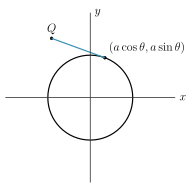
- The line to the circle is tangent, and the point it meets the circle is \((a \cos \theta, a \sin \theta)\) and it will be a distance \(b - a \theta\) away, therefore it is at \((a \cos \theta - (b-a \theta) \sin \theta, a \sin \theta + (b-a \theta) \cos \theta)\)
- The velocity will be \(\displaystyle \binom{-a \dot{\theta}\sin \theta-b \dot{\theta}\cos \theta + a \dot{\theta} \sin \theta + a \theta \dot{\theta} \cos \theta}{ a \dot{\theta} \cos \theta - b \dot{\theta} \sin \theta -a \dot{\theta} \cos \theta + a \theta \dot{\theta} \sin \theta}= \binom{-b \dot{\theta}\cos \theta + a \theta \dot{\theta} \cos \theta}{ - b \dot{\theta} \sin \theta + a \theta \dot{\theta} \sin \theta}\) Therefore the speed will be \(\dot{\theta}(b-a\theta)\)
- Conservation of energy and the fact that the tension is perpendicular to the velocity means no work is being done on the particle and hence it's speed is unchanged. So \(u = \dot{\theta}(b-a\theta)\).
- Note that the acceleration is \begin{align*} && \mathbf{a} &= \frac{\d}{\d t} \left (-\dot{\theta}(b-a\theta) \binom{\cos \theta}{\sin \theta} \right) \\ &&&=-u \dot{\theta}\binom{-\sin \theta}{\cos \theta} \\ \Rightarrow && T &= ma \\ &&&= \frac{mu^2}{b - a \theta} \end{align*} It would be valuable to have \(\theta\) in terms of \(t\), so we want to solve \begin{align*} &&\frac{\d \theta}{\d t} (b-a\theta) &= u \\ \Rightarrow && b \theta - a\frac{\theta^2}{2} + C &= ut \\ t = 0, \theta = 0: && C &= 0 \\ \Rightarrow && b\theta - \frac{a}{2} \theta^2 &= ut \\ \Rightarrow && \theta &= \frac{b \pm \sqrt{b^2-2aut}}{a} \end{align*} At \(t\) increases, \(\theta\) increases so \(a\theta = b -\sqrt{b^2-2aut}\) or \(b-a \theta = \sqrt{b^2-2aut}\) and the result follows
2021 Paper 3 Q11
The continuous random variable \(X\) has probability density function \[ f(x) = \begin{cases} \lambda e^{-\lambda x} & \text{for } x \geqslant 0, \\ 0 & \text{otherwise,} \end{cases} \] where \(\lambda\) is a positive constant. The random variable \(Y\) is the greatest integer less than or equal to \(X\), and \(Z = X - Y\).
- Show that, for any non-negative integer \(n\), \[ \mathrm{P}(Y = n) = (1 - e^{-\lambda})\,e^{-n\lambda}. \]
- Show that \[ \mathrm{P}(Z < z) = \frac{1 - e^{-\lambda z}}{1 - e^{-\lambda}} \qquad \text{for } 0 \leqslant z \leqslant 1. \]
- Evaluate \(\mathrm{E}(Z)\).
- Obtain an expression for \[ \mathrm{P}(Y = n \text{ and } z_1 < Z < z_2), \] where \(0 \leqslant z_1 < z_2 \leqslant 1\) and \(n\) is a non-negative integer. Determine whether \(Y\) and \(Z\) are independent.
Solution:
- \(\,\) \begin{align*} && \mathbb{P}(Y = n) &= \mathbb{P}(X \in [n, n+1)) \\ &&&= \int_n^{n+1} \lambda e^{-\lambda x} \d x \\ &&&= \left [-e^{-\lambda x} \right]_n^{n+1} \\ &&&= e^{-\lambda n} - e^{-\lambda(n+1)} \\ &&&= e^{-\lambda n}(1- e^{-\lambda}) \end{align*}
- \(,\) \begin{align*} && \mathbb{P}(Z < z) &= \sum_{i=0}^{\infty} \mathbb{P}(X \in (n, n+z)) \\ &&&= \sum_{i=0}^{\infty} \int_{n}^{n+z} \lambda e^{-\lambda x} \d x \\ &&&= \sum_{i=0}^{\infty} [-e^{-\lambda x}]_{n}^{n+z} \\ &&&= \sum_{i=0}^{\infty} (1-e^{-\lambda x})e^{-\lambda n} \\ &&&= \frac{1-e^{-\lambda x}}{1-e^{-\lambda}} \end{align*}
- Give the cdf of \(Z\), we see that \(f_Z(z) = \frac{\lambda e^{-\lambda z}}{1-e^{-\lambda}}\) so \begin{align*} && \E[Z] &= \int_0^1 z \frac{\lambda e^{-\lambda z}}{1-e^{-\lambda}} \d z \\ &&&= \frac{\lambda}{1-e^{-\lambda}} \int_0^1 ze^{-\lambda z} \d z \\ &&&= \frac{\lambda}{1-e^{-\lambda}} \left ( \left [-\frac{1}{\lambda} ze^{-\lambda z} \right]_0^1+\int_0^1 \frac{1}{\lambda} e^{-\lambda z} \d z \right) \\ &&&= \frac{\lambda}{1-e^{-\lambda}} \left ( -\frac{e^{-\lambda}}{\lambda} + \frac{1-e^{-\lambda}}{\lambda^2} \right) \\ &&&= \frac{1-e^{-\lambda}(1+\lambda)}{\lambda (1-e^{-\lambda})} \end{align*}
- \(\,\) \begin{align*} && \mathbb{P}(Y = n \text{ and }z_1 < Z < z_2)&= \mathbb{P}(X \in (n+z_1, n+z_2) ) \\ &&&= \int_{n+z_1}^{n+z_2} \lambda e^{-\lambda x} \d x \\ &&&= e^{-n\lambda}(e^{-\lambda z_1} - e^{-\lambda z_2}) \end{align*} Note that \(\mathbb{P}(z_1 < Z < z_2) = \mathbb{P}( Z < z_2) -\mathbb{P}(Z< z_1) =\frac{e^{-\lambda z_1} - e^{-\lambda z_2}}{1-e^{-\lambda}}\) Therefore \begin{align*} && \mathbb{P}(Y = n \text{ and }z_1 < Z < z_2) &= e^{-n\lambda}(e^{-\lambda z_1} - e^{-\lambda z_2}) \\ &&&= e^{-\lambda n}(1-e^{-\lambda}) \frac{e^{-\lambda z_1} - e^{-\lambda z_2}}{1-e^{-\lambda}} \\ &&&= \mathbb{P}(Y=n) \mathbb{P}(z_1 < Z < z_2) \end{align*} So they are independent, which is to be expected from the memorylessness property of the exponential distribution.
2021 Paper 3 Q12
- In a game, each member of a team of \(n\) players rolls a fair six-sided die. The total score of the team is the number of pairs of players rolling the same number. For example, if \(7\) players roll \(3, 3, 3, 3, 6, 6, 2\) the total score is \(7\), as six different pairs of players both score \(3\) and one pair of players both score \(6\). Let \(X_{ij}\), for \(1 \leqslant i < j \leqslant n\), be the random variable that takes the value \(1\) if players \(i\) and \(j\) roll the same number and the value \(0\) otherwise. Show that \(X_{12}\) is independent of \(X_{23}\). Hence find the mean and variance of the team's total score.
- Show that, if \(Y_i\), for \(1 \leqslant i \leqslant m\), are random variables with mean zero, then \[ \mathrm{Var}(Y_1 + Y_2 + \cdots + Y_m) = \sum_{i=1}^{m} \mathrm{E}(Y_i^2) + 2\sum_{i=1}^{m-1}\sum_{j=i+1}^{m} \mathrm{E}(Y_i Y_j). \]
- In a different game, each member of a team of \(n\) players rolls a fair six-sided die. The total score of the team is the number of pairs of players rolling the same even number minus the number of pairs of players rolling the same odd number. For example, if \(7\) players roll \(3, 3, 3, 3, 6, 6, 2\) the total score is \(-5\). Let \(Z_{ij}\), for \(1 \leqslant i < j \leqslant n\), be the random variable that takes the value \(1\) if players \(i\) and \(j\) roll the same even number, the value \(-1\) if players \(i\) and \(j\) roll the same odd number and the value \(0\) otherwise. Show that \(Z_{12}\) is not independent of \(Z_{23}\). Find the mean of the team's total score and show that the variance of the team's total score is \(\dfrac{1}{36}n(n^2 - 1)\).
Solution:
- First note that \(\mathbb{P}(X_{ij} = 1) = \frac16\) since it doesn't matter what \(i\) rolls, it only matters that \(j\) rolls the same thing, which happens \(1/6\) of the time. \begin{align*} && \mathbb{P}(X_{12} = 1, X_{23} = 1) &= \mathbb{P}(1, 2\text{ and }3\text{ all roll the same})\\ &&&= \frac{6}{6^3}= \frac1{6^2} \\ &&&= \mathbb{P}(X_{12} = 1)\mathbb{P}(X_{23} = 1) \\ && \mathbb{P}(X_{12} = 1, X_{23} = 0) &= \mathbb{P}(1, 2\text{ roll the same and }3\text{ rolls different}) \\ &&&= \frac{6 \cdot 1 \cdot 5}{6^3} = \frac{5}{6^2} \\ &&&= \mathbb{P}(X_{12} = 1)\mathbb{P}(X_{23} = 0) \\ && \mathbb{P}(X_{12} = 0, X_{23} = 0) &= \mathbb{P}(2, 3 \text{ roll different to} 2)\\ &&&= \frac{6 \cdot 5 \cdot 5}{6^3}= \frac{5^2}{6^2} \\ &&&= \mathbb{P}(X_{12} = 0)\mathbb{P}(X_{23} = 0) \end{align*} Therefore they are independent (the final case is clear by symmetry from case 2). Note that the score is \(S = \sum_{i \neq j} X_{ij}\) so \begin{align*} && \E[S] &= \E \left [ \sum_{i \neq j} X_{ij} \right] \\ &&&= \sum_{i \neq j} \E \left [ X_{ij} \right] \\ &&&= \sum_{i \neq j} \frac16 \\ &&&= \binom{n}{2} \frac16 = \frac{n(n-1)}{12} \\ \\ && \var[S] &= \var \left [ \sum_{i \neq j} X_{ij} \right] \\ &&& \sum_{i \neq j} \var \left [X_{ij} \right] \tag{pairwise ind.} \\ &&&= \binom{n}{2} \frac{5}{36} = \frac{5n(n-1)}{72} \end{align*}
- Note that \(\mathbb{P}(Z_{ij} = 1)=\mathbb{P}(Z_{ij} = -1) = \frac{3}{6^2} = \frac{1}{12}\) but that \(\mathbb{P}(Z_{12} = 1, Z_{23} = -1) = 0\). Notice that \(Z_{12}Z_{23}\) is either \(1\) or \(0\) (since \(2\) can't be both odd and even). \(\mathbb{P}(Z_{12}Z_{23} = 1) = \frac{1}{36}\). Notice that \(Z_{ij}, Z_{kl}\) are independent if \(i \neq j \neq k \neq l\) and so \begin{align*} && \E[T] &= \E \left [ \sum_{i \neq j} Z_{ij} \right] \\ &&&= \sum_{i \neq j}\E \left [ Z_{ij} \right] \\ &&&= 0 \\ \\ && \E[T^2] &= \E \left [ \left ( \sum_{i \neq j} Z_{ij} \right)^2 \right] \\ &&&= \E \left [ \sum_{i \neq j} Z_{ij}^2 + \sum_{i \neq j \neq k} Z_{ij}Z_{jk} + \sum_{i \neq j \neq k \neq l} Z_{ij}Z_{kl}\right] \\ &&&= \binom{n}{2} \frac{1}{6} + 2\frac{n(n-1)(n-2)}{2} \frac{1}{36} + 0 \\ &&&= \frac{n(n-1)}{12} + \frac{n(n-1)(n-2)}{6} \\ &&&= \frac{n(n-1)[3 + (n-2)]}{36} \\ &&&= \frac{n(n^2-1)}{36} \end{align*}