2021 Paper 3 Q6
Year: 2021
Paper: 3
Question Number: 6
Course: UFM Pure
Section: Hyperbolic functions
Problem
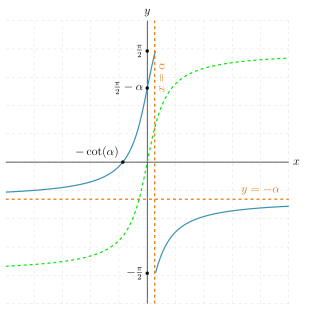
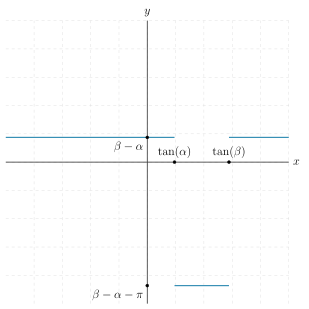
- For \(x \neq \tan\alpha\), the function \(f_\alpha\) is defined by \[ f_\alpha(x) = \tan^{-1}\!\left(\frac{x\tan\alpha + 1}{\tan\alpha - x}\right) \] where \(0 < \alpha < \tfrac{1}{2}\pi\). Show that \(f_\alpha'(x) = \dfrac{1}{1 + x^2}\). Hence sketch \(y = f_\alpha(x)\). On a separate diagram, sketch \(y = f_\alpha(x) - f_\beta(x)\) where \(0 < \alpha < \beta < \tfrac{1}{2}\pi\).
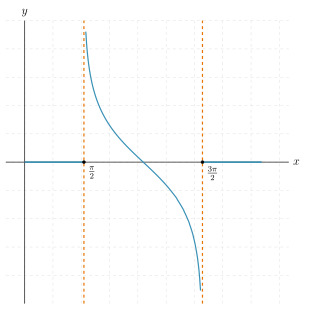
- For \(0 \leqslant x \leqslant 2\pi\) and \(x \neq \tfrac{1}{2}\pi,\, \tfrac{3}{2}\pi\), the function \(g(x)\) is defined by \[ g(x) = \tanh^{-1}(\sin x) - \sinh^{-1}(\tan x). \] For \(\tfrac{1}{2}\pi < x < \tfrac{3}{2}\pi\), show that \(g'(x) = 2\sec x\). Use this result to sketch \(y = g(x)\) for \(0 \leqslant x \leqslant 2\pi\).
Solution
- \(\,\) \begin{align*}
&& f_\alpha(x) &= \tan^{-1}\!\left(\frac{x\tan\alpha + 1}{\tan\alpha - x}\right) \\
&& f'_\alpha(x) &= \frac{1}{1 + \left(\frac{x\tan\alpha + 1}{\tan\alpha - x}\right) ^2} \cdot \frac{\tan \alpha \cdot (\tan \alpha - x) - (x \tan \alpha + 1) \cdot (-1)}{(\tan \alpha - x)^2} \\
&&&= \frac{\tan^2 \alpha -1}{(\tan \alpha - x)^2 + (x \tan \alpha +1)^2} \\
&&&= \frac{\tan^2 \alpha +1}{\tan^2 \alpha - 2x \tan \alpha + x^2 + x^2 \tan^2 \alpha + 2 x \tan \alpha + 1} \\
&&&= \frac{1+\tan^2 \alpha}{(1+\tan^2 \alpha(x^2 + 1)} = \frac{1}{1+x^2}
\end{align*}
- Let \(g(x) = \tanh^{-1}(\sin x) - \sinh^{-1}(\tan x)\) then
\begin{align*}
&& g'(x) &= \frac{1}{1-\sin^2 x} \cdot \cos x - \frac{1}{\sqrt{\tan^2 +1}} \cdot \sec^2 x \\
&&&= \sec x - \frac{\sec^2 x}{|\sec x|} \\
&&& = \begin{cases} 0 &\text{if } \sec x \geq 0 \\
2 \sec x &\text{ otherwise}
\end{cases}
\end{align*}
Therefore \(g'(x) = 2\sec x\) if \(\tfrac12 \pi < x < \tfrac32\pi\)
Therefore $\displaystyle g(x) = \begin{cases} 0 & \text{if } x \in [0, \frac{\pi}{2}] \cup [\frac{3\pi}{2}, 2\pi] \\
\ln( (\tan x + \sec x)^2) + C &\text{otherwise} \end{cases}$
Examiner's report
— 2021 STEP 3, Question 6The total entry was a marginal increase from that of 2019, that of 2020 having been artificially reduced. Comfortably more than 90% attempted one of the questions, four others were very popular, and a sixth was attempted by 70%. Every question was attempted by at least 10% of the candidature. 85% of candidates attempted no more than 7 questions, though very nearly all the candidates made genuine attempts on at most six questions (the extra attempts being at times no more than labelling a page or writing only the first line or two). Generally, candidates should be aware that when asked to "Show that" they must provide enough working to fully substantiate their working, and that they should follow the instructions in a question, so if it says "Hence", they should be using the previous work in the question in order to complete the next part. Likewise, candidates should be careful when dividing or multiplying, that things are positive, or at other times non-zero.
Rating Information
Difficulty Rating: 1500.0
Difficulty Comparisons: 0
Banger Rating: 1500.0
Banger Comparisons: 0
Show LaTeX source
Problem source
\begin{questionparts}
    \item For $x \neq \tan\alpha$, the function $f_\alpha$ is defined by
    \[
        f_\alpha(x) = \tan^{-1}\!\left(\frac{x\tan\alpha + 1}{\tan\alpha - x}\right)
    \]
    where $0 < \alpha < \tfrac{1}{2}\pi$.

    Show that $f_\alpha'(x) = \dfrac{1}{1 + x^2}$.

    Hence sketch $y = f_\alpha(x)$.

    On a separate diagram, sketch $y = f_\alpha(x) - f_\beta(x)$ where $0 < \alpha < \beta < \tfrac{1}{2}\pi$.

    \item For $0 \leqslant x \leqslant 2\pi$ and $x \neq \tfrac{1}{2}\pi,\, \tfrac{3}{2}\pi$, the function $g(x)$ is defined by
    \[
        g(x) = \tanh^{-1}(\sin x) - \sinh^{-1}(\tan x).
    \]
    For $\tfrac{1}{2}\pi < x < \tfrac{3}{2}\pi$, show that $g'(x) = 2\sec x$.

    Use this result to sketch $y = g(x)$ for $0 \leqslant x \leqslant 2\pi$.
\end{questionparts}
Solution source
\begin{questionparts}
\item $\,$ \begin{align*}
&&  f_\alpha(x) &= \tan^{-1}\!\left(\frac{x\tan\alpha + 1}{\tan\alpha - x}\right) \\
&& f'_\alpha(x) &= \frac{1}{1 + \left(\frac{x\tan\alpha + 1}{\tan\alpha - x}\right) ^2} \cdot \frac{\tan \alpha \cdot (\tan \alpha - x) - (x \tan \alpha + 1) \cdot (-1)}{(\tan \alpha - x)^2} \\
&&&= \frac{\tan^2 \alpha -1}{(\tan \alpha - x)^2 + (x \tan \alpha +1)^2} \\
&&&= \frac{\tan^2 \alpha +1}{\tan^2 \alpha - 2x \tan \alpha + x^2 + x^2 \tan^2 \alpha + 2 x \tan \alpha + 1} \\
&&&= \frac{1+\tan^2 \alpha}{(1+\tan^2 \alpha(x^2 + 1)} = \frac{1}{1+x^2}
\end{align*}


\begin{center}
    \begin{tikzpicture}
    \def\a{pi/6};
    \def\functionf(#1){atan(((#1)*tan(deg(\a))+1)/(tan(deg(\a))-(#1)))*pi/180};
    \def\xl{-10};
    \def\xu{10};
    \def\yl{-2};
    \def\yu{2};

    % Calculate scaling factors to make the plot square
    \pgfmathsetmacro{\xrange}{\xu-\xl}
    \pgfmathsetmacro{\yrange}{\yu-\yl}
    \pgfmathsetmacro{\xscale}{10/\xrange}
    \pgfmathsetmacro{\yscale}{10/\yrange}

    % Define the reusable styles to keep code clean
    \tikzset{
        x=\xscale cm, y=\yscale cm,
        axis/.style={thick, draw=black!80, -{Stealth[scale=1.2]}},
        grid/.style={thin, dashed, gray!30},
        curveA/.style={very thick, color=cyan!70!black, smooth},
        curveB/.style={very thick, color=orange!90!black, smooth},
        curveC/.style={very thick, color=green!90!black, smooth},
        curveBlack/.style={very thick, color=black, smooth},
        dot/.style={circle, fill=black, inner sep=1.2pt},
        labelbox/.style={fill=white, inner sep=2pt, rounded corners=2pt} % Protects text from lines
    }

    % Draw background grid
    \draw[grid] (\xl,\yl) grid (\xu,\yu);

    % Set up axes
    \draw[axis] (\xl,0) -- (\xu,0) node[right, black] {$x$};
    \draw[axis] (0,\yl) -- (0,\yu) node[above, black] {$y$};

    % Define the bounding region with clip
    \begin{scope}
        \clip (\xl,\yl) rectangle (\xu,\yu);

        \draw[curveA, domain=\xl:{tan(deg(\a))-0.001}, samples=150]
            plot (\x, {\functionf(\x)});
        \draw[curveA, domain={tan(deg(\a))+0.01}:\xu, samples=150]
            plot (\x, {\functionf(\x)});
        \draw[curveB, dashed] (\xl, {-\a}) -- (\xu, {-\a}) node[pos=0.9, above] {$\tiny y = - \alpha$};
        \draw[curveB, dashed] (\a, \yl) -- (\a, \yu) node[pos=0.8, sloped, below] {$x = \alpha$};
        \draw[curveC, dashed, domain=\xl:\xu, samples=150]
            plot (\x, {atan(\x)*pi/180});

        \filldraw (0, {pi/2}) circle (1.5pt) node [left] {$\frac{\pi}{2}$};
        \filldraw (0, {-pi/2}) circle (1.5pt) node [left] {$-\frac{\pi}{2}$};
        \filldraw (0, {\functionf(0)}) circle (1.5pt) node[left] {$\frac{\pi}{2}-\alpha$};
        \filldraw ({-1/tan(deg(\a))}, 0) circle (1.5pt) node[above left] {$\small -\cot(\alpha)$};
    \end{scope}

    \end{tikzpicture}
\end{center}


\begin{center}
    \begin{tikzpicture}
    \def\a{pi/6};
    \def\b{pi/3};
    \def\functionf(#1){atan(((#1)*tan(deg(\a))+1)/(tan(deg(\a))-(#1)))*pi/180};
    \def\xl{-3};
    \def\xu{3};
    \def\yl{-3};
    \def\yu{3};

    % Calculate scaling factors to make the plot square
    \pgfmathsetmacro{\xrange}{\xu-\xl}
    \pgfmathsetmacro{\yrange}{\yu-\yl}
    \pgfmathsetmacro{\xscale}{10/\xrange}
    \pgfmathsetmacro{\yscale}{10/\yrange}

    % Define the reusable styles to keep code clean
    \tikzset{
        x=\xscale cm, y=\yscale cm,
        axis/.style={thick, draw=black!80, -{Stealth[scale=1.2]}},
        grid/.style={thin, dashed, gray!30},
        curveA/.style={very thick, color=cyan!70!black, smooth},
        curveB/.style={very thick, color=orange!90!black, smooth},
        curveC/.style={very thick, color=green!90!black, smooth},
        curveBlack/.style={very thick, color=black, smooth},
        dot/.style={circle, fill=black, inner sep=1.2pt},
        labelbox/.style={fill=white, inner sep=2pt, rounded corners=2pt} % Protects text from lines
    }

    % Draw background grid
    \draw[grid] (\xl,\yl) grid (\xu,\yu);

    % Set up axes
    \draw[axis] (\xl,0) -- (\xu,0) node[right, black] {$x$};
    \draw[axis] (0,\yl) -- (0,\yu) node[above, black] {$y$};

    % Define the bounding region with clip
    \begin{scope}
        \clip (\xl,\yl) rectangle (\xu,\yu);

        \draw[curveA] (\xl, {\b-\a}) -- ({tan(deg(\a))}, {\b-\a});
        \draw[curveA] ({tan(deg(\a))}, {\b-\a-pi}) -- ({tan(deg(\b))}, {\b-\a-pi});
        \draw[curveA] (\xu, {\b-\a}) -- ({tan(deg(\b))}, {\b-\a});

        \filldraw (0, {\b-\a}) circle (1.5pt) node[below left] {$\beta - \alpha$};
        \filldraw (0, {\b-\a-pi}) circle (1.5pt) node[below left] {$\beta - \alpha-\pi$};
        \filldraw ({tan(deg(\a))}, 0) circle (1.5pt) node[above] {$\tan(\alpha)$};
        \filldraw ({tan(deg(\b))}, 0) circle (1.5pt) node[above] {$\tan(\beta)$};

    \end{scope}

    \end{tikzpicture}
\end{center}

\item Let $g(x) =  \tanh^{-1}(\sin x) - \sinh^{-1}(\tan x)$ then
\begin{align*}
&& g'(x) &= \frac{1}{1-\sin^2 x} \cdot \cos x - \frac{1}{\sqrt{\tan^2 +1}} \cdot \sec^2 x \\
&&&= \sec x - \frac{\sec^2 x}{|\sec x|} \\
&&& = \begin{cases} 0 &\text{if } \sec x \geq 0 \\
2 \sec x &\text{ otherwise}
\end{cases}
\end{align*}

Therefore $g'(x) = 2\sec x$ if $\tfrac12 \pi < x < \tfrac32\pi$

Therefore $\displaystyle g(x) = \begin{cases} 0 & \text{if } x \in [0, \frac{\pi}{2}] \cup [\frac{3\pi}{2}, 2\pi] \\
\ln( (\tan x + \sec x)^2) + C &\text{otherwise} \end{cases}$

\begin{center}
    \begin{tikzpicture}
    \def\a{pi/6};
    \def\b{pi/3};
    \def\functionf(#1){atan(((#1)*tan(deg(\a))+1)/(tan(deg(\a))-(#1)))*pi/180};
    \def\xl{-0.5};
    \def\xu{7};
    \def\yl{-8};
    \def\yu{8};

    % Calculate scaling factors to make the plot square
    \pgfmathsetmacro{\xrange}{\xu-\xl}
    \pgfmathsetmacro{\yrange}{\yu-\yl}
    \pgfmathsetmacro{\xscale}{10/\xrange}
    \pgfmathsetmacro{\yscale}{10/\yrange}

    % Define the reusable styles to keep code clean
    \tikzset{
        x=\xscale cm, y=\yscale cm,
        axis/.style={thick, draw=black!80, -{Stealth[scale=1.2]}},
        grid/.style={thin, dashed, gray!30},
        curveA/.style={very thick, color=cyan!70!black, smooth},
        curveB/.style={very thick, color=orange!90!black, smooth},
        curveC/.style={very thick, color=green!90!black, smooth},
        curveBlack/.style={very thick, color=black, smooth},
        dot/.style={circle, fill=black, inner sep=1.2pt},
        labelbox/.style={fill=white, inner sep=2pt, rounded corners=2pt} % Protects text from lines
    }

    % Draw background grid
    \draw[grid] (\xl,\yl) grid (\xu,\yu);

    % Set up axes
    \draw[axis] (\xl,0) -- (\xu,0) node[right, black] {$x$};
    \draw[axis] (0,\yl) -- (0,\yu) node[above, black] {$y$};

    % Define the bounding region with clip
    \begin{scope}
        \clip (\xl,\yl) rectangle (\xu,\yu);

        \draw[curveA, ultra thick] (0, 0 ) -- ({pi/2}, 0);
        \draw[curveA, ultra thick] ({3*pi/2}, 0 ) -- ({pi*2}, 0);

         \draw[curveA, domain={pi/2+0.05}:{3*pi/2-0.05}, samples=150]
            plot (\x, {ln((sec(deg(\x))+tan(deg(\x)))^2});
        \draw[curveB, dashed] ({pi/2}, \yl) -- ({pi/2}, \yu);
        \draw[curveB, dashed] ({3*pi/2}, \yl) -- ({3*pi/2}, \yu);
        \filldraw ({pi/2}, 0) circle (1.5pt) node[below right] {$\frac{\pi}2$};
        \filldraw ({3*pi/2}, 0) circle (1.5pt) node[below right] {$\frac{3\pi}2$};
    \end{scope}

    \end{tikzpicture}
\end{center}
\end{questionparts}
The seventh most popular question, it was attempted by almost 70% of candidates. However, it was fourth most successful with a mean just short of 8/20. Most candidates successfully differentiated f_α correctly to obtain the required result. Many then sketched a shifted arctan graph but frequently failed to appreciate that there were two branches to the curve with a discontinuity at x = tan α, and also often forgot that the range of the function is (−π/2, π/2). In addition, few candidates labelled all the requisite values of intercepts, the discontinuity, the asymptote, and the range on the axes. Few consequently sketched f_α(x) − f_β(x) correctly. In part (ii), many candidates incorrectly manipulated the negative sign when differentiating g, which then meant that although they sketched the section of the graph for π/2 < x < 3π/2, they did not wonder why the negative sign arose and hence failed to sketch the two constant segments of the function.