2021 Paper 3 Q5
Year: 2021
Paper: 3
Question Number: 5
Course: UFM Pure
Section: Polar coordinates
Problem
- Show that these curves meet when \[ 2\cos^2\theta - 2\cos\theta + 1 - a = 0. \] Hence show that these curves touch if \(a = \tfrac{1}{2}\) and find the other two values of \(a\) for which the curves touch.
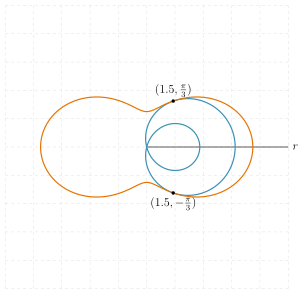
- Sketch the curves \(r = a + 2\cos\theta\) and \(r = 2 + \cos 2\theta\) on the same diagram in the case \(a = \tfrac{1}{2}\). Give the values of \(r\) and \(\theta\) at the points at which the curves touch and justify the other features you show on your sketch.
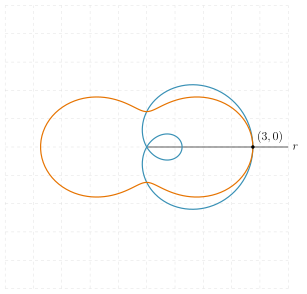
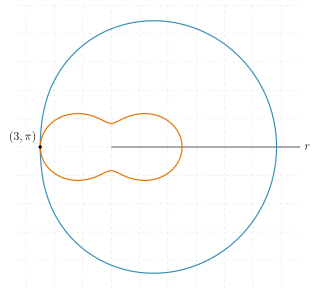
- On two further diagrams, one for each of the other two values of \(a\), sketch both the curves \(r = a + 2\cos\theta\) and \(r = 2 + \cos 2\theta\). Give the values of \(r\) and \(\theta\) at the points at which the curves touch and justify the other features you show on your sketch.
Solution
- The curves meet when they have the same radius for a given \(\theta\) ie \begin{align*} && a + 2 \cos \theta &= 2 + \cos 2 \theta \\ &&&= 2 + 2\cos^2 \theta - 1 \\ \Rightarrow && 0 &= 2 \cos ^2 \theta - 2 \cos \theta + 1 - a \end{align*} The curves touch if this has a repeated root, ie \(0 = \Delta = 4 - 8(1-a) \Rightarrow a = \frac12\). The second way the curves can touch is if there is a single root, but it's at an extreme value of \(\cos \theta = \pm 1\) ie \(0 = 2 - 2\cdot(\pm1) + 1 - a \Rightarrow a = 3 \pm 2 = 1, 5\)
- Suppose \(a = \frac12\) then the curves touch when \(0 = 2\cos^2 \theta - 2 \cos \theta + \frac12 = (2 \cos \theta-1 )(\cos \theta -\frac12) \Rightarrow \theta = \pm \frac{\pi}{3}\)
- \(a = 1\)
\(a = 5\)
Examiner's report
— 2021 STEP 3, Question 5The total entry was a marginal increase from that of 2019, that of 2020 having been artificially reduced. Comfortably more than 90% attempted one of the questions, four others were very popular, and a sixth was attempted by 70%. Every question was attempted by at least 10% of the candidature. 85% of candidates attempted no more than 7 questions, though very nearly all the candidates made genuine attempts on at most six questions (the extra attempts being at times no more than labelling a page or writing only the first line or two). Generally, candidates should be aware that when asked to "Show that" they must provide enough working to fully substantiate their working, and that they should follow the instructions in a question, so if it says "Hence", they should be using the previous work in the question in order to complete the next part. Likewise, candidates should be careful when dividing or multiplying, that things are positive, or at other times non-zero.
Rating Information
Difficulty Rating: 1500.0
Difficulty Comparisons: 0
Banger Rating: 1500.0
Banger Comparisons: 0
Show LaTeX source
Problem source
Two curves have polar equations $r = a + 2\cos\theta$ and $r = 2 + \cos 2\theta$, where $r \geqslant 0$ and $a$ is a constant.

\begin{questionparts}
    \item Show that these curves meet when
    \[
        2\cos^2\theta - 2\cos\theta + 1 - a = 0.
    \]
    Hence show that these curves touch if $a = \tfrac{1}{2}$ and find the other two values of $a$ for which the curves touch.

    \item Sketch the curves $r = a + 2\cos\theta$ and $r = 2 + \cos 2\theta$ on the same diagram in the case $a = \tfrac{1}{2}$. Give the values of $r$ and $\theta$ at the points at which the curves touch and justify the other features you show on your sketch.

    \item On two further diagrams, one for each of the other two values of $a$, sketch both the curves $r = a + 2\cos\theta$ and $r = 2 + \cos 2\theta$. Give the values of $r$ and $\theta$ at the points at which the curves touch and justify the other features you show on your sketch.
\end{questionparts}
Solution source
\begin{questionparts}
\item The curves meet when they have the same radius for a given $\theta$ ie \begin{align*}
&& a + 2 \cos \theta &= 2 + \cos 2 \theta \\
&&&= 2 + 2\cos^2 \theta - 1 \\
\Rightarrow && 0 &= 2 \cos ^2 \theta - 2 \cos \theta + 1 - a
\end{align*}
The curves touch if this has a repeated root, ie $0 = \Delta = 4 - 8(1-a) \Rightarrow a = \frac12$.

The second way the curves can touch is if there is a single root, but it's at an extreme value of $\cos \theta = \pm 1$ ie $0 = 2 - 2\cdot(\pm1) + 1 - a \Rightarrow a = 3 \pm 2 = 1, 5$

\item Suppose $a = \frac12$ then the curves touch when $0 = 2\cos^2 \theta - 2 \cos \theta + \frac12 = (2 \cos \theta-1 )(\cos \theta -\frac12) \Rightarrow \theta = \pm \frac{\pi}{3}$


\begin{center}
    \begin{tikzpicture}
    \def\functionf(#1){((#1)*exp(-(#1)^2))};
    \def\xl{-4};
    \def\xu{4};
    \def\yl{-4};
    \def\yu{4};

    % Calculate scaling factors to make the plot square
    \pgfmathsetmacro{\xrange}{\xu-\xl}
    \pgfmathsetmacro{\yrange}{\yu-\yl}
    \pgfmathsetmacro{\xscale}{10/\xrange}
    \pgfmathsetmacro{\yscale}{10/\yrange}

    % Define the reusable styles to keep code clean
    \tikzset{
        x=\xscale cm, y=\yscale cm,
        axis/.style={thick, draw=black!80, -{Stealth[scale=1.2]}},
        grid/.style={thin, dashed, gray!30},
        curveA/.style={very thick, color=cyan!70!black, smooth},
        curveB/.style={very thick, color=orange!90!black, smooth},
        curveC/.style={very thick, color=green!90!black, smooth},
        curveBlack/.style={very thick, color=black, smooth},
        dot/.style={circle, fill=black, inner sep=1.2pt},
        labelbox/.style={fill=white, inner sep=2pt, rounded corners=2pt} % Protects text from lines
    }

    % Draw background grid
    \draw[grid] (\xl,\yl) grid (\xu,\yu);

    % Set up axes
    \draw[axis] (0,0) -- (\xu,0) node[right, black] {$r$};
    % \draw[axis] (0,\yl) -- (0,\yu) node[above, black] {$y$};

    % Define the bounding region with clip
    \begin{scope}
        \clip (\xl,\yl) rectangle (\xu,\yu);

        \draw[curveA, domain=0:{2*pi}, samples=150]
            plot ({(0.5 + 2 * cos(deg(\x)))*cos(deg(\x))},
                  {(0.5 + 2 * cos(deg(\x)))*sin(deg(\x))});
        \draw[curveB, domain=0:{2*pi}, samples=150]
            plot ({(2 + cos(2*deg(\x)))*cos(deg(\x))},
                  {(2 + cos(2*deg(\x)))*sin(deg(\x))});

        \filldraw ({1/2*1.5},{1.5*sqrt(3/4)}) circle (1.5pt) node[above] {$(1.5, \frac{\pi}{3})$};
        \filldraw ({1/2*1.5},{-1.5*sqrt(3/4)}) circle (1.5pt) node[below] {$(1.5, -\frac{\pi}{3})$};
    \end{scope}

    \end{tikzpicture}
\end{center}


\item $a = 1$
\begin{center}
    \begin{tikzpicture}
    \def\functionf(#1){((#1)*exp(-(#1)^2))};
    \def\xl{-4};
    \def\xu{4};
    \def\yl{-4};
    \def\yu{4};

    % Calculate scaling factors to make the plot square
    \pgfmathsetmacro{\xrange}{\xu-\xl}
    \pgfmathsetmacro{\yrange}{\yu-\yl}
    \pgfmathsetmacro{\xscale}{10/\xrange}
    \pgfmathsetmacro{\yscale}{10/\yrange}

    % Define the reusable styles to keep code clean
    \tikzset{
        x=\xscale cm, y=\yscale cm,
        axis/.style={thick, draw=black!80, -{Stealth[scale=1.2]}},
        grid/.style={thin, dashed, gray!30},
        curveA/.style={very thick, color=cyan!70!black, smooth},
        curveB/.style={very thick, color=orange!90!black, smooth},
        curveC/.style={very thick, color=green!90!black, smooth},
        curveBlack/.style={very thick, color=black, smooth},
        dot/.style={circle, fill=black, inner sep=1.2pt},
        labelbox/.style={fill=white, inner sep=2pt, rounded corners=2pt} % Protects text from lines
    }

    % Draw background grid
    \draw[grid] (\xl,\yl) grid (\xu,\yu);

    % Set up axes
    \draw[axis] (0,0) -- (\xu,0) node[right, black] {$r$};
    % \draw[axis] (0,\yl) -- (0,\yu) node[above, black] {$y$};

    % Define the bounding region with clip
    \begin{scope}
        \clip (\xl,\yl) rectangle (\xu,\yu);

        \draw[curveA, domain=0:{2*pi}, samples=150]
            plot ({(1 + 2 * cos(deg(\x)))*cos(deg(\x))},
                  {(1 + 2 * cos(deg(\x)))*sin(deg(\x))});
        \draw[curveB, domain=0:{2*pi}, samples=150]
            plot ({(2 + cos(2*deg(\x)))*cos(deg(\x))},
                  {(2 + cos(2*deg(\x)))*sin(deg(\x))});

        \filldraw (3,0) circle (1.5pt) node[above right] {$(3,0)$};
    \end{scope}

    \end{tikzpicture}
\end{center}


$a = 5$
\begin{center}
    \begin{tikzpicture}
    \def\functionf(#1){((#1)*exp(-(#1)^2))};
    \def\xl{-4};
    \def\xu{8};
    \def\yl{-6};
    \def\yu{6};

    % Calculate scaling factors to make the plot square
    \pgfmathsetmacro{\xrange}{\xu-\xl}
    \pgfmathsetmacro{\yrange}{\yu-\yl}
    \pgfmathsetmacro{\xscale}{10/\xrange}
    \pgfmathsetmacro{\yscale}{10/\yrange}

    % Define the reusable styles to keep code clean
    \tikzset{
        x=\xscale cm, y=\yscale cm,
        axis/.style={thick, draw=black!80, -{Stealth[scale=1.2]}},
        grid/.style={thin, dashed, gray!30},
        curveA/.style={very thick, color=cyan!70!black, smooth},
        curveB/.style={very thick, color=orange!90!black, smooth},
        curveC/.style={very thick, color=green!90!black, smooth},
        curveBlack/.style={very thick, color=black, smooth},
        dot/.style={circle, fill=black, inner sep=1.2pt},
        labelbox/.style={fill=white, inner sep=2pt, rounded corners=2pt} % Protects text from lines
    }

    % Draw background grid
    \draw[grid] (\xl,\yl) grid (\xu,\yu);

    % Set up axes
    \draw[axis] (0,0) -- (\xu,0) node[right, black] {$r$};
    % \draw[axis] (0,\yl) -- (0,\yu) node[above, black] {$y$};

    % Define the bounding region with clip
    \begin{scope}
        \clip (\xl,\yl) rectangle (\xu,\yu);

        \draw[curveA, domain=0:{2*pi}, samples=150]
            plot ({(5 + 2 * cos(deg(\x)))*cos(deg(\x))},
                  {(5 + 2 * cos(deg(\x)))*sin(deg(\x))});
        \draw[curveB, domain=0:{2*pi}, samples=150]
            plot ({(2 + cos(2*deg(\x)))*cos(deg(\x))},
                  {(2 + cos(2*deg(\x)))*sin(deg(\x))});

    \end{scope}
    \filldraw (-3,0) circle (1.5pt) node[above left] {$(3,\pi)$};

    \end{tikzpicture}
\end{center}


\end{questionparts}
A handful of candidates more attempted this question than question 2, but with marginally less success than question 4. Nearly every candidate obtained the very first result and many then obtained a = 1/2 from considering the discriminant. Finding the other values of a (1 and 5) caused many candidates difficulty which could have been overcome had they considered equating expressions for dy/dx. In the diagrams, the curve representing the second equation was often drawn as an ellipse, or with cusps rather than smooth indentations. On the other hand, touching points were usually well drawn. It seemed that many appreciated that the curves had symmetry but seldom referred to this in their justification. Similarly, many might have earned credit, but didn't, for indicating values of r for important points such as where the curves met the initial line or the line perpendicular to it. Few candidates found the angles of the cusp in the first two cases (especially with struggling to deal with arccos(−1/4), as opposed to arccos(−1/2)).