Problems
Filters
218 problems found
2009 Paper 2 Q2
The curve \(C\) has equation \[ y= a^{\sin (\pi \e^ x)}\,, \] where \(a>1\).
- Find the coordinates of the stationary points on \(C\).
- Use the approximations \(\e^t \approx 1+t\) and \(\sin t \approx t\) (both valid for small values of \(t\)) to show that \[ y\approx 1-\pi x \ln a \; \] for small values of \(x\).
- Sketch \(C\).
- By approximating \(C\) by means of straight lines joining consecutive stationary points, show that the area between \(C\) and the \(x\)-axis between the \(k\)th and \((k+1)\)th maxima is approximately \[ \Big( \frac {a^2+1}{2a} \Big) \ln \Big ( 1+ \big( k-\tfrac34)^{-1} \Big)\,. \]
Solution:
- \(\,\) \begin{align*} && y & = a^{\sin(\pi e^x)} \\ \Rightarrow && \frac{\d y}{\d x} &= a^{\sin(\pi e^x)} \cdot ( \ln a) \cdot (\cos (\pi e^x)) \cdot \pi e^x \\ \frac{\d y}{\d x} = 0: && 0 &= \cos(\pi e^x) \\ \Rightarrow && \pi e^x &= \left ( \frac{2n+1}{2} \right) \pi \\ \Rightarrow && x &= \ln \left ( \frac{2n+1}{2} \right) \\ && y &= a^{(-1)^n} \\ &&(x,y) &= \left (\ln \left ( \frac{2n+1}{2} \right), a^{(-1)^n} \right) \end{align*}
- \(\,\) \begin{align*} && y &= a^{\sin(\pi e^x)} \\ &&&= e^{\ln a \cdot \sin(\pi e^x)} \\ &&&\approx e^{\ln a \cdot \sin(\pi (1+x))} \\ &&&\approx e^{-\ln a \cdot \sin(\pi x)} \\ &&&\approx e^{-\ln a \cdot \pi x} \\ &&&\approx 1-( \pi\ln a) x \end{align*}
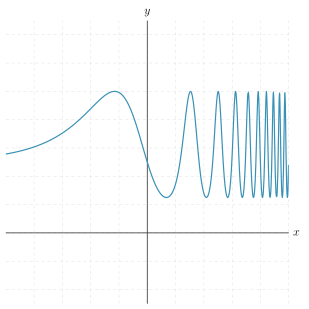
- The \(k\)th maxima is at \(\ln \left ( \frac{4(k-1)+1}{2}\right)\) and \(a\) ,and the \((k+1)\)th is at \(\ln \left ( \frac{4k+1}{2}\right)\). They have a minima between at \(\ln \left ( \frac{4k-3}{2}\right)\). \begin{align*} && \text{Area} &\approx \frac12 \left (\ln \left ( \frac{4k-1}{2}\right)- \ln \left ( \frac{4k-3}{2}\right)\right) \left ( a + \frac1a \right) + \frac12 \left ( \ln \left ( \frac{4k+1}{2}\right)-\ln \left ( \frac{4k-1}{2}\right)\right) \left ( a + \frac1a \right) \\ &&&= \frac{a^2+1}{2a} \ln \left (\frac{4k+1}{4k-3} \right) \\ &&&= \frac{a^2+1}{2a} \ln \left (1 + \frac{4}{4k-3} \right) \\ &&&= \frac{a^2+1}{2a} \ln \left (1 + \frac{1}{k-\tfrac34} \right) \\ &&&= \frac{a^2+1}{2a} \ln \left (1 + (k-\tfrac34)^{-1} \right) \\ \end{align*}
2009 Paper 2 Q12
A continuous random variable \(X\) has probability density function given by \[ \f(x) = \begin{cases} 0 & \mbox{for } x<0 \\ k\e^{-2 x^2} & \mbox{for } 0\le x< \infty \;,\\ \end{cases} \] where \(k\) is a constant.
- Sketch the graph of \(\f(x)\).
- Find the value of \(k\).
- Determine \(\E(X)\) and \(\var(X)\).
- Use statistical tables to find, to three significant figures, the median value of \(X\).
Solution:
- \par

- Let \(Y \sim N(0,\frac14)\), then: \begin{align*} &&\int_0^\infty \frac{1}{\sqrt{2 \pi \cdot \frac14}} e^{-2x^2} \, dx &= \frac12\\ \Rightarrow && \int_0^\infty e^{-2x^2} &= \frac{\sqrt{\pi}}{2 \sqrt{2}} \\ \Rightarrow && k &= \boxed{\frac{2\sqrt{2}}{\sqrt{\pi}}} \end{align*}
- \begin{align*} \mathbb{E}[X] &= \int_0^\infty x f(x) \, dx \\ &= \frac{2\sqrt{2}}{\sqrt{\pi}}\int_0^\infty x e^{-2x^2}\, dx \\ &= \frac{2\sqrt{2}}{\sqrt{\pi}} \left [-\frac{1}{4}e^{-2x^2} \right]_0^\infty \\ &= \frac{1}{\sqrt{2\pi}} \\ \end{align*} In order to calculate \(\mathbb{E}(X^2)\) it is useful to consider the related computation \(\mathbb{E}(Y^2)\). In fact, by symmetry, these will be the same values. Therefore \(\mathbb{E}(X^2) = \mathbb{E}(Y^2) = \mathrm{Var}(Y) = \frac{1}{4}\) (since \(\mathbb{E}(Y) = 0\)). Therefore \(\mathrm{Var}(Y) = \mathbb{E}(Y^2) - \mathbb{E}(Y)^2 = \frac14 - \frac{1}{2\pi}\)
- \begin{align*} && \mathbb{P}(X < x) &= \frac12 \\ \Leftrightarrow && 2\mathbb{P}(0 \leq Y < x) &= \frac12 \\ \Leftrightarrow && 2\l \mathbb{P}(Y < x) - \frac12 \r &= \frac12 \\ \Leftrightarrow && \mathbb{P}(Y < x)&= \frac34 \\ \Leftrightarrow && \mathbb{P}(\frac{Y-0}{1/2} < \frac{x}{1/2})&= \frac34 \\ \Leftrightarrow && \mathbb{P}(Z < \frac{x}{1/2})&= \frac34 \\ \Leftrightarrow && \Phi(2x)&= \frac34 \\ \Leftrightarrow && 2x &= 0.6744895\cdots \\ \Leftrightarrow && x &= 0.3372\cdots \\ \Leftrightarrow && &= 0.337 \, (3 \text{sf}) \\ \end{align*}
2009 Paper 3 Q3
The function \(\f(t)\) is defined, for \(t\ne0\), by \[ \f(t) = \frac t {\e^t-1}\,. \] \begin{questionparts} \item By expanding \(\e^t\), show that \(\displaystyle \lim _{t\to0} \f(t) = 1\,\). Find \(\f'(t)\) and evaluate \(\displaystyle \lim _{t\to0} \f'(t)\,\). \item Show that \(\f(t) +\frac12 t\) is an even function. [{\bf Note:} A function \(\g(t)\) is said to be {\em even} if \(\g(t) \equiv \g(-t)\).] \item Show with the aid of a sketch that \( \e^t( 1-t)\le 1\,\) and deduce that \(\f'(t)\ne 0\) for \(t\ne0\). \end{questionpart} Sketch the graph of \(\f(t)\).
Solution:
- Claim \(f(t) + \frac12 t\) is an even function. Proof: Consider \(f(-t) - \frac12t\), then \begin{align*} f(-t) - \frac12t &= \frac{-t}{e^{-t}-1} - \frac12t \\ &= \frac{-te^t}{1-e^t} - \frac12 t \\ &= \frac{t(1-e^t) -t}{1-e^t} - \frac12 t \\ &= t - \frac{t}{1-e^t} - \frac12 t \\ &= \frac{t}{e^t-1} + \frac12 t \end{align*} So it is even.
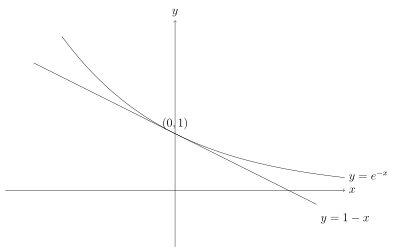
- Drawing the tangent to \(y = e^{-x}\) at \((0,1)\) we find that \(e^{-t} \geq (1-t)\) for all \(t\), in particular, \(e^t(1-t) \leq 1\) \(f'(t) = \frac{(e^t(1-t) -1}{(e^t-1)^2} \leq 0\) and \(f'(t) = -\frac12\) when \(t = 0\)

2008 Paper 1 Q4
A function \(\f(x)\) is said to be convex in the interval \(a < x < b\) if \(\f''(x)\ge0\) for all \(x\) in this interval.
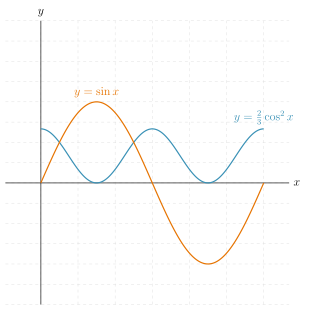
- Sketch on the same axes the graphs of \(y= \frac23 \cos^2 x\) and \(y=\sin x\) in the interval \(0\le x \le 2\pi\). The function \(\f(x)\) is defined for \(0 < x < 2\pi\) by \[\f(x) = \e^{\frac23 \sin x}. \] Determine the intervals in which \(\f(x)\) is convex.
- The function \(\g(x)\) is defined for \(0 < x < \frac12\pi\) by \[\g(x) = \e^{-k \tan x}. \] If \(k=\sin 2 \alpha\) and \(0 < \alpha < \frac{1}{4}\pi\), show that \(\g(x)\) is convex in the interval \(0 < x < \alpha\), and give one other interval in which \(\g(x)\) is convex.
Solution:
- \begin{align*} && f(x) &= \exp\left (\tfrac23\sin x \right) \\ && f'(x) &= \exp\left (\tfrac23\sin x \right) \cdot \tfrac23 \cos x \\ && f''(x) &= \left ( \exp\left (\tfrac23\sin x \right) \cdot \tfrac23\right) \left ( \tfrac23 \cos^2 x - \sin x \right) \end{align*} Therefore \(f(x)\) is convex when \(\frac23 \cos^2 x \geq \sin x\). Note that we can find the equality points when \begin{align*} && \sin x &= \frac23 \cos^2 x \\ &&&= \frac23 (1- \sin^2 x) \\ \Rightarrow && 0 &= 2\sin^2 x + 3 \sin x - 2 \\ &&&= (2 \sin x -1) (\sin x+2) \end{align*} ie \(\sin x = \frac12 \Rightarrow x = \frac{\pi}{6}, \frac{5\pi}{6}\). Therefore \(f\) is convex on \([0, \frac{\pi}{6}] \cup [\frac{5\pi}{6}, 2\pi]\)
- Suppose \(g(x) = \exp \left ( -k \tan x \right)\) then \begin{align*} && g'(x) &= \exp \left ( -k \tan x \right) \cdot (-k \sec^2 x ) \\ && g''(x) &= \left ( -k \exp \left ( -k \tan x \right) \right) \left ( -k\sec^4 x + 2 \sec x \cdot \sec x \tan x\right) \\ &&&= -k \exp \left ( -k \tan x \right) \sec^4 x \left ( -k + 2\sin x \cos x \right) \\ &&&= -k \exp \left ( -k \tan x \right) \sec^4 x \left ( -k + \sin 2x \right) \\ \end{align*} If \(0 < \alpha < \frac{\pi}{4}\) then \(k > 0\) so \(g\) is convex if \(-k + \sin 2x < 0\), ie \(\sin 2x < \sin 2\alpha\), ie on \((0, \alpha)\) and \((\frac{\pi}{2} - \alpha, \frac{\pi}{2})\)
2008 Paper 1 Q6
The function \(\f\) is defined by \[ \f(x) = \frac{\e^x-1}{\e-1}, \ \ \ \ \ x\ge0, \] and the function \(\g\) is the inverse function to \(\f\), so that \(\g(\f(x))=x\). Sketch \(\f(x)\) and \(\g(x)\) on the same axes. Verify, by evaluating each integral, that \[ \int_0^\frac12 \f(x) \,\d x + \int_0^k \g(x) \,\d x = \frac1 {2(\sqrt \e +1)}\,, \] where \(\displaystyle k= \frac 1{\sqrt\e+1}\), and explain this result by means of a diagram.
2008 Paper 1 Q10
On the (flat) planet Zog, the acceleration due to gravity is \(g\) up to height \(h\) above the surface and \(g'\) at greater heights. A particle is projected from the surface at speed \(V\) and at an angle \(\alpha\) to the surface, where \(V^2 \sin^2\alpha > 2 gh\,\). Sketch, on the same axes, the trajectories in the cases \(g'=g\) and \(g' < g\). Show that the particle lands a distance \(d\) from the point of projection given by \[ d = \left(\frac {V-V'} g + \frac {V'}{ g'} \right) V\sin2\alpha\,, \] where \(V' = \sqrt{V^2-2gh\,\rm{cosec}^2\alpha\,}\,\).
2008 Paper 2 Q3
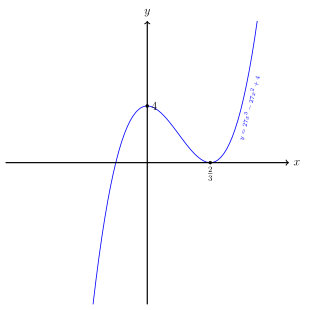
- Find the coordinates of the turning points of the curve \(y=27x^3-27x^2+4\). Sketch the curve and deduce that \(x^2(1-x)\le 4/27\) for all \(x\ge0\,\). Given that each of the numbers \(a\), \(b\) and \(c\) lies between \(0\) and \(1\), prove by contradiction that at least one of the numbers \(bc(1-a)\), \(ca(1-b)\) and \(ab(1-c)\) is less than or equal to \(4/27\).
- Given that each of the numbers \(p\) and \(q\) lies between \(0\) and \(1\), prove that at least one of the numbers \(p(1-q)\) and \(q(1-p)\) is less than or equal to \(1/4\).
Solution:
- \(\,\)
\begin{align*}
&& y & = 27x^3 - 27x^2 + 4 \\
\Rightarrow && \frac{\d y}{\d x} &= 81x^2 - 54x \\
\Rightarrow && x &= 0, \frac23 \\
\Rightarrow && (x,y) &= (0, 4), \left (\frac23, 0 \right)
\end{align*}
Since \(f(x) \geq 0\) for \(x \geq 0\) we must have \(27x^2(1-x) \leq 4 \Rightarrow x^2(1-x) \leq \frac{4}{27}\) Suppose for contradiction that \(bc(1-a) > \frac{4}{27}, ca(1-b) > \frac{4}{27}, ab(1-c) > \frac{4}{27}\) then taking the product we see \begin{align*} && \left ( \frac{4}{27} \right)^3 &< bc(1-a) \cdot ca(1-b) \cdot ab(1-c) \\ &&&= a^2(1-c) \cdot b^2(1-b) \cdot c^2(1-c) \leq \left ( \frac{4}{27}\right)^3 \end{align*} which is a contradiction.
- Notice that \(f(x) = x(1-x)\) has a turning point at \((\frac12, \frac14)\), and so \(f(x) \leq \frac14\). Suppose for contradiction that both \(p(1-q)\) and \(q(1-p)\) are larger than \(1/4\) \begin{align*} && \left ( \frac14 \right)^2 &< p(1-q) \cdot q(1-p) \\ &&&= p(1-p) \cdot q(1-q) \\ &&&\leq \left ( \frac14 \right)^2 \end{align*} which is a contradiction.
2008 Paper 2 Q6
A curve has the equation \(y=\f(x)\), where \[ \f(x) = \cos \Big( 2x+ \frac \pi 3\Big) + \sin \Big ( \frac{3x}2 - \frac \pi 4\Big). \]
- Find the period of \(\f(x)\).
- Determine all values of \(x\) in the interval \(-\pi\le x \le \pi\) for which \(\f(x)=0\). Find a value of \(x\) in this interval at which the curve touches the \(x\)-axis without crossing it.
- Find the value or values of \(x\) in the interval \(0\le x \le 2\pi\) for which \(\f(x)=2\,\).
Solution: \begin{align*} && f(x) &= \cos \left( 2x+ \frac \pi 3\right) + \sin \left ( \frac{3x}2 - \frac\pi 4\right) \\ &&&= \cos \left( 2x+ \frac \pi 3\right) + \cos\left (\frac{\pi}{2} - \left ( \frac{3x}2 - \frac\pi 4\right) \right)\\ &&&= \cos \left( 2x+ \frac \pi 3\right) + \cos\left (\frac{3\pi}{4} - \frac{3x}2 \right)\\ &&&= 2 \cos \left (\frac{2x+ \frac \pi 3+\frac{3\pi}{4} - \frac{3x}2}{2} \right) \cos \left ( \frac{\left (2x+ \frac \pi 3 \right) - \left (\frac{3\pi}{4} - \frac{3x}2 \right)}{2} \right)\\ &&&= 2 \cos \left (\frac{\frac{x}{2}+ \frac {13\pi}{12}}{2} \right) \cos \left ( \frac{\frac{7x}{2}- \frac {5\pi}{12}}{2} \right)\\ &&&= 2 \cos \left (\frac{x}{4}+ \frac {13\pi}{24} \right) \cos \left ( \frac{7x}{4}- \frac {5\pi}{24} \right)\\ \end{align*}
- The period of \(f\) will be the LCM of \(\frac{2\pi}{\pi}\) and \(\frac{2\pi}{\frac32} = \frac{4\pi}{3}\) which is \(4\pi\). (This is also clear from the factorised form).
- \(f(x) = 0\) means one of those two factors is zero, ie \begin{align*} \text{first factor}: && 0 &= \cos \left (\frac{x}{4}+ \frac {13\pi}{24} \right) \\ &&n\pi + \frac{\pi}{2}&= \frac{x}{4}+ \frac {13\pi}{24} \\ \Rightarrow && x &= 4n\pi - \frac{\pi}{6} \\ \Rightarrow && x &= -\frac{\pi}{6} \\ \\ \text{second factor}: && 0 &= \cos \left ( \frac{7x}{4}- \frac {5\pi}{24} \right) \\ && n\pi + \frac{\pi}{2} &= \frac{7x}{4}- \frac {5\pi}{24} \\ \Rightarrow && 7x &= 4n\pi + \frac{17}{6}\pi \\ \Rightarrow && x &= \frac{4n}7\pi + \frac{17}{42}\pi \\ \Rightarrow && x &= -\frac{31}{42} \pi, -\frac16\pi, \frac{17}{42}\pi, \frac{41}{42}\pi \end{align*} Therefore all solutions are \(-\frac{31}{42} \pi, -\frac16\pi, \frac{17}{42}\pi, \frac{41}{42}\pi\) We can see that \(-\frac{\pi}{6}\) is a repeated root, therefore it touches the axis and does not cross.
- \(f(x) = 2\) requires both factors to be \(1\) or \(-1\). \begin{align*} \text{first factor}: && \pm1 &= \cos \left (\frac{x}{4}+ \frac {13\pi}{24} \right) \\ &&n\pi &= \frac{x}{4}+ \frac {13\pi}{24} \\ \Rightarrow && x &= 4n\pi - \frac{13\pi}{6} \\ \Rightarrow && x &= \frac{11}{6}\pi \\ \end{align*} We only need to test this value, where it's \(-1\), so we look at \( \cos \left ( \frac{77\pi}{24}- \frac {5\pi}{24} \right) = \cos (3\pi) = -1\), so the only value is \(\frac{11}{6}\pi\)
2008 Paper 3 Q4
- Show, with the aid of a sketch, that \(y> \tanh (y/2)\) for \(y>0\) and deduce that \begin{equation} \textrm{arcosh} x > \dfrac{x-1}{\sqrt{x^2-1}} \text{ for } x>1. \tag{\(*\)} \end{equation}
- By integrating \((*)\), show that $\textrm{arcosh} x > 2 \dfrac{{x-1}}{\sqrt{x^2-1}} \( for \)x>1$.
- Show that $\textrm{arcosh} x >3 \dfrac{\sqrt{x^2-1}}{{x+2}} \( for \)x>1$.
Solution:
- If \(y = \textrm{arcosh} x \), then \(\tanh\textrm{arcosh} x/2 = \sqrt{\frac{\cosh \textrm{arcosh} x-1}{\cosh \textrm{arcosh} x+1}} = \sqrt{\frac{x-1}{x+1}} = \frac{x-1}{\sqrt{x^2-1}}\)
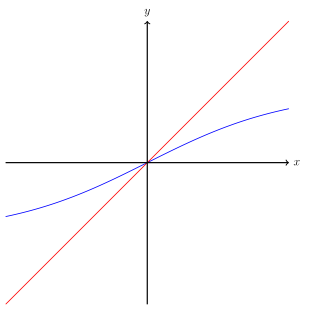
- \begin{align*} \int \textrm{arcosh} x \d x &= \left [x \textrm{arcosh} x \right] - \int \frac{x}{\sqrt{x^2-1}} \d x \\ &= x \textrm{arcosh} x - \sqrt{x^2-1}+C \\ \int \frac{x-1}{\sqrt{x^2-1}} &= \sqrt{x^2-1} - \textrm{arcosh} x +C \end{align*} Therefore \begin{align*} && \int_1^x \textrm{arcosh} t \d t &> \int_1^x \frac{t-1}{\sqrt{t^2-1}} \d t \\ \Rightarrow && x \textrm{arcosh} x - \sqrt{x^2-1} - 0 &> \sqrt{x^2-1} - \textrm{arcosh} x - 0 \\ \Rightarrow && (x+1) \textrm{arcosh} x &> 2\sqrt{x^2-1} \\ \Rightarrow && \textrm{arcosh} x & > 2\frac{\sqrt{x^2-1}}{x+1} \\ &&&= 2 \frac{\sqrt{x-1}}{\sqrt{x+1}} \\ &&&= 2 \frac{x-1}{\sqrt{x^2-1}} \end{align*}
- Integrating both sides again, \begin{align*} && \int_1^x \textrm{arcosh} t \d t &> 2 \int_1^x \frac{t-1}{\sqrt{t^2-1}} \d t \\ \Rightarrow && x \textrm{arcosh} x - \sqrt{x^2-1} &> 2\left (\sqrt{x^2-1} - \textrm{arcosh}x \right) \\ \Rightarrow && (x+2)\textrm{arcosh} x &> 3 \sqrt{x^2-1} \\ \Rightarrow && \textrm{arcosh} x &> 3 \frac{\sqrt{x^2-1}}{x+2} \end{align*}
2008 Paper 3 Q9
A particle of mass \(m\) is initially at rest on a rough horizontal surface. The particle experiences a force \(mg\sin \pi t\), where \(t\) is time, acting in a fixed horizontal direction. The coefficient of friction between the particle and the surface is \(\mu\). Given that the particle starts to move first at \(t=T_0\), state the relation between \(T_0\) and \(\mu\).
- For \(\mu = \mu_0\), the particle comes to rest for the first time at \(t=1\). Sketch the acceleration-time graph for \(0\le t \le 1\). Show that \[ 1+\left(1-\mu_0^2\right)^{\frac12} -\mu_0\pi +\mu_0 \arcsin \mu_0 =0\,. \]
- For \(\mu=\mu_0\) sketch the acceleration-time graph for \(0\le t\le 3\). Describe the motion of the particle in this case and in the case \(\mu=0\).
2008 Paper 3 Q12
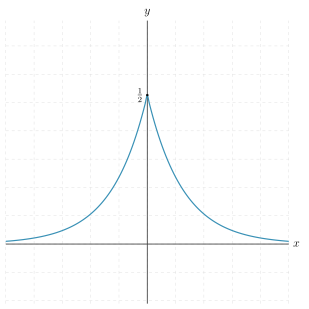
Let \(X\) be a random variable with a Laplace distribution, so that its probability density function is given by \[ \f(x) = \frac12 \e^{-\vert x \vert }\;, \text{ \(-\infty < x < \infty \)}. \tag{\(*\)} \] Sketch \(\f(x)\). Show that its moment generating function \({\rm M}_X(\theta)\) is given by \({\rm M}_X(\theta)= (1-\theta^2)^{-1}\) and hence find the variance of \(X\). A frog is jumping up and down, attempting to land on the same spot each time. In fact, in each of \(n\) successive jumps he always lands on a fixed straight line but when he lands from the \(i\)th jump (\(i=1\,,2\,,\ldots\,,n\)) his displacement from the point from which he jumped is \(X_i\,\)cm, where \(X_i\) has the distribution \((*)\). His displacement from his starting point after \(n\) jumps is \(Y\,\)cm (so that \(Y=\sum\limits_{i=1}^n X_i\)). Each jump is independent of the others. Obtain the moment generating function for \(Y/ \sqrt {2n}\) and, by considering its logarithm, show that this moment generating function tends to \(\exp(\frac12\theta^2)\) as \(n\to\infty\). Given that \(\exp(\frac12\theta^2)\) is the moment generating function of the standard Normal random variable, estimate the least number of jumps such that there is a \(5\%\) chance that the frog lands 25 cm or more from his starting point.
Solution:
2007 Paper 1 Q8
A curve is given by the equation \[ y = ax^3 - 6ax^2+ \left( 12a + 12 \right)x - \left( 8a + 16 \right)\,, \tag{\(*\)} \] where \(a\) is a real number. Show that this curve touches the curve with equation \[ y=x^3 \tag{\(**\)} \] at \(\left( 2 \, , \, 8 \right)\). Determine the coordinates of any other point of intersection of the two curves.
- Sketch on the same axes the curves \((*)\) and \((**)\) when \(a = 2\).
- Sketch on the same axes the curves \((*)\) and \((**)\) when \(a = 1\).
- Sketch on the same axes the curves \((*)\) and \((**)\) when \(a = -2\).
Solution: \begin{align*} && y &= ax^3 - 6ax^2+ \left( 12a + 12 \right)x - \left( 8a + 16 \right) \\ && y(2) &= 8a-24a+24a+24-8a-16 \\ &&&= 8 \\ && y'(x) &= 3ax^2-12ax+(12a+12) \\ && y'(0) &= 12a-24a+12a+12 \\ &&&= 12 \end{align*} Therefore since our curve has the same value and gradient at \((2,8)\) as \(y = x^3\) they must touch at this point. Therefore \begin{align*} && ax^3 - 6ax^2+ \left( 12a + 12 \right)x - \left( 8a + 16 \right) - x^3 &= (x-2)^2((a-1)x-(2a+4)) \end{align*} Therefore if \(a \neq 1\), they touch again when \(x = \frac{2a+4}{a-1}\).


2007 Paper 1 Q14
The discrete random variable \(X\) has a Poisson distribution with mean \(\lambda\).
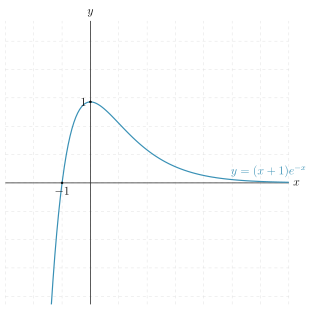
- Sketch the graph \(y=\l x+1 \r \e^{-x}\), stating the coordinates of the turning point and the points of intersection with the axes. It is known that \(\P(X \ge 2) = 1-p\), where \(p\) is a given number in the range \(0 < p <1\). Show that this information determines a unique value (which you should not attempt to find) of \(\lambda\).
- It is known (instead) that \(\P \l X = 1 \r = q\), where \(q\) is a given number in the range \(0 < q <1\). Show that this information determines a unique value of \(\lambda\) (which you should find) for exactly one value of \(q\) (which you should also find).
- It is known (instead) that \(\P \l X = 1 \, \vert \, X \le 2 \r = r\), where \(r\) is a given number in the range \(0 < r < 1\). Show that this information determines a unique value of \(\lambda\) (which you should find) for exactly one value of \(r\) (which you should also find).
Solution: Let \(X \sim Po(\lambda)\), then
- \(\,\)
Suppose \(\mathbb{P}(X \geq 2) = 1-p\) then \(\mathbb{P}(X=0) + \mathbb{P}(X=1) = p\), ie \(e^{-\lambda} +\lambda e^{-\lambda} = p\) If \(f(x) = (1+x)e^{-x}\) we have see it is strictly decreasing on \(x \geq 0\) and takes all values from \(1\) to \(0\), therefore we can find a unique value such that \(f(\lambda) = p\) which is our desired \(\lambda\).
- Note that \(\mathbb{P}(X = 1) = \lambda e^{-\lambda}\)
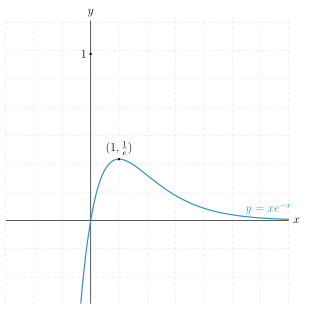
Sketching \(y = xe^{-x}\) and finding it's turning point we can see that there is a unique value of \(\lambda = 1\) when \(q = \frac{1}{e}\), otherwise there is either no solution (\(p > \frac1{e}\)) or two solutions (\(0 < q > \frac1{e}\)).
- Suppose \(\mathbb{P}(X = 1 | X \leq 2) = r\), ie \begin{align*} && r &= \frac{\lambda e^{-\lambda}}{e^{-\lambda} + \lambda e^{-\lambda} + \frac12 \lambda^2 e^{-\lambda}} \\ &&&= \frac{2\lambda}{2+2\lambda+\lambda^2} \\ \Rightarrow && 0 &= r\lambda^2 + 2(r-1) \lambda + 2r\\ \Rightarrow && \Delta &= 4(r-1)^2 - 4\cdot r \cdot 2 r \\ &&&= 4((r-1)^2-2r^2) \\ &&&= 4(r-1-\sqrt{2}r)(r-1+\sqrt{2}r) \\ &&&= -4((\sqrt{2}-1)r + 1)((1+\sqrt{2})r-1) \end{align*} Therefore our quadratic in \(r\) has a unique solution if \(r = \frac{1}{1+\sqrt{2}}\). If it has a positive solution then note since \(2r > 0\) both solutions are positive, so \(\lambda\) is not unique by excluding other solutions.
2007 Paper 2 Q2
A curve has equation \(y=2x^3-bx^2+cx\). It has a maximum point at \((p,m)\) and a minimum point at \((q,n)\) where \(p>0\) and \(n>0\). Let \(R\) be the region enclosed by the curve, the line \(x=p\) and the line \(y=n\).
- Express \(b\) and \(c\) in terms of \(p\) and \(q\).
- Sketch the curve. Mark on your sketch the point of inflection and shade the region \(R\). Describe the symmetry of the curve.
- Show that \(m-n=(q-p)^3\).
- Show that the area of \(R\) is \(\frac12 (q-p)^4\).
Solution:
- \(\,\) \begin{align*} && y &= 2x^3-bx^2+cx \\ \Rightarrow && y' &= 6x^2-2bx+c \end{align*} We must have \(p, q\) are the roots of this equation, ie \(\frac13b = p+q, \frac16c = pq\)
- The point of inflection will be at \(\frac{b}6\)
The graph will have rotational symmetry of \(180^{\circ}\) about the point of inflection.

- \begin{align*} && m-n &= 2(p^3-q^3)-b(p^2-q^2)+c(p-q) \\ &&&= (p-q)(2(p^2+qp+q^2)-b(p+q)+c) \\ &&&= (p-q)(2(p^2+qp+q^2)-3(p+q)^2+6pq) \\ &&&= (p-q)(-p^2-q^2+2pq) \\ &&&= (q-p)^3 \end{align*}
- The area of \(R\) is \begin{align*} A &= \frac12 bh \\ &= \frac12 (q-p)(m-n) = \frac12(q-p)^4 \end{align*} as required.
2007 Paper 2 Q14
The random variable \(X\) has a continuous probability density function \(\f(x)\) given by \begin{equation*} \f(x) = \begin{cases} 0 & \text{for } x \le 1 \\ \ln x & \text{for } 1\le x \le k\\ \ln k & \text{for } k\le x \le 2k\\ a-bx & \text{for } 2k \le x \le 4k \\ 0 & \text{for } x\ge 4k \end{cases} \end{equation*} where \(k\), \(a\) and \(b\) are constants.
- Sketch the graph of \(y=\f(x)\).
- Determine \(a\) and \(b\) in terms of \(k\) and find the numerical values of \(k\), \(a\) and \(b\).
- Find the median value of \(X\).
Solution:

- Since \(f(x)\) is continuous, \(a -bx\) joins \((2k, \ln k)\) and \((4k ,0)\). ie it has a gradient of \(\frac{-\ln k}{2k}\) and is zero at \(4k\), hence \(\displaystyle b = -\frac{\ln k}{2k}, a = 2\ln k\). The \(3\) sections have areas \(\int_1^k \ln x \d x = k \ln k -k +1\), \(k \ln k, k \ln k\). Therefore \begin{align*} &&1&= 3k\ln k - k +1 \\ \Rightarrow &&0 &= k(3\ln k - 1) \\ \Rightarrow &&\ln k &= \frac13 \\ \Rightarrow &&k &= e^{1/3} \\ && a &= \frac23 \\ && b&= -\frac16e^{-1/3} \end{align*}
- Clearly \(1 > k \ln k > \frac{1}{3}\), therefore the median must lie between \(k\) and \(2k\). So we need, \(\frac12\) to be the area of the rectangle + the triangle, ie: \begin{align*} && \frac12 &= k \ln k + (2k-M) \ln k \\ &&&= \frac13 k + \frac13 (2k - M) \\ \Rightarrow && M &= 3k - \frac32 \\ \Rightarrow && M &= 3e^{1/3} - \frac32 \end{align*}