2008 Paper 3 Q4
Year: 2008
Paper: 3
Question Number: 4
Course: UFM Pure
Section: Integration using inverse trig and hyperbolic functions
Difficulty: 1700.0
Banger: 1516.0
integration
hyperbolic functions
arcosh
inequality
curve sketching
substitution
tanh
proof by integration
Problem
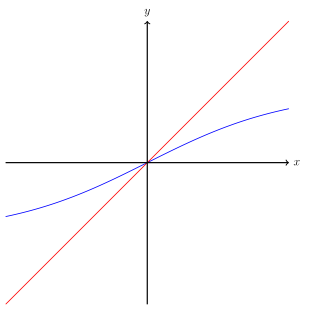
- Show, with the aid of a sketch, that \(y> \tanh (y/2)\) for \(y>0\) and deduce that \begin{equation} \textrm{arcosh} x > \dfrac{x-1}{\sqrt{x^2-1}} \text{ for } x>1. \tag{\(*\)} \end{equation}
- By integrating \((*)\), show that $\textrm{arcosh} x > 2 \dfrac{{x-1}}{\sqrt{x^2-1}} \( for \)x>1$.
- Show that $\textrm{arcosh} x >3 \dfrac{\sqrt{x^2-1}}{{x+2}} \( for \)x>1$.
Solution
- If \(y = \textrm{arcosh} x \), then \(\tanh\textrm{arcosh} x/2 = \sqrt{\frac{\cosh \textrm{arcosh} x-1}{\cosh \textrm{arcosh} x+1}} = \sqrt{\frac{x-1}{x+1}} = \frac{x-1}{\sqrt{x^2-1}}\)
- \begin{align*} \int \textrm{arcosh} x \d x &= \left [x \textrm{arcosh} x \right] - \int \frac{x}{\sqrt{x^2-1}} \d x \\ &= x \textrm{arcosh} x - \sqrt{x^2-1}+C \\ \int \frac{x-1}{\sqrt{x^2-1}} &= \sqrt{x^2-1} - \textrm{arcosh} x +C \end{align*} Therefore \begin{align*} && \int_1^x \textrm{arcosh} t \d t &> \int_1^x \frac{t-1}{\sqrt{t^2-1}} \d t \\ \Rightarrow && x \textrm{arcosh} x - \sqrt{x^2-1} - 0 &> \sqrt{x^2-1} - \textrm{arcosh} x - 0 \\ \Rightarrow && (x+1) \textrm{arcosh} x &> 2\sqrt{x^2-1} \\ \Rightarrow && \textrm{arcosh} x & > 2\frac{\sqrt{x^2-1}}{x+1} \\ &&&= 2 \frac{\sqrt{x-1}}{\sqrt{x+1}} \\ &&&= 2 \frac{x-1}{\sqrt{x^2-1}} \end{align*}
- Integrating both sides again, \begin{align*} && \int_1^x \textrm{arcosh} t \d t &> 2 \int_1^x \frac{t-1}{\sqrt{t^2-1}} \d t \\ \Rightarrow && x \textrm{arcosh} x - \sqrt{x^2-1} &> 2\left (\sqrt{x^2-1} - \textrm{arcosh}x \right) \\ \Rightarrow && (x+2)\textrm{arcosh} x &> 3 \sqrt{x^2-1} \\ \Rightarrow && \textrm{arcosh} x &> 3 \frac{\sqrt{x^2-1}}{x+2} \end{align*}
Examiner's report
— 2008 STEP 3, Question 4
~48% attempted (inferred)
Inferred ~48% from 'almost exactly the same number as Q3'
From the paper introduction
Most candidates attempted five, six or seven questions, and scored the majority of their total score on their best three or four. Those attempting seven or more tended not to do well, pursuing no single solution far enough to earn substantial marks.
Source: Cambridge STEP 2008 Examiner's Report
· 2008-full.pdf
Rating Information
Difficulty Rating: 1700.0
Difficulty Comparisons: 0
Banger Rating: 1516.0
Banger Comparisons: 1
Show LaTeX source
Problem source
\begin{questionparts}
\item Show, with the aid of  a sketch, that $y>  \tanh (y/2)$ for $y>0$
and deduce
that
\begin{equation}
\textrm{arcosh} x > \dfrac{x-1}{\sqrt{x^2-1}}
\text{  for  } x>1.
\tag{$*$}
\end{equation}
\item By integrating $(*)$, show that $\textrm{arcosh} x > 2
  \dfrac{{x-1}}{\sqrt{x^2-1}} $ for $x>1$.
\item Show that
 $\textrm{arcosh} x >3
  \dfrac{\sqrt{x^2-1}}{{x+2}}
$ for $x>1$.
\end{questionparts}
[\textbf{Note:} $\textrm{arcosh} x $ is another notation for
  $\cosh^{-1}x$.]
Solution source
\begin{questionparts}
\item \begin{center}
    \begin{tikzpicture}
    \def\functionf(#1){tanh((#1)/2)};
    \def\xl{-2};
    \def\xu{2};
    \def\yl{-2};
    \def\yu{2};

    % Calculate scaling factors to make the plot square
    \pgfmathsetmacro{\xrange}{\xu-\xl}
    \pgfmathsetmacro{\yrange}{\yu-\yl}
    \pgfmathsetmacro{\xscale}{10/\xrange}
    \pgfmathsetmacro{\yscale}{10/\yrange}

    % Define the styles for the axes and grid
    \tikzset{
        axis/.style={very thick, ->},
        grid/.style={thin, gray!30},
        x=\xscale cm,
        y=\yscale cm
    }

    % Define the bounding region with clip
    \begin{scope}
        % You can modify these values to change your plotting region
        \clip (\xl,\yl) rectangle (\xu,\yu);

        % Draw a grid (optional)
        % \draw[grid] (-5,-3) grid (5,3);

        \draw[thick, blue, smooth, domain=-2:2, samples=100]
            plot (\x, {\functionf(\x)});

        \draw[thick, red] (-2,-2) -- (2,2);
    \end{scope}

    % Set up axes
    \draw[axis] (\xl,0) -- (\xu,0) node[right] {$x$};
    \draw[axis] (0,\yl) -- (0,\yu) node[above] {$y$};

    \end{tikzpicture}
\end{center}

If $y = \textrm{arcosh} x $, then $\tanh\textrm{arcosh} x/2 = \sqrt{\frac{\cosh \textrm{arcosh} x-1}{\cosh \textrm{arcosh} x+1}} = \sqrt{\frac{x-1}{x+1}} = \frac{x-1}{\sqrt{x^2-1}}$

\item \begin{align*}
\int \textrm{arcosh} x \d x &= \left [x \textrm{arcosh} x \right] - \int \frac{x}{\sqrt{x^2-1}} \d x \\
&= x \textrm{arcosh} x - \sqrt{x^2-1}+C \\
\int \frac{x-1}{\sqrt{x^2-1}} &= \sqrt{x^2-1} - \textrm{arcosh} x +C
\end{align*}

Therefore

\begin{align*}
&& \int_1^x \textrm{arcosh} t \d t &> \int_1^x \frac{t-1}{\sqrt{t^2-1}} \d t \\
\Rightarrow && x \textrm{arcosh} x - \sqrt{x^2-1} - 0 &> \sqrt{x^2-1} - \textrm{arcosh} x  - 0 \\
\Rightarrow && (x+1) \textrm{arcosh} x &> 2\sqrt{x^2-1} \\
\Rightarrow && \textrm{arcosh} x & > 2\frac{\sqrt{x^2-1}}{x+1} \\
&&&= 2 \frac{\sqrt{x-1}}{\sqrt{x+1}} \\
&&&= 2 \frac{x-1}{\sqrt{x^2-1}}
\end{align*}

\item Integrating both sides again,
\begin{align*}
&& \int_1^x  \textrm{arcosh} t \d t &> 2 \int_1^x \frac{t-1}{\sqrt{t^2-1}} \d t \\
\Rightarrow && x \textrm{arcosh} x - \sqrt{x^2-1}  &> 2\left (\sqrt{x^2-1} - \textrm{arcosh}x  \right) \\
\Rightarrow && (x+2)\textrm{arcosh} x &> 3 \sqrt{x^2-1} \\
\Rightarrow && \textrm{arcosh} x &> 3 \frac{\sqrt{x^2-1}}{x+2}
\end{align*}

\end{questionparts}
Almost exactly the same number attempted this as question 3, but with much less success. The initial inequality was frequently poorly justified, but some managed to apply it correctly to obtain the starred result, and went on to do part (ii) respectably. However, for most, it was a case of all or nothing.