2009 Paper 3 Q3
Year: 2009
Paper: 3
Question Number: 3
Course: UFM Pure
Section: Taylor series
Difficulty: 1700.0
Banger: 1500.0
Taylor series
exponential function
limits
even function
curve sketching
differentiation
inequality
Maclaurin expansion
Problem
The function \(\f(t)\) is defined, for \(t\ne0\), by
\[
\f(t) = \frac t {\e^t-1}\,.
\]
\begin{questionparts}
\item
By expanding \(\e^t\), show that \(\displaystyle \lim _{t\to0} \f(t) = 1\,\).
Find \(\f'(t)\) and evaluate \(\displaystyle \lim _{t\to0} \f'(t)\,\).
\item
Show that \(\f(t) +\frac12 t\) is an even function.
[{\bf Note:} A function \(\g(t)\) is said to be {\em even}
if \(\g(t) \equiv \g(-t)\).]
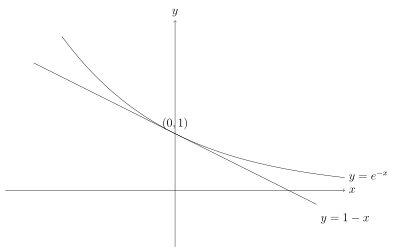
\item Show with the aid of a sketch that \( \e^t( 1-t)\le 1\,\) and deduce that \(\f'(t)\ne 0\) for \(t\ne0\).
\end{questionpart}
Sketch the graph of \(\f(t)\).
Solution
- Claim \(f(t) + \frac12 t\) is an even function. Proof: Consider \(f(-t) - \frac12t\), then \begin{align*} f(-t) - \frac12t &= \frac{-t}{e^{-t}-1} - \frac12t \\ &= \frac{-te^t}{1-e^t} - \frac12 t \\ &= \frac{t(1-e^t) -t}{1-e^t} - \frac12 t \\ &= t - \frac{t}{1-e^t} - \frac12 t \\ &= \frac{t}{e^t-1} + \frac12 t \end{align*} So it is even.
- Drawing the tangent to \(y = e^{-x}\) at \((0,1)\) we find that \(e^{-t} \geq (1-t)\) for all \(t\), in particular, \(e^t(1-t) \leq 1\) \(f'(t) = \frac{(e^t(1-t) -1}{(e^t-1)^2} \leq 0\) and \(f'(t) = -\frac12\) when \(t = 0\)

Examiner's report
— 2009 STEP 3, Question 3
Mean: ~11.5 / 20 (inferred)
~83% attempted (inferred)
Inferred ~11.5/20: 'marginally less well' than Q1/Q2 (12) → 12−0.5=11.5. Inferred ~83%: 'slightly more popular than the first 2 questions' (80%) → 80+3.
From the paper introduction
The vast majority of candidates (in excess of 95%) attempted at least five questions, and nearly a quarter attempted more than six questions, though very few doing so achieved high scores (about 2%). Most attempting more than six questions were submitting fragmentary answers, which, as the rubric informed candidates, earned little credit.
Source: Cambridge STEP 2009 Examiner's Report
· 2009-full.pdf
Rating Information
Difficulty Rating: 1700.0
Difficulty Comparisons: 0
Banger Rating: 1500.0
Banger Comparisons: 0
Show LaTeX source
Problem source
The function $\f(t)$ is defined, for $t\ne0$, by
\[
\f(t)  = \frac t {\e^t-1}\,.
\]

 \begin{questionparts}
\item
By expanding $\e^t$, show that  $\displaystyle \lim _{t\to0} \f(t) = 1\,$.
 Find $\f'(t)$ and evaluate  $\displaystyle  \lim _{t\to0} \f'(t)\,$.
\item
 Show that $\f(t) +\frac12 t$ is an even function.
[{\bf Note:} A function $\g(t)$ is said to be {\em even}
if $\g(t) \equiv  \g(-t)$.]
\item  Show with the aid of a sketch that $ \e^t(  1-t)\le 1\,$ and deduce that $\f'(t)\ne 0$ for $t\ne0$.
\end{questionpart}
Sketch the graph of $\f(t)$.
Solution source
\begin{questionparts}
$e^t = 1 + t + \frac{t^2}{2} + \cdots$, therefore
\begin{align*}
\lim_{t \to 0} f(t) &= \lim_{t \to 0} \frac{t}{e^t-1} \\
&= \lim_{t \to 0} \frac{t}{t + \frac{t^2}{2} + o(t^3)} \\
&= \lim_{t \to 0} \frac{1}{1 + \frac{t}{2} + o(t^2)} \\
&\to 1
\end{align*}

\begin{align*}
f'(t) &= \frac{(e^t-1) - te^t}{(e^t-1)^2} \\
\lim_{t \to 0} f'(t) &= \lim_{t \to 0}\frac{(e^t-1) - te^t}{(e^t-1)^2} \\
&= \lim_{t \to 0}\frac{t + \frac{t^2}{2} + o(t^3)- \l t + t^2 + \frac{t^3}{2} + o(t^4)\r}{(t + \frac{t^2}{2} + o(t^3))^2} \\
&=  \lim_{t \to 0}\frac{  -\frac{t^2}{2} + o(t^3)}{t^2 + o(t^3)} \\
&=  \lim_{t \to 0}\frac{  -\frac{1}{2} + o(t)}{1 + o(t)} \\
&\to -\frac12
\end{align*}

\item Claim $f(t) + \frac12 t$ is an even function.

Proof: Consider $f(-t) - \frac12t$, then
\begin{align*}
f(-t) - \frac12t &= \frac{-t}{e^{-t}-1} - \frac12t \\
&= \frac{-te^t}{1-e^t} - \frac12 t \\
&= \frac{t(1-e^t) -t}{1-e^t} - \frac12 t \\
&= t - \frac{t}{1-e^t} - \frac12 t \\
&= \frac{t}{e^t-1} + \frac12 t
\end{align*}

So it is even.

\item \begin{center}
\begin{tikzpicture}[scale=2]
    \draw[->] (-3, 0) -- (3, 0);
    \draw[->] (0,-1) -- (0,3);

    \node at (3,0) [right] {$x$};
    \node at (0,3) [above] {$y$};
    \node at (0,1) [above] {$(0,1)$};
    % \node at ({exp(1)/5},{2/exp(1)}) [above] {$(e, \frac1{e})$};
    \node at (3,0.25) [right] {$y = e^{-x}$};
    \node at (2.5,-.5) [right] {$y = 1-x$};
    \draw[domain = -1:1.5, samples=180, variable = \x]  plot ({2*\x},{exp(-\x)});
    \draw[domain = -1.25:1.25, samples=180, variable = \x]  plot ({2*\x},{1-\x});
\end{tikzpicture}
\end{center}

Drawing the tangent to $y = e^{-x}$ at $(0,1)$ we find that $e^{-t} \geq (1-t)$ for all $t$, in particular, $e^t(1-t) \leq 1$

$f'(t) = \frac{(e^t(1-t) -1}{(e^t-1)^2} \leq 0$  and $f'(t) = -\frac12$ when $t = 0$
\end{questionparts}

\begin{center}
\begin{tikzpicture}[scale=2]
    \draw[->] (-3, 0) -- (3, 0);
    \draw[->] (0,-1) -- (0,3);

    \node at (3,0) [right] {$x$};
    \node at (0,3) [above] {$y$};
    \node at (0,1) [above] {$(0,1)$};
    \node at (3,0.25) [right] {$y = \frac{x}{e^x-1}$};
    \draw[domain = -3:3, samples=180, variable = \x]  plot ({\x},{\x/(exp(\x)-1)});
\end{tikzpicture}
\end{center}


[Note: This is the exponential generating function for the Bernoulli numbers]
Though slightly more popular than the first 2 questions, the attempts scored marginally less well. Candidates began well, though the limit of f'(t) was not well done. The even function in (ii) was usually correctly justified. Part (iii) was frequently not quite correctly justified, though some did so by sketching the relevant functions. The sketch of f(t) often had the wrong gradient as it approached the y axis, and asymptotes were frequently not identified.