2008 Paper 3 Q12
Year: 2008
Paper: 3
Question Number: 12
Course: UFM Statistics
Section: Moment generating functions
Difficulty: 1700.0
Banger: 1516.0
moment generating functions
Laplace distribution
curve sketching
variance
central limit theorem
normal approximation
sum of independent random variables
hypothesis testing
Problem
Let \(X\) be a random variable with a Laplace distribution, so that its probability density function is given by
\[
\f(x) = \frac12 \e^{-\vert x \vert }\;,
\text{ \(-\infty < x < \infty \)}. \tag{\(*\)}
\]
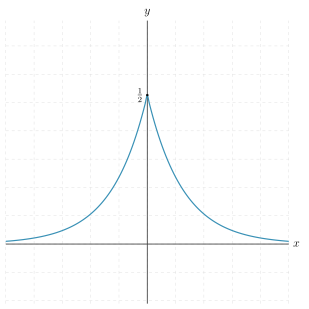
Sketch \(\f(x)\). Show that its moment generating function
\({\rm M}_X(\theta)\) is given by \({\rm M}_X(\theta)= (1-\theta^2)^{-1}\) and hence find the variance of \(X\).
A frog is jumping up and down, attempting to land on the same spot each time. In fact, in each of \(n\) successive jumps he always lands on a fixed straight line but when he lands from the \(i\)th jump (\(i=1\,,2\,,\ldots\,,n\)) his displacement from the point from which he jumped is \(X_i\,\)cm, where \(X_i\) has the distribution \((*)\). His displacement from his starting point after \(n\) jumps is \(Y\,\)cm (so that \(Y=\sum\limits_{i=1}^n X_i\)).
Each jump is independent of the others. Obtain the moment generating function for \(Y/ \sqrt {2n}\) and, by considering its logarithm, show that this moment generating function tends to \(\exp(\frac12\theta^2)\) as \(n\to\infty\).
Given that \(\exp(\frac12\theta^2)\) is the moment generating function of the standard Normal random variable, estimate the least number of jumps such that there is a \(5\%\) chance that the frog lands 25 cm or more from his starting point.
Solution
Examiner's report
— 2008 STEP 3, Question 12
~5% attempted (inferred)
Inferred ~5% from 'little more than a handful'
From the paper introduction
Most candidates attempted five, six or seven questions, and scored the majority of their total score on their best three or four. Those attempting seven or more tended not to do well, pursuing no single solution far enough to earn substantial marks.
Source: Cambridge STEP 2008 Examiner's Report
· 2008-full.pdf
Rating Information
Difficulty Rating: 1700.0
Difficulty Comparisons: 0
Banger Rating: 1516.0
Banger Comparisons: 1
Show LaTeX source
Problem source
Let $X$ be a random variable with a  Laplace distribution, so that   its probability density function is given by
\[
\f(x) = \frac12 \e^{-\vert x \vert }\;,
\text{  $-\infty < x < \infty $}. \tag{$*$}
\]
Sketch $\f(x)$. Show that its moment generating function
${\rm M}_X(\theta)$  is given by ${\rm M}_X(\theta)= (1-\theta^2)^{-1}$ and hence find the variance of $X$.
A frog is jumping up and down, attempting to land on the same  spot each time. In fact, in each of $n$ successive jumps he always lands on a fixed straight line but when he lands from  the $i$th jump ($i=1\,,2\,,\ldots\,,n$) his displacement from the point from which he jumped is $X_i\,$cm, where $X_i$ has the distribution $(*)$. His displacement from his starting point after $n$ jumps is $Y\,$cm (so that $Y=\sum\limits_{i=1}^n X_i$).
Each jump is independent of the others. Obtain the moment generating function  for $Y/ \sqrt {2n}$  and, by considering its logarithm, show that this moment generating function tends to $\exp(\frac12\theta^2)$ as $n\to\infty$.
Given that $\exp(\frac12\theta^2)$ is the moment generating function of the standard Normal random variable, estimate the least number of jumps such that there is a $5\%$ chance that the frog lands 25 cm or more from his starting point.
Solution source
\begin{center}
    \begin{tikzpicture}
    \def\functionf(#1){0.5 * exp(-abs(#1))};
    \def\xl{-4};
    \def\xu{4};
    \def\yl{-0.2}; \def\yu{.75};

    % Calculate scaling factors to make the plot square
    \pgfmathsetmacro{\xrange}{\xu-\xl}
    \pgfmathsetmacro{\yrange}{\yu-\yl}
    \pgfmathsetmacro{\xscale}{10/\xrange}
    \pgfmathsetmacro{\yscale}{10/\yrange}

    % Define the reusable styles to keep code clean
    \tikzset{
        x=\xscale cm, y=\yscale cm,
        axis/.style={thick, draw=black!80, -{Stealth[scale=1.2]}},
        grid/.style={thin, dashed, gray!30},
        curveA/.style={very thick, color=cyan!70!black, smooth},
        curveB/.style={very thick, color=orange!90!black, smooth},
        dot/.style={circle, fill=black, inner sep=1.2pt},
        labelbox/.style={fill=white, inner sep=2pt, rounded corners=2pt} % Protects text from lines
    }

    % Draw background grid
    \draw[grid] (\xl,\yl) grid (\xu,\yu);


    \draw[axis] (\xl,0) -- (\xu,0) node[right, black] {$x$};
    \draw[axis] (0,\yl) -- (0,\yu) node[above, black] {$y$};
    % Define the bounding region with clip
    \begin{scope}
        \clip (\xl,\yl) rectangle (\xu,\yu);

        \draw[curveA, domain=\xl:\xu, samples=151] plot(\x, {\functionf(\x)});
        \filldraw (0,0.5) circle (1pt) node[left] {$\frac12$};
    \end{scope}
        % Set up axes


    \end{tikzpicture}
\end{center}

\begin{align*}
&& M_X(\theta) &= \E \left [ e^{\theta X} \right] \\
&&&= \int_{-\infty}^{\infty} e^{\theta x} f(x) \d x \\
&&&= \int_{-\infty}^0 e^{\theta x}\frac12 e^{x} \d x+ \int_0^{\infty} e^{\theta x} \frac12 e^{-x} \d x \\
&&&= \frac12 \left [ \frac{1}{1+\theta}e^{(1+\theta)x} \right]_{-\infty}^0 +\frac12 \left [ \frac{1}{\theta-1}e^{(\theta-1)x} \right]_{0}^{\infty} \\
&&&= \frac12 \left (  \frac{1}{1+ \theta} + \frac{1}{1-\theta} \right) \\
&&&= \frac{1}{1-\theta^2} = (1-\theta^2)^{-1} \\
&&&= 1 + \theta^2 + \theta^4 + \cdots \\
\\
\Rightarrow && \E[X] &= 0 \\
&& \E[X^2] &= 2 \\
\Rightarrow && \var[X] &= 2
\end{align*}

\begin{align*}
&& M_{Y/\sqrt{2n}}(\theta) &= \E \left [ \exp \left ( \theta \frac{Y}{\sqrt{2n}} \right) \right] \\
&&&= \E \left [ \exp \left ( \frac{\theta }{\sqrt{2n}} \sum_{i=1}^n X_i  \right) \right] \\
&&&= \E \left [ \prod_{i=1}^n \exp \left ( \frac{\theta }{\sqrt{2n}} X_i  \right) \right] \\
&&&=  \prod_{i=1}^n \E \left [\exp \left ( \frac{\theta }{\sqrt{2n}} X_i  \right) \right] \tag{independence}\\
&&&=  \prod_{i=1}^n M_{X_i} \left ( \frac{\theta }{\sqrt{2n}} \right)\\
&&&=  \prod_{i=1}^n M_{X} \left ( \frac{\theta }{\sqrt{2n}} \right)\\
&&&=  M_{X} \left ( \frac{\theta }{\sqrt{2n}} \right)^n\\
&&&= \left (1 - \frac{\theta^2}{2n} \right)^{-n} \to \exp(\tfrac12 \theta^2)
\end{align*}

Given that $M_{Y/\sqrt{2n}} \to M_Z$ we assume that $Y/\sqrt{2n} \to Z$ or $Y/\sqrt{2n} \approx Z$.

\begin{align*}
&& 5\% &\approx \mathbb{P}(|Z| > 2) \\
&&&\approx \mathbb{P} \left (|Y| > 2\sqrt{2n} \right)
\end{align*}

So we wish to choose $n$ such that $2\sqrt{2n} = 25$ or $n = \frac{625}8 \approx 78$ so take $n = 79$
Little more than a handful of candidates attempted this with three strong attempts (near full marks) and the remainder making no headway at all.