Problems
Filters
1531 problems found
2002 Paper 1 Q9
\(\,\) \vspace*{-0.5in}
- If the normal reactions on the lower and higher wheels of the lorry are equal, show that the sum of the frictional forces between the wheels and the ground is zero.
- If \(P\) is such that the lorry does not tip over (but the normal reactions on the lower and higher wheels of the lorry need not be equal), show that \[ W\tan(\alpha - \beta) \le P \le W\tan(\alpha+\beta)\;, \] where \(\tan\beta = d/h\,\).
2002 Paper 1 Q10
A bicycle pump consists of a cylinder and a piston. The piston is pushed in with steady speed~\(u\). A particle of air moves to and fro between the piston and the end of the cylinder, colliding perfectly elastically with the piston and the end of the cylinder, and always moving parallel with the axis of the cylinder. Initially, the particle is moving towards the piston at speed \(v\). Show that the speed, \(v_n\), of the particle just after the \(n\)th collision with the piston is given by \(v_n=v+2nu\). Let \(d_n\) be the distance between the piston and the end of the cylinder at the \(n\)th collision, and let \(t_n\) be the time between the \(n\)th and \((n+1)\)th collisions. Express \(d_n - d_{n+1}\) in terms of \(u\) and \(t_n\), and show that \[ d_{n+1} = \frac{v+(2n-1)u}{v+(2n+1)u} \, d_n \;. \] Express \(d_n\) in terms of \(d_1\), \(u\), \(v\) and \(n\). In the case \(v=u\), show that \(ut_n = \displaystyle \frac {d_1} {n(n+1)}\). %%%%%Verify that \(\sum\limits_1^\infty t_n = d/u\).
2002 Paper 1 Q11
\(\,\)
2002 Paper 1 Q12
Harry the Calculating Horse will do any mathematical problem I set him, providing the answer is 1, 2, 3 or 4. When I set him a problem, he places a hoof on a large grid consisting of unit squares and his answer is the number of squares partly covered by his hoof. Harry has circular hoofs, of radius \(1/4\) unit. After many years of collaboration, I suspect that Harry no longer bothers to do the calculations, instead merely placing his hoof on the grid completely at random. I often ask him to divide 4 by 4, but only about \(1/4\) of his answers are right; I often ask him to add 2 and 2, but disappointingly only about \(\pi/16\) of his answers are right. Is this consistent with my suspicions? I decide to investigate further by setting Harry many problems, the answers to which are 1, 2, 3, or 4 with equal frequency. If Harry is placing his hoof at random, find the expected value of his answers. The average of Harry's answers turns out to be 2. Should I get a new horse?
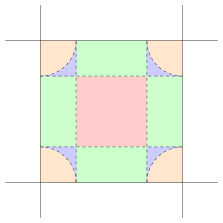
Solution: Without loss of generality, let's assume that Harry is putting the center of his hoof within one square.
2002 Paper 1 Q13
The random variable \(U\) takes the values \(+1\), \(0\) and \(-1\,\), each with probability \(\frac13\,\). The random variable \(V\) takes the values \(+1\) and \(-1\) as follows:
| if \(U=1\,\), | then \(\P(V=1)= \frac13\) and \(\P(V=-1)=\frac23\,\); |
| if \(U=0\,\), | then \(\P(V=1)= \frac12\) and \(\P(V=-1)=\frac12\,\); |
| if \(U=-1\,\), | then \(\P(V=1)= \frac23\) and \(\P(V=-1)=\frac13\,\). |
- Show that the probability that both roots of the equation \(x^2+Ux+V=0\) are real is \(\frac12\;\).
- Find the expected value of the larger root of the equation \(x^2+Ux+V=0\,\), given that both roots are real.
- Find the probability that the roots of the equation $$x^3+(U-2V)x^2+(1-2UV)x + U=0$$ are all positive.
Solution:
- \(\,\) \begin{align*} && \mathbb{P}(\text{both roots real}) &= \mathbb{P}(\Delta \geq 0) \\ &&&= \mathbb{P}(U^2 \geq 4V) \\ &&&= \mathbb{P}(V = -1) \\ &&&= \tfrac13 ( \tfrac23 + \tfrac12 + \tfrac13) \\ &&&= \tfrac13 \cdot \tfrac 32 = \frac12 \end{align*}
- Our equations will be: \(x^2+x-1 = 0\) with larger root \(\frac{-1 + \sqrt{5}}{2}\) \(x^2-1 = 0\) with larger root \(1\) \(x^2-x-1 = 0\) with larger root \(\frac{1 + \sqrt5}{2}\) and the expected value is \begin{align*} && \E[\text{larger root}|\text{both real}] &= \frac23 \left ( \frac23 \cdot \frac{-1+\sqrt5}{2} + \frac12 \cdot 1 + \frac13 \cdot \frac{1+\sqrt5}{2} \right) \\ &&&= \frac23 \left ( \frac{2+3\sqrt5}{6} \right) \\ &&&= \frac{2+3\sqrt5}{9} \end{align*}
- Suppose we have \(x^3+(U-2V)x^2+(1-2UV)x + U = 0\), then for all roots to be positive, we need \(U < 0 \Rightarrow U = -1\) (otherwise there is a root at or below zero). Therefore our two possible cubics are: \(x^3 -3x^2+3x-1 = (x-1)^3\) (all roots positive) \(x^3+x^2-x-1 = (x-1)(x+1)^2\) (not all roots positive!) Therefore the probability is \(\frac13 \cdot \frac23 = \frac29\)
2002 Paper 1 Q14
In order to get money from a cash dispenser I have to punch in an identification number. I have forgotten my identification number, but I do know that it is equally likely to be any one of the integers \(1\), \(2\), \ldots , \(n\). I plan to punch in integers in order until I get the right one. I can do this at the rate of \(r\) integers per minute. As soon as I punch in the first wrong number, the police will be alerted. The probability that they will arrive within a time \(t\) minutes is \(1-\e^{-\lambda t}\), where \(\lambda\) is a positive constant. If I follow my plan, show that the probability of the police arriving before I get my money is \[ \sum_{k=1}^n \frac{1-\e^{-\lambda(k-1)/r}}n\;. \] Simplify the sum. On past experience, I know that I will be so flustered that I will just punch in possible integers at random, without noticing which I have already tried. Show that the probability of the police arriving before I get my money is \[ 1-\frac1{n-(n-1)\e^{-\lambda/r}} \;. \]
2002 Paper 2 Q1
Show that \[ \int_{\frac{1}{6}\pi}^{\frac{1}{4}\pi} \frac 1{1-\cos2\theta} \;\d\theta = \frac{\sqrt3}2 - \frac12\;. \] By using the substitution \(x=\sin2\theta\), or otherwise, show that \[ \int_{\sqrt3/2}^1 \frac 1 {1-\sqrt{1-x^2}} \, \d x = \sqrt 3 -1 -\frac\pi 6 \;. \] Hence evaluate the integral \[ \int_1^{2/\sqrt3} \frac 1{y ( y - \sqrt{y^2-1^2})} \, \d y \;. \]
Solution: \begin{align*} && I &= \int_{\frac{1}{6}\pi}^{\frac{1}{4}\pi} \frac 1{1-\cos2\theta} \;\d\theta \\ &&&= \int_{\frac{1}{6}\pi}^{\frac{1}{4}\pi} \frac 1{2\sin^2 \theta} \;\d\theta \\ &&&= \frac12\int_{\frac{1}{6}\pi}^{\frac{1}{4}\pi} \cosec^2 \theta \;\d\theta \\ &&&= \frac12\left [-\cot \theta \right]_{\frac{1}{6}\pi}^{\frac{1}{4}\pi} \\ &&&= \frac12 \left (\cot \frac{\pi}{6} - \cot \frac{\pi}{4} \right)\\ &&&= \frac{\sqrt{3} - 1}{2} \end{align*} \begin{align*} && J &= \int_{\sqrt3/2}^1 \frac 1 {1-\sqrt{1-x^2}} \, \d x \\ x = \sin 2 \theta, \d x = 2\cos 2\theta \d \theta &&&=\int_{\pi/6}^{\pi/4} \frac{2 \cos 2 \theta }{1-\cos 2 \theta} \d \theta \\ &&&=\int_{\pi/6}^{\pi/4} \frac{2 \cos 2 \theta -2+2}{1-\cos 2 \theta} \d \theta \\ &&&= -2\left (\frac{\pi}{4} - \frac{\pi}6 \right) + 2I \\ &&&= \sqrt{3}-1-\frac{\pi}{6} \end{align*} \begin{align*} && K &= \int_1^{2/\sqrt{3}} \frac{1}{y(y-\sqrt{y^2-1})} \d y \\ y = 1/x, \d x = -1/y^2 \d y &&&= \int_{x=1}^{x=\sqrt{3}/2} \frac{1}{1-\sqrt{1-x^2}} \d x\\ &&&= \sqrt{3}-1 -\frac{\pi}6 \end{align*}
2002 Paper 2 Q2
Show that setting \(z - z^{-1}=w\) in the quartic equation \[ z^4 +5z^3 +4z^2 -5z +1=0 \] results in the quadratic equation \(w^2+5w+6=0\). Hence solve the above quartic equation. Solve similarly the equation \[ 2z^8 -3z^7-12z^6 +12z^5 +22z^4-12z^3 -12 z^2 +3z +2=0 \;. \]
Solution: \begin{align*} && 0 &= z^4 +5z^3 +4z^2 -5z +1 \\ &&0 &= z^2 + z^{-2} + 5(z-z^{-1}) + 4 \\ &&&= (z-z^{-1})^2+2+5(z-z^{-1})+4 \\ &&&= w^2 + 5w + 6 \\ &&&= (w+3)(w+2) \\ \Rightarrow && 0 &= z-z^{-1}+3 \\ \Rightarrow && 0 &= z^2+3z-1 \\ \Rightarrow && z &= \frac{-3 \pm \sqrt{3^2+4}}{2} = \frac{-3 \pm \sqrt{13}}{2} \\ \Rightarrow && 0 &= z-z^{-1}+2 \\ \Rightarrow && 0 &= z^2+2z-1 \\ \Rightarrow && z &= \frac{-2 \pm \sqrt{2^2+4}}{2} = - 1 \pm \sqrt{2} \\ \end{align*} \begin{align*} &&0 &= 2z^8 -3z^7-12z^6 +12z^5 +22z^4-12z^3 -12 z^2 +3z +2 \\ && 0 &= 2(z^4+z^{-4}) - 3(z^3-z^{-3})-12(z^2+z^{-2})+12(z-z^{-1})+22 \\ &&&= 2\left ((z-z^{-1})^4+4(z^2+z^{-2})-6\right)-3 \left ((z-z^{-1})^3+3(z-z^{-1}) \right)-12 \left ((z-z^{-1})^2+2 \right)+12(z-z^{-1})+22 \\ &&&= 2(w^4+4(w^2+2)-6)-3w^3-9w-12w^2-24+12w+22 \\ &&&= 2 w^4-3w^3-4w^2+3w+2 \\ \Rightarrow && 0 &= 2(w^2+w^{-2})-3(w-w^{-1})-4 \\ &&&= 2((w-w^{-1})^2+2)-3(w-w^{-1})-4 \\ &&&= 2x^2-3x \\ &&&= x(2x-3) \\ \Rightarrow && 0 &= w -w^{-1} \\ \Rightarrow && w &= \pm 1 \\ \Rightarrow && \pm 1 &= z-z^{-1} \\ \Rightarrow && 0 &= z^2 \mp z-1 \\ \Rightarrow && z &= \frac{\pm 1 \pm \sqrt{5}}{2} \\ \Rightarrow && \frac32 &= w-w^{-1} \\ \Rightarrow && 0 &= 2w^2-3w -2 \\ &&&= (2w+1)(w-2) \\ \Rightarrow && 2 &= z-z^{-1} \\ \Rightarrow && 0 &= z^2-2z-1 \\ \Rightarrow && z &= 1 \pm \sqrt{2} \\ \Rightarrow && -\frac12 &= z-z^{-1} \\ \Rightarrow && 0 &= 2z^2+z-2 \\ \Rightarrow && z &= \frac{-1 \pm \sqrt{17}}{4} \\ \Rightarrow && z &\in \left \{ \frac{\pm 1 \pm \sqrt{5}}{2}, 1 \pm \sqrt{2}, \frac{-1 \pm \sqrt{17}}{4} \right \} \end{align*}
2002 Paper 2 Q3
The \(n\)th Fermat number, \(F_n\), is defined by \[ F_n = 2^{2^n} +1\, , \ \ \ \ \ \ \ n=0, \ 1, \ 2, \ \ldots \ , \] where \(\ds 2^{2^n}\) means \(2\) raised to the power \(2^n\,\). Calculate \(F_0\), \(F_1\), \(F_2\) and \(F_3\,\). Show that, for \(k=1\), \(k=2\) and \(k=3\,\), $$ F_0F_1 \ldots F_{k-1} = F_k-2 \;. \tag{*} $$ Prove, by induction, or otherwise, that \((*)\) holds for all \(k\ge1\). Deduce that no two Fermat numbers have a common factor greater than \(1\). Hence show that there are infinitely many prime numbers.
Solution: \begin{align*} && F_0 &= 2^{2^0}+1 \\ &&&= 2^1+1 = 3\\ && F_1 &= 2^{2^1}+1 \\ &&&= 2^2+1 = 5 \\ && F_2 &= 2^{2^2}+1 \\ &&&= 2^4+1 \\ &&&= 17 \\ &&F_3 &= 2^{2^3}+1 \\ &&&= 2^8+1 \\ &&&= 257 \\ \\ && \text{empty product} &= 1\\ && F_1 - 2 &= 3-2 = 1\\ \Rightarrow&& 1 &= F_1-2\\ && F_0 &=3 \\ && F_2-2 &= 3 \\ \Rightarrow && F_0 &= F_2 - 2\\ && F_0F_1 &= 3 \cdot 5 = 15 \\ && F_3-2 &= 17-2 = 15 \\ \Rightarrow && F_0F_1 &= F_3-2 \end{align*} \begin{align*} && F_0 F_1 \cdots F_{k-1} &= \prod_{i=0}^{k-1} \left ( 2^{2^{i}}+1\right) \\ &&&= \sum_{l = \text{sum of }2^i} 2^l \\ &&&= \sum_{l=0}^{2^{k}-1}2^l \\ &&&= 2^{2^k}-1 \\ &&&= F_k-2 \end{align*} Suppose \(p \mid F_a, F_b\) with \(b > a\), then \(p \mid 2=F_b - F_0\cdots F_a \cdots F_{b-1}\) therefore \(p = 1, 2\), but \(2 \nmid F_a\) for any \(a\). Therefore any number dividing two Fermat numbers is \(1\), ie they are all coprime. Consider the smallest prime dividing \(F_n\) for each \(n\). Clearly these are all different since each \(F_n\) is coprime from all the others. Clearly there are infinitely many of time (since there are infinitely many \(F_n\)). Therefore there are infinitely many primes.
2002 Paper 2 Q4
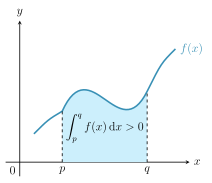
Give a sketch to show that, if \(\f(x) > 0\) for \(p < x < q\,\), then \(\displaystyle \int_p^{q} \f(x) \d x > 0\,\).
- By considering \(\f(x) = ax^2-bx+c\,\) show that, if \(a > 0\) and \(b^2 < 4ac\), then \(3b < 2a+6c\,\).
- By considering \(\f(x)= a\sin^2x - b\sin x + c\,\) show that, if \(a > 0\) and \(b^2< 4ac\), then \(4b < (a+2c)\pi\)
- Show that, if \(a > 0\), \(b^2 < 4ac\) and \(q > p > 0\,\), then $$ b\ln(q/p) < a\left(\frac1p -\frac1q\right) +c(q-p)\;. $$
Solution:
- If \(a > 0\) and \(b^2 < 4ac \Rightarrow \Delta < 0\) then \(f(x) = ax^2-bx+c > 0\) for all \(x\). Therefore \begin{align*} && 0 & < \int_0^1 (ax^2-bx+c) \d x\\ &&&= \frac13 a-\frac12b+c \\ \Rightarrow && 3b &< 2a+6c \end{align*}
- Similar logic tells us this must also be always positive, therefore \begin{align*} && 0 &< \int_0^{\pi} (a \sin^2 x - b \sin x +c ) \d x\\ &&&= \frac{\pi}{2}a - 2b+\pi c \\ \Rightarrow && 4b &< (a+2c)\pi \end{align*}
- Similar logic shows that \(f(x) = \frac{a}{x^2}-\frac{b}{x} +c>0\), therefore \begin{align*} && 0 &< \int_p^q \left (\frac{a}{x^2} - \frac{b}{x} + c\right) \d x \\ &&&=a\left (\frac{1}{p} - \frac{1}{q} \right) - b(\ln q - \ln p)+c(q-p) \\ \Rightarrow && b \ln (q/p) &,< a\left (\frac{1}{p} - \frac{1}{q} \right) +c(q-p) \end{align*}
2002 Paper 2 Q5
The numbers \(x_n\), where \(n=0\), \(1\), \(2\), \(\ldots\) , satisfy \[ x_{n+1} = kx_n(1-x_n) \;. \]
- Prove that, if \(0 < k < 4\) and \(0 < x_0 < 1\), then \(0 < x_n < 1\) for all \(n\,\).
- Given that \(x_0=x_1=x_2 = \cdots =a\,\), with \(a\ne0\) and \(a\ne1\), find \(k\) in terms of \(a\,\).
- Given instead that \(x_0=x_2=x_4 = \cdots = a\,\), with \(a\ne0\) and \(a\ne1\), show that \(ab^3 -b^2 +(1-a)=0\), where \(b=k(1-a)\,\). Given, in addition, that \(x_1 \ne a\), find the possible values of \(k\) in terms of \(a\,\).
Solution:
- Consider \(f(x) = x(1-x) = x - x^2 = \tfrac14 - (x - \tfrac12)^2\) which is clearly in \((0,\tfrac14)\) when \(x \in (0,1)\), therefore if \(0 < k < 4\) then \(f(x) \in (0, 1)\) and so by induction \(x_n \in (0,1)\).
- Suppose \(a = g(a)\) then \(a = ka(1-a) \Rightarrow 1 = k(1-a) \Rightarrow k = \frac{1}{1-a}\) (since \(a \neq 0, 1\))
- If \(g(g(a)) = a\) then \begin{align*} && a &= kg(a)(1-g(a)) \\ &&&= k^2a(1-a)(1-ka(1-a)) \\ &&&= -k^3a^2(1-a)^2 + k^2a(1-a) \\ \Rightarrow && 1 &= -k^3a(1-a)^2 + k^2(1-a) \\ \Rightarrow && 1-a &= -k^3a(1-a)^3+k^2(1-a)^2 \\ \Rightarrow && 1-a &= -ab^3+b^2 \\ \Rightarrow && 0 &= ab^3-b^2+(1-a) \end{align*} Note that \begin{align*} && 0 &= ab^3-b^2+(1-a) \\ &&&= (b-1)(ab^2-(1-a)b - (1-a)) \end{align*} and since \(b \neq 1\) (otherwise \(x_2 =0\) which is a contradiction) we must have \(b = \frac{1-a \pm \sqrt{(1-a)^2+4a(1-a)}}{2a} = \frac{1-a\pm \sqrt{1+2a-3a^2}}{2a}\) and so \(k = \frac{b}{1-a} = \frac{1-a \pm \sqrt{1+2a-3a^2}}{2a(1-a)}\)
2002 Paper 2 Q6
The lines \(l_1\), \(l_2\) and \(l_3\) lie in an inclined plane \(P\) and pass through a common point \(A\). The line \(l_2\) is a line of greatest slope in \(P\). The line \(l_1\) is perpendicular to \(l_3\) and makes an acute angle \(\alpha\) with \(l_2\). The angles between the horizontal and \(l_1\), \(l_2\) and \(l_3\) are \(\pi/6\), \(\beta\) and \(\pi/4\), respectively. Show that \(\cos\alpha\sin\beta = \frac12\,\) and find the value of \(\sin\alpha \sin\beta\,\). Deduce that \(\beta = \pi/3\,\). The lines \(l_1\) and \(l_3\) are rotated in \(P\) about \(A\) so that \(l_1\) and \(l_3\) remain perpendicular to each other. The new acute angle between \(l_1\) and \(l_2\) is \(\theta\). The new angles which \(l_1\) and \(l_3\) make with the horizontal are \(\phi\) and \(2\phi\), respectively. Show that \[ \tan^2\theta = \frac{3+\sqrt{13}}2\;. \]
2002 Paper 2 Q7
In 3-dimensional space, the lines \(m_1\) and \(m_2\) pass through the origin and have directions \(\bf i + j\) and \(\bf i +k \), respectively. Find the directions of the two lines \(m_3\) and \(m_4\) that pass through the origin and make angles of \(\pi/4\) with both \(m_1\) and \(m_2\). Find also the cosine of the acute angle between \(m_3\) and \(m_4\). The points \(A\) and \(B\) lie on \(m_1\) and \(m_2\) respectively, and are each at distance \(\lambda \surd2\) units from~\(O\). The points \(P\) and \(Q\) lie on \(m_3\) and \(m_4\) respectively, and are each at distance \(1\) unit from~\(O\). If all the coordinates (with respect to axes \(\bf i\), \(\bf j\) and \(\bf k\)) of \(A\), \(B\), \(P\) and \(Q\) are non-negative, prove that:
- there are only two values of \(\lambda\) for which \(AQ\) is perpendicular to \(BP\,\);
- there are no non-zero values of \(\lambda\) for which \(AQ\) and \(BP\) intersect.
2002 Paper 2 Q8
Find \(y\) in terms of \(x\), given that: \begin{eqnarray*} \mbox{for \(x < 0\,\)}, && \frac{\d y}{\d x} = -y \mbox{ \ \ and \ \ } y = a \mbox{ when } x = -1\;; \\ \mbox{for \(x > 0\,\)}, && \frac{\d y}{\d x} = y \mbox{ \ \ \ \ and \ \ } y = b \ \mbox{ when } x = 1\;. \end{eqnarray*} Sketch a solution curve. Determine the condition on \(a\) and \(b\) for the solution curve to be continuous (that is, for there to be no `jump' in the value of \(y\)) at \(x = 0\). Solve the differential equation \[ \frac{\d y}{\d x} = \left\vert \e^x-1\right\vert y \] given that \(y=\e^{\e}\) when \(x=1\) and that \(y\) is continuous at \(x=0\,\). Write down the following limits: \ \[ \text{(i)} \ \ \lim_ {x \to +\infty} y\exp(-\e^x)\;; \ \ \ \ \ \ \ \ \ \text{(ii)} \ \ \lim_{x \to -\infty}y \e^{-x}\,. \]
2002 Paper 2 Q9
A particle is projected from a point \(O\) on a horizontal plane
with speed \(V\) and at an angle
of elevation \(\alpha\). The vertical plane in which the motion takes place
is perpendicular to two vertical walls, both of height \(h\), at distances
\(a\) and \(b\) from \(O\). Given that the particle just passes over the
walls, find \(\tan\alpha\) in terms of \(a\), \(b\) and \(h\) and
show that
\[
\frac{2V^2} g = \frac {ab} h +\frac{ (a+b)^2 h}{ab} \;.
\]
The heights of the walls are now increased by the same small positive
amount \(\delta h\,\).
A second particle is projected so that it just passes over
both walls, and the new angle and speed of projection
are \(\alpha +\delta \alpha \) and \(V+\delta V\), respectively.
Show that
\[
\sec^2 \alpha \, \delta \alpha \approx \frac {a+b}{ab}\,\delta h \;,
\]
and deduce that \(\delta \alpha >0\,\). Show also that
\(\delta V\) is positive if \(h> ab/(a+b)\) and negative if \(h