2002 Paper 1 Q12
Year: 2002
Paper: 1
Question Number: 12
Course: LFM Stats And Pure
Section: Geometric Probability
Difficulty: 1484.0
Banger: 1469.5
geometric probability
circle covering squares
grid
expected value
area calculation
random placement
probability
Problem
Harry the Calculating Horse will do any mathematical problem I set him, providing the answer is 1, 2, 3 or 4. When I set him a problem, he places a hoof on a large grid consisting of unit squares and his answer is the number of squares partly covered by his hoof. Harry has circular hoofs, of radius \(1/4\) unit.
After many years of collaboration, I suspect that Harry no longer bothers to do the calculations, instead merely placing his hoof on the grid completely at random. I often ask him to divide 4 by 4, but only about \(1/4\) of his answers are right; I often ask him to add 2 and 2, but disappointingly only about \(\pi/16\) of his answers are right. Is this consistent with my suspicions?
I decide to investigate further by setting Harry many problems, the answers to which are 1, 2, 3, or 4 with equal frequency. If Harry is placing his hoof at random, find the expected value of his answers. The average of Harry's answers turns out to be 2. Should I get a new horse?
Solution
Without loss of generality, let's assume that Harry is putting the center of his hoof within one square.
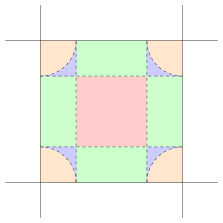 Based on the colour he places his foot in (red \(1\), green \(2\), blue \(3\) and orange \(4\)) we can see that the probability of him hitting \(1\) is \(\frac14\) and the probability of him getting \(4\) is \(\pi 0.25^2 = \frac{\pi}{16}\) just as you expected.
The expected value of randomly placinging his hoof is:
\begin{align*}
\E[A] &= \frac14 \cdot 1 + \frac{4}{8} \cdot 2 + \left ( \frac14 - \frac{\pi}{16}\right) \cdot 3 + \frac{\pi}{16} \cdot 4 \\
&= 2 + \frac{\pi}{16}
\end{align*}
The expected value we should get is \(2.5\). That he is worse than random means we should probably investigate further. There is probably some bias, which might be solvable (it's hard for the horse to answer \(3\) for example), but it may just be we need a new horse.
Based on the colour he places his foot in (red \(1\), green \(2\), blue \(3\) and orange \(4\)) we can see that the probability of him hitting \(1\) is \(\frac14\) and the probability of him getting \(4\) is \(\pi 0.25^2 = \frac{\pi}{16}\) just as you expected.
The expected value of randomly placinging his hoof is:
\begin{align*}
\E[A] &= \frac14 \cdot 1 + \frac{4}{8} \cdot 2 + \left ( \frac14 - \frac{\pi}{16}\right) \cdot 3 + \frac{\pi}{16} \cdot 4 \\
&= 2 + \frac{\pi}{16}
\end{align*}
The expected value we should get is \(2.5\). That he is worse than random means we should probably investigate further. There is probably some bias, which might be solvable (it's hard for the horse to answer \(3\) for example), but it may just be we need a new horse.
Rating Information
Difficulty Rating: 1484.0
Difficulty Comparisons: 1
Banger Rating: 1469.5
Banger Comparisons: 2
Show LaTeX source
Problem source
Harry the Calculating Horse will do any mathematical problem I set  him, providing the answer is 1, 2, 3 or 4. When I set  him a problem, he   places a  hoof on a large  grid consisting of unit squares and  his   answer is  the number of squares partly covered by his hoof. Harry has circular hoofs, of radius $1/4$ unit.
After many years of collaboration, I suspect that Harry no longer bothers to do the calculations, instead merely placing his hoof on the grid completely at random. I often ask him to  divide 4 by 4, but only  about $1/4$ of his answers are right;  I often ask him to add 2 and 2, but disappointingly only about $\pi/16$ of his answers are right. Is this consistent with my suspicions?
I decide to investigate  further by setting  Harry many problems,  the answers to which are 1, 2, 3, or 4 with equal frequency. If Harry is placing his hoof at random, find the expected value of his answers. The average of Harry's answers turns out to  be 2. Should I get a new horse?
Solution source
Without loss of generality, let's assume that Harry is putting the center of his hoof within one square.


\begin{center}
    \begin{tikzpicture}[scale=5]


        \filldraw[color=red!20] (0.25, .25) rectangle (.75, .75);
        \filldraw[color=green!20] (0.25, 0) rectangle (.75, .25);
        \filldraw[color=green!20] (0.75, .25) rectangle (1, .75);
        \filldraw[color=green!20] (0.25, .75) rectangle (.75, 1);
        \filldraw[color=green!20] (0, 0.25) rectangle (.25, .75);

        \filldraw[color=orange!20] (0,0) -- (.25, 0) arc (0:90:.25) -- cycle;
        \filldraw[color=orange!20] (1,0) -- (.75, 0) arc (180:90:.25) -- cycle;
        \filldraw[color=orange!20] (0,1) -- (.25, 1) arc (0:-90:.25) -- cycle;
        \filldraw[color=orange!20] (1,1) -- ( .75, 1) arc (180:270:.25) -- cycle;

        \filldraw[color=blue!20] (.25,.25) -- (.25, 0) arc (0:90:.25) -- cycle;
        \filldraw[color=blue!20] (.75,.25) -- (.75, 0) arc (180:90:.25) -- cycle;
        \filldraw[color=blue!20] (.25,.75) -- (.25, 1) arc (0:-90:.25) -- cycle;
        \filldraw[color=blue!20] (.75,.75) -- ( .75, 1) arc (180:270:.25) -- cycle;


        \draw (-.25, -.25) grid (1.25, 1.25);

        \draw[dashed] (.25, 0) -- (.25, 1);
        \draw[dashed] (.75, 0) -- (.75, 1);
        \draw[dashed] (0, .25) -- (1, .25);
        \draw[dashed] (0, .75) -- (1, .75);
        \draw[dashed] (.25, 0) arc (0:90:.25);
        \draw[dashed] (.75, 0) arc (180:90:.25);
        \draw[dashed] ( .25, 1) arc (0:-90:.25);
        \draw[dashed] ( .75, 1) arc (180:270:.25);


    \end{tikzpicture}
\end{center}

Based on the colour he places his foot in (red $1$, green $2$, blue $3$ and orange $4$) we can see that the probability of him hitting $1$ is $\frac14$ and the probability of him getting $4$ is $\pi 0.25^2 = \frac{\pi}{16}$ just as you expected.

The expected value of randomly placinging his hoof is:

\begin{align*}
\E[A] &= \frac14 \cdot 1 + \frac{4}{8} \cdot 2 + \left ( \frac14 - \frac{\pi}{16}\right) \cdot 3 + \frac{\pi}{16} \cdot 4 \\
&= 2 + \frac{\pi}{16}
\end{align*}

The expected value we should get is $2.5$. That he is \textit{worse} than random means we should probably investigate further. There is probably some bias, which might be solvable (it's hard for the horse to answer $3$ for example), but it may just be we need a new horse.