Problems
Filters
57 problems found
2003 Paper 2 Q9
\(AB\) is a uniform rod of weight \(W\,\). The point \(C\) on \(AB\) is such that \(AC>CB\,\). The rod is in contact with a rough horizontal floor at \(A\,\) and with a cylinder at \(C\,\). The cylinder is fixed to the floor with its axis horizontal. The rod makes an angle \({\alpha}\) with the horizontal and lies in a vertical plane perpendicular to the axis of the cylinder. The coefficient of friction between the rod and the floor is \(\tan \lambda_1\) and the coefficient of friction between the rod and the cylinder is \(\tan \lambda_2\,\). Show that if friction is limiting both at \(A\) and at \(C\), and \({\alpha} \ne {\lambda}_2 - {\lambda}_1\,\), then the frictional force acting on the rod at \(A\) has magnitude $$ \frac{ W\sin {\lambda}_1 \, \sin({\alpha}-{\lambda}_2)} {\sin ({\alpha}+{\lambda}_1-{\lambda}_2)} \;.$$ %and that %$$ %p=\frac{\cos{\alpha} \, \sin({\alpha}+{\lambda}_1-{\lambda}_2)} %{2\cos{\lambda}_1 \, \sin {\lambda}_2}\;. %$$
2002 Paper 1 Q9
\(\,\) \vspace*{-0.5in}
- If the normal reactions on the lower and higher wheels of the lorry are equal, show that the sum of the frictional forces between the wheels and the ground is zero.
- If \(P\) is such that the lorry does not tip over (but the normal reactions on the lower and higher wheels of the lorry need not be equal), show that \[ W\tan(\alpha - \beta) \le P \le W\tan(\alpha+\beta)\;, \] where \(\tan\beta = d/h\,\).
2002 Paper 2 Q11
A rigid straight beam \(AB\) has length \(l\) and weight \(W\). Its weight per unit length at a distance \(x\) from \(B\) is \(\alpha Wl^{-1} (x/l)^{\alpha-1}\,\), where \(\alpha\) is a positive constant. Show that the centre of mass of the beam is at a distance \(\alpha l/(\alpha+1)\) from \(B\). The beam is placed with the end \(A\) on a rough horizontal floor and the end \(B\) resting against a rough vertical wall. The beam is in a vertical plane at right angles to the plane of the wall and makes an angle of \(\theta\) with the floor. The coefficient of friction between the floor and the beam is \(\mu\) and the coefficient of friction between the wall and the beam is also \(\mu\,\). Show that, if the equilibrium is limiting at both \(A\) and \(B\), then \[ \tan\theta = \frac{1-\alpha \mu^2}{(1+\alpha)\mu}\;. \] Given that \(\alpha =3/2\,\) and given also that the beam slides for any \(\theta<\pi/4\,\) find the greatest possible value of \(\mu\,\).
2001 Paper 3 Q9
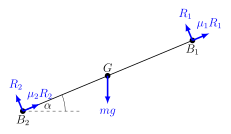
\(B_1\) and \(B_2\) are parallel, thin, horizontal fixed beams. \(B_1\) is a vertical distance \(d \sin \alpha \) above \(B_2\), and a horizontal distance \(d\cos\alpha \) from \(B_2\,\), where \(0<\alpha<\pi/2\,\). A long heavy plank is held so that it rests on the two beams, perpendicular to each, with its centre of gravity at \(B_1\,\). The coefficients of friction between the plank and \(B_1\) and \(B_2\) are \(\mu_1\) and \(\mu_2\,\), respectively, where \(\mu_1<\mu_2\) and \(\mu_1+\mu_2=2\tan\alpha\,\). The plank is released and slips over the beams experiencing a force of resistance from each beam equal to the limiting frictional force (i.e. the product of the appropriate coefficient of friction and the normal reaction). Show that it will come to rest with its centre of gravity over \(B_2\) in a time \[ \pi \left(\frac{d}{g(\mu_2-\mu_1)\cos\alpha }\right)^{\!\frac12}\;. \]
Solution:
2000 Paper 1 Q11
A rod \(AB\) of length 0.81 m and mass 5 kg is in equilibrium with the end \(A\) on a rough floor and the end \(B\) against a very rough vertical wall. The rod is in a vertical plane perpendicular to the wall and is inclined at \(45^{\circ}\) to the horizontal. The centre of gravity of the rod is at \(G\), where \(AG = 0.21\) m. The coefficient of friction between the rod and the floor is 0.2, and the coefficient of friction between the rod and the wall is 1.0. Show that the friction cannot be limiting at both \(A\) and \(B\). A mass of 5 kg is attached to the rod at the point \(P\) such that now the friction is limiting at both \(A\) and \(B\). Determine the length of \(AP\).
2000 Paper 1 Q14
The random variable \(X\) is uniformly distributed on the interval \([-1,1]\). Find \(\E(X^2)\) and \(\var (X^2)\). A second random variable \(Y\), independent of \(X\), is also uniformly distributed on \([-1,1]\), and \(Z=Y-X\). Find \(\E(Z^2)\) and show that \(\var (Z^2) = 7 \var (X^2)\).
Solution: \(X \sim U(-1,1)\) \begin{align*} \E[X^2] &= \int_{-1}^1 \frac12 x^2 \, dx \\ &= \frac{1}{6} \left [ x^3 \right]_{-1}^1 \\ &= \frac{1}{3} \end{align*} \begin{align*} \E[X^4] &= \int_{-1}^1 \frac12 x^4 \, dx \\ &= \frac{1}{10} \left [ x^5 \right]_{-1}^1 \\ &= \frac{1}{5} \end{align*} \begin{align*} \var[X^2] &=\E[X^4] - \E[X^2]^2 \\ &= \frac{1}{5} - \frac{1}{9} \\ &= \frac{4}{45} \end{align*} \begin{align*} \E(Z^2) &= \E(Y^2 - 2XY+Z^2) \\ &= \E(Y^2) - 2\E(X)\E(Y)+\E(Z^2) \\ &= \frac{1}{3} - 0 + \frac{1}{3} \\ &= \frac{2}{3} \end{align*} \begin{align*} \E[Z^4] &= \E[Y^4 -4Y^3X+6Y^2X^2-4YX^3+X^4] \\ &= \E[Y^4]-4\E[Y^3]\E[X]+6\E[Y^2]\E[X^2]-4\E[Y]\E[X^3]+\E[X^4] \\ &= \frac{1}{5}+6 \frac{1}{3} \frac13 + \frac{1}{5} \\ &= \frac{2}{5} + \frac{2}{3} \\ &= \frac{16}{15} \end{align*} \begin{align*} \var(Z^2) &= \E(Z^4) - \E(Z^2) \\ &= \frac{16}{15} - \frac{4}{9} \\ &= \frac{28}{45} \\ &= 7 \var(X^2) \end{align*}
2000 Paper 3 Q10
A sphere of radius \(a\) and weight \(W\) rests on horizontal ground. A thin uniform beam of weight \(3\sqrt3\,W\) and length \(2a\) is freely hinged to the ground at \(X\), which is a distance \({\sqrt 3} \, a\) from the point of contact of the sphere with the ground. The beam rests on the sphere, lying in the same vertical plane as the centre of the sphere. The coefficients of friction between the beam and the sphere and between the sphere and the ground are \(\mu_1\) and \(\mu_2\) respectively. Given that the sphere is on the point of slipping at its contacts with both the ground and the beam, find the values of \(\mu_1\) and \(\mu_2\).
Solution:

1997 Paper 2 Q9
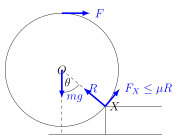
A uniform solid sphere of diameter \(d\) and mass \(m\) is drawn very slowly and without slipping from horizontal ground onto a step of height \(d/4\) by a horizontal force which is always applied to the highest point of the sphere and is always perpendicular to the vertical plane which forms the face of the step. Find the maximum horizontal force throughout the movement, and prove that the coefficient of friction between the sphere and the edge of the step must exceed \(1/\sqrt{3}\).
Solution:
1996 Paper 2 Q14
The random variable \(X\) is uniformly distributed on \([0,1]\). A new random variable \(Y\) is defined by the rule \[ Y=\begin{cases} 1/4 & \mbox{ if }X\leqslant1/4,\\ X & \mbox{ if }1/4\leqslant X\leqslant3/4\\ 3/4 & \mbox{ if }X\geqslant3/4. \end{cases} \] Find \({\mathrm E}(Y^{n})\) for all integers \(n\geqslant 1\). Show that \({\mathrm E}(Y)={\mathrm E}(X)\) and that \[{\mathrm E}(X^{2})-{\mathrm E}(Y^{2})=\frac{1}{24}.\] By using the fact that \(4^{n}=(3+1)^{n}\), or otherwise, show that \({\mathrm E}(X^{n}) > {\mathrm E}(Y^{n})\) for \(n\geqslant 2\). Suppose that \(Y_{1}\), \(Y_{2}\), \dots are independent random variables each having the same distribution as \(Y\). Find, to a good approximation, \(K\) such that \[{\rm P}(Y_{1}+Y_{2}+\cdots+Y_{240000} < K)=3/4.\]
Solution: \begin{align*} && \E[Y^n] &= \frac14 \cdot \frac1{4^n} + \frac14 \cdot \frac{3^n}{4^n} + \frac12 \int_{1/4}^{3/4}2 y^n \d y \\ &&&= \frac{3^n+1}{4^{n+1}} + \left [ \frac{y^{n+1}}{n+1} \right]_{1/4}^{3/4} \\ &&&= \frac{3^n+1}{4^{n+1}} + \frac{3^{n+1}-1}{(n+1)4^{n+1}} \end{align*} \begin{align*} && \E[Y] &= \frac{3+1}{16} + \frac{9-1}{2 \cdot 16} \\ &&&= \frac{1}{4} + \frac{1}{4} = \frac12 = \E[X] \end{align*} \begin{align*} && \E[X^2] &= \int_0^1 x^2 \d x = \frac13 \\ && \E[Y^2] &= \frac{9+1}{64} + \frac{27-1}{3 \cdot 64} = \frac{56}{3 \cdot 64} = \frac{7}{24} \\ \Rightarrow && \E[X^2] - \E[Y^2] &= \frac13 - \frac{7}{24} = \frac{1}{24} \end{align*} \begin{align*} && \E[X^n] &= \frac{1}{n+1} \\ && \E[Y^n] &= \frac{1}{n+1} \frac{1}{4^{n+1}}\left ( (n+1)(3^n+1)+3^{n+1}-1 \right) \\ &&&= \frac{1}{n+1} \frac{1}{4^{n+1}}\left ( 3^{n+1} + (n+1)3^n +n \right) \\ \\ && (3+1)^{n+1} &= 3^{n+1} + (n+1)3^n + \cdots + (n+1) \cdot 3 + 1 \\ &&&> 3^{n+1} + (n+1)3^n + n + 1 \end{align*} if \(n \geq 2\) Notice that by the central limit theorem: \begin{align*} &&\frac{1}{240\,000} \sum_{i=1}^{240\,000} Y_i &\sim N \left ( \frac12, \frac{1}{24 \cdot 240\,000}\right) \\ \Rightarrow && \mathbb{P}\left (\frac{\frac{1}{240\,000} \sum_{i=1}^{240\,000} Y_i - \frac12}{\frac1{24} \frac{1}{100}} \leq \frac23 \right) &\approx 0.75 \\ \Rightarrow && \mathbb{P} \left ( \sum_i Y_i \leq 240\,000 \cdot \left ( \frac2{3} \frac1{2400}+\frac12 \right) \right ) & \approx 0.75 \\ \Rightarrow && K &= 120\,000 + 66 \\ &&&\approx 120\,066 \end{align*}
1996 Paper 3 Q10
Two rough solid circular cylinders, of equal radius and length and of uniform density, lie side by side on a rough plane inclined at an angle \(\alpha\) to the horizontal, where \(0<\alpha<\pi/2\). Their axes are horizontal and they touch along their entire length. The weight of the upper cylinder is \(W_1\) and the coefficient of friction between it and the plane is \(\mu_1\). The corresponding quantities for the lower cylinder are \(W_2\) and \(\mu_2\) respectively and the coefficient of friction between the two cylinders is \(\mu\). Show that for equilibrium to be possible:
- \(W_1\ge W_2\);
- \(\mu\geqslant\dfrac{W_1+W_2}{W_1-W_2}\);
- \(\mu_{1}\geqslant\left(\dfrac{2W_{1}\cot\alpha}{W_{1}+W_{2}}-1\right)^{-1}\,.\)
Solution:
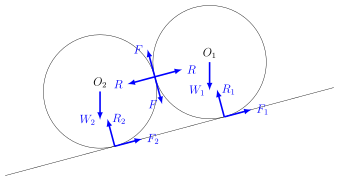
- \begin{align*} \overset{\curvearrowright}{O_2}: && 0 &= F_2 - F \\ \Rightarrow && F_2 &= F \\ \overset{\curvearrowright}{O_1}: && 0 &= F_1- F \\ \Rightarrow && F_1 &= F \\ \text{N2}(\swarrow, 2): && 0 &= R+W_2\sin\alpha -F \tag{1}\\ \text{N2}(\swarrow, 1): && 0 &= W_1\sin\alpha -F-R\tag{2}\\ \Rightarrow && W_1 \sin \alpha-R &= W_2 \sin \alpha+R \\ \Rightarrow && W_1 &\geq W_2 \end{align*}
- \begin{align*} (1)+(2)\Rightarrow && F &= \frac12 \sin \alpha (W_1 + W_2) \\ (1)-(2) \Rightarrow && R &= \frac12 \sin \alpha (W_1-W_2) \\ \Rightarrow && \frac{F}{R} &= \frac{W_1+W_2}{W_1-W_2} \\ \underbrace{\Rightarrow}_{F \leq \mu R} && \mu &\geq \frac{W_1+W_2}{W_1-W_2}\\ \end{align*}
- \begin{align*} \text{N2}(\nwarrow, 1): && 0 &= F+R_1-W_1\cos \alpha \\ \Rightarrow && R_1 &= W_1\cos \alpha - F \\ &&&= W_1 \cos \alpha - \frac12 \sin \alpha (W_1 + W_2) \\ \Rightarrow && \frac{R_1}{F_1} &= \frac{R_1}{F} \\ &&&= \frac{W_1 \cos \alpha - \frac12 \sin \alpha (W_1 + W_2)}{\frac12 \sin \alpha (W_1 + W_2) } \\ &&&= \frac{2W_1 \cot \alpha}{W_1+W_2} - 1 \\ \Rightarrow && \mu_1 & \geq \left ( \frac{2W_1 \cot \alpha}{W_1+W_2} - 1 \right)^{-1} \end{align*}
1995 Paper 1 Q11
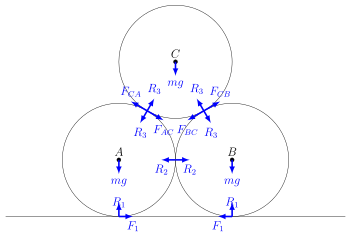
Two identical uniform cylinders, each of mass \(m,\) lie in contact with one another on a horizontal plane and a third identical cylinder rests symmetrically on them in such a way that the axes of the three cylinders are parallel. Assuming that all the surfaces in contact are equally rough, show that the minimum possible coefficient of friction is \(2-\sqrt{3}.\)
Solution:
1995 Paper 2 Q9
\noindent
1995 Paper 2 Q14
Suppose \(X\) is a random variable with probability density \[ \mathrm{f}(x)=Ax^{2}\exp(-x^{2}/2) \] for \(-\infty < x < \infty.\) Find \(A\). You belong to a group of scientists who believe that the outcome of a certain experiment is a random variable with the probability density just given, while other scientists believe that the probability density is the same except with different mean (i.e. the probability density is \(\mathrm{f}(x-\mu)\) with \(\mu\neq0\)). In each of the following two cases decide whether the result given would shake your faith in your hypothesis, and justify your answer.
- A single trial produces the result 87.3.
- 1000 independent trials produce results having a mean value \(0.23.\)
Solution: Let \(Z \sim N(0,1)\), with a pdf of \(f(x) = \frac{1}{\sqrt{2\pi}} \exp(-x^2/2)\) \begin{align*} && 1 &= \int_{-\infty}^\infty Ax^2 \exp(-x^2/2) \d x \\ &&&= A\sqrt{2\pi} \int_{-\infty}^\infty x^2 \frac{1}{\sqrt{2\pi}} \exp(-x^2/2) \d x \\ &&&= A\sqrt{2\pi} \E[Z^2] = A\sqrt{2\pi} \\ \Rightarrow && A &= \frac{1}{\sqrt{2\pi}} \end{align*}
- The probability of seeing a result as extreme as \(87.3\) is \begin{align*} \mathbb{P}(X > 87.3) &= \frac{1}{\sqrt{2\pi}}\int_{87.3}^{\infty} x^2 \exp(-x^2/2) \d x \\ &= \left [ -\frac{1}{\sqrt{2\pi}}x \exp(-x^2/2)\right]_{87.3}^{\infty}+\int_{87.3}^{\infty}\frac{1}{\sqrt{2\pi}} \exp(-x^2/2) \d x \\ &\approx 0 +(1- \Phi(87.3)) \\ &\approx 0 \end{align*} It is very unlikely this data point has come from our distribution rather than one with a higher mean, therefore our faith is very shaken.
- If there are 1000 trials of this, we would expect the sample mean to be distributed according to the CLT. Each sample has mean \(0\) and variance \(\E[X^2] = \int_{-\infty}^\infty x^4 \frac{1}{\sqrt{2\pi}} \exp(-x^2/2) \d x = \E[Z^4] = 3\), therefore the sample mean is \(N(0, 3/1000)\). Therefore the probability of being \(0.23\) away is \begin{align*} && \mathbb{P}(S > 0.23) &= \mathbb{P}\left (Z > \frac{0.23}{\sqrt{3/1000}} \right) \\ &&&= \mathbb{P}\left (Z > \frac{0.23}{\sqrt{30}/100} \right) \\ &&&\approx \mathbb{P}\left (Z > \frac{0.23}{0.055} \right) \\ &&& \approx 0 \end{align*} again our faith should be shaken
1994 Paper 2 Q9
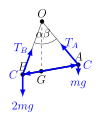
A light rod of length \(2a\) is hung from a point \(O\) by two light inextensible strings \(OA\) and \(OB\) each of length \(b\) and each fixed at \(O\). A particle of mass \(m\) is attached to the end \(A\) and a particle of mass \(2m\) is attached to the end \(B.\) Show that, in equilibrium, the angle \(\theta\) that the rod makes the horizontal satisfies the equation \[ \tan\theta=\frac{a}{3\sqrt{b^{2}-a^{2}}}. \] Express the tension in the string \(AO\) in terms of \(m,g,a\) and \(b\).
Solution:

1994 Paper 3 Q11
A step-ladder has two sections \(AB\) and \(AC,\) each of length \(4a,\) smoothly hinged at \(A\) and connected by a light elastic rope \(DE,\) of natural length \(a/4\) and modulus \(W\), where \(D\) is on \(AB,\) \(E\) is on \(AC\) and \(AD=AE=a.\) The section \(AB,\) which contains the steps, is uniform and of weight \(W\) and the weight of \(AC\) is negligible. The step-ladder rests on a smooth horizontal floor and a man of weight \(4W\) carefully ascends it to stand on a rung distant \(\beta a\) from the end of the ladder resting on the floor. Find the height above the floor of the rung on which the man is standing when \(\beta\) is the maximum value at which equilibrium is possible.
Solution:
