Problems
Filters
86 problems found
2005 Paper 2 Q12
The twins Anna and Bella share a computer and never sign their e-mails. When I e-mail them, only the twin currently online responds. The probability that it is Anna who is online is \(p\) and she answers each question I ask her truthfully with probability \(a\), independently of all her other answers, even if a question is repeated. The probability that it is Bella who is online is~\(q\), where \(q=1-p\), and she answers each question truthfully with probability \(b\), independently of all her other answers, even if a question is repeated.
- I send the twins the e-mail: `Toss a fair coin and answer the following question. Did the coin come down heads?'. I receive the answer `yes'. Show that the probability that the coin did come down heads is \(\frac{1}{2}\) if and only if \(2(ap+bq)=1\).
- I send the twins the e-mail: `Toss a fair coin and answer the following question. Did the coin come down heads?'. I receive the answer `yes'. I then send the e-mail: `Did the coin come down heads?' and I receive the answer `no'. Show that the probability (taking into account these answers) that the coin did come down heads is \(\frac{1}{2}\,\).
- I send the twins the e-mail: `Toss a fair coin and answer the following question. Did the coin come down heads?'. I receive the answer `yes'. I then send the e-mail: `Did the coin come down heads?' and I receive the answer `yes'. Show that, if \(2(ap+bq)=1\), the probability (taking into account these answers) that the coin did come down heads is \(\frac{1}{2}\,\).
2005 Paper 2 Q13
The number of printing errors on any page of a large book of \(N\) pages is modelled by a Poisson variate with parameter \(\lambda\) and is statistically independent of the number of printing errors on any other page. The number of pages in a random sample of \(n\) pages (where \(n\) is much smaller than \(N\) and \(n\ge2\)) which contain fewer than two errors is denoted by \(Y\). Show that \(\P(Y=k) = \binom n k p^kq^{n-k}\) where \(p=(1+\lambda)e^{-\lambda}\) and \(q=1-p\,\). Show also that, if \(\lambda\) is sufficiently small,
- \(q\approx \frac12 \lambda^2\,\);
- the largest value of \(n\) for which \(\P(Y=n)\ge 1-\lambda\) is approximately \(2/\lambda\,\);
- \(\P(Y>1 \;\vert\; Y>0) \approx 1-n(\lambda^2/2)^{n-1}\;.\)
Solution: First notice that the the probability a page contains fewer than two errors is \(\mathbb{P}(X < 2)\) where \(X \sim Po(\lambda)\), ie \(\mathbb{P}(X<2) = e^{-\lambda} + \lambda e^{-\lambda} = (1+\lambda)e^{-\lambda}\). Therefore the number of pages \(Y\) with fewer than two errors out of our sample of \(n\) is \(Bin(n, p)\) where \(p\) is as before. ie \(\mathbb{P}(Y = k) = \binom{n}{k} p^kq^{n-k}\).
- \(\,\) \begin{align*} && q &= 1- p = 1-(1+\lambda)e^{-\lambda} \\ &&&= 1 - (1+ \lambda)(1 - \lambda + \tfrac12 \lambda^2 + o(\lambda^3)) \\ &&&= 1 - 1+ \lambda - \lambda+\lambda^2 - \tfrac12 \lambda^2 + o(\lambda^3) \\ &&&= \tfrac12 \lambda^2 + o(\lambda^3) \end{align*}
- \(\,\) \begin{align*} && \mathbb{P}(Y = n) &= p^n \\ &&&= (1+\lambda)^ne^{-\lambda n} \\ &&&= (1 + n \lambda + \frac{n(n-1)}{2} \lambda^2 + \cdots)(1 - \lambda n + \frac{\lambda^2 n^2}{2} + \cdots) \\ &&&= 1 + 0 \lambda + \left ( \frac{n(n-1)}{2} + \frac{n^2}{2} - n^2 \right) \lambda^2 + o(\lambda^3) \\ &&&= 1 - \frac{n}{2} \lambda^2 + o(\lambda^3) \end{align*} So if \(\frac{n}{2} \lambda \leq 1\) or \(n \leq \frac{2}{\lambda}\) \(\mathbb{P}(Y = n) \leq 1- \lambda\).
- \(\,\) \begin{align*} && \mathbb{P}(Y > 1 | Y > 0) &= \frac{1-(q^n + npq^{n-1})}{1-q^n} \\ &&&= 1 - \frac{npq^{n-1}}{1-q^n} \\ &&&= 1 -n \frac{(1+ \lambda)e^{-\lambda} (\tfrac12 \lambda^2 + o(\lambda^3))^{n-1}}{1-(\tfrac12 \lambda^2 + o(\lambda^3))^n} \\ &&&= 1 - n \left (\frac{\lambda^2}{2} \right)^{n-1} \frac{(1+ \lambda)(1-\lambda + \lambda^2/2 - \cdots)(1+o(\lambda)^{n-1}}{1-(\tfrac12 \lambda^2 + o(\lambda^3))^n} \\ &&&= 1 - n \left (\frac{\lambda^2}{2} \right)^{n-1} (1 + o(\lambda)) \\ &&&\approx 1 - n \left (\frac{\lambda^2}{2} \right)^{n-1} \end{align*}
2004 Paper 1 Q14
Three pirates are sharing out the contents of a treasure chest containing \(n\) gold coins and \(2\) lead coins. The first pirate takes out coins one at a time until he takes out one of the lead coins. The second pirate then takes out coins one at a time until she draws the second lead coin. The third pirate takes out all the gold coins remaining in the chest. Find:
- the probability that the first pirate will have some gold coins;
- the probability that the second pirate will have some gold coins;
- the probability that all three pirates will have some gold coins.
Solution:
- The first pirate will have some gold coins as long as the very first coin drawn is a gold coin, ie \(\frac{n}{n+2}\).
- The probability the second pirate will have some gold coins is the probability the two lead coins are separate. There are \((n+2)!\) ways to arrange the coins, and there are \((n+1)! \cdot 2\) ways to arrange the coins where they are together, therefore the probability is: \[ 1 - \frac{2(n+1)!}{(n+2)!} = 1 - \frac{2}{n+2} = \frac{n}{n+2} \]
- For all three pirates to have some gold coins we need the lead coins to be separate and not first or last. If we line up all \(n\) gold coins, there are \(n-1\) gaps between them we could place the \(2\) lead coins in, therefore \(\binom{n-1}{2}\) ways to place the lead coins with the restriction. Without the restriction there are \(\binom{n+2}{2}\) ways to choose where to put the coins, therefore \begin{align*} && P &= \frac{\binom{n-1}{2}}{\binom{n+2}{2}} \\ &&&= \frac{(n-1)(n-2)}{(n+2)(n+1)} \end{align*} [Notice this is clearly \(0\) if there are only \(1\) or \(2\) gold coins]
2004 Paper 2 Q12
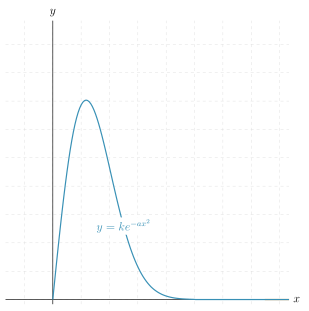
Sketch the graph, for \(x \ge 0\,\), of $$ y = kx\e^{-ax^2} \;, $$ where \(a\) and \(k\) are positive constants. The random variable \(X\) has probability density function \(\f(x)\) given by \begin{equation*} \f(x)= \begin{cases} kx\e^{-ax^2} & \text{for \(0 \le x \le 1\)}\\[3pt] 0 & \text{otherwise}. \end{cases} \end{equation*} Show that \(\displaystyle k=\frac{2a}{1-\e^{-a}}\) and find the mode \(m\) in terms of \(a\,\), distinguishing between the cases \(a < \frac12\) and \(a > \frac12\,\). Find the median \(h\) in terms of \(a\), and show that \(h > m\) if \(a > -\ln\left(2\e^{-1/2} - 1\right).\) Show that, \(-\ln\left(2\e^{-1/2}-1\right)> \frac12 \,\). Show also that, if \(a > -\ln\left(2\e^{-1/2} - 1\right) \,\), then $$ P(X > m \;\vert\; X < h) = {{2\e^{-1/2}-\e^{-a}-1} \over 1-\e^{-a}}\;. $$
Solution:
2004 Paper 2 Q14
Explain why, if \(\mathrm{A, B}\) and \(\mathrm{C}\) are three events, \[ \mathrm{P(A \cup B \cup C) = P(A) + P(B) + P(C) - P(A \cap B) - P(B \cap C) - P(C \cap A) +P(A \cap B \cap C)}, \] where \(\mathrm{P(X)}\) denotes the probability of event \(\mathrm{X}\). A cook makes three plum puddings for Christmas. He stirs \(r\) silver sixpences thoroughly into the pudding mixture before dividing it into three equal portions. Find an expression for the probability that each pudding contains at least one sixpence. Show that the cook must stir 6 or more sixpences into the mixture if there is to be less than \({1 \over 3}\) chance that at least one of the puddings contains no sixpence. Given that the cook stirs 6 sixpences into the mixture and that each pudding contains at least one sixpence, find the probability that there are two sixpences in each pudding.
Solution:

2004 Paper 3 Q13
A men's endurance competition has an unlimited number of rounds. In each round, a competitor has, independently, a probability \(p\) of making it through the round; otherwise, he fails the round. Once a competitor fails a round, he drops out of the competition; before he drops out, he takes part in every round. The grand prize is awarded to any competitor who makes it through a round which all the other remaining competitors fail; if all the remaining competitors fail at the same round the grand prize is not awarded. If the competition begins with three competitors, find the probability that:
- all three drop out in the same round;
- two of them drop out in round \(r\) (with \(r \ge 2\)) and the third in an earlier round;
- the grand prize is awarded.
Solution:
- This is the same as the sum of the probability that they all drop out in the \(k\)th round for all values of \(k\), ie \begin{align*} \mathbb{P}(\text{all drop in same round}) &= \sum_{k=0}^\infty \mathbb{P}(\text{all drop out in the }k+1\text{th round}) \\ &= \sum_{k=0}^{\infty}(p^k(1-p))^3 \\ &= (1-p)^3 \sum_{k=0}^{\infty}p^{3k} \\ &= \frac{(1-p)^3}{1-p^3} \\ &= \frac{1+3p(1-p)(p-(1-p))-p^3}{1-p^3} \\ &= \frac{1-p^3-3p(1-p)(1-2p)}{1-p^3} \end{align*}
- There are \(3\) ways to choose the person who drops out earlier, and then they can drop out in round \(0, 1, \cdots r-1\) \begin{align*} \mathbb{P}(\text{exactly two drop out in round }r\text{ and one before}) &= 3\sum_{k=0}^{r-2} (p^{r-1}(1-p))^2p^k(1-p) \\ &= 3p^{2r-2}(1-p)^3 \sum_{k=0}^{r-2}p^k \\ &= 3p^{2r-2}(1-p)^3 \frac{1-p^{r-1}}{1-p} \\ &= 3p^{2r-2}(1-p)^2(1-p^{r-1}) \end{align*}
- The probability exactly \(2\) finish after the third \begin{align*} \mathbb{P}(\text{exactly two drop out after third}) &= \sum_{r=2}^{\infty}\mathbb{P}(\text{exactly two drop out in round }r\text{ and one before}) \\ &= \sum_{r=2}^{\infty}3p^{2r-2}(1-p)^2(1-p^{r-1}) \\ &= 3(1-p)^2p^{-2}\sum_{r=2}^{\infty}(p^{2r}-p^{3r-1}) \\ &= 3(1-p)^2p^{-2} \left( \frac{p^4}{1-p^2} - \frac{p^5}{1-p^3} \right) \\ &= \frac{3(1-p)^2(p^2(1-p^3)-p^3(1-p^2))}{(1-p^2)(1-p^3)}\\ &= \frac{3(1-p)^3p^2}{(1-p^2)(1-p^3)}\\ \end{align*} Therefore the probability the grand prize is not awarded is \begin{align*} P &= 1 - \frac{(1-p)^3}{1-p^3} - \frac{3(1-p)^3p^2}{(1-p^2)(1-p^3)} \\ &= \frac{(1-p^3)(1-p^2) - (1-p)^3(1-p^2)-3(1-p)^3p^2}{(1-p^2)(1-p^3)} \\ &= \frac{(1-p^3)(1-p^2) - (1-p)^3(1+2p^2)}{(1-p^2)(1-p^3)} \\ \end{align*}
2003 Paper 1 Q13
If a football match ends in a draw, there may be a "penalty shoot-out". Initially the teams each take 5 shots at goal. If one team scores more times than the other, then that team wins. If the scores are level, the teams take shots alternately until one team scores and the other team does not score, both teams having taken the same number of shots. The team that scores wins. Two teams, Team A and Team B, take part in a penalty shoot-out. Their probabilities of scoring when they take a single shot are \(p_A\) and \(p_B\) respectively. Explain why the probability \(\alpha\) of neither side having won at the end of the initial \(10\)-shot period is given by $$\alpha =\sum_{i=0}^5\binom{5}{i}^2(1-p_A)^i(1-p_B)^i\,p_A^{5-i}p_B^{5-i}.$$ Show that the expected number of shots taken is \(\displaystyle 10+ \frac{2\alpha}\beta\;,\) where \(\beta=p_A+p_B-2p_Ap_B\,.\)
Solution: Note that in the first \(10\)-short period the number of goals scored by each team is \(B(5, \p_i)\). For them to be equal they must both have scored the same number of goals, ie \begin{align*} && \alpha &= \sum_{i=0}^5 \mathbb{P}(\text{both teams score }5-i) \\ &&&= \sum_{i=0}^5 \binom{5}{i} (1-p_A)^ip_A^{5-i} \binom{5}{i} (1-p_B)^i p_B^{5-i} \\ &&&= \sum_{i=0}^5 \binom{5}{i} ^2(1-p_A)^i (1-p_B)^i p_A^{5-i} p_B^{5-i} \\ \end{align*} Suppose we make it to the end of the shoot out with scores tied. The probability that we finish each round is \(p_A(1-p_B) + p_B(1-p_A)\) (the probability \(A\) wins or \(B\) wins). This is \(p_A + p_B - 2p_Ap_B = \beta\)). Therefore the number of additional rounds is geometric with parameter \(\beta\) and the expected number of rounds is \(\frac{1}{\beta}\). Each round has two shots, and there is a probability \(\alpha\) of this occuring, ie \(\frac{2\alpha}{\beta}\). Added to the \(10\) guaranteed shots we get the desired result
2003 Paper 2 Q12
The life of a certain species of elementary particles can be described as follows. Each particle has a life time of \(T\) seconds, after which it disintegrates into \(X\) particles of the same species, where \(X\) is a random variable with binomial distribution \(\mathrm{B}(2,p)\,\). A population of these particles starts with the creation of a single such particle at \(t=0\,\). Let \(X_n\) be the number of particles in existence in the time interval \(nT < t < (n+1)T\,\), where \(n=1\,\), \(2\,\), \(\ldots\). Show that \(\P(X_1=2 \mbox { and } X_2=2) = 6p^4q^2\;\), where \(q=1-p\,\). Find the possible values of \(p\) if it is known that \(\P(X_1=2 \vert X_2=2) =9/25\,\). Explain briefly why \(\E(X_n) =2p\E(X_{n-1})\) and hence determine \(\E(X_n)\) in terms of \(p\). Show that for one of the values of \(p\) found above \(\lim_{n \to \infty}\E(X_n) = 0\) and that for the other \(\lim_{n \to \infty}\E(X_n) = + \infty\,\).
Solution: Notice that we can see the total number generated as \(X_n \sim B(2X_{n-1},p)\), since a Binomial is a sum of independent Bernoullis, and there are two Bernoullis per particle. \begin{align*} && \mathbb{P}(X_1=2 \mbox { and } X_2=2) &= \underbrace{p^2}_{\text{two generated in first iteration}} \cdot \underbrace{\binom{4}{2}p^2q^2}_{\text{two generated from the first two}} \\ &&&= 6p^4q^2 \end{align*} \begin{align*} && \mathbb{P})(X_1 = 2 |X_2 = 2) &= \frac{ \mathbb{P}(X_1=2 \mbox { and } X_2=2) }{ \mathbb{P}( X_2=2) } \\ &&&= \frac{6p^4q^2}{6p^4q^2+2pq \cdot p^2} \\ &&&= \frac{3pq}{3pq+1} \\ \Rightarrow && \frac{9}{25} &= \frac{3pq}{3pq+1} \\ \Rightarrow && 27pq + 9 &= 75pq \\ \Rightarrow && 9 &= 48pq \\ \Rightarrow && pq &= \frac{3}{16} \\ \Rightarrow && 0 &= p^2 - p + \frac3{16} \\ \Rightarrow && p &= \frac14, \frac34 \end{align*} By the same reasoning about the Bernoullis, we must have \(\E[X_n] = \E[\E[X_n | X_{n-1}]] = \E[2pX_{n-1}] = 2p \E[X_{n-1}]\) therefore \(\E[X_n] = (2p)^n\). If \(p = \frac14\) then \(\E[X_n] = \frac1{2^n} \to 0\) If \(p = \frac34\) then \(\E[X_n] = \left(\frac32 \right)^n \to \infty\)
2003 Paper 3 Q13
In a rabbit warren, underground chambers \(A, B, C\) and \(D\) are at the vertices of a square, and burrows join \(A\) to \(B\), \ \(B\) to \(C\), \ \(C\) to \(D\) and \(D\) to \(A\). Each of the chambers also has a tunnel to the surface. A rabbit finding itself in any chamber runs along one of the two burrows to a neighbouring chamber, or leaves the burrow through the tunnel to the surface. Each of these three possibilities is equally likely. Let \(p_A\,\), \(p_B\,\), \(p_C\) and \(p_D\) be the probabilities of a rabbit leaving the burrow through the tunnel from chamber \(A\), given that it is currently in chamber \(A, B, C\) or \(D\), respectively.
- Explain why \(p_A = \frac13 + \frac13p_B + \frac13 p_D\).
- Determine \(p_A\,\).
- Find the probability that a rabbit which starts in chamber \(A\) does not visit chamber~\(C\), given that it eventually leaves the burrow through the tunnel in chamber \(A\).
2002 Paper 1 Q13
The random variable \(U\) takes the values \(+1\), \(0\) and \(-1\,\), each with probability \(\frac13\,\). The random variable \(V\) takes the values \(+1\) and \(-1\) as follows:
| if \(U=1\,\), | then \(\P(V=1)= \frac13\) and \(\P(V=-1)=\frac23\,\); |
| if \(U=0\,\), | then \(\P(V=1)= \frac12\) and \(\P(V=-1)=\frac12\,\); |
| if \(U=-1\,\), | then \(\P(V=1)= \frac23\) and \(\P(V=-1)=\frac13\,\). |
- Show that the probability that both roots of the equation \(x^2+Ux+V=0\) are real is \(\frac12\;\).
- Find the expected value of the larger root of the equation \(x^2+Ux+V=0\,\), given that both roots are real.
- Find the probability that the roots of the equation $$x^3+(U-2V)x^2+(1-2UV)x + U=0$$ are all positive.
Solution:
- \(\,\) \begin{align*} && \mathbb{P}(\text{both roots real}) &= \mathbb{P}(\Delta \geq 0) \\ &&&= \mathbb{P}(U^2 \geq 4V) \\ &&&= \mathbb{P}(V = -1) \\ &&&= \tfrac13 ( \tfrac23 + \tfrac12 + \tfrac13) \\ &&&= \tfrac13 \cdot \tfrac 32 = \frac12 \end{align*}
- Our equations will be: \(x^2+x-1 = 0\) with larger root \(\frac{-1 + \sqrt{5}}{2}\) \(x^2-1 = 0\) with larger root \(1\) \(x^2-x-1 = 0\) with larger root \(\frac{1 + \sqrt5}{2}\) and the expected value is \begin{align*} && \E[\text{larger root}|\text{both real}] &= \frac23 \left ( \frac23 \cdot \frac{-1+\sqrt5}{2} + \frac12 \cdot 1 + \frac13 \cdot \frac{1+\sqrt5}{2} \right) \\ &&&= \frac23 \left ( \frac{2+3\sqrt5}{6} \right) \\ &&&= \frac{2+3\sqrt5}{9} \end{align*}
- Suppose we have \(x^3+(U-2V)x^2+(1-2UV)x + U = 0\), then for all roots to be positive, we need \(U < 0 \Rightarrow U = -1\) (otherwise there is a root at or below zero). Therefore our two possible cubics are: \(x^3 -3x^2+3x-1 = (x-1)^3\) (all roots positive) \(x^3+x^2-x-1 = (x-1)(x+1)^2\) (not all roots positive!) Therefore the probability is \(\frac13 \cdot \frac23 = \frac29\)
2002 Paper 1 Q14
In order to get money from a cash dispenser I have to punch in an identification number. I have forgotten my identification number, but I do know that it is equally likely to be any one of the integers \(1\), \(2\), \ldots , \(n\). I plan to punch in integers in order until I get the right one. I can do this at the rate of \(r\) integers per minute. As soon as I punch in the first wrong number, the police will be alerted. The probability that they will arrive within a time \(t\) minutes is \(1-\e^{-\lambda t}\), where \(\lambda\) is a positive constant. If I follow my plan, show that the probability of the police arriving before I get my money is \[ \sum_{k=1}^n \frac{1-\e^{-\lambda(k-1)/r}}n\;. \] Simplify the sum. On past experience, I know that I will be so flustered that I will just punch in possible integers at random, without noticing which I have already tried. Show that the probability of the police arriving before I get my money is \[ 1-\frac1{n-(n-1)\e^{-\lambda/r}} \;. \]
2002 Paper 3 Q12
In a game, a player tosses a biased coin repeatedly until two successive tails occur, when the game terminates. For each head which occurs the player wins \(\pounds 1\). If \(E\) is the expected number of tosses of the coin in the course of a game, and \(p\) is the probability of a head, explain why \[ E = p \l 1 + E \r + \l 1 - p \r p \l 2 + E \r + 2 \l 1 - p \r ^2\,, \] and hence determine \(E\) in terms of \(p\). Find also, in terms of \(p\), the expected winnings in the course of a game. A second game is played, with the same rules, except that the player continues to toss the coin until \(r\) successive tails occur. Show that the expected number of tosses in the course of a game is given by the expression \(\displaystyle {1 - q^r \over p q^r}\,\), where \(q = 1 - p\).
2001 Paper 1 Q12
Four students, Arthur, Bertha, Chandra and Delilah, exchange gossip. When Arthur hears a rumour, he tells it to one of the other three without saying who told it to him. He decides whom to tell by choosing at random amongst the other three, omitting the ones that he knows have already heard the rumour. When Bertha, Chandra or Delilah hear a rumour, they behave in exactly the same way (even if they have already heard it themselves). The rumour stops being passed round when it is heard by a student who knows that the other three have already heard it. Arthur starts a rumour and tells it to Chandra. By means of a tree diagram, or otherwise, show that the probability that Arthur rehears it is \(3/4\). Find also the probability that Bertha hears it twice and the probability that Chandra hears it twice.
Solution: Without loss of generality, \(C\) will tell \(B\) about the rumour. If \(B\) tells \(D\) then \(D\) can either tell \(A\) or \(C\) at which point either \(A\) is told or the rumour stops spreading.


2001 Paper 1 Q13
Four students, one of whom is a mathematician, take turns at washing up over a long period of time. The number of plates broken by any student in this time obeys a Poisson distribution, the probability of any given student breaking \(n\) plates being \(\e^{-\lambda} \lambda^n/n!\) for some fixed constant \(\lambda\), independent of the number of breakages by other students. Given that five plates are broken, find the probability that three or more were broken by the mathematician.
Solution: Let \(X\) be the number of plates broken by the mathematician and \(Y\) by the other student. Then \(X \sim Po(\lambda), Y \sim Po(3\lambda)\) and \(X+Y \sim Po(4\lambda)\) \begin{align*} && \mathbb{P}(X = k | X+Y = n) &= \frac{\mathbb{P}(X = k, Y = n-k)}{\mathbb{P}(X+Y=n)} \\ &&&= \frac{e^{-\lambda} \lambda^k/k! \cdot e^{-3\lambda} (4\lambda)^{n-k}/(n-k)!}{e^{-4\lambda}(4\lambda)^n/n!} \\ &&&= \binom{n}{k} \left ( \frac{1}{4} \right)^k \left ( \frac{3}{5} \right)^{n-k} \end{align*} Therefore \(X | X+Y = n \sim Binomial(n, \tfrac14)\) \begin{align*} \mathbb{P}(X \geq 3 | X + Y = n) &= \binom{5}{3} \frac{3^2}{4^5} + \binom{5}{4} \frac{3}{4^5} + \binom{5}{5} \frac{1}{4^5} \\ &= \frac{1}{4^5} \left ( 90+ 15 + 1 \right) \\ &= \frac{106}{4^5} = \frac{53}{512} \approx \frac1{10} \end{align*}
2001 Paper 1 Q14
On the basis of an interview, the \(N\) candidates for admission to a college are ranked in order according to their mathematical potential. The candidates are interviewed in random order (that is, each possible order is equally likely).
- Find the probability that the best amongst the first \(n\) candidates interviewed is the best overall.
- Find the probability that the best amongst the first \(n\) candidates interviewed is the best or second best overall.
Solution:
- The probability the best person falls in the first \(n\) is \(\frac{n}{N}\)
- The probability the best two people do not fall in the first \(n\) candidates is \begin{align*} && 1-P &= \frac{\binom{N-2}{n}}{\binom{N}{n}} \\ &&&= \frac{(N-2)(N-3)\cdots(N-2-n+1)}{n!} \frac{n!}{N(N-1)(N-2) \cdots (N-n+1)} \\ &&&= \frac{(N-n)(N-n-1)}{N(N-1)} \\ \Rightarrow && P &= 1- \frac{(N-n)(N-n-1)}{N(N-1)} \\ &&&= \frac{N(N-1) - N(N-1)+n(N-n-1)+Nn}{N(N-1)} \\ &&&= \frac{n(2N-n-1)}{N(N-1)} \end{align*}