Problems
Filters
45 problems found
2009 Paper 2 Q8
The non-collinear points \(A\), \(B\) and \(C\) have position vectors \(\bf a\), \(\bf b\) and \(\bf c\), respectively. The points \(P\) and \(Q\) have position vectors \(\bf p\) and \(\bf q\), respectively, given by \[ {\bf p}= \lambda {\bf a} +(1-\lambda){\bf b} \text{ \ \ \ and \ \ \ } {\bf q}= \mu {\bf a} +(1-\mu){\bf c} \] where \(0<\lambda<1\) and \(\mu>1\). Draw a diagram showing \(A\), \(B\), \(C\), \(P\) and \(Q\). Given that \(CQ\times BP = AB\times AC\), find \(\mu\) in terms of \(\lambda\), and show that, for all values of \(\lambda\), the the line \(PQ\) passes through the fixed point \(D\), with position vector \({\bf d}\) given by \({\bf d= -a +b +c}\,\). What can be said about the quadrilateral \(ABDC\)?
2008 Paper 1 Q9
Two identical particles \(P\) and \(Q\), each of mass \(m\), are attached to the ends of a diameter of a light thin circular hoop of radius \(a\). The hoop rolls without slipping along a straight line on a horizontal table with the plane of the hoop vertical. Initially, \(P\) is in contact with the table. At time \(t\), the hoop has rotated through an angle \(\theta\). Write down the position at time \(t\) of \(P\), relative to its starting point, in cartesian coordinates, and determine its speed in terms of \(a\), \(\theta\) and \(\dot\theta\). Show that the total kinetic energy of the two particles is \(2ma^2\dot\theta^2\). Given that the only external forces on the system are gravity and the vertical reaction of the table on the hoop, show that the hoop rolls with constant speed.
Solution:

2008 Paper 3 Q3
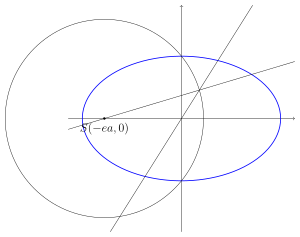
The point \(P(a\cos\theta\,,\, b\sin\theta)\), where \(a>b>0\), lies on the ellipse \[\dfrac {x^2}{a^2} + \dfrac {y^2}{b^2}=1\,.\] The point \(S(-ea\,,\,0)\), where \(b^2=a^2(1-e^2)\,\), is a focus of the ellipse. The point \(N\) is the foot of the perpendicular from the origin, \(O\), to the tangent to the ellipse at \(P\). The lines \(SP\) and \(ON\) intersect at \(T\). Show that the \(y\)-coordinate of \(T\) is \[\dfrac{b\sin\theta}{1+e\cos\theta}\,.\] Show that \(T\) lies on the circle with centre \(S\) and radius \(a\).
Solution: Find the gradient of the tangent of the ellipse at \(P\): \begin{align*} && \frac{2x}{a^2} + \frac{2y}{b^2} \frac{\d y}{\d x} &= 0 \\ \Rightarrow && \frac{\d y}{\d x} &= - \frac{2xb^2}{2ya^2} \\ &&&=- \frac{a \cos \theta b^2}{b \sin \theta a^2} \\ &&&=-\frac{b}{a} \cot \theta \end{align*} Therefore the gradient of \(ON\) is \(\frac{a}{b} \tan \theta\). \begin{align*} && y &= \frac{a}{b} \tan \theta x \\ && \frac{y-0}{x-(-ea)} &= \frac{b\sin \theta-0}{a\cos \theta -(-ea)} \\ && y &= \frac{b \sin \theta}{a(e+\cos \theta)}(x+ea) \\ \Rightarrow && y &= \frac{b \sin \theta}{a(\cos \theta+e)}\frac{b}{a} \cot \theta y+ \frac{eb \sin \theta}{\cos \theta + e} \\ &&&= \frac{b^2 \cos \theta}{a^2(\cos \theta +e)}y + \frac{eb \sin \theta}{\cos \theta + e} \\ \Rightarrow && (\cos \theta+e)y &= (1-e^2)\cos \theta y +eb \sin \theta\\ && e(1+e\cos \theta)y &= eb \sin \theta \\ \Rightarrow && y &= \frac{b \sin \theta}{1+e\cos \theta} \\ && x &= \frac{b \sin \theta}{1+e\cos \theta} \frac{b}{a} \cot \theta \\ &&&= \frac{b^2 \cos \theta}{a(1+e\cos \theta)} \end{align*} Therefore \(\displaystyle T\left (\frac{b^2 \cos \theta}{a(1+e\cos \theta)}, \frac{b \sin \theta}{1+e\cos \theta} \right)\). Finally, we can look at the distance of \(T\) from \(S\) \begin{align*} && d^2 &= \left (\frac{b^2 \cos \theta}{a(1+e\cos \theta)}-(-ea) \right)^2 + \left (\frac{b \sin \theta}{1+e\cos \theta} -0\right)^2 \\ &&&= \frac{\left (b^2 \cos \theta+ea^2(1+e\cos\theta)\right)^2 + \left ( ab \sin \theta\right)^2}{a^2(1+e\cos \theta)^2} \\ &&&= \frac{b^4\cos^2\theta+e^2a^4(1+e\cos\theta)^2+2ea^2b^2(1+e\cos\theta)+a^2b^2\sin^2\theta}{a^2(1+e\cos\theta)^2} \\ &&&= \frac{a^4(1-e^2)^2\cos^2\theta+e^2a^4(1+e\cos\theta)^2+2ea^2a^2(1-e^2)(1+e\cos\theta)+a^4(1-e^2)\sin^2\theta}{a^2(1+e\cos\theta)^2} \\ &&&= a^2 \left ( \frac{(1-e^2)^2\cos^2\theta+e^2(1+e\cos\theta)^2+2e(1-e^2)(1+e\cos\theta)+(1-e^2)(1-\cos^2\theta)}{(1+e\cos\theta)^2} \right) \\ &&&= a^2 \left ( \frac{e^2(1+e\cos\theta)^2+(1-e^2)((1-e^2)\cos^2\theta+2e(1+e\cos\theta)+(1-\cos^2\theta))}{(1+e\cos\theta)^2} \right) \\ &&&= a^2 \left ( \frac{e^2(1+e\cos\theta)^2+(1-e^2)(1+e\cos\theta)^2}{(1+e\cos\theta)^2} \right) \\ &&&= a^2 \end{align*} Therefore a circle radius \(a\) centre \(S\).
2008 Paper 3 Q6
In this question, \(p\) denotes \(\dfrac{\d y}{\d x}\,\).
- Given that \[ y=p^2 +2 xp\,, \] show by differentiating with respect to \(x\) that \[ \frac{\d x}{\d p} = -2 - \frac {2x} p . \] Hence show that \(x = -\frac23p +Ap^{-2}\,,\) where \(A\) is an arbitrary constant. Find \(y\) in terms of \(x\) if \(p=-3\) when \(x=2\).
- Given instead that \[ y=2xp +p \ln p\,,\] and that \(p=1\) when \(x=-\frac14\), show that \(x=-\frac12 \ln p - \frac14\,\) and find \(y\) in terms of \(x\).
2007 Paper 1 Q7
- The line \(L_1\) has vector equation $\displaystyle {\bf r} = \begin{pmatrix} 1 \\ 0 \\ 2 \end{pmatrix} + \lambda \begin{pmatrix} \hphantom{-} 2 \\ \hphantom{-} 2 \\ -3 \end{pmatrix} $. The line \(L_2\) has vector equation $\displaystyle {\bf r} = \begin{pmatrix} \hphantom{-} 4 \\ -2 \\ \hphantom{-} 9 \end{pmatrix} + \mu \begin{pmatrix} \hphantom{-} 1 \\ \hphantom{-} 2 \\ -2 \end{pmatrix} . $ Show that the distance \(D\) between a point on \(L_1\) and a point on \(L_2\) can be expressed in the form \[ D^2 = \left(3\mu -4 \lambda-5 \right)^2 + \left( \lambda -1 \right)^2 + 36\,. \] Hence determine the minimum distance between these two lines and find the coordinates of the points on the two lines that are the minimum distance apart.
- The line \(L_3\) has vector equation ${\bf r} = \begin{pmatrix} 2 \\ 3 \\ 5 \end{pmatrix} + \alpha \begin{pmatrix} 0 \\ 1 \\ 0 \end{pmatrix} . $ The line \(L_4\) has vector equation $ {\bf r} = \begin{pmatrix} \hphantom{-} 3 \\ \hphantom{-} 3 \\ -2 \end{pmatrix} + \beta \begin{pmatrix} \, 4k\\ 1-k \\ \!\!\! -3k \end{pmatrix} . $ Determine the minimum distance between these two lines, explaining geometrically the two different cases that arise according to the value of \(k\).
2006 Paper 2 Q7
An ellipse has equation $\dfrac{x^2}{a^2} +\dfrac {y^2}{b^2} = 1$. Show that the equation of the tangent at the point \((a\cos\alpha, b\sin\alpha)\) is \[ y=- \frac {b \cot \alpha} a \, x + b\, {\rm cosec\,}\alpha\,. \] The point \(A\) has coordinates \((-a,-b)\), where \(a\) and \(b\) are positive. The point \(E\) has coordinates \((-a,0)\) and the point \(P\) has coordinates \((a,kb)\), where \(0 < k < 1\). The line through \(E\) parallel to \(AP\) meets the line \(y=b\) at the point \(Q\). Show that the line \(PQ\) is tangent to the above ellipse at the point given by \(\tan(\alpha/2)=k\). Determine by means of sketches, or otherwise, whether this result holds also for \(k=0\) and \(k=1\).
2005 Paper 1 Q2
The point \(P\) has coordinates \(\l p^2 , 2p \r\) and the point \(Q\) has coordinates \(\l q^2 , 2q \r\), where \(p\) and~\(q\) are non-zero and \(p \neq q\). The curve \(C\) is given by \(y^2 = 4x\,\). The point \(R\) is the intersection of the tangent to \(C\) at \(P\) and the tangent to \(C\) at \(Q\). Show that \(R\) has coordinates \(\l pq , p+q \r\). The point \(S\) is the intersection of the normal to \(C\) at \(P\) and the normal to \(C\) at \(Q\). If \(p\) and \(q\) are such that \(\l 1 , 0 \r\) lies on the line \(PQ\), show that \(S\) has coordinates \(\l p^2 + q^2 + 1 , \, p+q \r\), and that the quadrilateral \(PSQR\) is a rectangle.
2005 Paper 1 Q11
A particle moves so that \({\bf r}\), its displacement from a fixed origin at time \(t\), is given by \[{\bf r} = \l \sin{2t} \r {\bf i} + \l 2\cos t \r \bf{j}\,,\] where \(0 \le t < 2\pi\).
- Show that the particle passes through the origin exactly twice.
- Determine the times when the velocity of the particle is perpendicular to its displacement.
- Show that, when the particle is not at the origin, its velocity is never parallel to its displacement.
- Determine the maximum distance of the particle from the origin, and sketch the path of the particle.
Solution:
- It is at the origin when both \(\sin 2t\) and \(\cos t = 0\), but this \(\sin 2t = 2 \sin t \cos t\) so this happens precisely when \(\cos t = 0\), ie when \(t = \frac{\pi}{2}, \frac{3\pi}{2}\)
- \(\,\) \begin{align*} && \dot{\mathbf{r}} &= 2 \cos 2t \mathbf{i} - 2 \sin t \mathbf{j} \\ && \mathbf{r} \cdot \dot{\mathbf{r}} &= 2\cos 2t \sin 2t - 2 \sin t 2 \cos t \\ &&&= \sin 2t \left (2\cos 2t - 2 \right) \end{align*} Therefore they are perpendicular when \(\sin 2t = 0 \Rightarrow t = 0, \frac{\pi}{2}, \pi, \frac{3\pi}{2}, 2\pi\) and when \(\cos 2t = 1 \Rightarrow 2t = 0, 2\pi, 4\pi \Rightarrow t = 0, \pi, 2\pi\), therefore all solutions are \( t = 0, \frac{\pi}{2}, \pi, \frac{3\pi}{2}, 2\pi\)
- For \(\mathbf{r}\) and \(\dot{\mathbf{r}}\) to be parallel, we would need \begin{align*} && \frac{2 \cos 2t}{\sin 2t} &= \frac{-2 \sin t}{2 \cos t}\\ && 2 \cos 2t \cos t &= - \sin t \sin 2t \\ && 0 &= 2\cos t (\cos 2t + \sin ^2 t) \\ &&&= 2 \cos t (\cos^2 t) \\ &&&= 2 \cos^3 t \end{align*} Therefore the only time we can be parallel is when \(\cos t = 0\), which is when we are at the origin.
- \(\frac{\d }{\d t} (\mathbf{r} \cdot \mathbf{r}) = 2 \mathbf{r} \cdot \mathbf{\dot{r}}\) so we should check the values when velocity and displacement are perpendicular, ie \( t = 0, \frac{\pi}{2}, \pi, \frac{3\pi}{2}, 2\pi\) which have values \(\mathbf{r} = \binom{0}{2}, \binom{0}{0}, \binom{0}{-2}, \binom{0}{0}, \binom{0}{2}\). Therefore the maximum distance is \(2\).

2005 Paper 2 Q7
The position vectors, relative to an origin \(O\), at time \(t\) of the particles \(P\) and \(Q\) are $$\cos t \; {\bf i} + \sin t\;{\bf j} + 0 \; {\bf k} \text{ and } \cos (t+\tfrac14{\pi})\, \big[{\tfrac32}{\bf i} + { \tfrac {3\sqrt{3}}2} {\bf k}\big] + 3\sin(t+\tfrac14{\pi}) \; {\bf j}\;,$$ respectively, where \(0\le t \le 2\pi\,\).
- Give a geometrical description of the motion of \(P\) and \(Q\).
- Let \(\theta\) be the angle \(POQ\) at time \(t\) that satisfies \(0\le\theta\le\pi\,\). Show that \[ \cos\theta = \tfrac{3\surd2}{8} -\tfrac14 \cos( 2t +\tfrac14 \pi)\;. \]
- Show that the total time for which \(\theta \ge \frac14 \pi\) is \(\tfrac32 \pi\,\).
Solution:
- \(P\) is travelling in a unit circle about the origin in the \(\mathbf{i}-\mathbf{j}\) plane. \(Q\) is travelling in a circle (also about the origin, but in a different plane with radius \(3\)).
- \(\,\) \begin{align*} && \mathbf{p}\cdot \mathbf{q} &= |\mathbf{p}||\mathbf{q}| \cos \theta \\ \Rightarrow && \cos \theta &= \frac{\tfrac32\cos t \cos(t + \tfrac{\pi}4)+3\sin t \sin (t + \tfrac{\pi}{4})}{3} \\ &&&= \tfrac12\cos t \cos(t + \tfrac{\pi}4)+\sin t \sin (t + \tfrac{\pi}{4}) \\ &&&= \tfrac14 (\cos (2t + \tfrac{\pi}{4}) + \cos(\tfrac{\pi}{4} ))+\tfrac12(\cos(\tfrac{\pi}{4})-\cos(2t + \tfrac{\pi}{4})) \\ &&&= \tfrac{3\sqrt{2}}8 - \tfrac14 \cos ( 2t +\tfrac{\pi}{4}) \end{align*}
- If \(\theta \geq \frac14\pi\), then \(\cos \theta \leq \frac{\sqrt{2}}2\) \begin{align*} && \frac{\sqrt{2}}2 & \geq \frac{3\sqrt{2}}8 - \frac14 \cos ( 2t +\tfrac{\pi}{4}) \\ \Rightarrow && \frac{\sqrt{2}}2 &\geq -\cos(2t + \tfrac{\pi}{4}) \\ \Rightarrow && \cos(2t + \tfrac{\pi}{4}) &\geq -\frac{1}{\sqrt{2}} \\ \Rightarrow && 2t + \tfrac{\pi}{4} &\not\in (\tfrac{3\pi}{4},\tfrac{5\pi}{4}) \cup (\tfrac{11\pi}{4},\tfrac{13\pi}{4}) \\ \Rightarrow && t &\not\in (\tfrac{\pi}{4}, \tfrac{\pi}{2})\cup (\tfrac{5\pi}{4}, \tfrac{3\pi}{2}) \end{align*} which is is a time of \(\frac{\pi}{2}\), therefore the left over time is \(\frac32\pi\)
2000 Paper 2 Q7
The line \(l\) has vector equation \({\bf r} = \lambda {\bf s}\), where \[ {\bf s} = (\cos\theta+\sqrt3\,) \; {\bf i} +(\surd2\;\sin\theta)\;{\bf j} +(\cos\theta-\sqrt3\,)\;{\bf k} \] and \(\lambda\) is a scalar parameter. Find an expression for the angle between \(l\) and the line \mbox{\({\bf r} = \mu(a\, {\bf i} + b\,{\bf j} +c\, {\bf k})\)}. Show that there is a line \(m\) through the origin such that, whatever the value of \(\theta\), the acute angle between \(l\) and \(m\) is \(\pi/6\). A plane has equation \(x-z=4\sqrt3\). The line \(l\) meets this plane at \(P\). Show that, as \(\theta\) varies, \(P\) describes a circle, with its centre on \(m\). Find the radius of this circle.
1997 Paper 3 Q5
Find the ratio, over one revolution, of the distance moved by a wheel rolling on a flat surface to the distance traced out by a point on its circumference.
Solution: The point on the circumference will have position \((a\cos t, a \sin t )\) relative to the circumference where \(t \in [0, 2\pi]\). the wheel will travel \(2\pi a\), therefore the position is \((a\cos t + at, a \sin t )\). The total distance travelled can be computed using the arc length: \begin{align*} && s &= \int_0^{2\pi} \sqrt{\left ( \frac{\d y}{\d t} \right)^2 +\left ( \frac{\d x}{\d t} \right)^2} \d t \\ &&&= \int_0^{2\pi} \sqrt{(a - a\sin t)^2 +(a \cos t)^2 } \d t \\ &&&= a \int_0^{2\pi} \sqrt{2 - 2 \sin t } \d t \\ &&&= \sqrt{2}a \int_0^{2 \pi} \sqrt{1 - \sin t} \d t \\ &&&= \sqrt{2}a \int_0^{2 \pi} \frac{|\cos t|}{\sqrt{1 + \sin t}} \d t \\ &&&= 2\sqrt{2} a \int_{-\pi/2}^{\pi/2} \frac{\cos t}{\sqrt{1+\sin t}} \d t \\ &&&= 2\sqrt{2} a \left [ 2\sqrt{1+\sin t} \right]_{-\pi/2}^{\pi/2} \\ &&& = 2\sqrt{2} a 2\sqrt{2} \\ &&&= 8a \end{align*} Therefore the ratio is \(\frac{4}{\pi}\)
1994 Paper 1 Q5
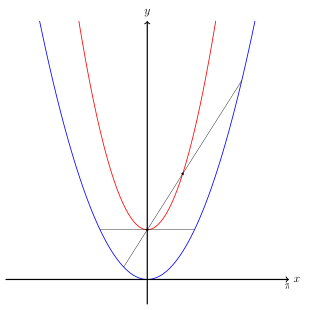
A parabola has the equation \(y=x^{2}.\) The points \(P\) and \(Q\) with coordinates \((p,p^{2})\) and \((q,q^{2})\) respectively move on the parabola in such a way that \(\angle POQ\) is always a right angle.
- Find and sketch the locus of the midpoint \(R\) of the chord \(PQ.\)
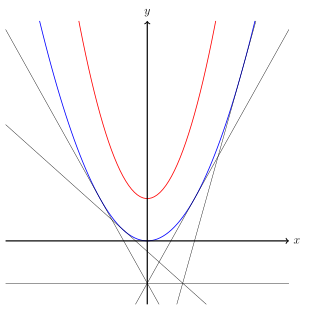
- Find and sketch the locus of the point \(T\) where the tangents to the parabola at \(P\) and \(Q\) intersect.
Solution:
- The line \(PO\) has gradient \(\frac{p^2}{p} = p\) and teh line \(QO\) has gradient \(q\), therefore we must have that \(pq = -1\). Therefore, \(R\) is the point
\begin{align*}
&& R &= \left ( \frac{p-\frac{1}{p}}{2}, \frac{p^2+\frac{1}{p^2}}{2} \right) \\
&&&= \left ( \frac12\left ( p - \frac{1}{p} \right),2\left (\frac12 \left(p-\frac{1}{p}\right) \right)^2+1 \right) \\
&&&= \left ( t, 2t^2+1\right)
\end{align*}
So we are looking at another parabola.
- The tangents are \(y = 2px+c\), ie \(p^2 = 2p^2+c\), ie \(y = 2px -p^2\) so we have
\begin{align*}
&& y - 2px &= -p^2 \\
&& y - 2qx &= -q^2 \\
\Rightarrow && (2p-2q)x &= p^2-q^2 \\
\Rightarrow && x &= \frac12 (p+q)\\
&& y &= p(p+q)-p^2 \\
&& y &= pq = -1
\end{align*}
Therefore \(x = \frac12(p - \frac1p), y= -1\), so we have the line \(y = -1\) (the directrix)
1993 Paper 3 Q1
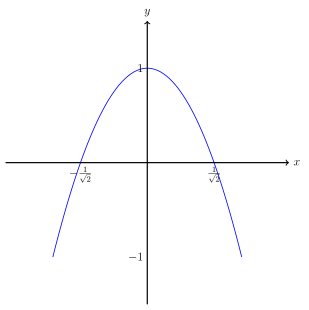
The curve \(P\) has the parametric equations $$ x= \sin\theta, \quad y=\cos2\theta \qquad\hbox{ for }-\pi/2 \le \theta \le \pi/2. $$ Show that \(P\) is part of the parabola \(y=1-2x^2\) and sketch \(P\). Show that the length of \(P\) is \(\surd (17) + {1\over 4} \sinh^{-1}4\). Obtain the volume of the solid enclosed when \(P\) is rotated through \(2\pi\) radians about the line \(y=-1\).
Solution: First notice that \(y = \cos 2 \theta = 1 - 2\sin^2 \theta = 1- 2x^2\), therefore \(P\) is lies on that parabola.
1993 Paper 3 Q8
A square pyramid has its base vertices at the points \(A\) \((a,0,0)\), \(B\) \((0,a,0)\), \(C\) \((-a,0,0)\) and \(D\) \((0,-a,0)\), and its vertex at \(E\) \((0,0,a)\). The point \(P\) lies on \(AE\) with \(x\)-coordinate \(\lambda a\), where \(0<\lambda<1\), and the point \(Q\) lies on \(CE\) with \(x\)-coordinate \(-\mu a\), where \(0<\mu<1\). The plane \(BPQ\) cuts \(DE\) at \(R\) and the \(y\)-coordinate of \(R\) is \(-\gamma a\). Prove that $$ \gamma = {\lambda \mu \over \lambda + \mu - \lambda \mu}. $$ Show that the quadrilateral \(BPRQ\) cannot be a parallelogram.
1992 Paper 2 Q3
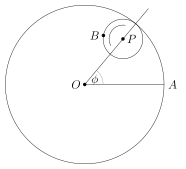
In the figure, the large circle with centre \(O\) has radius \(4\) and the small circle with centre \(P\) has radius \(1\). The small circle rolls around the inside of the larger one. When \(P\) was on the line \(OA\) (before the small circle began to roll), the point \(B\) was in contact with the point \(A\) on the large circle.