2008 Paper 3 Q3
Year: 2008
Paper: 3
Question Number: 3
Course: UFM Pure
Section: Conic sections
Difficulty: 1700.0
Banger: 1484.8
conics
ellipse
tangent-normal
parametric
focus-directrix
geometric proof
circle
intersection of lines
Problem
The point \(P(a\cos\theta\,,\, b\sin\theta)\), where \(a>b>0\), lies on the ellipse
\[\dfrac {x^2}{a^2} + \dfrac {y^2}{b^2}=1\,.\]
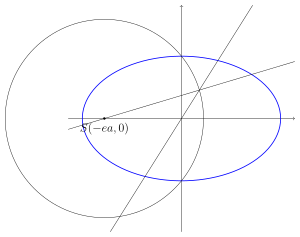
The point \(S(-ea\,,\,0)\), where \(b^2=a^2(1-e^2)\,\), is a focus of the ellipse. The point \(N\) is the foot of the perpendicular from the origin, \(O\), to the tangent to the ellipse at \(P\). The lines \(SP\) and \(ON\) intersect at \(T\). Show that the \(y\)-coordinate of \(T\) is
\[\dfrac{b\sin\theta}{1+e\cos\theta}\,.\]
Show that \(T\) lies on the circle with centre \(S\) and radius \(a\).
Solution
Find the gradient of the tangent of the ellipse at \(P\):
\begin{align*}
&& \frac{2x}{a^2} + \frac{2y}{b^2} \frac{\d y}{\d x} &= 0 \\
\Rightarrow && \frac{\d y}{\d x} &= - \frac{2xb^2}{2ya^2} \\
&&&=- \frac{a \cos \theta b^2}{b \sin \theta a^2} \\
&&&=-\frac{b}{a} \cot \theta
\end{align*}
Therefore the gradient of \(ON\) is \(\frac{a}{b} \tan \theta\).
\begin{align*}
&& y &= \frac{a}{b} \tan \theta x \\
&& \frac{y-0}{x-(-ea)} &= \frac{b\sin \theta-0}{a\cos \theta -(-ea)} \\
&& y &= \frac{b \sin \theta}{a(e+\cos \theta)}(x+ea) \\
\Rightarrow && y &= \frac{b \sin \theta}{a(\cos \theta+e)}\frac{b}{a} \cot \theta y+ \frac{eb \sin \theta}{\cos \theta + e} \\
&&&= \frac{b^2 \cos \theta}{a^2(\cos \theta +e)}y + \frac{eb \sin \theta}{\cos \theta + e} \\
\Rightarrow && (\cos \theta+e)y &= (1-e^2)\cos \theta y +eb \sin \theta\\
&& e(1+e\cos \theta)y &= eb \sin \theta \\
\Rightarrow && y &= \frac{b \sin \theta}{1+e\cos \theta} \\
&& x &= \frac{b \sin \theta}{1+e\cos \theta} \frac{b}{a} \cot \theta \\
&&&= \frac{b^2 \cos \theta}{a(1+e\cos \theta)}
\end{align*}
Therefore \(\displaystyle T\left (\frac{b^2 \cos \theta}{a(1+e\cos \theta)}, \frac{b \sin \theta}{1+e\cos \theta} \right)\).
Finally, we can look at the distance of \(T\) from \(S\)
\begin{align*}
&& d^2 &= \left (\frac{b^2 \cos \theta}{a(1+e\cos \theta)}-(-ea) \right)^2 + \left (\frac{b \sin \theta}{1+e\cos \theta} -0\right)^2 \\
&&&= \frac{\left (b^2 \cos \theta+ea^2(1+e\cos\theta)\right)^2 + \left ( ab \sin \theta\right)^2}{a^2(1+e\cos \theta)^2} \\
&&&= \frac{b^4\cos^2\theta+e^2a^4(1+e\cos\theta)^2+2ea^2b^2(1+e\cos\theta)+a^2b^2\sin^2\theta}{a^2(1+e\cos\theta)^2} \\
&&&= \frac{a^4(1-e^2)^2\cos^2\theta+e^2a^4(1+e\cos\theta)^2+2ea^2a^2(1-e^2)(1+e\cos\theta)+a^4(1-e^2)\sin^2\theta}{a^2(1+e\cos\theta)^2} \\
&&&= a^2 \left ( \frac{(1-e^2)^2\cos^2\theta+e^2(1+e\cos\theta)^2+2e(1-e^2)(1+e\cos\theta)+(1-e^2)(1-\cos^2\theta)}{(1+e\cos\theta)^2} \right) \\
&&&= a^2 \left ( \frac{e^2(1+e\cos\theta)^2+(1-e^2)((1-e^2)\cos^2\theta+2e(1+e\cos\theta)+(1-\cos^2\theta))}{(1+e\cos\theta)^2} \right) \\
&&&= a^2 \left ( \frac{e^2(1+e\cos\theta)^2+(1-e^2)(1+e\cos\theta)^2}{(1+e\cos\theta)^2} \right) \\
&&&= a^2
\end{align*}
Therefore a circle radius \(a\) centre \(S\).
Examiner's report
— 2008 STEP 3, Question 3
~48% attempted (inferred)
Inferred ~48% from 'just under half'
From the paper introduction
Most candidates attempted five, six or seven questions, and scored the majority of their total score on their best three or four. Those attempting seven or more tended not to do well, pursuing no single solution far enough to earn substantial marks.
Source: Cambridge STEP 2008 Examiner's Report
· 2008-full.pdf
Rating Information
Difficulty Rating: 1700.0
Difficulty Comparisons: 0
Banger Rating: 1484.8
Banger Comparisons: 3
Show LaTeX source
Problem source
The point $P(a\cos\theta\,,\, b\sin\theta)$, where $a>b>0$, lies on the ellipse
\[\dfrac {x^2}{a^2} + \dfrac {y^2}{b^2}=1\,.\]
The point $S(-ea\,,\,0)$, where $b^2=a^2(1-e^2)\,$, is a focus of the ellipse. The point $N$ is the foot of the perpendicular from  the origin, $O$, to the tangent to the ellipse at $P$. The lines $SP$ and $ON$ intersect at $T$. Show that the $y$-coordinate of  $T$ is
\[\dfrac{b\sin\theta}{1+e\cos\theta}\,.\]
Show that $T$ lies on the circle with centre $S$ and radius $a$.
Solution source
Find the gradient of the tangent of the ellipse at $P$:

\begin{align*}
&& \frac{2x}{a^2} + \frac{2y}{b^2} \frac{\d y}{\d x} &= 0 \\
\Rightarrow && \frac{\d y}{\d x} &= - \frac{2xb^2}{2ya^2} \\
&&&=- \frac{a \cos \theta b^2}{b \sin \theta a^2} \\
&&&=-\frac{b}{a} \cot \theta
\end{align*}

Therefore the gradient of $ON$ is $\frac{a}{b} \tan \theta$.

\begin{align*}
&& y &= \frac{a}{b} \tan \theta x \\
&& \frac{y-0}{x-(-ea)} &= \frac{b\sin \theta-0}{a\cos \theta -(-ea)} \\
&& y &= \frac{b \sin \theta}{a(e+\cos \theta)}(x+ea) \\
\Rightarrow && y &= \frac{b \sin \theta}{a(\cos \theta+e)}\frac{b}{a} \cot \theta y+ \frac{eb \sin \theta}{\cos \theta + e} \\
&&&= \frac{b^2 \cos \theta}{a^2(\cos \theta +e)}y + \frac{eb \sin \theta}{\cos \theta + e} \\
\Rightarrow && (\cos \theta+e)y &= (1-e^2)\cos \theta y +eb \sin \theta\\
&& e(1+e\cos \theta)y &= eb \sin \theta \\
\Rightarrow && y &= \frac{b \sin \theta}{1+e\cos \theta} \\
&& x &= \frac{b \sin \theta}{1+e\cos \theta} \frac{b}{a} \cot \theta \\
&&&= \frac{b^2 \cos \theta}{a(1+e\cos \theta)}
\end{align*}

Therefore $\displaystyle T\left (\frac{b^2 \cos \theta}{a(1+e\cos \theta)}, \frac{b \sin \theta}{1+e\cos \theta} \right)$.

Finally, we can look at the distance of $T$ from $S$

\begin{align*}
&& d^2 &= \left (\frac{b^2 \cos \theta}{a(1+e\cos \theta)}-(-ea) \right)^2 + \left (\frac{b \sin \theta}{1+e\cos \theta} -0\right)^2 \\
&&&= \frac{\left (b^2 \cos \theta+ea^2(1+e\cos\theta)\right)^2 + \left ( ab \sin \theta\right)^2}{a^2(1+e\cos \theta)^2} \\
&&&= \frac{b^4\cos^2\theta+e^2a^4(1+e\cos\theta)^2+2ea^2b^2(1+e\cos\theta)+a^2b^2\sin^2\theta}{a^2(1+e\cos\theta)^2} \\
&&&= \frac{a^4(1-e^2)^2\cos^2\theta+e^2a^4(1+e\cos\theta)^2+2ea^2a^2(1-e^2)(1+e\cos\theta)+a^4(1-e^2)\sin^2\theta}{a^2(1+e\cos\theta)^2} \\
&&&= a^2 \left ( \frac{(1-e^2)^2\cos^2\theta+e^2(1+e\cos\theta)^2+2e(1-e^2)(1+e\cos\theta)+(1-e^2)(1-\cos^2\theta)}{(1+e\cos\theta)^2} \right) \\
&&&=  a^2 \left ( \frac{e^2(1+e\cos\theta)^2+(1-e^2)((1-e^2)\cos^2\theta+2e(1+e\cos\theta)+(1-\cos^2\theta))}{(1+e\cos\theta)^2} \right) \\
&&&=  a^2 \left ( \frac{e^2(1+e\cos\theta)^2+(1-e^2)(1+e\cos\theta)^2}{(1+e\cos\theta)^2} \right) \\
&&&= a^2
\end{align*}

Therefore a circle radius $a$ centre $S$.

\begin{center}
    \begin{tikzpicture}
        \def\xl{-4};
        \def\xu{4};

        \draw[->] (-4,0) -- (4,0);
        \draw[->] (0,-4) -- (0,4);

        \def\a{3.5};
        \def\b{2.2};
        \def\e{sqrt(1-\b*\b/(\a*\a))};

        \draw[thick, blue, smooth, domain=0:360, samples=100]
            plot ({\a*cos(\x)},{\b*sin(\x)});

        \filldraw ({-\e*\a},0) circle (1pt) node[below] {$S(-ea,0)$};

        \draw ({-\e*\a},0) circle (\a);

        \begin{scope}
        % You can modify these values to change your plotting region
            \clip (\xl,\xl) rectangle (\xu,\xu);
            \draw (\xl, {\xl*\a/\b*tan(45)}) -- (\xu, {\xu*\a/\b*tan(45)});
            \draw (\xl, {(\b*sin(45)/(\a*(cos(45)+\e))*(\xl+\e*\a)}) -- (\xu, {(\b*sin(45)/(\a*(cos(45)+\e))*(\xu+\e*\a)});
        \end{scope}
    \end{tikzpicture}
\end{center}
Just under half attempted this. Most were reluctant to use parametric differentiation. Some found T's coordinates successfully and got no further, but most either made very little progress on the whole question, or got right through it.