1992 Paper 2 Q3
Year: 1992
Paper: 2
Question Number: 3
Course: LFM Pure
Section: Integration
Difficulty: 1600.0
Banger: 1485.7
integration
parametric
hypocycloid
curve sketching
trigonometric
area calculation
rolling circle
product of trig functions
Problem
In the figure, the large circle with centre \(O\) has radius \(4\) and
the small circle with centre \(P\) has radius \(1\). The small circle
rolls around the inside of the larger one. When \(P\) was on the line
\(OA\) (before the small circle began to roll), the point \(B\) was
in contact with the point \(A\) on the large circle.
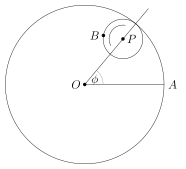 Sketch the curve \(C\) traced by \(B\) as the circle rolls. Show that
if we take \(O\) to be the origin of cartesian coordinates and the
line \(OA\) to be the \(x\)-axis (so that \(A\) is the point \((4,0)\))
then \(B\) is the point
\[
(3\cos\phi+\cos3\phi,3\sin\phi-\sin3\phi).
\]
It is given that the area of the region enclosed by the curve \(C\)
is
\[
\int_{0}^{2\pi}x\frac{\mathrm{d}y}{\mathrm{d}\phi}\,\mathrm{d}\phi,
\]
where \(B\) is the point \((x,y).\) Calculate this area.
Sketch the curve \(C\) traced by \(B\) as the circle rolls. Show that
if we take \(O\) to be the origin of cartesian coordinates and the
line \(OA\) to be the \(x\)-axis (so that \(A\) is the point \((4,0)\))
then \(B\) is the point
\[
(3\cos\phi+\cos3\phi,3\sin\phi-\sin3\phi).
\]
It is given that the area of the region enclosed by the curve \(C\)
is
\[
\int_{0}^{2\pi}x\frac{\mathrm{d}y}{\mathrm{d}\phi}\,\mathrm{d}\phi,
\]
where \(B\) is the point \((x,y).\) Calculate this area.
No solution available for this problem.
Rating Information
Difficulty Rating: 1600.0
Difficulty Comparisons: 0
Banger Rating: 1485.7
Banger Comparisons: 1
Show LaTeX source
Problem source
In the figure, the large circle with centre $O$ has radius $4$ and
the small circle with centre $P$ has radius $1$. The small circle
rolls around the inside of the larger one. When $P$ was on the line
$OA$ (before the small circle began to roll), the point $B$ was
in contact with the point $A$ on the large circle.
\begin{center}
\begin{tikzpicture}[scale=0.7]
    % Main circle centered at origin
    \draw (0,0) circle (4);

    % Define points
    \coordinate (O) at (0,0);
    \coordinate (A) at (4,0);
    \coordinate (P) at ({3*cos(50)},{3*sin(50)});
    \coordinate (Q) at ({5*cos(50)},{5*sin(50)});
    \coordinate (B) at ({3*cos(50) + 1*cos(170)}, {3*sin(50) + 1*sin(170)});

    % Smaller circle centered at P
    \draw (P) circle (1);

    % Line from origin to A
    \draw (O) -- (A);

    \draw[-{Stealth[length=3mm]}]
         ($(P) + ({0.7*cos(210)},{0.7*sin(210)})$)
         arc (210:80:.7);
    % Line from origin to B
    \draw (O) -- (Q);

    % Angle phi
    \draw pic["$\phi$", draw=gray!80, angle radius=0.65cm] {angle=A--O--P};

    % Labels
    \node[left] at (O) {$O$};
    \node[right] at (A) {$A$};
    \node[right] at (P) {$P$};
    \node[left] at (B) {$B$};

    % Points (smaller than before to match reference)
    \fill (O) circle (2.5pt);
    \fill (P) circle (2.5pt);
    \fill (B) circle (2.5pt);
\end{tikzpicture}
\end{center}
Sketch the curve $C$ traced by $B$ as the circle rolls. Show that
if we take $O$ to be the origin of cartesian coordinates and the
line $OA$ to be the $x$-axis (so that $A$ is the point $(4,0)$)
then $B$ is the point
\[
(3\cos\phi+\cos3\phi,3\sin\phi-\sin3\phi).
\]
It is given that the area of the region enclosed by the curve $C$
is
\[
\int_{0}^{2\pi}x\frac{\mathrm{d}y}{\mathrm{d}\phi}\,\mathrm{d}\phi,
\]
where $B$ is the point $(x,y).$ Calculate this area.