Problems
Filters
57 problems found
2013 Paper 2 Q9
The diagram shows three identical discs in equilibrium in a vertical plane. Two discs rest, not in contact with each other, on a horizontal surface and the third disc rests on the other two. The angle at the upper vertex of the triangle joining the centres of the discs is \(2\theta\).
- Show that the normal reaction between the horizontal surface and a disc in contact with the surface is \(\frac32 W\,\).
- Find the normal reaction between two discs in contact and show that the magnitude of the frictional force between two discs in contact is \(\dfrac{W\sin\theta}{2(1+\cos\theta)}\,\).
- Show that if \(\mu <2- \surd3\,\) there is no value of \(\theta\) for which equilibrium is possible.
2013 Paper 3 Q13
- The continuous random variable \(X\) satisfies
\(0\le X\le 1\), and has probability density function
\(\f(x)\) and cumulative distribution
function \(\F(x)\). The
greatest value of \(\f(x)\) is \(M\), so that \(0\le \f(x) \le M\).
- Show that \(0\le \F(x) \le Mx\) for \(0\le x\le1\).
- For any function \(\g(x)\), show that \[ \int_0^1 2 \g(x) \F(x) \f(x) \d x = \g(1) - \int_0^1 \g'(x) \big( \F(x)\big)^2 \d x \,. \]
- The
continuous random variable \(Y\)
satisfies
\(0\le Y\le 1\), and has probability density function
\(k \F(y) \f(y)\), where \(\f\) and \(\F\) are as above.
- Determine the value of the constant \(k\).
- Show that \[ 1+ \frac{nM}{n+1}\mu_{n+1} - \frac{nM}{n+1} \le \E(Y^n) \le 2M\mu_{n+1}\,, \] where \(\mu_{n+1} = \E(X^{n+1})\) and \(n\ge0\).
- Hence show that, for \(n\ge 1\), \[ \mu _n \ge \frac{n}{(n+1)M} -\frac{n-1}{n+1} \,.\]
Solution:
- \(\,\) \begin{align*} && 0 &\leq f(t) &\leq M \\ \Rightarrow && \int_0^x 0 \d t &\leq \int_0^x f(t) \d t & \leq \int_0^x M \d x \\ \Rightarrow && 0 &\leq F(x) &\leq Mx \end{align*}
- \(\,\) \begin{align*} && \int_0^1 2g(x)F(x)f(x) \d x &= \left [ g(x) F(x)^2 \right] - \int_0^1 g'(x) \left ( F(x)\right)^2 \d x \\ &&&= g(1) - \int_0^1 g'(x) \left ( F(x)\right)^2 \d x \end{align*}
- \(\,\) \begin{align*} && 1 &= \int_0^1 kF(y)f(y) \d y \\ &&&= k\left [ \frac12 F(y)^2\right]_0^1 \\ &&&= \frac{k}{2} \\ \Rightarrow && k &= 2 \end{align*}
- \(\,\) \begin{align*} \E[Y^n] &= \int_0^1 y^n 2F(y)f(y) \d y \\ &\geq \int_0^1 y^n 2My f(y) \d y \\ &= 2M\int_0^1 y^{n+1} f(y) \d y \\ &= 2M \E[X^{n+1}] = 2M\mu_{n+1} \\ \\ \E[Y^n] &= \int_0^1 y^n 2F(y)f(y) \d y \\ &= 1 - \int_0^1 ny^{n-1} F(y)^2 \d y \\ &\geq 1 - \int_0^1 ny^{n-1}My F(y) \d y \\ &= 1 - M\int_0^1 ny^n F(y) \d y \\ &= 1 - M[\frac{n}{n+1}y^{n+1} F(y)]_0^1 + M\int_0^1\frac{n}{n+1} y^{n+1} f(y) \d y \\ &= 1 - \frac{nM}{n+1} + \frac{nM}{n+1} \mu_{n+1} \end{align*}
- Since \(\E[Y^{n-1}] \geq 0\) we must have \begin{align*} && 2M\mu_n \geq 1 + \frac{(n-1)M}{n}\mu_n - \frac{(n-1)M}{n} \\ \Rightarrow && \mu_n \left (2M + \frac{(n-1)M}{n} \right) \geq 1 - \frac{(n-1)M}{n} \\ \Rightarrow && \mu_n \frac{3Mn-M}{n} & \geq \frac{n-(n-1)M}{n} \\ \Rightarrow && \mu_n & \geq \frac{n-(n-1)M}{3Mn-M} \end{align*}
2012 Paper 2 Q10
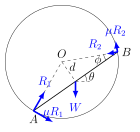
A hollow circular cylinder of internal radius \(r\) is held fixed with its axis horizontal. A uniform rod of length \(2a\) (where \(a < r\)) rests in equilibrium inside the cylinder inclined at an angle of \(\theta\) to the horizontal, where \(\theta\ne0\). The vertical plane containing the rod is perpendicular to the axis of the cylinder. The coefficient of friction between the cylinder and each end of the rod is \(\mu\), where \(\mu > 0\). Show that, if the rod is on the point of slipping, then the normal reactions \(R_1\) and \(R_2\) of the lower and higher ends of the rod, respectively, on the cylinder are related by \[ \mu(R_1+R_2) = (R_1-R_2)\tan\phi \] where \(\phi\) is the angle between the rod and the radius to an end of the rod. Show further that \[ \tan\theta = \frac {\mu r^2}{r^2 -a^2(1+\mu^2)}\,. \] Deduce that \(\lambda <\phi \), where \(\tan\lambda =\mu\).
Solution:
2011 Paper 1 Q11
A thin non-uniform bar \(AB\) of length \(7d\) has centre of mass at a point \(G\), where \(AG=3d\). A light inextensible string has one end attached to \(A\) and the other end attached to \(B\). The string is hung over a smooth peg \(P\) and the bar hangs freely in equilibrium with \(B\) lower than~\(A\). Show that \[ 3\sin\alpha = 4\sin\beta\,, \] where \(\alpha\) and \(\beta\) are the angles \(PAB\) and \(PBA\), respectively. Given that \(\cos\beta=\frac45\) and that \(\alpha\) is acute, find in terms of \(d\) the length of the string and show that the angle of inclination of the bar to the horizontal is \(\arctan \frac17\,\).
2011 Paper 2 Q13
What property of a distribution is measured by its skewness?
- One measure of skewness, \(\gamma\), is given by \[ \displaystyle \gamma= \frac{ \E\big((X-\mu)^3\big)}{\sigma^3}\,, \] where \(\mu\) and \(\sigma^2\) are the mean and variance of the random variable \(X\). Show that \[ \gamma = \frac{ \E(X^3) -3\mu \sigma^2 - \mu^3}{\sigma^3}\,. \] The continuous random variable \(X\) has probability density function \(\f\) where \[ \f(x) = \begin{cases} 2x & \text{for } 0\le x\le 1\,, \\[2mm] 0 & \text{otherwise}\,. \end{cases} \] Show that for this distribution \(\gamma= -\dfrac{2\sqrt2}{5}\).
- The decile skewness, \(D\), of a distribution is defined by \[D= \frac { {\rm F}^{-1}(\frac9{10}) - 2{\rm F} ^{-1}(\frac12) + {\rm F}^{-1} (\frac1{10}) } {{\rm F}^{-1}(\frac9{10}) - {\rm F} ^{-1} (\frac1{10})}\,, \] where \({\rm F}^{-1}\) is the inverse of the cumulative distribution function. Show that, for the above distribution, \( D= 2 -\sqrt5\,.\) The Pearson skewness, \(P\), of a distribution is defined by \[ P = \frac{3(\mu-M)}{\sigma} \,,\] where \(M\) is the median. Find \(P\) for the above distribution and show that \(D > P > \gamma\,\).
Solution: Skewness is a measure of the symmetry (specifically the lack-thereof) in the distribution. How much mass is there on one side rather than another.
- \(\,\) \begin{align*} && \gamma &= \frac{\E \left [ (X - \mu)^3 \right ]}{\sigma^3} \\ &&&= \frac{\E \left [ X^3 - 3\mu X^2 + 3\mu^2 X - \mu^3 \right ]}{\sigma^3} \\ &&&= \frac{\E [ X^3 ]- 3\mu \E[X^2] + 3\mu^2 \E[X] - \mu^3 }{\sigma^3} \\ &&&= \frac{\E [ X^3 ]- 3\mu (\mu^2 + \sigma^2) + 3\mu^2\cdot \mu- \mu^3 }{\sigma^3} \\ &&&= \frac{\E [ X^3 ]- 3\mu \sigma^2 - \mu^3 }{\sigma^3} \\ \end{align*} \begin{align*} && f(x) &= \begin{cases} 2x & \text{for } 0\le x\le 1\,, \\[2mm] 0 & \text{otherwise}\,. \end{cases} \\ && \E[X] &= \int_0^1 2x^2 \d x \\ &&&= \frac23 \\ && \E[X^2] &= \int_0^1 2x^3 \d x \\ &&&= \frac12 \\ && \E[X^3] &= \int_0^1 2x^4 \d x \\ &&&= \frac25 \\ \\ && \mu &= \frac23 \\ && \sigma^2 &= \frac12 - \frac49 = \frac{1}{18} \\ && \gamma &= \frac{\frac25 - 3 \cdot \frac23 \cdot \frac1{18} - \frac8{27}}{\frac{1}{54\sqrt2}} \\ &&&= -\frac{2\sqrt2}{5} \end{align*}
- First note that \(\displaystyle F(x) = \int_0^x 2t \d t = x^2\) for \(x \in [0,1]\). In particular, \(F^{-1}(x) = \sqrt{x}\), so \begin{align*} && D &= \frac { {\rm F}^{-1}(\frac9{10}) - 2{\rm F} ^{-1}(\frac12) + {\rm F}^{-1} (\frac1{10}) } {{\rm F}^{-1}(\frac9{10}) - {\rm F} ^{-1} (\frac1{10})} \\ &&&= \frac{\sqrt{\frac9{10}} - 2 \sqrt{\frac5{10}} + \sqrt{\frac1{10}}}{\sqrt{\frac9{10}}-\sqrt{\frac1{10}}} \\ &&&= \frac{3-2\sqrt5+1}{3 - 1} \\ &&&= \frac{4-2\sqrt5}{2} = 2-\sqrt5 \end{align*} \begin{align*} && P &= \frac{3(\mu - M)}{\sigma} \\ &&&= \frac{3(\frac23 - \sqrt{\frac12})}{\frac{1}{3\sqrt2}} \\ &&&= 6 \sqrt2 - 9 \end{align*} First we compare \(P\) and \(D\), \(6\sqrt2-9\) and \(2-\sqrt5\) \begin{align*} && D & > P \\ \Leftrightarrow && 2-\sqrt5 &> 6\sqrt2 - 9 \\ \Leftrightarrow && 11 -6\sqrt2 &> \sqrt 5 \\ \Leftrightarrow && (121 + 72 - 132\sqrt2) & > 5 \\ \Leftrightarrow && 188 & > 132\sqrt2 \\ \Leftrightarrow && 47 & > 33 \sqrt 2\\ \Leftrightarrow && 2209 & > 2178 \end{align*} also \begin{align*} && P &> \gamma \\ \Leftrightarrow && 6\sqrt2 - 9 &> -\frac{2\sqrt2}{5} \\ \Leftrightarrow && 30\sqrt2 - 45 & > -2\sqrt2 \\ \Leftrightarrow && 32 \sqrt 2 &> 45 \\ \Leftrightarrow && 2048 &> 2025 \end{align*}
2010 Paper 1 Q9

Solution:


2010 Paper 2 Q11
A uniform rod \(AB\) of length \(4L \) and weight \(W\) is inclined at an angle \(\theta\) to the horizontal. Its lower end \(A\) rests on a fixed support and the rod is held in equilibrium by a string attached to the rod at a point \(C\) which is \(3L \) from \(A\). The reaction of the support on the rod acts in a direction \(\alpha\) to \(AC\) and the string is inclined at an angle \(\beta\) to \(CA\). Show that \[ \cot\alpha = 3\tan \theta + 2 \cot \beta\,. \] Given that \(\theta =30^\circ\) and \(\beta = 45^\circ\), show that \(\alpha= 15^\circ\).
2009 Paper 2 Q9
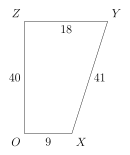
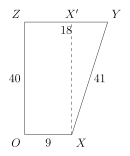
- A uniform lamina \(OXYZ\) is in the shape of the trapezium shown in the diagram. It is right-angled at \(O\) and \(Z\), and \(OX\) is parallel to \(YZ\). The lengths of the sides are given by \(OX=9\,\)cm, \(XY=41\,\)cm, \(YZ=18\,\)cm and \(ZO=40\,\)cm. Show that its centre of mass is a distance \(7\,\)cm from the edge \(OZ\).
- The diagram shows a tank with no lid made of thin sheet metal. The base \(OXUT\), the back \(OTWZ\) and the front \(XUVY\) are rectangular, and each end is a trapezium as in part (i). The width of the tank is \(d\,\)cm.
Show that the centre of mass of the tank, when empty, is a distance \[ \frac {3(140+11d)}{5(12+d)}\,\text{cm} \] from the back of the tank. The tank is then filled with a liquid. The mass per unit volume of this liquid is \(k\) times the mass per unit area of the sheet metal. In the case \(d=20\), find an expression for the distance of the centre of mass of the filled tank from the back of the tank.

Solution:
- \begin{array}{c|c|c|c} & OXX'Z & XX'Y & OXYZ \\ \hline \text{Area} & 360 & 180 & 540\\ \text{COM} & \binom{4.5}{20} & \binom{12}{\frac{80}{3}} & \binom{\overline{x}}{\overline{y}} \end{array} \begin{align*} && 2 \binom{3}{20} + \binom{12}{\frac{80}{3}} &= 3 \binom{\overline{x}}{\overline{y}} \\ \Rightarrow && \binom{\overline{x}}{\overline{y}} &= \frac13 \binom{21}{\frac{200}{3}} \\ &&&= \binom{7}{\frac{200}{9}} \end{align*} ie, the centre of mass is \(7\text{ cm}\) from \(OZ\)
- \begin{align*} && \underbrace{540 \cdot 7}_{OXYZ} + \underbrace{540 \cdot 7}_{TUVW} + \underbrace{40d\cdot 0}_{OTWZ} + \underbrace{9d\cdot 4.5}_{OXUT} + \underbrace{41d \cdot 13.5}_{XUVY} &= (540+540+40d+9d+41d) \overline{x} \\ \Rightarrow && \overline{x} &= \frac{540\cdot 14 + 50d \cdot 4.5 + 41d \cdot 9}{1080 + 90d} \\ &&&= \frac{90 \cdot 84 + 225d + 369d}{1080+90d} \\ &&&= \frac{90 \cdot 84 + 594d}{1080+90d} \\ &&&= \frac{54(140+11d)}{90(12+d)} \\ &&&= \frac{3(140+11d)}{5(12+d)} \end{align*} The volume of the prizm is \(540d\), it's center of mass is \(7\). For the tank, it COM is \(\frac{3(140+11\cdot20)}{5(12+20)} = \frac{27}4\) and area is \(2880\) Therefore for the combined shape we have: \begin{align*} && 540dk \cdot 7 + 2880 \cdot \frac{27}{4} &= (540 \cdot20 k+2880) \overline{x} \\ \Rightarrow && \overline{x} &= \frac{720(150k+27)}{720(15k + 4)} \\ &&&= \frac{3(50k+9)}{15k+4} \end{align*} \begin{align*} && \end{align*}
2008 Paper 1 Q11
A straight uniform rod has mass \(m\). Its ends \(P_1\) and \(P_2\) are attached to small light rings that are constrained to move on a rough rigid circular wire with centre \(O\) fixed in a vertical plane, and the angle \(P_1OP_2\) is a right angle. The rod rests with \(P_1\) lower than \(P_2\), and with both ends lower than \(O\). The coefficient of friction between each of the rings and the wire is \(\mu\). Given that the rod is in limiting equilibrium (i.e. \ on the point of slipping at both ends), show that \[ \tan \alpha = \frac{1-2\mu -\mu^2}{1+2\mu -\mu^2}\,, \] where \(\alpha\) is the angle between \(P_1O\) and the vertical (\(0<\alpha<45^\circ\)). Let \(\theta\) be the acute angle between the rod and the horizontal. Show that \(\theta =2\lambda\), where \(\lambda \) is defined by \(\tan \lambda= \mu\) and \(0<\lambda<22.5^\circ\).
2007 Paper 2 Q10
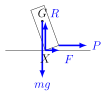
A solid figure is composed of a uniform solid cylinder of density \(\rho\) and a uniform solid hemisphere of density \(3\rho\). The cylinder has circular cross-section, with radius \(r\), and height \(3r\), and the hemisphere has radius \(r\). The flat face of the hemisphere is joined to one end of the cylinder, so that their centres coincide. The figure is held in equilibrium by a force \(P\) so that one point of its flat base is in contact with a rough horizontal plane and its base is inclined at an angle \(\alpha\) to the horizontal. The force \(P\) is horizontal and acts through the highest point of the base. The coefficient of friction between the solid and the plane is \(\mu\). Show that \[\mu \ge \left\vert \tfrac98 -\tfrac12 \cot\alpha\right\vert\,. \]
Solution: The centre of mass of the sphere will be at \((0, \frac{3}{2}r)\) and the centre of mass of the hemisphere will be at \((0, 3r + \frac38r)\), their masses will be \(3\pi r^3 \cdot \rho \) and \(\frac23 \pi r^3 \cdot 3\rho \), meaning the center of mass will be \(\frac{\frac92r + \frac{27}{8} \cdot 2r}{3 + 2} = \frac{45/4}{5}r = \frac{9}{4}r\) above the center of the base.
2006 Paper 2 Q9
A painter of weight \(kW\) uses a ladder to reach the guttering on the outside wall of a house. The wall is vertical and the ground is horizontal. The ladder is modelled as a uniform rod of weight \(W\) and length \(6a\). The ladder is not long enough, so the painter stands the ladder on a uniform table. The table has weight \(2W\) and a square top of side \(\frac12 a\) with a leg of length \(a\) at each corner. The foot of the ladder is at the centre of the table top and the ladder is inclined at an angle \(\arctan 2\) to the horizontal. The edge of the table nearest the wall is parallel to the wall. The coefficient of friction between the foot of the ladder and the table top is \(\frac12\). The contact between the ladder and the wall is sufficiently smooth for the effects of friction to be ignored.
- Show that, if the legs of the table are fixed to the ground, the ladder does not slip on the table however high the painter stands on the ladder.
- It is given that \(k=9\) and that the coefficient of friction between each table leg and the ground is \(\frac13\). If the legs of the table are not fixed to the ground, so that the table can tilt or slip, determine which occurs first when the painter slowly climbs the ladder.
2005 Paper 1 Q9
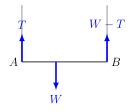
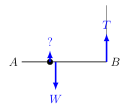
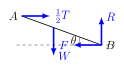
A non-uniform rod \(AB\) has weight \(W\) and length \(3l\). When the rod is suspended horizontally in equilibrium by vertical strings attached to the ends \(A\) and \(B\), the tension in the string attached to \(A\) is \(T\). When instead the rod is held in equilibrium in a horizontal position by means of a smooth pivot at a distance \(l\) from \(A\) and a vertical string attached to \(B\), the tension in the string is \(T\). Show that \(5T = 2W\). When instead the end \(B\) of the rod rests on rough horizontal ground and the rod is held in equilibrium at an angle \(\theta\) to the horizontal by means of a string that is perpendicular to the rod and attached to \(A\), the tension in the string is \(\frac12 T\). Calculate \(\theta\) and find the smallest value of the coefficient of friction between the rod and the ground that will prevent slipping.
Solution:
2004 Paper 1 Q11
Two uniform ladders \(AB\) and \(BC\) of equal length are hinged smoothly at \(B\). The weight of \(AB\) is \(W\) and the weight of \(BC\) is \(4W \). The ladders stand on rough horizontal ground with \(\angle ABC=60^\circ\,\). The coefficient of friction between each ladder and the ground is \(\mu\). A decorator of weight \(7W\) begins to climb the ladder \(AB\) slowly. When she has climbed up \(\frac13\) of the ladder, one of the ladders slips. Which ladder slips, and what is the value of \(\mu\)?
Solution:

2004 Paper 2 Q9
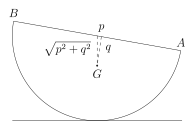
The base of a non-uniform solid hemisphere, of mass \(M,\) has radius \(r.\) The distance of the centre of gravity, \(G\), of the hemisphere from the base is \(p\) and from the centre of the base is \(\sqrt{p^2 + q^2} \,\). The hemisphere rests in equilibrium with its curved surface on a horizontal plane. A particle of mass \(m,\,\) where \(m\) is small, is attached to \(A\,\), the lowest point of the circumference of the base. In the new position of equilibrium, find the angle, \(\alpha\), that the base makes with the horizontal. The particle is removed and attached to the point \(B\) of the base which is at the other end of the diameter through \(A\,\). In the new position of equilibrium the base makes an angle \({\beta}\) with the horizontal. Show that $$\tan(\alpha-\beta)= \frac{2mMrp} {M^2\left(p^2+q^2\right)-m^2r^2}\;.$$
Solution:
2004 Paper 3 Q9
A circular hoop of radius \(a\) is free to rotate about a fixed horizontal axis passing through a point \(P\) on its circumference. The plane of the hoop is perpendicular to this axis. The hoop hangs in equilibrium with its centre, \(O\), vertically below \(P\). The point \(A\) on the hoop is vertically below \(O\), so that \(POA\) is a diameter of the hoop. A mouse \(M\) runs at constant speed \(u\) round the rough inner surface of the lower part of the hoop. Show that the mouse can choose its speed so that the hoop remains in equilibrium with diameter \(POA\) vertical. Describe what happens to the hoop when the mouse passes the point at which angle \(AOM = 2 \arctan \mu\,\), where \(\mu\) is the coefficient of friction between mouse and hoop.