2009 Paper 2 Q9
Year: 2009
Paper: 2
Question Number: 9
Course: UFM Mechanics
Section: Centre of Mass 2
Problem
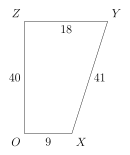
- A uniform lamina \(OXYZ\) is in the shape of the trapezium shown in the diagram. It is right-angled at \(O\) and \(Z\), and \(OX\) is parallel to \(YZ\). The lengths of the sides are given by \(OX=9\,\)cm, \(XY=41\,\)cm, \(YZ=18\,\)cm and \(ZO=40\,\)cm. Show that its centre of mass is a distance \(7\,\)cm from the edge \(OZ\).
- The diagram shows a tank with no lid made of thin sheet metal. The base \(OXUT\), the back \(OTWZ\) and the front \(XUVY\) are rectangular, and each end is a trapezium as in part (i). The width of the tank is \(d\,\)cm.
Show that the centre of mass of the tank, when empty, is a distance \[ \frac {3(140+11d)}{5(12+d)}\,\text{cm} \] from the back of the tank. The tank is then filled with a liquid. The mass per unit volume of this liquid is \(k\) times the mass per unit area of the sheet metal. In the case \(d=20\), find an expression for the distance of the centre of mass of the filled tank from the back of the tank.

Solution
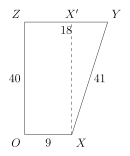
- \begin{array}{c|c|c|c} & OXX'Z & XX'Y & OXYZ \\ \hline \text{Area} & 360 & 180 & 540\\ \text{COM} & \binom{4.5}{20} & \binom{12}{\frac{80}{3}} & \binom{\overline{x}}{\overline{y}} \end{array} \begin{align*} && 2 \binom{3}{20} + \binom{12}{\frac{80}{3}} &= 3 \binom{\overline{x}}{\overline{y}} \\ \Rightarrow && \binom{\overline{x}}{\overline{y}} &= \frac13 \binom{21}{\frac{200}{3}} \\ &&&= \binom{7}{\frac{200}{9}} \end{align*} ie, the centre of mass is \(7\text{ cm}\) from \(OZ\)
- \begin{align*} && \underbrace{540 \cdot 7}_{OXYZ} + \underbrace{540 \cdot 7}_{TUVW} + \underbrace{40d\cdot 0}_{OTWZ} + \underbrace{9d\cdot 4.5}_{OXUT} + \underbrace{41d \cdot 13.5}_{XUVY} &= (540+540+40d+9d+41d) \overline{x} \\ \Rightarrow && \overline{x} &= \frac{540\cdot 14 + 50d \cdot 4.5 + 41d \cdot 9}{1080 + 90d} \\ &&&= \frac{90 \cdot 84 + 225d + 369d}{1080+90d} \\ &&&= \frac{90 \cdot 84 + 594d}{1080+90d} \\ &&&= \frac{54(140+11d)}{90(12+d)} \\ &&&= \frac{3(140+11d)}{5(12+d)} \end{align*} The volume of the prizm is \(540d\), it's center of mass is \(7\). For the tank, it COM is \(\frac{3(140+11\cdot20)}{5(12+20)} = \frac{27}4\) and area is \(2880\) Therefore for the combined shape we have: \begin{align*} && 540dk \cdot 7 + 2880 \cdot \frac{27}{4} &= (540 \cdot20 k+2880) \overline{x} \\ \Rightarrow && \overline{x} &= \frac{720(150k+27)}{720(15k + 4)} \\ &&&= \frac{3(50k+9)}{15k+4} \end{align*} \begin{align*} && \end{align*}
Examiner's report
— 2009 STEP 2, Question 9Of the 1000+ entries for this paper, around 920 scripts actually arrived for marking, giving another slight increase in the take-up for this paper. Of this number, five candidates scored a maximum and seventy-five achieved a scoring total of 100 or more. At the other end of the scale, almost two hundred candidates failed to reach the 40-mark mark. Otherwise, marks were spread reasonably normally across the mark range, though there were two peaks at about 45 and 65 in the distribution. It is comforting to find that the 'post-match analysis' bears out the view that I gained, quite firmly, during the marking process that there were several quantum states of mark-scoring ability amongst the candidature. Many (about one-fifth of the entry) struggled to find anything very much with which they were comfortable, and marks for these candidates were scored in 3s and 4s, with such folk often making eight or nine poor efforts at different questions without ever getting to grips with the content of any one of them. The next "ability band" saw those who either scored moderately well on a handful of questions or managed one really successful question plus a few bits-'n'-pieces in order to get up to a total in the mid-forties. To go much beyond that score required a little bit of extra talent that could lead them towards the next mark-hurdle in the mid-sixties. Thereafter, totals seemed to decline almost linearly on the distribution. Once again, it is clear that candidates need to give the questions at least a couple of minutes' worth of thought before commencing answering. Making attempts at more than the six scoring efforts permitted is a waste of valuable time, and the majority of those who do so are almost invariably the weaker brethren in the game. Many such candidates begin their efforts to individual questions promisingly, but get no more than half-a-dozen marks in before abandoning that question in favour of another – often with the replacement faring no better than its predecessor. In many such cases, the candidate's best-scoring question mark would come from their fifth, or sixth, or seventh, or …?, question attempted, and this suggests either that they do not know where their strengths lie, or that they are just not going to be of the view that they are not going to be challenged to think. And, to be fair to the setting panel, we did put some fairly obvious signposts up for those who might take the trouble to look for such things. With the pleasing number of very high totals to be found, it is clear that there are many places in which good marks were available to those with the ability to first identify them and then to persevere long enough to be able to determine what was really going on therein. It is extremely difficult to set papers in which each question is pitched at an equivalent level of difficulty. Apart from any other factors, candidates have widely differing strengths and weaknesses; one student's algebraic nuance can be the final nail in the coffin of many others, for instance. Moreover, it has seemed enormously clear to me – more particularly so since the arrival of modular A-levels – that there is absolutely no substitute for prolonged and determined practice at questions of substance. One moment's recognition of a technique at work can turn several hours of struggle into just a few seconds of polishing off, and a lack of experience is always painfully clear when marking work from candidates who are under-practised at either the art of prolonged mathematics or the science of creative problem-solving. At the other, more successful, end of the scale there were many candidates who managed to produce extraordinary amounts of outstanding work, racking up full-, or nearly full-, marks on question after question. With the marks distributed as they were, it seems that the paper was pitched appropriately at the intended level, and that it successfully managed to distinguish between the different ability-levels to be found among the candidates. As in previous years, the pure maths questions provided the bulk of candidates' work, with relatively few efforts to be found at the applied ones. Moreover, many of these were clearly acts of desperation.
Rating Information
Difficulty Rating: 1600.0
Difficulty Comparisons: 0
Banger Rating: 1484.0
Banger Comparisons: 1
Show LaTeX source
Problem source
\begin{questionparts}
\item
A uniform lamina $OXYZ$ is in the shape of the trapezium shown in the diagram. It is right-angled at $O$ and $Z$, and $OX$ is parallel to $YZ$. The lengths of the sides are given by $OX=9\,$cm, $XY=41\,$cm, $YZ=18\,$cm and $ZO=40\,$cm. Show that its centre of mass is a distance $7\,$cm from the edge $OZ$.
\begin{center}
\begin{tikzpicture}
% Define coordinates based on the PSTricks code
\coordinate (O) at (3.1,0.87);
\coordinate (X) at (4.77,0.87);
\coordinate (Z) at (3.1,4.85);
\coordinate (Y) at (6.04,4.85);
% \coordinate (W) at (8,6);
% \coordinate (V) at (10.71,6);
% \coordinate (T) at (8,2);
% \coordinate (U) at (9.45,1.99);
% Draw the main quadrilateral OZYX
\draw (Z) -- (Y);
\draw (Y) -- (X);
\draw (O) -- (Z);
\draw (O) -- (X);
% Draw the upper part
% \draw (Z) -- (W);
% \draw (W) -- (V);
% \draw (V) -- (Y);
% \draw (V) -- (U);
% \draw (U) -- (X);
% % Draw dashed lines for hidden edges
% \draw[dashed] (W) -- (T);
% \draw[dashed] (T) -- (O);
% \draw[dashed] (T) -- (U);
% Draw the small vertical line near W
% \draw (W) -- (8,5.33);
% Add vertex labels
\node[below left] at (O) {$O$};
\node[below right] at (X) {$X$};
\node[above left] at (Z) {$Z$};
\node[above right] at (Y) {$Y$};
% \node[above] at (W) {$W$};
% \node[above] at (V) {$V$};
% \node[above right] at (T) {$T$};
% \node[below right] at (U) {$U$};
% Add measurements
\node[below] at ($(Z)!0.5!(Y)$) {$18$};
\node[right] at ($(X)!0.5!(Y)$) {$41$};
\node[below] at ($(O)!0.5!(X)$) {$9$};
\node[left] at ($(Z)!0.5!(O)$) {$40$};
% \node[above] at ($(Z)!0.5!(W)$) {$d$};
% \node[below right] at ($(X)!0.5!(U)$)  {$d$};
\end{tikzpicture}
\end{center}
\item
The diagram shows a tank with no lid made of thin sheet metal. The base $OXUT$, the back $OTWZ$ and the front $XUVY$ are rectangular, and each end is a trapezium as in part \textbf{(i)}. The width of the tank is $d\,$cm.
\begin{center}
\begin{tikzpicture}
% Define coordinates based on the PSTricks code
\coordinate (O) at (3.1,0.87);
\coordinate (X) at (4.77,0.87);
\coordinate (Z) at (3.1,4.85);
\coordinate (Y) at (6.04,4.85);
\coordinate (W) at (8,6);
\coordinate (V) at (10.71,6);
\coordinate (T) at (8,2);
\coordinate (U) at (9.45,1.99);
% Draw the main quadrilateral OZYX
\draw (Z) -- (Y);
\draw (Y) -- (X);
\draw (O) -- (Z);
\draw (O) -- (X);
% Draw the upper part
\draw (Z) -- (W);
\draw (W) -- (V);
\draw (V) -- (Y);
\draw (V) -- (U);
\draw (U) -- (X);
% Draw dashed lines for hidden edges
\draw[dashed] (W) -- (T);
\draw[dashed] (T) -- (O);
\draw[dashed] (T) -- (U);
% Draw the small vertical line near W
\draw (W) -- (8,5.33);
% Add vertex labels
\node[below left] at (O) {$O$};
\node[below right] at (X) {$X$};
\node[above left] at (Z) {$Z$};
\node[above right] at (Y) {$Y$};
\node[above] at (W) {$W$};
\node[above] at (V) {$V$};
\node[above right] at (T) {$T$};
\node[below right] at (U) {$U$};
% Add measurements
\node[below] at ($(Z)!0.5!(Y)$) {$18$};
\node[right] at ($(X)!0.5!(Y)$) {$41$};
\node[below] at ($(O)!0.5!(X)$) {$9$};
\node[left] at ($(Z)!0.5!(O)$) {$40$};
\node[above] at ($(Z)!0.5!(W)$) {$d$};
\node[below right] at ($(X)!0.5!(U)$)  {$d$};
\end{tikzpicture}
\end{center}
 Show that the centre of mass of the tank, when empty,
is a distance
\[
\frac {3(140+11d)}{5(12+d)}\,\text{cm}
\]
from the back of the tank.
The tank is then filled with a liquid.  The mass per unit volume of this liquid  is $k$ times the mass per unit area of the sheet metal. In the case $d=20$, find an expression for the distance of the centre of mass of the filled tank from the back of the tank.
\end{questionparts}
Solution source
\begin{questionparts}
\item
\begin{center}
\begin{tikzpicture}

% Define coordinates based on the PSTricks code
\coordinate (O) at (3.1,0.87);
\coordinate (X) at (4.77,0.87);
\coordinate (Z) at (3.1,4.85);
\coordinate (Y) at (6.04,4.85);
\coordinate (x) at (4.77,4.85);
% \coordinate (W) at (8,6);
% \coordinate (V) at (10.71,6);
% \coordinate (T) at (8,2);
% \coordinate (U) at (9.45,1.99);

% Draw the main quadrilateral OZYX
\draw (Z) -- (Y);
\draw (Y) -- (X);
\draw (O) -- (Z);
\draw (O) -- (X);

\draw[dashed] (X) -- (x);


% Draw the upper part
% \draw (Z) -- (W);
% \draw (W) -- (V);
% \draw (V) -- (Y);
% \draw (V) -- (U);
% \draw (U) -- (X);

% % Draw dashed lines for hidden edges
% \draw[dashed] (W) -- (T);
% \draw[dashed] (T) -- (O);
% \draw[dashed] (T) -- (U);

% Draw the small vertical line near W
% \draw (W) -- (8,5.33);

% Add vertex labels
\node[below left] at (O) {$O$};
\node[below right] at (X) {$X$};
\node[above] at (x) {$X'$};
\node[above left] at (Z) {$Z$};
\node[above right] at (Y) {$Y$};
% \node[above] at (W) {$W$};
% \node[above] at (V) {$V$};
% \node[above right] at (T) {$T$};
% \node[below right] at (U) {$U$};

% Add measurements
\node[below] at ($(Z)!0.5!(Y)$) {$18$};
\node[right] at ($(X)!0.5!(Y)$) {$41$};
\node[below] at ($(O)!0.5!(X)$) {$9$};
\node[left] at ($(Z)!0.5!(O)$) {$40$};
% \node[above] at ($(Z)!0.5!(W)$) {$d$};
% \node[below right] at ($(X)!0.5!(U)$)  {$d$};

\end{tikzpicture}
\end{center}

\begin{array}{c|c|c|c}
& OXX'Z & XX'Y & OXYZ \\ \hline
\text{Area} & 360 & 180 & 540\\
\text{COM} & \binom{4.5}{20} & \binom{12}{\frac{80}{3}} & \binom{\overline{x}}{\overline{y}}
\end{array}

\begin{align*}
&& 2 \binom{3}{20} + \binom{12}{\frac{80}{3}} &= 3 \binom{\overline{x}}{\overline{y}} \\
\Rightarrow &&  \binom{\overline{x}}{\overline{y}} &= \frac13  \binom{21}{\frac{200}{3}} \\
&&&= \binom{7}{\frac{200}{9}}
\end{align*}

ie, the centre of mass is $7\text{ cm}$ from $OZ$

\item \begin{align*}
&& \underbrace{540 \cdot 7}_{OXYZ} + \underbrace{540 \cdot 7}_{TUVW} + \underbrace{40d\cdot 0}_{OTWZ} + \underbrace{9d\cdot 4.5}_{OXUT} + \underbrace{41d \cdot 13.5}_{XUVY} &= (540+540+40d+9d+41d) \overline{x} \\
\Rightarrow && \overline{x} &= \frac{540\cdot 14 + 50d \cdot 4.5 + 41d \cdot 9}{1080 + 90d} \\
&&&= \frac{90 \cdot 84 + 225d + 369d}{1080+90d} \\
&&&=  \frac{90 \cdot 84 + 594d}{1080+90d} \\
&&&= \frac{54(140+11d)}{90(12+d)} \\
&&&= \frac{3(140+11d)}{5(12+d)}
\end{align*}

The volume of the prizm is $540d$, it's center of mass is $7$.

For the tank, it COM is $\frac{3(140+11\cdot20)}{5(12+20)} = \frac{27}4$ and area is $2880$

Therefore for the combined shape we have:

\begin{align*}
&& 540dk \cdot 7 + 2880 \cdot \frac{27}{4} &= (540 \cdot20 k+2880) \overline{x} \\
\Rightarrow && \overline{x} &= \frac{720(150k+27)}{720(15k + 4)} \\
&&&= \frac{3(50k+9)}{15k+4}
\end{align*}

\begin{align*}
&&
\end{align*}

\end{questionparts}
Of the applied maths questions, this was (again) by far the most popular, drawing around 300 attempts. It also proved to be one of the highest-scoring of all the questions on the paper, with a mean score of 12. Finding the position of the centre of mass was sensibly used by most candidates, and the first two parts yielded high marks. The last part attracted less confident algebra, which is curious given that it involved much the same sort of work.