2004 Paper 2 Q9
Year: 2004
Paper: 2
Question Number: 9
Course: UFM Mechanics
Section: Centre of Mass 2
Difficulty: 1600.0
Banger: 1484.0
centre of mass
hemisphere
equilibrium
moments
trigonometry
tan addition formula
particle on curved surface
non-uniform body
Problem
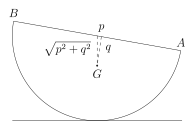
The base of a non-uniform solid hemisphere, of mass \(M,\) has radius \(r.\) The distance of the centre of gravity, \(G\), of the hemisphere from the base is \(p\) and from the centre of the base is \(\sqrt{p^2 + q^2} \,\). The hemisphere rests in equilibrium with its curved surface on a horizontal plane.
A particle of mass \(m,\,\) where \(m\) is small, is attached to \(A\,\), the lowest point of the circumference of the base. In the new position of equilibrium, find the angle, \(\alpha\), that the base makes with the horizontal.
The particle is removed and attached to the point \(B\) of the base which is at the other end of the diameter through \(A\,\). In the new position of equilibrium the base makes an angle \({\beta}\) with the horizontal.
Show that
$$\tan(\alpha-\beta)= \frac{2mMrp} {M^2\left(p^2+q^2\right)-m^2r^2}\;.$$
Solution
Rating Information
Difficulty Rating: 1600.0
Difficulty Comparisons: 0
Banger Rating: 1484.0
Banger Comparisons: 1
Show LaTeX source
Problem source
The base of a non-uniform solid hemisphere, of mass $M,$ has radius $r.$ The distance of the centre of gravity, $G$, of the hemisphere from the base is $p$ and from the centre of the base is $\sqrt{p^2 + q^2} \,$.  The hemisphere rests in equilibrium with  its curved surface on a horizontal plane.
A particle of mass $m,\,$ where $m$ is small, is attached to $A\,$, the lowest point of the circumference of the base.  In the new position of equilibrium, find the angle, $\alpha$, that the base makes with the horizontal.
The particle is removed and attached to the point $B$ of the base which is at the other end of the diameter through $A\,$. In the new position of equilibrium the base  makes an angle ${\beta}$ with the horizontal.
Show that
$$\tan(\alpha-\beta)= \frac{2mMrp}  {M^2\left(p^2+q^2\right)-m^2r^2}\;.$$
Solution source
\begin{tikzpicture}[scale=1.5]
    \draw[domain = 10:190, samples=180, variable = \x]  plot ({2*cos(\x)},{2*(1-sin(\x))});

    \draw ({2*cos(10)}, {2*(1-sin(10))}) --  ({2*cos(190)}, {2*(1-sin(190))});

    \draw (-2, 0) -- (2, 0);
    \draw[dashed] ({cos(10) + cos(190)}, {2 - sin(10) - sin(190)}) -- (0, 1.3);
    \draw[dashed] ({0.525*2*cos(10) + 0.475*2*cos(190)},
                   {0.525*2*(1 - sin(10))+ 0.475*2*(1 - sin(190))}) -- (0, 1.3);

    % \node[circle,fill=black,inner sep=0pt,minimum size=1pt] at (0, 1.1) {$G$};
    \node[below] at (0, 1.3) {$G$};
    \node[above] at (0.1, 2) {$p$};
    \node[right] at (0.1, 1.7) {$q$};
    \node[left] at (-0.05, 1.7) {$\sqrt{p^2+q^2}$};
    \filldraw (0, 1.3) circle (0.5pt);

    \node[above] at ({2*cos(10)}, {2*(1-sin(10))}) {$A$};
    \node[above] at ({2*cos(190)}, {2*(1-sin(190))}) {$B$};


\end{tikzpicture}

In the coordinate system where $(0,0)$ is the centre base of the hemisphere, $G$ is at $(p, q)$.

Once the mass is attached at $A$, the new centre of mass will satisfy: $M \begin{pmatrix} p \\ q \end{pmatrix} + m \begin{pmatrix} r \\ 0 \end{pmatrix} = (M+m)\bar{x} \Rightarrow \bar{x} = \frac{1}{M+m} \begin{pmatrix} Mp+mr \\ Mq \end{pmatrix}$

The angle between the horizontal and $AB$, $\alpha$ will satisfy:

$$\tan \alpha = \frac{Mp + mr}{Mq}$$

Similarly, when the mass is attached at $B$, the new centre of mass will satisfy: $M \begin{pmatrix} p \\ q \end{pmatrix} + m \begin{pmatrix} -r \\ 0 \end{pmatrix} = (M+m)\bar{x} \Rightarrow \bar{x} = \frac{1}{M+m} \begin{pmatrix} Mp-mr \\ Mq \end{pmatrix}$
The angle between the horizontal and $AB$, $\beta$ will satisfy:
$$\tan \beta = \frac{Mp - mr}{Mq}$$

We are trying to find:
\begin{align*}
    \tan \l \alpha - \beta \r &= \frac{\tan \alpha - \tan \beta}{1+ \tan \alpha \tan \beta} \\
    &= \frac{\frac{Mp + mr}{Mq} - \frac{Mp - mr}{Mq}}{1 + \frac{Mp + mr}{Mq} \frac{Mp - mr}{Mq}} \\
    &= \frac{(Mp + mr)Mq - (Mp - mr)Mq}{M^2q^2 + (Mp + mr)(Mp - mr)} \\
    &= \frac{2Mmrp}{M^2(q^2+p^2) -m^2r^2} \\
\end{align*}