Problems
Filters
83 problems found
2016 Paper 2 Q10
A thin uniform wire is bent into the shape of an isosceles triangle \(ABC\), where \(AB\) and \(AC\) are of equal length and the angle at \(A\) is \(2\theta\). The triangle \(ABC\) hangs on a small rough horizontal peg with the side \(BC\) resting on the peg. The coefficient of friction between the wire and the peg is \(\mu\). The plane containing \(ABC\) is vertical. Show that the triangle can rest in equilibrium with the peg in contact with any point on \(BC\) provided \[ \mu \ge 2\tan\theta(1+\sin\theta) \,. \]
Solution:


2016 Paper 3 Q9
Three pegs \(P\), \(Q\) and \(R\) are fixed on a smooth horizontal table in such a way that they form the vertices of an equilateral triangle of side \(2a\). A particle \(X\) of mass \(m\) lies on the table. It is attached to the pegs by three springs, \(PX\), \(QX\) and \(RX\), each of modulus of elasticity \(\lambda\) and natural length \(l\), where \(l < \frac{ \ 2 }{\sqrt3}\, a\). Initially the particle is in equilibrium. Show that the extension in each spring is \(\frac{\ 2}{\sqrt3}\,a -l\,\). The particle is then pulled a small distance directly towards \(P\) and released. Show that the tension \(T\) in the spring \(RX\) is given by \[ T= \frac {\lambda} l \left( \sqrt{\frac {4a^2}3 + \frac{2ax}{\sqrt3} +x^2\; }\; -l\right) , \] where \(x\) is the displacement of \(X\) from its equilibrium position. Show further that the particle performs approximate simple harmonic motion with period \[ 2\pi \sqrt{ \frac{4mla}{3 (4a-\sqrt3 \, l)\lambda } \; }\,. \]
2015 Paper 1 Q11
Two long circular cylinders of equal radius lie in equilibrium on an inclined plane, in \mbox{contact} with one another and with their axes horizontal. The weights of the upper and lower \mbox{cylinders} are \(W_1\) and \(W_2\), respectively, where \(W_1>W_2\)\,. The coefficients of friction \mbox{between} the \mbox{inclined} plane and the upper and lower cylinders are \(\mu_1\) and \(\mu_2\), respectively, and the \mbox{coefficient} of friction \mbox{between} the two cylinders is \(\mu\). The angle of inclination of the plane is~\(\alpha\) (which is positive).
- Let \(F\) be the magnitude of the frictional force between the two cylinders, and let \(F_1\) and \(F_2\) be the magnitudes of the frictional forces between the upper cylinder and the plane, and the lower cylinder and the plane, respectively. Show that \(F=F_1=F_2\,\).
- Show that \[ \mu \ge \dfrac{W_1+W_2}{W_1-W_2} \,,\] and that \[ \tan\alpha \le \frac{ 2 \mu_1 W_1}{(1+\mu_1)(W_1+ W_2)}\,. \]
2015 Paper 2 Q9
An equilateral triangle \(ABC\) is made of three light rods each of length \(a\). It is free to rotate in a vertical plane about a horizontal axis through \(A\). Particles of mass \(3m\) and \(5m\) are attached to \(B\) and \(C\) respectively. Initially, the system hangs in equilibrium with \(BC\) below \(A\).
- Show that, initially, the angle \(\theta\) that \(BC\) makes with the horizontal is given by \(\sin\theta = \frac17\).
- The triangle receives an impulse that imparts a speed \(v\) to the particle \(B\). Find the minimum speed \(v_0\) such that the system will perform complete rotations if \(v>v_0\).
Solution:
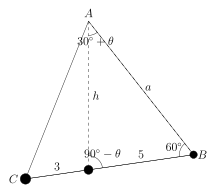
- The sine rule tells us: \begin{align*} && \frac{\frac58 a}{\sin(30^\circ + \theta)} &= \frac{a}{\sin(90^{\circ}-\theta)} \\ \Rightarrow &&\frac58 \cos \theta &= \frac12 \cos \theta+ \frac{\sqrt{3}}2 \sin \theta \\ \Rightarrow && \frac{1}{4\sqrt{3}} &= \tan \theta \\ \Rightarrow && \sin \theta &= \sqrt{\frac{1}{48+1}} = \frac17 \end{align*}
- \(\,\) \begin{align*} && \text{initial energy} &= \frac12(5m)v^2 + \frac12 (3m)v^2 - 3m \cdot g \cdot a \cos(30^{\circ}+\theta) -5m \cdot g \cdot a\cos(30^\circ - \theta) \\ &&&= 4m v^2 - amg(4\sqrt{3} \cos \theta + \sin \theta) \\ &&&= 4mv^2 - 7amg \\ && \text{energy at top} &= \frac12 m v_{top}^2 + 7amg \end{align*} We need this equation to be positive for all values of \(v_{top} \geq 0\), so \(4mv^2 \geq 14amg \Rightarrow v_0 = \sqrt{\frac{7ag}2}\)
2013 Paper 1 Q11
\(\,\)
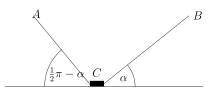
- In the case \(W> T\sin(\alpha+\beta)\), show that the block will remain at rest provided \[ W\sin\lambda \ge T\cos(\alpha+\beta- \lambda)\,, \] where \(\lambda\) is the acute angle such that \(\tan\lambda = \mu\).
- In the case \(W=T\tan\phi\), where \(2\phi =\alpha+\beta\), show that the block will start to move in a direction that makes an angle \(\phi\) with the horizontal.
Solution:
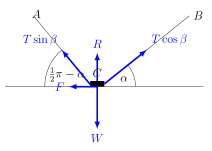
- Assuming the block is at rest we must have: \begin{align*} \text{N2}(\uparrow): && 0 &= T \sin \beta\cos \alpha + T \cos \beta \sin \alpha +R -W \\ \Rightarrow && W &> T \sin \beta\cos \alpha + T \cos \beta \sin \alpha \\ &&&= T\sin(\alpha+\beta) \\ \Rightarrow && R &= W-T\sin(\alpha+\beta)\\ \\ \text{N2}(\rightarrow): && 0 &= T \cos \beta \cos \alpha - T \sin \beta \sin \alpha - F \\ \Rightarrow && T \cos(\alpha+\beta) &= F \\ &&&\leq \mu (W-T\sin(\alpha+\beta)) \\ \Rightarrow && W \sin \lambda &\geq T \cos (\alpha+\beta)\cos \lambda +T \sin (\alpha+\beta) \sin \lambda \\ &&&= T\cos(\alpha+\beta-\lambda) \end{align*}
- If \(W = T\tan \phi\) where \(2\phi = \alpha + \beta\) then \begin{align*} \text{N2}(\uparrow): && ma_y &= T\sin(\alpha+\beta) - W \\ &&&= T \sin(\alpha+\beta) - T \tan \left ( \frac{\alpha+\beta}{2} \right ) \\ &&&= T \tan \left ( \frac{\alpha+\beta}{2} \right ) \left ( 2 \cos^2 \left ( \frac{\alpha+\beta}{2} \right ) -1\right) \\ &&&= T \tan \phi \cos \left ( \alpha+\beta\right ) \tag{notice this is positive so \(R=F=0\)} \\ \text{N2}(\rightarrow): && ma_x &= T \cos(\alpha+\beta) \\ \Rightarrow && \frac{a_y}{a_x} &= \tan \phi \end{align*} Therefore we are accelerating at an angle \(\phi\) to the horizontal
2013 Paper 2 Q9
The diagram shows three identical discs in equilibrium in a vertical plane. Two discs rest, not in contact with each other, on a horizontal surface and the third disc rests on the other two. The angle at the upper vertex of the triangle joining the centres of the discs is \(2\theta\).
- Show that the normal reaction between the horizontal surface and a disc in contact with the surface is \(\frac32 W\,\).
- Find the normal reaction between two discs in contact and show that the magnitude of the frictional force between two discs in contact is \(\dfrac{W\sin\theta}{2(1+\cos\theta)}\,\).
- Show that if \(\mu <2- \surd3\,\) there is no value of \(\theta\) for which equilibrium is possible.
2013 Paper 3 Q9
A sphere of radius \(R\) and uniform density \(\rho_{\text{s}}\) is floating in a large tank of liquid of uniform density \(\rho\). Given that the centre of the sphere is a distance \(x\) above the level of the liquid, where \(x < R\), show that the volume of liquid displaced is \[ \frac \pi 3 (2R^3-3R^2x +x^3)\,. \] The sphere is acted upon by two forces only: its weight and an upward force equal in magnitude to the weight of the liquid it has displaced. Show that \[ 4 R^3\rho_{\text{s}} (g+\ddot x) = (2R^3 -3R^2x +x^3)\rho g\,. \] Given that the sphere is in equilibrium when \(x=\frac12 R\), find \(\rho_{\text{s}}\) in terms of \(\rho\). Find, in terms of \(R\) and \(g\), the period of small oscillations about this equilibrium position.
2013 Paper 3 Q11
An equilateral triangle, comprising three light rods each of length \(\sqrt3a\), has a particle of mass \(m\) attached to each of its vertices. The triangle is suspended horizontally from a point vertically above its centre by three identical springs, so that the springs and rods form a tetrahedron. Each spring has natural length \(a\) and modulus of elasticity \(kmg\), and is light. Show that when the springs make an angle \(\theta\) with the horizontal the tension in each spring is \[ \frac{ kmg(1-\cos\theta)}{\cos\theta}\,. \] Given that the triangle is in equilibrium when \(\theta = \frac16 \pi\), show that \(k=4\sqrt3 +6\). The triangle is released from rest from the position at which \(\theta=\frac13\pi\). Show that when it passes through the equilibrium position its speed \(V\) satisfies \[ V^2 = \frac{4ag}3(6+\sqrt3)\,. \]
2012 Paper 1 Q11
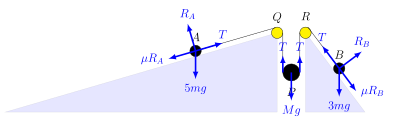
The diagram shows two particles, \(A\) of mass \(5m\) and \(B\) of mass \(3m\), connected by a light inextensible string which passes over two smooth, light, fixed pulleys, \(Q\) and \(R\), and under a smooth pulley \(P\) which has mass \(M\) and is free to move vertically. Particles \(A\) and \(B\) lie on fixed rough planes inclined to the horizontal at angles of \(\arctan \frac 7{24}\) and \(\arctan\frac43\) respectively. The segments \(AQ\) and \(RB\) of the string are parallel to their respective planes, and segments \(QP\) and \(PR\) are vertical. The coefficient of friction between each particle and its plane is \(\mu\).

- Given that the system is in equilibrium, with both \(A\) and \(B\) on the point of moving up their planes, determine the value of \(\mu\) and show that \(M = 6m\).
- In the case when \(M = 9m\), determine the initial accelerations of \(A\), \(B\) and \(P\) in terms of \(g\).
Solution:
2012 Paper 2 Q10
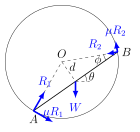
A hollow circular cylinder of internal radius \(r\) is held fixed with its axis horizontal. A uniform rod of length \(2a\) (where \(a < r\)) rests in equilibrium inside the cylinder inclined at an angle of \(\theta\) to the horizontal, where \(\theta\ne0\). The vertical plane containing the rod is perpendicular to the axis of the cylinder. The coefficient of friction between the cylinder and each end of the rod is \(\mu\), where \(\mu > 0\). Show that, if the rod is on the point of slipping, then the normal reactions \(R_1\) and \(R_2\) of the lower and higher ends of the rod, respectively, on the cylinder are related by \[ \mu(R_1+R_2) = (R_1-R_2)\tan\phi \] where \(\phi\) is the angle between the rod and the radius to an end of the rod. Show further that \[ \tan\theta = \frac {\mu r^2}{r^2 -a^2(1+\mu^2)}\,. \] Deduce that \(\lambda <\phi \), where \(\tan\lambda =\mu\).
Solution:
2011 Paper 1 Q11
A thin non-uniform bar \(AB\) of length \(7d\) has centre of mass at a point \(G\), where \(AG=3d\). A light inextensible string has one end attached to \(A\) and the other end attached to \(B\). The string is hung over a smooth peg \(P\) and the bar hangs freely in equilibrium with \(B\) lower than~\(A\). Show that \[ 3\sin\alpha = 4\sin\beta\,, \] where \(\alpha\) and \(\beta\) are the angles \(PAB\) and \(PBA\), respectively. Given that \(\cos\beta=\frac45\) and that \(\alpha\) is acute, find in terms of \(d\) the length of the string and show that the angle of inclination of the bar to the horizontal is \(\arctan \frac17\,\).
2011 Paper 2 Q11
Three non-collinear points \(A\), \(B\) and \(C\) lie in a horizontal ceiling. A particle \(P\) of weight \(W\) is suspended from this ceiling by means of three light inextensible strings \(AP\), \(BP\) and \(CP\), as shown in the diagram. The point \(O\) lies vertically above \(P\) in the ceiling.
- Show that the unit vector in the direction \(PB\) can be written in the form \[ -\frac13\, {\bf i} - \frac{\sqrt2\,}3\, {\bf j} + \frac{\sqrt2\, }{\sqrt3 \,} \,{\bf k} \,,\] where \(\bf i\,\), \(\, \bf j\) and \(\bf k\) are the usual mutually perpendicular unit vectors with \(\bf j\) parallel to \(OA\) and \(\bf k\) vertically upwards.
- Find expressions in vector form for the forces acting on \(P\).
- Show that \(U=\sqrt6 V\) and find \(T\), \(U\) and \(V\) in terms of \(W\).
2011 Paper 3 Q9
Particles \(P\) and \(Q\) have masses \(3m\) and \(4m\), respectively. They lie on the outer curved surface of a~smooth circular cylinder of radius~\(a\) which is fixed with its axis horizontal. They are connected by a light inextensible string of length \(\frac12 \pi a\), which passes over the surface of the cylinder. The particles and the string all lie in a vertical plane perpendicular to the axis of the cylinder, and the axis intersects this plane at \(O\). Initially, the particles are in equilibrium. Equilibrium is slightly disturbed and \(Q\) begins to move downwards. Show that while the two particles are still in contact with the cylinder the angle \(\theta\) between \(OQ\) and the vertical satisfies \[ 7a\dot\theta^2 +8g \cos\theta + 6 g\sin\theta = 10g\,. \]
- Given that \(Q\) loses contact with the cylinder first, show that it does so when~\(\theta=\beta\), where \(\beta\) satisfies \[ 15\cos\beta +6\sin\beta =10. \]
- Show also that while \(P\) and \(Q\) are still in contact with the cylinder the tension in the string is $\frac {12}7 mg(\sin\theta +\cos\theta)\,$.
2011 Paper 3 Q11
A thin uniform circular disc of radius \(a\) and mass \(m\) is held in equilibrium in a horizontal plane a distance \(b\) below a horizontal ceiling, where \(b>2a\). It is held in this way by \(n\) light inextensible vertical strings, each of length \(b\); one end of each string is attached to the edge of the disc and the other end is attached to a point on the ceiling. The strings are equally spaced around the edge of the disc. One of the strings is attached to the point \(P\) on the disc which has coordinates \((a,0,-b)\) with respect to cartesian axes with origin on the ceiling directly above the centre of the disc. The disc is then rotated through an angle \(\theta\) (where \(\theta<\pi\)) about its vertical axis of symmetry and held at rest by a couple acting in the plane of the disc. Show that the string attached to~\(P\) now makes an angle \(\phi\) with the vertical, where \[ b\sin\phi = 2a \sin\tfrac12 \theta\,. \] Show further that the magnitude of the couple is \[ \frac {mga^2\sin\theta}{\sqrt{b^2-4a^2\sin^2 \frac12\theta \ } \ }\,. \] The disc is now released from rest. Show that its angular speed, \(\omega\), when the strings are vertical is given by \[ \frac{a^2\omega^2}{4g} = b-\sqrt{b^2 - 4a^2\sin^2 \tfrac12\theta \;}\,. \]
2010 Paper 2 Q11
A uniform rod \(AB\) of length \(4L \) and weight \(W\) is inclined at an angle \(\theta\) to the horizontal. Its lower end \(A\) rests on a fixed support and the rod is held in equilibrium by a string attached to the rod at a point \(C\) which is \(3L \) from \(A\). The reaction of the support on the rod acts in a direction \(\alpha\) to \(AC\) and the string is inclined at an angle \(\beta\) to \(CA\). Show that \[ \cot\alpha = 3\tan \theta + 2 \cot \beta\,. \] Given that \(\theta =30^\circ\) and \(\beta = 45^\circ\), show that \(\alpha= 15^\circ\).