Problems
Filters
71 problems found
2014 Paper 1 Q10
- A uniform spherical ball of mass \(M\) and radius \(R\) is released from rest with its centre a distance \(H+R\) above horizontal ground. The coefficient of restitution between the ball and the ground is \(e\). Show that, after bouncing, the centre of the ball reaches a height \(R+He^2\) above the ground.
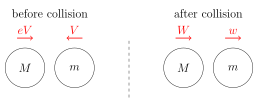
- A second uniform spherical ball, of mass \(m\) and radius \(r\), is now released from rest together with the first ball (whose centre is again a distance \(H+R\) above the ground when it is released). The two balls are initially one on top of the other, with the second ball (of mass \(m\)) above the first. The two balls separate slightly during their fall, with their centres remaining in the same vertical line, so that they collide immediately after the first ball has bounced on the ground. The coefficient of restitution between the balls is also \(e\). The centre of the second ball attains a height \(h\) above the ground. Given that \(R=0.2\), \(r=0.05\), \(H=1.8\), \(h=4.5\) and \(e=\frac23\), determine the value of \(M/m\).
Solution:
- The story for first ball (before it collides with the second ball) will be exactly the same, ie it rebounds with speed \(eV\).
For the second ball, it will also have fallen a distance \(H\) and will be travelling with the same speed \(V\). Their speed of approach therefore will be \((1+e)V\), and the speed of separating therefore must be \(e(1+e)V\)
Given the centre of the second ball reaches a height of \(h\) (from a position of height) \(2R+r\), we must have:
\begin{align*}
&& v^2 &= u^2 + 2as \\
&& 0 &= w^2 - 2g(h - 2R-r) \\
\Rightarrow && w^2 &= 2g(h-2R-r)
\end{align*}
Taking upwards to be positive, then we have:
\begin{align*} \text{COM}: && MeV + m(-V) &= M(w-e(1+e)V) + mw \\ \Rightarrow && V(Me-m)+e(1+e)MV &= w(M+m) \\ \Rightarrow && w &= \frac{2Me+e^2M-m}{M+m} V \\ \Rightarrow && w^2 &= \left ( \frac{M/m(2e+e^2)-1}{M/m+1}\right)^2 V^2 \\ \Rightarrow && 2g(h-2R-r) &= \left ( \frac{M/m(2e+e^2)-1}{M/m+1}\right)^2 2gH \\ \Rightarrow && \left ( \frac{M/m(2e+e^2)-1}{M/m+1}\right)^2 &= \frac{h-2R-r}{H} \\ &&&= \frac{4.5-0.4-0.05}{1.8} \\ &&&= \frac{9}{4} \\ \Rightarrow && \frac{M/m(\frac43+\frac49)-1}{M/m+1} &= \frac32 \\ \Rightarrow && \frac{16}9M/m-1 &= \frac32 M/m+\frac32 \\ \Rightarrow && \frac{5}{18}M/m &= \frac{5}{2} \\ \Rightarrow && M/m &= 9 \end{align*}
2013 Paper 3 Q11
An equilateral triangle, comprising three light rods each of length \(\sqrt3a\), has a particle of mass \(m\) attached to each of its vertices. The triangle is suspended horizontally from a point vertically above its centre by three identical springs, so that the springs and rods form a tetrahedron. Each spring has natural length \(a\) and modulus of elasticity \(kmg\), and is light. Show that when the springs make an angle \(\theta\) with the horizontal the tension in each spring is \[ \frac{ kmg(1-\cos\theta)}{\cos\theta}\,. \] Given that the triangle is in equilibrium when \(\theta = \frac16 \pi\), show that \(k=4\sqrt3 +6\). The triangle is released from rest from the position at which \(\theta=\frac13\pi\). Show that when it passes through the equilibrium position its speed \(V\) satisfies \[ V^2 = \frac{4ag}3(6+\sqrt3)\,. \]
2012 Paper 3 Q10
A small ring of mass \(m\) is free to slide without friction on a hoop of radius \(a\). The hoop is fixed in a vertical plane. The ring is connected by a light elastic string of natural length \(a\) to the highest point of the hoop. The ring is initially at rest at the lowest point of the hoop and is then slightly displaced. In the subsequent motion the angle of the string to the downward vertical is \(\phi\). Given that the ring first comes to rest just as the string becomes slack, find an expression for the modulus of elasticity of the string in terms of \(m\) and \(g\). Show that, throughout the motion, the magnitude \(R\) of the reaction between the ring and the hoop is given by \[ R = ( 12\cos^2\phi -15\cos\phi +5) mg \] and that \(R\) is non-zero throughout the motion.
2012 Paper 3 Q11
One end of a thin heavy uniform inextensible perfectly flexible rope of length \(2L\) and mass \(2M\) is attached to a fixed point \(P\). A particle of mass \(m\) is attached to the other end. Initially, the particle is held at \(P\) and the rope hangs vertically in a loop below \(P\). The particle is then released so that it and a section of the rope (of decreasing length) fall vertically as shown in the diagram.
2011 Paper 1 Q10
A particle, \(A\), is dropped from a point \(P\) which is at a height \(h\) above a horizontal plane. A~second particle, \(B\), is dropped from \(P\) and first collides with \(A\) after \(A\) has bounced on the plane and before \(A\) reaches \(P\) again. The bounce and the collision are both perfectly elastic. Explain why the speeds of \(A\) and \(B\) immediately before the first collision are the same. The masses of \(A\) and \(B\) are \(M\) and \(m\), respectively, where \(M>3m\), and the speed of the particles immediately before the first collision is \(u\). Show that both particles move upwards after their first collision and that the maximum height of \(B\) above the plane after the first collision and before the second collision is \[ h+ \frac{4M(M-m)u^2}{(M+m)^2g}\,. \]
2011 Paper 3 Q9
Particles \(P\) and \(Q\) have masses \(3m\) and \(4m\), respectively. They lie on the outer curved surface of a~smooth circular cylinder of radius~\(a\) which is fixed with its axis horizontal. They are connected by a light inextensible string of length \(\frac12 \pi a\), which passes over the surface of the cylinder. The particles and the string all lie in a vertical plane perpendicular to the axis of the cylinder, and the axis intersects this plane at \(O\). Initially, the particles are in equilibrium. Equilibrium is slightly disturbed and \(Q\) begins to move downwards. Show that while the two particles are still in contact with the cylinder the angle \(\theta\) between \(OQ\) and the vertical satisfies \[ 7a\dot\theta^2 +8g \cos\theta + 6 g\sin\theta = 10g\,. \]
- Given that \(Q\) loses contact with the cylinder first, show that it does so when~\(\theta=\beta\), where \(\beta\) satisfies \[ 15\cos\beta +6\sin\beta =10. \]
- Show also that while \(P\) and \(Q\) are still in contact with the cylinder the tension in the string is $\frac {12}7 mg(\sin\theta +\cos\theta)\,$.
2011 Paper 3 Q10
Particles \(P\) and \(Q\), each of mass \(m\), lie initially at rest a distance \(a\) apart on a smooth horizontal plane. They are connected by a light elastic string of natural length \(a\) and modulus of elasticity \(\frac12 m a \omega^2\), where \(\omega\) is a constant. Then \(P\) receives an impulse which gives it a velocity \(u\) directly away from \(Q\). Show that when the string next returns to length \(a\), the particles have travelled a distance \(\frac12 \pi u/\omega\,\), and find the speed of each particle. Find also the total time between the impulse and the subsequent collision of the particles.
2011 Paper 3 Q11
A thin uniform circular disc of radius \(a\) and mass \(m\) is held in equilibrium in a horizontal plane a distance \(b\) below a horizontal ceiling, where \(b>2a\). It is held in this way by \(n\) light inextensible vertical strings, each of length \(b\); one end of each string is attached to the edge of the disc and the other end is attached to a point on the ceiling. The strings are equally spaced around the edge of the disc. One of the strings is attached to the point \(P\) on the disc which has coordinates \((a,0,-b)\) with respect to cartesian axes with origin on the ceiling directly above the centre of the disc. The disc is then rotated through an angle \(\theta\) (where \(\theta<\pi\)) about its vertical axis of symmetry and held at rest by a couple acting in the plane of the disc. Show that the string attached to~\(P\) now makes an angle \(\phi\) with the vertical, where \[ b\sin\phi = 2a \sin\tfrac12 \theta\,. \] Show further that the magnitude of the couple is \[ \frac {mga^2\sin\theta}{\sqrt{b^2-4a^2\sin^2 \frac12\theta \ } \ }\,. \] The disc is now released from rest. Show that its angular speed, \(\omega\), when the strings are vertical is given by \[ \frac{a^2\omega^2}{4g} = b-\sqrt{b^2 - 4a^2\sin^2 \tfrac12\theta \;}\,. \]
2010 Paper 3 Q9
\(\,\)
2010 Paper 3 Q11
A bullet of mass \(m\) is fired horizontally with speed \(u\) into a wooden block of mass \(M\) at rest on a horizontal surface. The coefficient of friction between the block and the surface is \(\mu\). While the bullet is moving through the block, it experiences a constant force of resistance to its motion of magnitude \(R\), where \(R>(M+m)\mu g\). The bullet moves horizontally in the block and does not emerge from the other side of the block.
- Show that the magnitude, \(a\), of the deceleration of the bullet relative to the block while the bullet is moving through the block is given by \[ a= \frac R m + \frac {R-(M+m)\mu g}{M}\, . \]
- Show that the common speed, \(v\), of the block and bullet when the bullet stops moving through the block satisfies \[ av = \frac{Ru-(M+m)\mu gu}M\,. \]
- Obtain an expression, in terms of \(u\), \(v\) and \(a\), for the distance moved by the block while the bullet is moving through the block.
- Show that the total distance moved by the block is \[ \frac{muv}{2(M+m)\mu g}\,. \]
2009 Paper 3 Q10
A light spring is fixed at its lower end and its axis is vertical. When a certain particle \(P\) rests on the top of the spring, the compression is \(d\). When, instead, \(P\) is dropped onto the top of the spring from a height \(h\) above it, the compression at time \(t\) after \(P\) hits the top of the spring is \(x\). Obtain a second-order differential equation relating \(x\) and \(t\) for \(0\le t \le T\), where \(T\) is the time at which \(P\) first loses contact with the spring. Find the solution of this equation in the form \[ x= A + B\cos (\omega t) + C\sin(\omega t)\,, \] where the constants \(A\), \(B\), \(C\) and \(\omega\) are to be given in terms of \(d\), \(g\) and \(h\) as appropriate. Show that \[ T = \sqrt{d/g\;} \left (2 \pi - 2 \arctan \sqrt{2h/d\;}\;\right)\,. \]
2008 Paper 1 Q9
Two identical particles \(P\) and \(Q\), each of mass \(m\), are attached to the ends of a diameter of a light thin circular hoop of radius \(a\). The hoop rolls without slipping along a straight line on a horizontal table with the plane of the hoop vertical. Initially, \(P\) is in contact with the table. At time \(t\), the hoop has rotated through an angle \(\theta\). Write down the position at time \(t\) of \(P\), relative to its starting point, in cartesian coordinates, and determine its speed in terms of \(a\), \(\theta\) and \(\dot\theta\). Show that the total kinetic energy of the two particles is \(2ma^2\dot\theta^2\). Given that the only external forces on the system are gravity and the vertical reaction of the table on the hoop, show that the hoop rolls with constant speed.
Solution:

2008 Paper 3 Q11
A circular wheel of radius \(r\) has moment of inertia \(I\) about its axle, which is fixed in a horizontal position. A light string is wrapped around the circumference of the wheel and a particle of mass \(m\) hangs from the free end. The system is released from rest and the particle descends. The string does not slip on the wheel. As the particle descends, the wheel turns through \(n_1\) revolutions, and the string then detaches from the wheel. At this moment, the angular speed of the wheel is \(\omega_0\). The wheel then turns through a further \(n_2\) revolutions, in time \(T\), before coming to rest. The couple on the wheel due to resistance is constant. Show that \[ \frac12 \omega_0 T = 2 \pi n_2\] and \[ I =\dfrac {mgrn_1T^2 -4\pi mr^2n_2^2}{4\pi n_2(n_1+n_2)}\;. \]
2007 Paper 3 Q9
Two small beads, \(A\) and \(B\), each of mass \(m\), are threaded on a smooth horizontal circular hoop of radius \(a\) and centre \(O\). The angle \(\theta\) is the acute angle determined by \(2\theta = \angle AOB\). The beads are connected by a light straight spring. The energy stored in the spring is \[ mk^2 a^2(\theta - \alpha)^2, \] where \(k\) and \(\alpha\) are constants satisfying \(k>0\) and \(\frac \pi 4< \alpha<\frac\pi2\). The spring is held in compression with \(\theta =\beta\) and then released. Find the period of oscillations in the two cases that arise according to the value of \(\beta\) and state the value of \(\beta\) for which oscillations do not occur.
2007 Paper 3 Q11
- A wheel consists of a thin
light circular rim attached by light spokes of length \(a\)
to a small hub of mass
\(m\). The wheel rolls without slipping
on a rough horizontal table
directly towards a straight edge of the table.
The plane of the wheel is vertical throughout the motion.
The speed of the wheel is \(u\), where
\(u^2
- Two particles, each of mass \(m/2\), are attached to a light circular hoop of radius \(a\), at the ends of a diameter. The hoop rolls without slipping on a rough horizontal table directly towards a straight edge of the table. The plane of the hoop is vertical throughout the motion. When the centre of the hoop is vertically above the edge of the table it has speed \(u\), where \(u^2
- Two particles, each of mass \(m/2\), are attached to a light circular hoop of radius \(a\), at the ends of a diameter. The hoop rolls without slipping on a rough horizontal table directly towards a straight edge of the table. The plane of the hoop is vertical throughout the motion. When the centre of the hoop is vertically above the edge of the table it has speed \(u\), where \(u^2