Problems
Filters
233 problems found
1992 Paper 3 Q6
Given that \({\displaystyle I_{n}=\int_{0}^{\pi}\frac{x\sin^{2}(nx)}{\sin^{2}x}\,\mathrm{d}x,}\) where \(n\) is a positive integer, show that \(I_{n}-I_{n-1}=J_{n},\) where \[ J_{n}=\int_{0}^{\pi}\frac{x\sin(2n-1)x}{\sin x}\,\mathrm{d}x. \] Obtain also a reduction formula for \(J_{n}.\) The curve \(C\) is given by the cartesian equation \[ y=\dfrac{x\sin^{2}(nx)}{\sin^{2}x}, \] where \(n\) is a positive integer and \(0\leqslant x\leqslant\pi.\) Show that the area under the curve \(C\) is \(\frac{1}{2}n\pi^{2}.\)
Solution: \begin{align*} I_n - I_{n-1} &= \int_0^{\pi} \frac{x \sin^2(nx)}{\sin ^2 x} \d x-\int_0^{\pi} \frac{x \sin^2((n-1)x)}{\sin ^2 x} \d x \\ &= \int_0^{\pi} \frac{x}{\sin^2 x} \left ( \sin^2 (nx) - \sin^2((n-1)x) \right) \d x \\ &= \int_0^{\pi} \frac{x}{\sin^2 x}\frac12 \left ( \cos (2(n-1)x) - \cos(2nx) \right) \d x \\ &= \int_0^{\pi} \frac{x}{\sin^2 x}\frac12 2 \sin ((2n-1)x )\sin x \d x \\ &= \int_0^{\pi} \frac{x\sin ((2n-1)x )}{\sin x}d x \\ &= J_n \\ \\ J_{n+1} - J_{n} &= \int_0^{\pi} \frac{x \left (\sin ((2n+1)x )-\sin ((2n-1)x )\right)}{\sin x} \d x \\ &= \int_0^{\pi} \frac{x \left ( 2 \cos (\frac{4n x}{2}) \sin \frac{2x}{2} \right)}{\sin x} \d x \\ &= \int_0^{\pi}2x \cos (2n x) \d x \\ &= \left [ \frac{x}{2n} \sin (2n x) \right]_0^{\pi} - \int_0^{\pi} \frac{1}{2n} \sin (2n x) \d x \\ &= \left [ \frac{1}{4n^2} \cos (2n x)\right]_0^{\pi} \\ &= 0 \\ \\ J_1 &= \int_0^\pi x \d x \\ &= \frac{\pi^2}{2} \\ \Rightarrow J_n &= \frac{\pi^2}{2} \\ \end{align*} And so \(I_n = I_1 + (n-1) \frac{\pi^2}{2}\) and \(I_1 = \frac{\pi^2}{2}\) so \(I_n = \frac12 n \pi^2\). But \(I_n\) is exactly the area under the curve described.
1991 Paper 1 Q6
Criticise each step of the following arguments. You should correct the arguments where necessary and possible, and say (with justification) whether you think the conclusion are true even though the argument is incorrect.
- The function \(g\) defined by \[ \mathrm{g}(x)=\frac{2x^{3}+3}{x^{4}+4} \] satisfies \(\mathrm{g}'(x)=0\) only for \(x=0\) or \(x=\pm1.\) Hence the stationary values are given by \(x=0\), \(\mathrm{g}(x)=\frac{3}{4}\) and \(x=\pm1,\) \(\mathrm{g}(x)=1.\) Since \(\frac{3}{4}<1,\) there is a minimum at \(x=0\) and maxima at \(x=\pm1.\) Thus we must have \(\frac{3}{4}\leqslant\mathrm{g}(x)\leqslant1\) for all \(x\).
- \({\displaystyle \int(1-x)^{-3}\,\mathrm{d}x=-3(1-x)^{-4}}\quad\) and so \(\quad{\displaystyle \int_{-1}^{3}(1-x)^{-3}\,\mathrm{d}x=0.}\)
Solution:
- \begin{align*} && g(x) &= \frac{2x^3+3}{x^4+4} \\ \Rightarrow && g'(x) &= \frac{6x^2(x^4+4) - (2x^3+3)(4x^3)}{(x^4+4)^2} \\ &&&= \frac{-2x^6-12x^3+24x^2}{(x^4+4)} \\ &&&= \frac{-2x^2(x^4+6x-12)}{(x^4+4)} \end{align*} So \(g'(x)\) is not \(0\) for \(x = \pm 1\). We can also note that \(g(-1) = \frac1{5} \neq 1\) Even if the other turning point was \(1\), we would also need to check the behaviour as \(x \to \pm \infty\). We can also note that \(g(-1) = \frac{1}{5} < \frac34\) so the conclusion is also not true.
- There are several errors. \[ \int (1-x)^{-3} \d x = \underbrace{\frac{1}{4}}_{\text{correct constant}}(1-x)^{-4} + \underbrace{C}_{\text{constant of integration}} \] We cannot integrate through the asymptote at \(1\). There is a sense in which we could argue \(\displaystyle \int_{-1}^3 (1-x)^{-3} \d x = 0\), specifically using Cauchy principal value \begin{align*} \mathrm {p.v.} \int_{-1}^3 (1-x)^{-3} &=\lim_{\epsilon \to 0} \left [ \int_{-1}^{1-\epsilon} (1-x)^{-3} \d x+ \int_{1+\epsilon}^{3} (1-x)^{-3} \d x\right] \\ &=\lim_{\epsilon \to 0} \left [ \left[ \frac14 (1-x)^{-4}\right]_{-1}^{1-\epsilon}+ \left[ \frac14 (1-x)^{-4}\right]_{1+\epsilon}^3\right] \\ &=\lim_{\epsilon \to 0} \left [ \frac14 \epsilon^{-4}-\frac14 \frac1{2^4} + \frac14 \frac1{2^4} - \frac14 \epsilon^{-4} \right] \\ &= \lim_{\epsilon \to 0} 0 \\ &= 0 \end{align*} However, in many normal ways of treating this integral it would be undefined.
1991 Paper 1 Q8
- By a substitution of the form \(y=k-x\) for suitable \(k\), prove that, for any function \(\mathrm{f}\), \[ \int_{0}^{\pi}x\mathrm{f}(\sin x)\,\mathrm{d}x=\pi\int_{0}^{\frac{1}{2}\pi}\mathrm{f}(\sin x)\,\mathrm{d}x. \] Hence or otherwise evaluate \[ \int_{0}^{\pi}\frac{x}{2+\sin x}\,\mathrm{d}x. \]
- Evaluate \[ \int_{0}^{1}\frac{(\sin^{-1}t)\cos\left[(\sin^{-1}t)^{2}\right]}{\sqrt{1-t^{2}}}\,\mathrm{d}t. \] {[}No credit will be given for numerical answers obtained by use of a calculator.{]}
Solution:
- \begin{align*} y = \pi - x, \d y = -\d x: && \int_0^{\pi} x f(\sin x) &= \int_{y = \pi}^{y = 0}(\pi - y) f(\sin(\pi-y))- \d y \\ &&&= \int_0^{\pi} (\pi -y) f(\sin y) \d y \\ \Rightarrow && 2 \int_0^{\pi} x f(\sin x)\d x &= \pi \int_0^{\pi} f(\sin x) \d x \\ &&&= \pi \int_0^{\pi/2} f(\sin x ) \d x + \pi \int_{\pi/2}^{\pi} f(\sin x ) \d x \\ &&&= \pi \int_0^{\pi/2} f(\sin x ) \d x +\pi \int_{y=\pi/2}^{y=0} f(\sin (\pi-y) ) (-\d y) \\ &&&= 2 \pi \int_0^{\pi/2} f(\sin x) \d x \\ \Rightarrow && \int_0^{\pi} x f(\sin x)\d x &= \pi \int_0^{\pi/2} f(\sin x) \d x \end{align*} Therefore if \(f(x) = \frac1{2+\sin x}\), letting \(t = \tan \frac{x}{2}\) we have \(\sin x = \frac{2 t}{1+t^2}, \frac{dt}{\d x} = \frac12 (1+t^2)\) \begin{align*} && \int_0^{\pi} \frac{x}{2 + \sin x } \d x &= \pi \int_0^{\pi/2} \frac{1}{2 + \sin x} \d x \\ &&&= \pi \int_{t = 0}^{t = 1} \frac{1}{2+\frac{2t}{1+t^2}} \frac{2}{1+t^2} \d t \\ &&&=\pi \int_0^1 \frac{2}{2t^2+2t+2} \d t\\ &&&=\pi \int_0^1 \frac{1}{(t+\tfrac12)^2 + \tfrac34} \d t\\ &&&= \pi \left [\frac{1}{\sqrt{3/4}} \tan^{-1} \frac{u}{\sqrt{3/4}} \right ]_{u=1/2}^{3/2} \\ &&&= \frac{2 \pi}{\sqrt{3}} \left ( \tan^{-1} \sqrt{3} - \tan^{-1} \frac1{\sqrt{3}} \right) \\ &&&= \frac{2 \pi}{\sqrt{3}} \left ( \frac{\pi}{3} - \frac{\pi}{6} \right) \\ &&&= \frac{\pi^2}{3\sqrt{3}} \end{align*}
- Let \(u = (\sin^{-1} t)^2, \frac{\d u}{\d t} = 2(\sin^{-1} t) \frac{1}{\sqrt{1-t^2}}\) \begin{align*} \int_{0}^{1}\frac{(\sin^{-1}t)\cos\left[(\sin^{-1}t)^{2}\right]}{\sqrt{1-t^{2}}}\,\mathrm{d}t &= \int_{u=0}^{\pi^2/4} \frac12 \cos u \d u \\ &= \frac12 \sin \frac{\pi^2}{4} \end{align*}
1991 Paper 2 Q5
Give a rough sketch of the function \(\tan^{k}\theta\) for \(0\leqslant\theta\leqslant\frac{1}{4}\pi\) in the two cases \(k=1\) and \(k\gg1\) (i.e. \(k\) is much greater than 1). Show that for any positive integer \(n\) \[ \int_{0}^{\frac{1}{4}\pi}\tan^{2n+1}\theta\,\mathrm{d}\theta=(-1)^{n}\left(\tfrac{1}{2}\ln2+\sum_{m=1}^{n}\frac{(-1)^{m}}{2m}\right), \] and deduce that \[ \sum_{m=1}^{\infty}\frac{(-1)^{m-1}}{2m}=\tfrac{1}{2}\ln2. \] Show similarly that \[ \sum_{m=1}^{\infty}\frac{(-1)^{m-1}}{2m-1}=\frac{\pi}{4}. \]
Solution:

1991 Paper 2 Q6
Show by means of a sketch, or otherwise, that if \(0\leqslant\mathrm{f}(y)\leqslant\mathrm{g}(y)\) for \(0\leqslant y\leqslant x\) then \[ 0\leqslant\int_{0}^{x}\mathrm{f}(y)\,\mathrm{d}y\leqslant\int_{0}^{x}\mathrm{g}(y)\,\mathrm{d}y. \] Starting from the inequality \(0\leqslant\cos y\leqslant1,\) or otherwise, prove that if \(0\leqslant x\leqslant\frac{1}{2}\pi\) then \(0\leqslant\sin x\leqslant x\) and \(\cos x\geqslant1-\frac{1}{2}x^{2}.\) Deduce that \[ \frac{1}{1800}\leqslant\int_{0}^{\frac{1}{10}}\frac{x}{(2+\cos x)^{2}}\,\mathrm{d}x\leqslant\frac{1}{1797}. \] Show further that if \(0\leqslant x\leqslant\frac{1}{2}\pi\) then \(\sin x\geqslant x-\frac{1}{6}x^{3}.\) Hence prove that \[ \frac{1}{3000}\leqslant\int_{0}^{\frac{1}{10}}\frac{x^{2}}{(1-x+\sin x)^{2}}\,\mathrm{d}x\leqslant\frac{2}{5999}. \]
1991 Paper 2 Q8
Solve the quadratic equation \(u^{2}+2u\sinh x-1=0\), giving \(u\) in terms of \(x\). Find the solution of the differential equation \[ \left(\frac{\mathrm{d}y}{\mathrm{d}x}\right)^{2}+2\frac{\mathrm{d}y}{\mathrm{d}x}\sinh x-1=0 \] which satisfies \(y=0\) and \(y'>0\) at \(x=0\). Find the solution of the differential equation \[ \sinh x\left(\frac{\mathrm{d}y}{\mathrm{d}x}\right)^{2}+2\frac{\mathrm{d}y}{\mathrm{d}x}-\sinh x=0 \] which satisfies \(y=0\) at \(x=0\).
Solution: \begin{align*} && 0 &= u^2 + 2u \sinh x -1 \\ &&&= u^2 + u(e^x-e^{-x})-e^{x}e^{-x} \\ &&&= (u-e^{-x})(u+e^x) \\ \Rightarrow && u &= e^{-x}, -e^x \end{align*} \begin{align*} && 0 &= \left(\frac{\mathrm{d}y}{\mathrm{d}x}\right)^{2}+2\frac{\mathrm{d}y}{\mathrm{d}x}\sinh x-1 \\ \Rightarrow && \frac{\d y}{\d x} &= e^{-x}, -e^x \\ \Rightarrow && y &= -e^{-x}+C, -e^x+C \\ y(0) = 0: && C &= 1\text{ both cases } \\ y'(0) > 0: && y &= 1-e^{-x} \end{align*} \begin{align*} && 0 &= \sinh x u^2 + 2u -\sinh x \\ \Rightarrow && u &= \frac{-2 \pm \sqrt{4+4\sinh^2 x}}{2\sinh x} \\ &&&= \frac{-1 \pm \cosh x}{\sinh x} = - \textrm{cosech }x \pm \textrm{coth}x \\ \\ && 0 &= \sinh x\left(\frac{\mathrm{d}y}{\mathrm{d}x}\right)^{2}+2\frac{\mathrm{d}y}{\mathrm{d}x}-\sinh x \\ \Rightarrow && \frac{\d y}{\d x} &= - \textrm{cosech }x \pm \textrm{coth}x \\ \Rightarrow && y &= -\ln \left ( \tanh \frac{x}{2} \right) \pm \ln \sinh x+C \end{align*} For \(x \to 0\) to be defined, we need \(+\), so \begin{align*} && y &= \ln \left (\frac{\sinh x}{\tanh \frac{x}{2}} \right) + C \\ && y &= \ln \left (\frac{2\sinh \frac{x}{2} \cosh \frac{x}{2}}{\tanh \frac{x}{2}} \right)+C \\ &&&= \ln \left (2 \cosh^2 x \right) + C \\ y(0) = 0: && 0 &= \ln 2+C \\ \Rightarrow && y &= \ln(2 \cosh^2 x) -\ln 2 \\ && y &= 2 \ln (\cosh x) \end{align*}
1991 Paper 2 Q14
The current in a straight river of constant width \(h\) flows at uniform speed \(\alpha v\) parallel to the river banks, where \(0<\alpha<1\). A boat has to cross from a point \(A\) on one bank to a point \(B\) on the other bank directly opposite to \(A\). The boat moves at constant speed \(v\) relative to the water. When the position of the boat is \((x,y)\), where \(x\) is the perpendicular distance from the opposite bank and \(y\) is the distance downstream from \(AB\), the boat is pointing in a direction which makes an angle \(\theta\) with \(AB\). Determine the velocity vector of the boat in terms of \(v,\theta\) and \(\alpha.\) The pilot of the boat steers in such a way that the boat always points exactly towards \(B\). Show that the velocity vector of the boat is \[ \begin{pmatrix}\dfrac{\mathrm{d}x}{\mathrm{d}t}\\ \tan\theta\dfrac{\mathrm{d}x}{\mathrm{d}t}+x\sec^{2}\theta\dfrac{\mathrm{d}\theta}{\mathrm{d}t} \end{pmatrix}. \] By comparing this with your previous expression deduce that \[ \alpha\frac{\mathrm{d}x}{\mathrm{d}\theta}=-x\sec\theta \] and hence show that \[ (x/h)^{\alpha}=(\sec\theta+\tan\theta)^{-1}. \] Let \(s(t)\) be a new variable defined by \(\tan\theta=\sinh(\alpha s).\) Show that \(x=h\mathrm{e}^{-s},\) and that \[ h\mathrm{e}^{-s}\cosh(\alpha s)\frac{\mathrm{d}s}{\mathrm{d}t}=v. \] Hence show that the time of crossing is \(hv^{-1}(1-\alpha^{2})^{-1}.\)
1991 Paper 3 Q5
The curve \(C\) has the differential equation in polar coordinates \[ \frac{\mathrm{d}^{2}r}{\mathrm{d}\theta^{2}}+4r=5\sin3\theta,\qquad\text{for }\quad\frac{\pi}{5}\leqslant\theta\leqslant\frac{3\pi}{5}, \] and, when \(\theta=\dfrac{\pi}{2},\) \(r=1\) and \(\dfrac{\mathrm{d}r}{\mathrm{d}\theta}=-2.\) Show that \(C\) forms a closed loop and that the area of the region enclosed by \(C\) is \[ \frac{\pi}{5}+\frac{25}{48}\left[\sin\left(\frac{\pi}{5}\right)-\sin\left(\frac{2\pi}{5}\right)\right]. \]
Solution: First we seek the complementary function. \begin{align*} && \frac{\mathrm{d}^{2}r}{\mathrm{d}\theta^{2}}+4r &= 0 \\ \Rightarrow && r &= A \sin 2\theta + B \cos 2 \theta \end{align*} Next we seek a particular integral, of the form \(r = C \sin 3 \theta\). \begin{align*} && \frac{\mathrm{d}^{2}r}{\mathrm{d}\theta^{2}}+4r &= 5 \sin 3 \theta \\ \Rightarrow && -9C \sin 3 \theta + 4C \sin 3 \theta &= 5 \sin 3 \theta \\ \Rightarrow && C &= -1 \\ \end{align*} So our general solution is \(A \sin 2\theta + B \cos 2 \theta -\sin 3 \theta\). Plugging in boundary conditions we obtain: \begin{align*} \theta = \frac{\pi}{2}, r = 1: &&1 &= -B +1 \\ \Rightarrow && B &= 0 \\ \theta = \frac{\pi}{2}, \frac{\d r}{\d \theta} = -2: && -2 &= -2A \\ \Rightarrow && A &= 1 \end{align*} So the general solution is \(r = \sin 2 \theta - \sin 3 \theta = 2 \sin \left ( \frac{-\theta}{2} \right) \cos \left (\frac{5 \theta}{2} \right)\) First notice that for \(\theta \in \left [\frac{\pi}{5}, \frac{3 \pi}{5} \right]\) this is positive, and it is zero on the end points, therefore we are tracing out a a loop. The area of the loop will be: \begin{align*} A &= \int_{\pi/5}^{3\pi/5} \frac12 \left ( \sin 2 \theta - \sin 3 \theta \right)^2 \d \theta \\ &= \frac12\int_{\pi/5}^{3\pi/5} \sin^2 2\theta + \sin^2 3 \theta - 2 \sin 2 \theta \cos 3 \theta \d \theta \\ &= \frac12\int_{\pi/5}^{3\pi/5} \frac{1-2 \cos 4 \theta}{2} + \frac{1-2 \cos6 \theta}{2} - \sin5 \theta-\cos\theta \d \theta \\ &= \frac12 \left [\theta - \frac14 \sin 4 \theta-\frac16 \sin 6 \theta + \frac15 \cos 5 \theta - \sin \theta \right]_{\pi/5}^{3\pi/5} \\ &= \frac{\pi}{5} +\frac{25}{48}\left [ \sin\left(\frac{\pi}{5}\right)-\sin\left(\frac{2\pi}{5}\right) \right] \end{align*}
1991 Paper 3 Q7
- Prove that \[ \int_{0}^{\frac{1}{2}\pi}\ln(\sin x)\,\mathrm{d}x=\int_{0}^{\frac{1}{2}\pi}\ln(\cos x)\,\mathrm{d}x=\tfrac{1}{2}\int_{0}^{\frac{1}{2}\pi}\ln(\sin2x)\,\mathrm{d}x-\tfrac{1}{4}\pi\ln2 \] and \[ \int_{0}^{\frac{1}{2}\pi}\ln(\sin2x)\,\mathrm{d}x=\tfrac{1}{2}\int_{0}^{\pi}\ln(\sin x)\,\mathrm{d}x=\int_{0}^{\frac{1}{2}\pi}\ln(\sin x)\,\mathrm{d}x. \] Hence, or otherwise, evaluate \({\displaystyle \int_{0}^{\frac{1}{2}\pi}\ln(\sin x)\,\mathrm{d}x.}\) You may assume that all the integrals converge.
- Given that \(\ln u< u\) for \(u\geqslant1\) deduce that \[ \tfrac{1}{2}\ln x < \sqrt{x}\qquad\mbox{ for }\quad x\geqslant1. \] Deduce that \(\dfrac{\ln x}{x}\rightarrow0\) as \(x\rightarrow\infty\) and that \(x\ln x\rightarrow0\) as \(x\rightarrow0\) through positive values.
- Using the results of parts (i) and (ii), or otherwise, evaluate \({\displaystyle \int_{0}^{\frac{1}{2}\pi}x\cot x\,\mathrm{d}x.}\)
Solution:
- \begin{align*} u = \frac{\pi}{2} - x :&& \int_0^{\tfrac12 \pi} \ln (\sin x) \d x &= \int_{\frac12\pi}^0 \ln (\cos u) (- 1)\d u \\ &&&= \int_0^{\frac12 \pi} \ln (\cos x) \d x \\ \Rightarrow && 2 \int_0^{\tfrac12 \pi} \ln (\sin x) \d x &= \int_0^{\tfrac12 \pi} \ln (\sin x) \d x +\int_0^{\tfrac12 \pi} \ln (\cos x) \d x \\ &&&= \int_0^{\tfrac12 \pi}\left (\ln (\sin x)+ \ln (\cos x) \right) \d x \\ &&&= \int_0^{\frac12 \pi} \ln \left (\frac12 \sin 2x \right) \d x \\ &&&= \int_0^{\frac12 \pi} \left ( \ln \left (\sin 2x \right) - \ln 2 \right)\d x \\ &&&= \int_0^{\frac12 \pi} \ln \left (\sin 2x \right)\d x - \frac{\pi}{2} \ln 2\\ \Rightarrow && \int_0^{\tfrac12 \pi} \ln (\sin x) \d x &= \frac12 \int_0^{\frac12 \pi} \ln \left (\sin 2x \right)\d x - \frac{\pi}{4} \ln 2 \end{align*} \begin{align*} u = 2x, \d u = 2 \d x && \int_0^{\frac12 \pi} \ln \left (\sin 2x \right)\d x &= \int_0^{\pi} \ln (\sin u) \frac12 \d u \\ &&&= \frac12 \int_0^{\pi} \ln (\sin u) \d u \\ &&&=\frac12 \left ( \int_0^{\pi/2} \ln (\sin u) \d u + \int_{\pi/2}^{\pi} \ln (\sin u) \d u \right)\\ &&&= \int_0^{\pi/2} \ln (\sin u) \d u \\ \Rightarrow && I &= \frac12 I - \frac14 \pi \ln 2 \\ \Rightarrow && I &= -\frac12 \pi \ln 2 \end{align*}
- \begin{align*} && \ln u &< u & \quad (u \geq 1)\\ \underbrace{\Rightarrow}_{u = \sqrt{x}} && \ln \sqrt{x} &< \sqrt{x} \\ \Rightarrow && \frac12 \ln x &< \sqrt{x} \\ \Rightarrow && \frac{\ln x}{x} &< \frac{2\sqrt{x}}{x} \\ &&&= \frac{2}{\sqrt{x}} \\ &&&\to 0 & (x \to \infty) \\ && x \ln x &= \frac{\ln 1/y}{y} \\ &&&= -\frac{\ln y}{y} \\ &&&\to 0 & (y \to \infty, x \to 0) \end{align*}
- \begin{align*} \int_{0}^{\frac{1}{2}\pi}x\cot x\,\mathrm{d}x &= \left [ x \ln(\sin x) \right]_0^{\pi/2} - \int_0^{\pi/2} \ln (\sin x) \d x \\ &= \left ( \frac{\pi}{2} \ln 1 - \lim_{x \to 0} x \ln (\sin x) \right) - \left ( -\frac12 \pi \ln 2 \right) \\ &= \frac12 \pi \ln 2 \end{align*}
1991 Paper 3 Q9
The parametric equations \(E_{1}\) and \(E_{2}\) define the same ellipse, in terms of the parameters \(\theta_{1}\) and \(\theta_{2}\), (though not referred to the same coordinate axes). \begin{alignat*}{2} E_{1}:\qquad & x=a\cos\theta_{1}, & \quad & y=b\sin\theta_{1},\\ E_{2}:\qquad & x=\dfrac{k\cos\theta_{2}}{1+e\cos\theta_{2}}, & \quad & y=\dfrac{k\sin\theta_{2}}{1+e\cos\theta_{2}}, \end{alignat*} where \(0< b< a,\) \(0< e< 1\) and \(0< k\). Find the position of the axes for \(E_{2}\) relative to the axes for \(E_{1}\) and show that \(k=a(1-e^{2})\) and \(b^{2}=a^{2}(1-e^{2}).\) {[}The standard polar equation of an ellipse is \(r=\dfrac{\ell}{1+e\cos\theta}.]\) By considering expressions for the length of the perimeter of the ellipse, or otherwise, prove that \[ \int_{0}^{\pi}\sqrt{1-e^{2}\cos^{2}\theta}\,\mathrm{d}\theta=\int_{0}^{\pi}\frac{1-e^{2}}{(1+e\cos\theta)^{2}}\sqrt{1+e^{2}+2e\cos\theta}\,\mathrm{d}\theta. \] Given that \(e\) is so small that \(e^{6}\) may be neglected, show that the value of either integral is \[ \tfrac{1}{64}\pi(64-16e^{2}-3e^{4}). \]
1990 Paper 1 Q5
- Evaluate \[ \int_{1}^{3}\frac{1}{6x^{2}+19x+15}\,\mathrm{d}x\,. \]
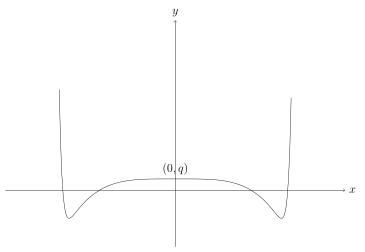
- Sketch the graph of the function \(\mathrm{f}\), where \(\mathrm{f}(x)=x^{1760}-x^{220}+q\), and \(q\) is a constant. Find the possible numbers of \textit{distinct }roots of the equation \(\mathrm{f}(x)=0\), and state the inequalities satisfied by \(q\).
Solution:
- \begin{align*} \int_{1}^{3}\frac{1}{6x^{2}+19x+15}\,\mathrm{d}x &= \int_1^3 \frac1{(2x+3)(3x+5)} \d x \\ &= \int_1^3 \l \frac{2}{2x+3} - \frac{3}{3x+5} \r \d x \\ &= \left [\ln(2x+3) - \ln(3x+5) \right ]_1^3 \\ &= \l \ln9 - \ln14 \r - \l \ln 5 - \ln 8 \r \\ &= \ln \frac{72}{70} \\ &= \ln \frac{36}{35} \end{align*}
- When \(q = 0\) the roots are \(-1, 0, 1\) There can be \(0, 2, 3, 4\) roots. There will be no roots if \(q > -\min (x^{1760} - x^{220})\) since the whole graph will be above the axis. There will be \(2\) roots if \(q = -\min (x^{1760} - x^{220})\) or \(q > 0\) There will be \(4\) roots if \(0 > q > -\min (x^{1760} - x^{220})\). There will be \(3\) roots if \(q =0\)
1990 Paper 1 Q9
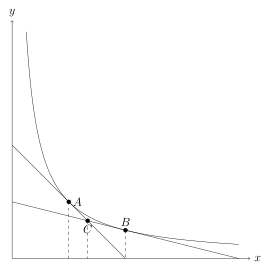
Let \(A\) and \(B\) be the points \((1,1)\) and \((b,1/b)\) respectively, where \(b>1\). The tangents at \(A\) and \(B\) to the curve \(y=1/x\) intersect at \(C\). Find the coordinates of \(C\). Let \(A',B'\) and \(C'\) denote the projections of \(A,B\) and \(C\), respectively, to the \(x\)-axis. Obtain an expression for the sum of the areas of the quadrilaterals \(ACC'A'\) and \(CBB'C'\). Hence or otherwise prove that, for \(z>0\), \[ \frac{2z}{2+z}\leqslant\ln\left(1+z\right)\leqslant z. \]
Solution:
1990 Paper 1 Q16
A bus is supposed to stop outside my house every hour on the hour. From long observation I know that a bus will always arrive some time between 10 minutes before and ten minutes after the hour. The probability it arrives at a given instant increases linearly (from zero at 10 minutes before the hour) up to a maximum value at the hour, and then decreases linearly at the same rate after the hour. Obtain the probability density function of \(T\), the time in minutes after the scheduled time at which a bus arrives. If I get up when my alarm clock goes off, I arrive at the bus stop at 7.55am. However, with probability 0.5, I doze for 3 minutes before it rings again. In that case with probability 0.8 I get up then and reach the bus stop at 7.58am, or, with probability 0.2, I sleep a little longer, not reaching the stop until 8.02am. What is the probability that I catch a bus by 8.10am? I buy a louder alarm clock which ensures that I reach the stop at exactly the same time each morning. This clock keeps perfect time, but may be set to an incorrect time. If it is correct, the alarm goes off so that I should reach the stop at 7.55am. After 100 mornings I find that I have had to wait for a bus until after 9am (according to the new clock) on 5 occasions. Is this evidence that the new clock is incorrectly set? {[}The time of arrival of different buses are independent of each other.{]}
Solution: The probability density function will look like a triangle with base \(20\) minutes and therefore height \(\frac{1}{10}\) per minute, ie: \begin{align*} f_T(t) &= \begin{cases} \frac{1}{100}(t+10) & \text{if } -10 \leq t \leq 0 \\ \frac{1}{100}(10-t) & \text{if } 0 \leq t \leq 10 \\ 0 & \text{otherwise} \end{cases} \end{align*} \begin{align*} \mathbb{P}(\text{catch bus}) &=0.5 \mathbb{P}(\text{bus arrives after 7:55})+0.4 \mathbb{P}(\text{bus arrives after 7:58}) + 0.1 \mathbb{P}(\text{bus arrives after 8:02}) \\ &= \frac12 \cdot \left (1 - \frac18 \right) + \frac{2}{5} \cdot \left ( 1 - \frac{4^2}{5^2} \cdot \frac{1}{2} \right) + \frac{1}{10} \cdot \frac{4^2}{5^2} \cdot \frac12 \\ &= \frac{1\,483}{2\,000} \\ &\approx 74\% \end{align*} \begin{align*} \mathbb{P}(\text{catch bus}) &= \mathbb{P}(\text{bus arrives after 7:55}) \mathbb{P}(\text{catch next bus by 9:00}) \\ &= \frac78 + \frac18 \cdot \frac12 \\ &= \frac{15}{16} \end{align*} He should expect to miss \(6.25\) buses, so missing \(5\) seems about right. (Using a binomial calculation, seeing 5 or fewer buses is ~\(40\%\) which isn't suspicious).
1990 Paper 2 Q8
The functions \(\mathrm{x}\) and \(\mathrm{y}\) are related by \[ \mathrm{x}(t)=\int_{0}^{t}\mathrm{y}(u)\,\mathrm{d}u, \] so that \(\mathrm{x}'(t)=\mathrm{y}(t)\). Show that \[ \int_{0}^{1}\mathrm{x}(t)\mathrm{y}(t)\,\mathrm{d}t=\tfrac{1}{2}\left[\mathrm{x}(1)\right]^{2}. \] In addition, it is given that \(\mbox{y}(t)\) satisfies \[ \mathrm{y}''+(\mathrm{y}^{2}-1)\mathrm{y}'+\mathrm{y}=0,\mbox{ }(*) \] with \(\mathrm{y}(0)=\mathrm{y}(1)\) and \(\mathrm{y}'(0)=\mathrm{y}'(1)\). By integrating \((*)\), prove that \(\mathrm{x}(1)=0.\) By multiplying \((*)\) by \(\mathrm{x}(t)\) and integrating by parts, prove the relation \[ \int_{0}^{1}\left[\mathrm{y}(t)\right]^{2}\,\mathrm{d}t=\tfrac{1}{3}\int_{0}^{1}\left[\mathrm{y}(t)\right]^{4}\,\mathrm{d}t. \] Prove also the relation \[ \int_{0}^{1}\left[\mathrm{y}'(t)\right]^{2}\,\mathrm{d}t=\int_{0}^{1}\left[\mathrm{y}(t)\right]^{2}\,\mathrm{d}t. \]
Solution: Consider \(\frac12 x(t)^2\) then differentiating we obtain \(x(t)x'(t) = x(t)y(t)\). Also note that \(x(0) = \int_0^0 y(u) \d u = 0\) Therefore, \begin{align*} \int_0^1 x(t)y(t) \d t &= \left [ \frac12 x(t)^2 \right]_0^1 \\ &= \frac12[x(1)]^2 \end{align*} \begin{align*} && 0 &= y'' + (y^2-1)y' + y \\ \Rightarrow && 0 &= \int_0^1 \l y'' + (y^2-1)y' + y \r \d t \\ &&&= \left [y'(t) + \frac13y^3-y+x \right]_0^1 \\ &&&= x(1) \end{align*} Therefore \(x(1) = 0\). \begin{align*} && 0 &= xy'' + (y^2-1)y' x+ yx \\ \Rightarrow && 0 &= \int_0^1 \l xy'' + (y^2-1)y'x + xy \r \d t \\ &&&= \left [ x y' +(\frac13 y^3-y)x \right]_0^1 - \int_0^1 yy'+\frac13y^4-y^2 \d t \\ &&&= 0 - \frac13 \int_0^1 [y(t)]^4 \d t - \int_0^1 [y(t)]^2 \d t \\ \Rightarrow && \int_0^1 [y(t)]^2 \d t &= \frac13 \int_0^1 [y(t)]^4 \d t \end{align*} \begin{align*} && 0 &= yy'' + (y^2-1)y' y+ y^2 \\ \Rightarrow && 0 &= \int_0^1 \l yy'' + (y^2-1)y'y + y^2 \r \d t \\ &&&= \left [ y y' +(\frac14 y^4-\frac12y^2) \right]_0^1 - \int_0^1 [y'(t)]^2 \d t + \int_0^1 y^2 \d t \\ &&&= 0 - \int_0^1 [y'(t)]^2 \d t + \int_0^1 y^2 \d t \\ \Rightarrow && \int_0^1 [y'(t)]^2 \d t &= \int_0^1 [y(t)]^2 \d t \end{align*}
1990 Paper 2 Q9
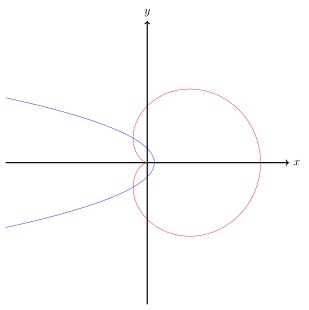
Show by means of a sketch that the parabola \(r(1+\cos\theta)=1\) cuts the interior of the cardioid \(r=4(1+\cos\theta)\) into two parts. Show that the total length of the boundary of the part that includes the point \(r=1,\theta=0\) is \(18\sqrt{3}+\ln(2+\sqrt{3}).\)
Solution: