1990 Paper 2 Q9
Year: 1990
Paper: 2
Question Number: 9
Course: UFM Pure
Section: Polar coordinates
Difficulty: 1600.0
Banger: 1500.0
Problem
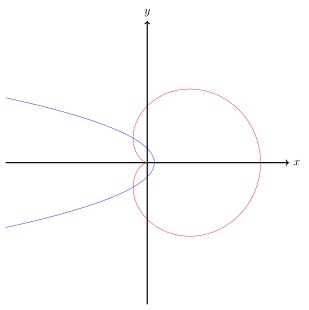
Show by means of a sketch that the parabola \(r(1+\cos\theta)=1\) cuts the interior of the cardioid \(r=4(1+\cos\theta)\) into two parts.
Show that the total length of the boundary of the part that includes the point \(r=1,\theta=0\) is \(18\sqrt{3}+\ln(2+\sqrt{3}).\)
Solution
Rating Information
Difficulty Rating: 1600.0
Difficulty Comparisons: 0
Banger Rating: 1500.0
Banger Comparisons: 0
Show LaTeX source
Problem source
Show by means of a sketch that the parabola $r(1+\cos\theta)=1$ cuts the interior of the cardioid $r=4(1+\cos\theta)$ into two parts.
Show that the total length of the boundary of the part that includes the point $r=1,\theta=0$ is $18\sqrt{3}+\ln(2+\sqrt{3}).$
Solution source
\begin{center}

    \begin{tikzpicture}[scale=0.5]

        \def\xl{-10};
        \def\xu{10};
        \def\yl{-10};
        \def\yu{10};
        \pgfmathsetmacro{\xrange}{\xu-\xl}
        \pgfmathsetmacro{\yrange}{\yu-\yl}
        \pgfmathsetmacro{\xscale}{1}
        \pgfmathsetmacro{\yscale}{\xrange/\yrange}
            \tikzset{
            axis/.style={very thick, ->},
            grid/.style={thin, gray!30},
            x=\xscale cm,
            y=\yscale cm
        }
        \draw[axis] (\xl,0) -- (\xu,0) node[right] {$x$};
        \draw[axis] (0,\yl) -- (0,\yu) node[above] {$y$};

        \begin{scope}
        % You can modify these values to change your plotting region
        \clip (\xl,\yl) rectangle (\xu,\yu);

        % Draw a grid (optional)
        \draw[blue, smooth, domain=-170:170, samples=100]
            plot ({cos(\x)/(1+cos(\x)}, {sin(\x)/(1+cos(\x)});
        \draw[red, smooth, domain=-170:170, samples=100]
            plot ({cos(\x)*4*(1+cos(\x)}, {sin(\x)*4*(1+cos(\x)});
    \end{scope}

    \end{tikzpicture}
\end{center}


The curves will intersect when:

\begin{align*}
&& \frac{1}{1+\cos \theta} &= 4 (1 + \cos \theta) \\
\Rightarrow && 1 + \cos \theta &= \pm \frac{1}{2} \\
\Rightarrow && \cos \theta &= -\frac12 \\
\Rightarrow && \theta &= \pm \frac{2\pi}{3},
\end{align*}

Therefore we can measure the two sides of the boundaries. For the cardioid it will be:

\begin{align*}
s &= \int_{-2\pi/3}^{2 \pi /3} \sqrt{r^2 + \left ( \frac{\d r}{\d \theta} \right)^2}  \d \theta \\
&= \int_{-2\pi/3}^{2 \pi /3}\sqrt{r^2 + \left ( \frac{\d r}{\d \theta} \right)^2}  \d \theta \\
&= \int_{-2\pi/3}^{2 \pi /3}\sqrt{16(1 + \cos \theta)^2 + 16 \sin^2 \theta}  \d \theta \\
&= 4\int_{-2\pi/3}^{2 \pi /3}\sqrt{2 + 2 \cos \theta}  \d \theta \\
&= 8\int_{-2\pi/3}^{2 \pi /3}\sqrt{\cos^2 \frac{\theta}{2}}  \d \theta \\
&= 8\int_{-2\pi/3}^{2 \pi /3}|\cos \frac{\theta}{2}| \d \theta \\
&= 16\int_{\pi}^{2\pi/3}(-\cos \frac{\theta}{2}) \d \theta + 8\int_{-\pi}^{\pi}\cos \frac{\theta}{2} \d \theta \\
&= 16 \cdot \left [ 2\sin \frac{\theta}{2}\right]_{\pi}^{2\pi/3}+ 8 \cdot 4 \\
&= 16 \cdot (\sqrt{3}-2) + 8 \cdot 4 \\
&= 16\sqrt{3}
\end{align*}

For the parabola we have that $\sqrt{x^2+y^2} + x = 1 \Rightarrow x^2 + y^2 = 1 - 2x + x^2 \Rightarrow y^2 = 1-2x$. So we can parameterise our parabola as $y = t, x = \frac{1-t^2}2$. And we are interested in the points $t = -\sqrt{3}$ and $t =\sqrt3$
\begin{align*}
&&s &= \int_{-\sqrt3}^\sqrt3 \sqrt{\left ( \frac{\d x}{\d t} \right)^2 + \left ( \frac{\d y}{\d t} \right)^2 } \d t \\
&&&= \int_{-\sqrt3}^\sqrt3 \sqrt{t^2+1^2} \d t \\
\sinh u = t, \frac{\d t}{\d u} = \cosh u&&&= \int_{-\sinh^{-1} \sqrt3}^{\sinh^{-1}\sqrt3} \cosh^2 u \d u \\
&&&= \left [\frac12 u + \frac14 \sinh(2u) \right ]_{-\sinh^{-1} \sqrt3}^{\sinh^{-1}\sqrt3} \\
&&&= \sinh^{-1} \sqrt{3} + 2\sqrt{3} \\
&&&= \ln(2 + \sqrt{3}) + 2\sqrt{3}
\end{align*}

Therefore the total distance is as required.