Problems
Filters
218 problems found
1990 Paper 2 Q3
Sketch the curves given by \[ y=x^{3}-2bx^{2}+c^{2}x, \] where \(b\) and \(c\) are non-negative, in the cases: \begin{questionparts} \item \(2b < c\sqrt{3}\) \item \(2b=c\sqrt{3}\neq0\) \item \(c\sqrt{3} < 2b < 2c\), \item \(b=c\neq0\) \item \(b > c > 0\), \item \(c=0,b\neq0\) \item \(c=b=0\). \end{questionpart} Sketch also the curves given by \(y^{2}=x^{3}-2bx^{2}+c^{2}x\) in the cases \((i), (v)\) and \((vii)\).
Solution:


1990 Paper 2 Q7
A damped system with feedback is modelled by the equation \[ \mathrm{f}'(t)+\mathrm{f}(t)-k\mathrm{f}(t-1)=0,\mbox{ }\tag{\(\dagger\)} \] where \(k\) is a given non-zero constant. Show that (non-zero) solutions for \(\mathrm{f}\) of the form \(\mathrm{f}(t)=A\mathrm{e}^{pt},\) where \(A\) and \(p\) are constants, are possible provided \(p\) satisfies \[ p+1=k\mathrm{e}^{-p}.\mbox{ }\tag{*} \] Show also, by means of a sketch, or otherwise, that equation \((*)\) can have \(0,1\) or \(2\) real roots, depending on the value of \(k\), and find the set of values of \(k\) for which such solutions of \((\dagger)\) exist. For what set of values of \(k\) do such solutions tend to zero as \(t\rightarrow+\infty\)?
Solution: Suppose \(f(t) = Ae^{pt}\) is a solution, then \begin{align*} && 0 &= Ape^{pt} + Ae^{pt} - Ake^{p(t-1)} \\ \Leftrightarrow && 0 &= p +1 - ke^{-p} \\ \Leftrightarrow && p+1 &= ke^{-p} \end{align*}

1990 Paper 2 Q9
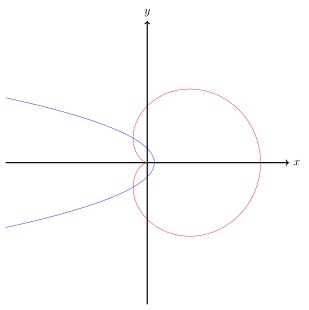
Show by means of a sketch that the parabola \(r(1+\cos\theta)=1\) cuts the interior of the cardioid \(r=4(1+\cos\theta)\) into two parts. Show that the total length of the boundary of the part that includes the point \(r=1,\theta=0\) is \(18\sqrt{3}+\ln(2+\sqrt{3}).\)
Solution:
1990 Paper 3 Q7
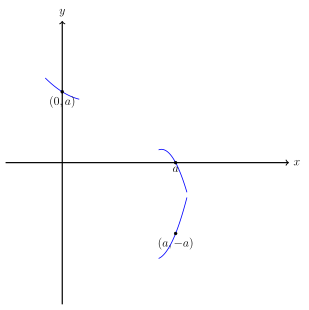
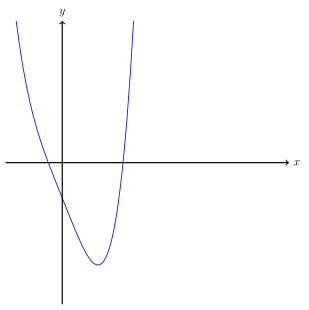
The points \(P\,(0,a),\) \(Q\,(a,0)\) and \(R\,(a,-a)\) lie on the curve \(C\) with cartesian equation \[ xy^{2}+x^{3}+a^{2}y-a^{3}=0,\qquad\mbox{ where }a>0. \] At each of \(P,Q\) and \(R\), express \(y\) as a Taylor series in \(h\), where \(h\) is a small increment in \(x\), as far as the term in \(h^{2}.\) Hence, or otherwise, sketch the shape of \(C\) near each of these points. Show that, if \((x,y)\) lies on \(C\), then \[ 4x^{4}-4a^{3}x-a^{4}\leqslant0. \] Sketch the graph of \(y=4x^{4}-4a^{3}x-a^{4}.\) Given that the \(y\)-axis is an asymptote to \(C\), sketch the curve \(C\).
Solution: \begin{align*} && 0 &= xy^{2}+x^{3}+a^{2}y-a^{3} \\ \frac{\d }{\d x} : && 0 &= y^2+2xyy' + 3x^2+a^2y' \\ \Rightarrow && y' &= -\frac{y^2+3x^2}{a^2+2xy} \\ \\ \frac{\d^2 }{\d x^2}: && 0 &= 2yy'+2yy'+2x(y')^2+2xyy''+6x+a^2y'' \\ \Rightarrow && y'' &= -\frac{4yy'+2x(y')^2+6x}{a^2+2xy} \\ \\ P: && y &= a \\ && y' &= -\frac{a^2}{a^2} = -1 \\ && y'' &= -\frac{-4a}{a^2} = \frac{4}{a} \\ \Rightarrow && y &\approx a - h+\frac{2}{a}h^2 \\ \\ Q: && y &= 0 \\ && y' &= -\frac{3a^2}{a^2} = -3 \\ && y'' &= -\frac{18a+6a}{a^2} = -\frac{24}{a} \\ \Rightarrow && y &\approx 0-3h-\frac{12}{a}h \\ \\ R: && y &= -a \\ && y' &= -\frac{a^2+3a^2}{a^2-2a^2} = 4 \\ && y'' &= -\frac{-16a+32a+6a}{a^2-2a^2} = \frac{22}{a} \\ \Rightarrow && y &\approx -a+4h + \frac{11}{a}h^2 \end{align*} Alternatively: \begin{align*} && 0 &= xy^{2}+x^{3}+a^{2}y-a^{3} \\ P(0,a): && y &\approx a + c_1h + c_2h^2 \\ && 0 &= h(a+c_1h)^2 + a^2(a + c_1h + c_2h^2)-a^3 \\ &&&= a^3-a^3 + (a^2+a^2c_1)h+(2ac_1+a^2c_2)h^2 \\ \Rightarrow && c_1 &=-1, c_2 =\frac{2}{a} \\ \Rightarrow && y &\approx a - h + \frac{2}{a}h^2 \\ \\ Q(a,0): && y &\approx c_1h + c_2h^2 \\ && 0 &= (a+h)(c_1h)^2+(a+h)^3+a^2(c_1h + c_2h^2 )-a^3 \\ &&&= a^3-a^3+(3a^2+a^2c_1)h + (ac_1^2+3a+a^2c_2)h^2 + \cdots \\ \Rightarrow && c_1 &=-3, c_2 = -\frac{12}{a} \\ \Rightarrow && y &\approx -3h -\frac{12}{a}h \\ \\ R(a,-a): && y &\approx -a + c_1h + c_2h^2 \\ && 0 &= (a+h)(-a + c_1h+c_2h^2)^2+(a+h)^3+a^2(-a + c_1h + c_2h^2)-a^3 \\ &&&= (a^2-2a^2c_1+3a^2+a^2c_1)h+(-2ac_1+c_1^2+\cdots)h^2 \\ \Rightarrow && c_1 &=4, c_2 = \frac{11}{a} \\ \Rightarrow && y &\approx -a + 4h + \frac{11}{a} \end{align*}

1990 Paper 3 Q10
By considering the graphs of \(y=kx\) and \(y=\sin x,\) show that the equation \(kx=\sin x,\) where \(k>0,\) may have \(0,1,2\) or \(3\) roots in the interval \((4n+1)\frac{\pi}{2} < x < (4n+5)\frac{\pi}{2},\) where \(n\) is a positive integer. For a certain given value of \(n\), the equation has exactly one root in this interval. Show that \(k\) lies in an interval which may be written \(\sin\delta < k < \dfrac{2}{(4n+1)\pi},\) where \(0 < \delta < \frac{1}{2}\pi\) and \[ \cos\delta=\left((4n+5)\frac{\pi}{2}-\delta\right)\sin\delta. \] Show that, if \(n\) is large, then \(\delta\approx\dfrac{2}{(4n+5)\pi}\) and obtain a second, improved, approximation.
Solution:

- be below \(((4n+1)\tfrac{\pi}{2}, 1)\) and
- not touch the second gradient
1989 Paper 1 Q7
Sketch the curve \(y^{2}=1-\left|x\right|\). A rectangle, with sides parallel to the axes, is inscribed within this curve. Show that the largest possible area of the rectangle is \(8/\sqrt{27}\). Find the maximum area of a rectangle similarly inscribed within the curve given by \(y^{2m}=\left(1-\left|x\right|\right)^{n}\), where \(m\) and \(n\) are positive integers, with \(n\) odd.
Solution:

1989 Paper 1 Q9
Sketch the graph of \(8y=x^{3}-12x\) for \(-4\leqslant x\leqslant4\), marking the coordinates of the turning points. Similarly marking the turning points, sketch the corresponding graphs in the \((X,Y)\)-plane, if \begin{alignat*}{3} \rm{(a)} & \quad & & X=\tfrac{1}{2}x, & \qquad & Y=y,\\ \rm{(b)} & & & X=x, & & Y=\tfrac{1}{2}y,\\ \rm{(c)} & & & X=\tfrac{1}{2}x+1, & & Y=y,\\ \rm{(d)} & & & X=x, & & Y=\tfrac{1}{2}y+1. \end{alignat*} Find values for \(a,b,c,d\) such that, if \(X=ax+b,\) \(Y=cy+d\), then the graph in the \((X,Y)\)-plane corresponding to \(8y=x^{3}-12x\) has turning points at \((X,Y)=(0,0)\) and \((X,Y)=(1,1)\).
Solution: \(8\frac{\d y}{\d x} = 3(x^2-4)\) so the turning points are at \((\pm 2, \mp 2)\)


1989 Paper 2 Q3
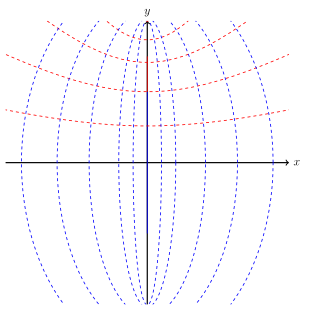
The real numbers \(x\) and \(y\) are related to the real numbers \(u\) and \(v\) by \[ 2(u+\mathrm{i}v)=\mathrm{e}^{x+\mathrm{i}y}-\mathrm{e}^{-x-\mathrm{i}y}. \] Show that the line in the \(x\)-\(y\) plane given by \(x=a\), where \(a\) is a positive constant, corresponds to the ellipse \[ \left(\frac{u}{\sinh a}\right)^{2}+\left(\frac{v}{\cosh a}\right)^{2}=1 \] in the \(u\)-\(v\) plane. Show also that the line given by \(y=b\), where \(b\) is a constant and \(0<\sin b<1,\) corresponds to one branch of a hyperbola in the \(u\)-\(v\) plane. Write down the \(u\) and \(v\) coordinates of one point of intersection of the ellipse and hyperbola branch, and show that the curves intersect at right-angles at this point. Make a sketch of the \(u\)-\(v\) plane showing the ellipse, the hyperbola branch and the line segments corresponding to:
- \(x=0\);
- \(y=\frac{1}{2}\pi,\) \(\quad 0\leqslant x\leqslant a.\)
Solution: \begin{align*} && 2(u+iv) &= e^{a+iy} - e^{-a-iy} \\ && &=(e^a \cos y - e^{-a} \cos y) + (e^a \sin y + e^{-a} \sin y)i \\ &&&= 2 \sinh a \cos y + 2\cosh a \sin y i\\ \Rightarrow && \frac{u}{\sinh a} &= \cos y \\ && \frac{v}{\cosh a} &= \sin y \\ \Rightarrow && 1 &= \left(\frac{u}{\sinh a}\right)^{2}+\left(\frac{v}{\cosh a}\right)^{2} \end{align*} \begin{align*} && 2(u+iv) &= e^{x+ib} - e^{-x-ib} \\ &&&= 2\sinh x \cos b + 2\cosh x \sin b i \\ \Rightarrow && \frac{u}{\cos b} &= \sinh x \\ && \frac{v}{\sin b} &= \cosh x \\ \Rightarrow && 1 &= \left (\frac{v}{\sin b} \right)^2 - \left (\frac{u}{\cos b} \right)^2 \end{align*} Therefore all the points lie of a hyperbola, and since \(\frac{v}{\sin b} > 0 \Rightarrow v > 0\) it's one branch of the hyperbola. (And all points on it are reachable as \(x\) varies from \(-\infty < x < \infty\). \begin{align*} 2(u+iv) &= e^{a+ib} - e^{-a-ib} \\ &= 2 \sinh a \cos b + 2 \cosh a \sin b i \end{align*} so we can take \(u = \sinh a \cos b, v = \cosh a \sin b\). \begin{align*} \frac{\d }{\d u} && 0 &= \frac{2 u}{\sinh^2 a} + \frac{2v}{\cosh^2 a} \frac{\d v}{\d u} \\ \Rightarrow && \frac{\d v}{\d u} &= -\frac{u}{v} \coth^2 a \\ \\ && \frac{\d v}{\d u} \rvert_{(u,v)} &= -\frac{\sinh a \cos b}{\cosh a \sin b} \coth^2 a \\ &&&= -\cot b \coth a \\ \frac{\d }{\d u} && 0 &= \frac{2 v}{\sin^2 b} \frac{\d v}{\d u} - \frac{2u}{\cos^2 b} \\ \Rightarrow && \frac{\d v}{\d u} &= \frac{u}{v} \tan^2 b \\ && \frac{\d v}{\d u} \rvert_{(u,v)} &= \frac{\sinh a \cos b}{\cosh a \sin b} \tan^2 b \\ &&&= \tanh a \tan b \end{align*} Therefore they are negative reciprocals and hence perpendicular.
1989 Paper 2 Q4
The function \(\mathrm{f}\) is defined by \[ \mathrm{f}(x)=\frac{\left(x-a\right)\left(x-b\right)}{\left(x-c\right)\left(x-d\right)}\qquad\left(x\neq c,\ x\neq d\right), \] where \(a,b,c\) and \(d\) are real and distinct, and \(a+b\neq c+d\). Show that \[ \frac{x\mathrm{f}'(x)}{\mathrm{f}(x)}=\left(1-\frac{a}{x}\right)^{-1}+\left(1-\frac{b}{x}\right)^{-1}-\left(1-\frac{c}{x}\right)^{-1}-\left(1-\frac{d}{x}\right)^{-1}, \] \((x\neq0,x\neq a,x\neq b)\) and deduce that when \(\left|x\right|\) is much larger than each of \(\left|a\right|,\left|b\right|,\left|c\right|\) and \(\left|d\right|,\) the gradient of \(\mathrm{f}(x)\) has the same sign as \((a+b-c-d).\) It is given that there is a real value of real value of \(x\) for which \(\mathrm{f}(x)\) takes the real value \(z\) if and only if \[ [\left(c-d\right)^{2}z+\left(a-c\right)\left(b-d\right)+\left(a-d\right)\left(b-c\right)]^{2}\geqslant4\left(a-c\right)\left(b-d\right)\left(a-d\right)\left(b-c\right). \] Describe briefly a method by which this result could be proved, but do not attempt to prove it. Given that \(a < b\) and \(a < c < d\), make sketches of the graph of \(\mathrm{f}\) in the four distinct cases which arise, indicating the cases for which the range of \(\mathrm{f}\) is not the whole of \(\mathbb{R}.\)
Solution: Notice that \(\ln f(x) = \ln (x - a) + \ln (x-b) - \ln (x-c) - \ln (x-d)\) therefore: \begin{align*} \frac{\d}{\d x}: && \frac{f'(x)}{f(x)} &= (x-a)^{-1}+(x-b)^{-1}-(x-c)^{-1} - (x-d)^{-1} \\ &&&= \frac{1}{x} \left ( (1-\frac{a}{x})^{-1}+(1-\frac{b}{x})^{-1}-(1-\frac{c}{x})^{-1} - (1-\frac{d}{x})^{-1}\right) \end{align*} Multiplying by \(x\) gives the desired result. When \(|x|\) is very large then: \begin{align*} \frac{x f'(x)}{f(x)} &\approx 1 + \frac{a}{x} + o(\frac{1}{x^2})+ 1 + \frac{b}{x} + o(\frac{1}{x^2})-(1 + \frac{c}{x} + o(\frac{1}{x^2}))-(1 + \frac{d}{x} + o(\frac{1}{x^2})) \\ &= \frac{a+b-c-d}{x} + o(x^{-2}) \end{align*} Dividing by \(x\) we obtain \(\frac{f'(x)}{f(x)} \approx \frac{a+b-c-d}{x^2} + o(x^{-3})\) if \(|x|\) is sufficiently large this will be dominated by the \(\frac{a+b-c-d}{x^2}\) term which will have the same sign as \((a+b-c-d)\). When \(|x|\) is very large all of the brackets will have the same sign, and therefore \(f(x)\) will be positive, and so \(f'(x)\) must have the same sign as \(a+b-c-d\). To prove this result, we could set \(f(x) = k\) and rearrange to form a quadratic in \(x\). We could then check the discriminant is non-zero. Case 1: \(a < c < d < b\) and \(a+b > c+d \Rightarrow\) not all values reached and approx asymtope from below on the right and above on the left.


1989 Paper 2 Q5
- Show that in polar coordinates, the gradient of any curve at the point
\((r,\theta)\) is
\[
\left.\left(\frac{\mathrm{d}r}{\mathrm{d}\theta}\tan\theta+r\right)\right/\left(\frac{\mathrm{d}r}{\mathrm{d}\theta}-r\tan\theta\right).
\]

- A mirror is designed so that any ray of light which hits one side of the mirror and which is parallel to a certain fixed line \(L\) is reflected through a fixed point \(O\) on \(L\). For any ray hitting the mirror, the normal to the mirror at the point of reflection bisects the angle between the incident ray and the reflected ray, as shown in the figure. Prove that the mirror intersects any plane containing \(L\) in a parabola.
Solution:
- Suppose our curve is \(r(\theta)\), then \(y = r \sin \theta, x = r \cos \theta\) and \begin{align*} && \frac{\d y}{\d \theta} &= \frac{\d r}{\d \theta} \sin \theta + r \cos \theta \\ && \frac{\d x}{\d \theta} &= \frac{\d r}{\d \theta} \cos \theta - r \sin \theta \\ \Rightarrow && \frac{\d y}{\d x} &= \frac{\d y}{\d \theta} \Bigg / \frac{\d x}{\d \theta} \\ &&&= \frac{\frac{\d r}{\d \theta} \sin \theta + r \cos \theta}{\frac{\d r}{\d \theta} \cos \theta - r \sin \theta} \\ &&&= \frac{\frac{\d r}{\d \theta} \tan\theta + r }{\frac{\d r}{\d \theta} - r \tan\theta} \end{align*} as required.
- Set up a system of polar coordinates such that the origin is at \(O\) and all points in the plane containing \(L\) are represented by \((r, \theta)\). The constraint we have is that the angle of the normal, is \(\frac12 \theta\). Let \(\tan \tfrac12 \theta = t\), then \(\tan \theta = \frac{2t}{1-t^2}\) \begin{align*} && \tan \frac12 \theta &= -\frac{\frac{\d r}{\d \theta} - r \tan\theta}{\frac{\d r}{\d \theta} \tan\theta + r } \\ \Rightarrow && t &= -\frac{r'-r\frac{2t}{1-t^2}}{r' \frac{2t}{1-t^2}+r} \\ &&&= \frac{2tr-(1-t^2)r'}{2tr'+(1-t^2)r} \\ \Rightarrow && (2t^2+1-t^2)r' &= (2t-t+t^3)r \\ && (1+t^2)r' &= t(t^2+1) r \\ \Rightarrow && r' &= t r \\ \Rightarrow && \frac{\d r}{\d \theta} &= \tan \tfrac12 \theta r \\ \Rightarrow && \int \frac1r \d r &= \int \tan \frac12 \theta \d \theta \\ && \ln r &= -2\ln \cos \tfrac12 \theta+C \\ \Rightarrow && r\cos^2 \frac12 \theta &= C \\ \Rightarrow && r + r\cos \theta &= D \\ \Rightarrow && r &= D-x \\ \Rightarrow && x^2 + y^2 &= D^2 - 2Dx + x^2 \\ \Rightarrow && y^2 &= D^2-2Dx \end{align*} Therefore it is a parabola
1989 Paper 3 Q4
Sketch the curve whose cartesian equation is \[ y=\frac{2x(x^{2}-5)}{x^{2}-4}, \] and give the equations of the asymptotes and of the tangent to the curve at the origin. Hence, or otherwise, determine (giving reasons) the number of real roots of the following equations:
- \(4x^{2}(x^{2}-5)=(5x-2)(x^{2}-4)\);
- \(4x^{2}(x^{2}-5)^{2}=(x^{2}-4)^{2}(x^{2}+1)\);
- \(4z^{2}(z-5)^{2}=(z-4)^{2}(z+1)\).
Solution:

- \begin{align*} && 4x^{2}(x^{2}-5)&=(5x-2)(x^{2}-4) \\ && \frac{2x(x^2-5)}{x^2-4} &= \frac{5x-2}{2x} = \frac52 -\frac1x \end{align*} Therefore it will have two roots as the hyperbola will intersect our graph in two places. (In the upper left and lower right quadrants).
- \begin{align*}
&& 4x^{2}(x^{2}-5)^{2}&=(x^{2}-4)^{2}(x^{2}+1) \\
&& \frac{2x(x^2-5)}{x^2-4} &= \frac{(x^2-4)(x^2+1)}{2x}
\end{align*}
No solutions \begin{align*} && 4z^{2}(z-5)^{2}&=(z-4)^{2}(z+1) \\ && \frac{2z(z^2-5)}{z^2-4} &= \frac{(z+5)(z-4)(z+1)}{(z-5)(z+4)} \end{align*}
 5 solutions
1988 Paper 1 Q1
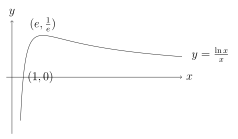
Sketch the graph of the function \(\mathrm{h}\), where \[ \mathrm{h}(x)=\frac{\ln x}{x},\qquad(x>0). \] Hence, or otherwise, find all pairs of distinct positive integers \(m\) and \(n\) which satisfy the equation \[ n^{m}=m^{n}. \]
Solution:
1988 Paper 2 Q4
The complex number \(w\) is such that \(w^{2}-2w\) is real.
- Sketch the locus of \(w\) in the Argand diagram.
- If \(w^{2}=x+\mathrm{i}y,\) describe fully and sketch the locus of points \((x,y)\) in the \(x\)-\(y\) plane.
Solution:
- Suppose \(w = u+ vi\) then \(w^2 - 2w = u^2-v^2-2u+(2uv-2v)i\) so to be purely real we must have \(2uv-2v = 2v(u-1) = 0\) ie either \(v = 0\) or \(u = 1\). Therefore the locus is the real axis and the line \(1 + ti\):

- If \(w^2 = x+yi\) then we must have \(x = u^2-v^2\) and \(y = 2uv\), so either \(v = 0, y = 0, x = u^2-2u \geq -1\) or \(u = 1, x = 1-v^2, y = 2v\) which is a parabola:


1988 Paper 2 Q6
Show that the following functions are positive when \(x\) is positive:
- [ \(x-\tanh x\)
- \(x\sinh x-2\cosh x+2\)
- \(2x\cosh2x-3\sinh2x+4x\).
Solution:
- Notice that \(f(x) = x - \tanh x\) has \(f'(x) = 1-\textrm{sech}^2 x = \tanh^2 x > 0\) so \(f(x)\) is strictly increasing on \((0, \infty)\) and \(f(0) = 0\) therefore \(f(x)\) is positive for all \(x\) positive
- Let \(f(x) = x\sinh x-2\cosh x+2\) then \(f'(x) = \sinh x +x \cosh x - 2 \sinh x = x \cosh x -\sinh x = \cosh x ( x - \tanh x) > 0\) by the first part. \(f(0) = 0\) so \(f(x)\) is positive for all \(x\) positive.
- Let \(f(x) = 2x\cosh2x-3\sinh2x+4x\) then \begin{align*} f'(x) &= 2\cosh 2x +4x\sinh 2x - 6 \cosh 2x + 4 \\ &= 4( x\sinh 2x-\cosh 2x +1) \\ &= 4(x2\cosh x \sinh x -2\cosh^2x ) \\ &= 8 \cosh^2 x (x - \tanh x) \end{align*} Which is always positive when \(x\) > 0, \(f(0) = 0\) so \(f(x) > 0\) for all positive \(x\).
1988 Paper 2 Q8
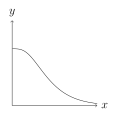
In a crude model of population dynamics of a community of aardvarks and buffaloes, it is assumed that, if the numbers of aardvarks and buffaloes in any year are \(A\) and \(B\) respectively, then the numbers in the following year at \(\frac{1}{4}A+\frac{3}{4}B\) and \(\frac{3}{2}B-\frac{1}{2}A\) respectively. It does not matter if the model predicts fractions of animals, but a non-positive number of buffaloes means that the species has become extinct, and the model ceases to apply. Using matrices or otherwise, show that the ratio of the number of aardvarks to the number of buffaloes can remain the same each year, provided it takes one of two possible values. Let these two possible values be \(x\) and \(y\), and let the numbers of aardvarks and buffaloes in a given year be \(a\) and \(b\) respectively. By writing the vector \((a,b)\) as a linear combination of the vectors \((x,1)\) and \((y,1),\) or otherwise, show how the numbers of aardvarks and buffaloes in subsequent years may be found. On a sketch of the \(a\)-\(b\) plane, mark the regions which correspond to the following situations
- an equilibrium population is reached as time \(t\rightarrow\infty\);
- buffaloes become extinct after a finite time;
- buffaloes approach extinction as \(t\rightarrow\infty.\)
Solution: If the population in a given year is \(\mathbf{v} = \begin{pmatrix}A \\ B \end{pmatrix}\) then the population the next year is \(\mathbf{Mv}\) where \(\mathbf{M} = \begin{pmatrix} \frac14 & \frac34 \\ -\frac12 &\frac32 \end{pmatrix}\) The ratio is the same if \(\mathbf{Mv} = \lambda \mathbf{v}\) ie if \(\mathbf{v}\) is an eigenvector of \(\mathbf{M}\). The eigenvalues will be \(1\) and \(\frac38\) (by inspection) so we should be able to solve for the eigenvectors: \(\lambda = 1\) we have \(\frac14A + \frac34B = A \Rightarrow A = B\) a ratio of \(1\). \(\lambda = \frac38\) we have \(\frac14A + \frac34B = \frac38A \Rightarrow \frac34B = \frac18A \Rightarrow A = 6B\) a ratio of \(6\). If we write \(\begin{pmatrix} a \\ b \end{pmatrix}\) as \(x_1 \begin{pmatrix} 1 \\ 1 \end{pmatrix} + x_6 \begin{pmatrix} 6 \\ 1 \end{pmatrix}\) we find that after \(n\) years, we have: \(x_1 \begin{pmatrix} 1 \\ 1 \end{pmatrix} + \l \frac38 \r^n x_6 \begin{pmatrix} 6 \\ 1 \end{pmatrix}\) for the populations. Therefore if \(x_1\) is \(< 0\) then in finite time we will end up with one population being 0. If \(x_1 > 0\) are positive we tend to a finite population and if \(x_1 = 0\) then over time the population will tend to \(0\) at infinity. In our diagram these areas correspond to (red) - die out in finite time, (green) population stable and the thick black line where the population goes extinct as \(t \to \infty\)
