1990 Paper 3 Q7
Year: 1990
Paper: 3
Question Number: 7
Course: UFM Pure
Section: Taylor series
Difficulty: 1700.0
Banger: 1552.4
Taylor series
implicit differentiation
curve sketching
asymptotes
inequality
polynomial
implicit curve
local approximation
Problem
The points \(P\,(0,a),\) \(Q\,(a,0)\) and \(R\,(a,-a)\) lie on the curve \(C\) with cartesian equation
\[
xy^{2}+x^{3}+a^{2}y-a^{3}=0,\qquad\mbox{ where }a>0.
\]
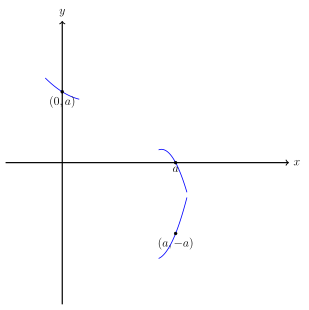
At each of \(P,Q\) and \(R\), express \(y\) as a Taylor series in \(h\), where \(h\) is a small increment in \(x\), as far as the term in \(h^{2}.\)
Hence, or otherwise, sketch the shape of \(C\) near each of these points.
Show that, if \((x,y)\) lies on \(C\), then
\[
4x^{4}-4a^{3}x-a^{4}\leqslant0.
\]
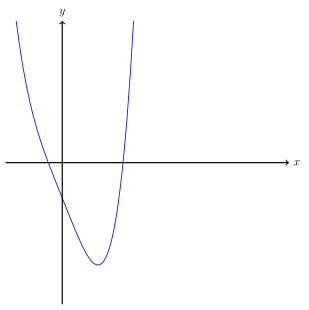
Sketch the graph of \(y=4x^{4}-4a^{3}x-a^{4}.\)
Given that the \(y\)-axis is an asymptote to \(C\), sketch the curve \(C\).
Solution
\begin{align*}
&& 0 &= xy^{2}+x^{3}+a^{2}y-a^{3} \\
\frac{\d }{\d x} : && 0 &= y^2+2xyy' + 3x^2+a^2y' \\
\Rightarrow && y' &= -\frac{y^2+3x^2}{a^2+2xy} \\
\\
\frac{\d^2 }{\d x^2}: && 0 &= 2yy'+2yy'+2x(y')^2+2xyy''+6x+a^2y'' \\
\Rightarrow && y'' &= -\frac{4yy'+2x(y')^2+6x}{a^2+2xy} \\
\\
P: && y &= a \\
&& y' &= -\frac{a^2}{a^2} = -1 \\
&& y'' &= -\frac{-4a}{a^2} = \frac{4}{a} \\
\Rightarrow && y &\approx a - h+\frac{2}{a}h^2 \\
\\
Q: && y &= 0 \\
&& y' &= -\frac{3a^2}{a^2} = -3 \\
&& y'' &= -\frac{18a+6a}{a^2} = -\frac{24}{a} \\
\Rightarrow && y &\approx 0-3h-\frac{12}{a}h \\
\\
R: && y &= -a \\
&& y' &= -\frac{a^2+3a^2}{a^2-2a^2} = 4 \\
&& y'' &= -\frac{-16a+32a+6a}{a^2-2a^2} = \frac{22}{a} \\
\Rightarrow && y &\approx -a+4h + \frac{11}{a}h^2
\end{align*}
Alternatively:
\begin{align*}
&& 0 &= xy^{2}+x^{3}+a^{2}y-a^{3} \\
P(0,a): && y &\approx a + c_1h + c_2h^2 \\
&& 0 &= h(a+c_1h)^2 + a^2(a + c_1h + c_2h^2)-a^3 \\
&&&= a^3-a^3 + (a^2+a^2c_1)h+(2ac_1+a^2c_2)h^2 \\
\Rightarrow && c_1 &=-1, c_2 =\frac{2}{a} \\
\Rightarrow && y &\approx a - h + \frac{2}{a}h^2 \\
\\
Q(a,0): && y &\approx c_1h + c_2h^2 \\
&& 0 &= (a+h)(c_1h)^2+(a+h)^3+a^2(c_1h + c_2h^2 )-a^3 \\
&&&= a^3-a^3+(3a^2+a^2c_1)h + (ac_1^2+3a+a^2c_2)h^2 + \cdots \\
\Rightarrow && c_1 &=-3, c_2 = -\frac{12}{a} \\
\Rightarrow && y &\approx -3h -\frac{12}{a}h \\
\\
R(a,-a): && y &\approx -a + c_1h + c_2h^2 \\
&& 0 &= (a+h)(-a + c_1h+c_2h^2)^2+(a+h)^3+a^2(-a + c_1h + c_2h^2)-a^3 \\
&&&= (a^2-2a^2c_1+3a^2+a^2c_1)h+(-2ac_1+c_1^2+\cdots)h^2 \\
\Rightarrow && c_1 &=4, c_2 = \frac{11}{a} \\
\Rightarrow && y &\approx -a + 4h + \frac{11}{a}
\end{align*}
 If \((x,y)\) lies on the curve, then viewing it as a quadratic in \(y\) we must have \(\Delta = (a^2)^2-4\cdot x \cdot (x^3-a^3) \geq 0 \Rightarrow a^4-4x^4+4xa^3 \geq 0 \Rightarrow 4x^4-4a^3x-a^4 \leq 0\)

Rating Information
Difficulty Rating: 1700.0
Difficulty Comparisons: 0
Banger Rating: 1552.4
Banger Comparisons: 6
Show LaTeX source
Problem source
The points $P\,(0,a),$ $Q\,(a,0)$ and $R\,(a,-a)$ lie on the curve $C$ with cartesian equation
\[
xy^{2}+x^{3}+a^{2}y-a^{3}=0,\qquad\mbox{ where }a>0.
\]
At each of $P,Q$ and $R$, express $y$ as a Taylor series in $h$, where $h$ is a small increment in $x$, as far as the term in $h^{2}.$
Hence, or otherwise, sketch the shape of $C$ near each of these points.
Show that, if $(x,y)$ lies on $C$, then
\[
4x^{4}-4a^{3}x-a^{4}\leqslant0.
\]
Sketch the graph of $y=4x^{4}-4a^{3}x-a^{4}.$
Given that the $y$-axis is an asymptote to $C$, sketch the curve $C$.
Solution source
\begin{align*}
&& 0 &= xy^{2}+x^{3}+a^{2}y-a^{3} \\
\frac{\d }{\d x} : && 0 &= y^2+2xyy' + 3x^2+a^2y' \\
\Rightarrow && y' &= -\frac{y^2+3x^2}{a^2+2xy} \\
\\
\frac{\d^2 }{\d x^2}: && 0 &= 2yy'+2yy'+2x(y')^2+2xyy''+6x+a^2y'' \\
\Rightarrow && y'' &= -\frac{4yy'+2x(y')^2+6x}{a^2+2xy} \\
\\
P: && y &= a \\
&& y' &= -\frac{a^2}{a^2} = -1 \\
&& y'' &= -\frac{-4a}{a^2} = \frac{4}{a} \\
\Rightarrow && y &\approx a - h+\frac{2}{a}h^2 \\
\\
Q: && y &= 0 \\
&& y' &= -\frac{3a^2}{a^2} = -3 \\
&& y'' &= -\frac{18a+6a}{a^2} = -\frac{24}{a} \\
\Rightarrow && y &\approx 0-3h-\frac{12}{a}h \\
\\
R: && y &= -a \\
&& y' &= -\frac{a^2+3a^2}{a^2-2a^2} = 4 \\
&& y'' &= -\frac{-16a+32a+6a}{a^2-2a^2} = \frac{22}{a} \\
\Rightarrow && y &\approx -a+4h + \frac{11}{a}h^2
\end{align*}

Alternatively:

\begin{align*}
&& 0 &= xy^{2}+x^{3}+a^{2}y-a^{3} \\
P(0,a): && y &\approx a + c_1h + c_2h^2 \\
&& 0 &= h(a+c_1h)^2 + a^2(a + c_1h + c_2h^2)-a^3 \\
&&&= a^3-a^3 + (a^2+a^2c_1)h+(2ac_1+a^2c_2)h^2 \\
\Rightarrow && c_1 &=-1, c_2 =\frac{2}{a} \\
\Rightarrow && y &\approx a - h + \frac{2}{a}h^2 \\
\\
Q(a,0):  && y &\approx c_1h + c_2h^2 \\
&& 0 &= (a+h)(c_1h)^2+(a+h)^3+a^2(c_1h + c_2h^2 )-a^3 \\
&&&= a^3-a^3+(3a^2+a^2c_1)h + (ac_1^2+3a+a^2c_2)h^2 + \cdots \\
\Rightarrow && c_1 &=-3, c_2 = -\frac{12}{a} \\
\Rightarrow && y &\approx -3h -\frac{12}{a}h \\
\\
R(a,-a): && y &\approx -a + c_1h + c_2h^2 \\
&& 0 &= (a+h)(-a + c_1h+c_2h^2)^2+(a+h)^3+a^2(-a + c_1h + c_2h^2)-a^3 \\
&&&= (a^2-2a^2c_1+3a^2+a^2c_1)h+(-2ac_1+c_1^2+\cdots)h^2 \\
\Rightarrow && c_1 &=4, c_2 = \frac{11}{a} \\
\Rightarrow && y &\approx -a + 4h + \frac{11}{a}
\end{align*}

\begin{center}
    \begin{tikzpicture}
    \def\disc(#1){sqrt(4 - (#1)^4 + 8*(#1))}
    % \def\functiong(#1){ - 0.5*(#1)*(#1)};
    \def\xl{-1};
    \def\xu{4};
    \def\yl{-4};
    \def\yu{4};

    % Calculate scaling factors to make the plot square
    \pgfmathsetmacro{\xrange}{\xu-\xl}
    \pgfmathsetmacro{\yrange}{\yu-\yl}
    \pgfmathsetmacro{\xscale}{10/\xrange}
    \pgfmathsetmacro{\yscale}{10/\yrange}

    % Define the styles for the axes and grid
    \tikzset{
        axis/.style={very thick, ->},
        grid/.style={thin, gray!30},
        x=\xscale cm,
        y=\yscale cm
    }

    % Define the bounding region with clip
    \begin{scope}
        % You can modify these values to change your plotting region
        \clip (\xl,\yl) rectangle (\xu,\yu);

        % Draw a grid (optional)
        % \draw[grid] (-5,-3) grid (5,3);
        \draw[thick, blue, smooth, domain=-0.3:0.3, samples=50]
        plot ({\x}, {2-\x+\x*\x});
        \draw[thick, blue, smooth, domain=-0.3:0.2, samples=50]
        plot ({2+\x}, {-3*\x-6*\x*\x});
        \draw[thick, blue, smooth, domain=-0.3:0.2, samples=50]
        plot ({2+\x}, {-2+4*\x+11/2*\x*\x});


    \end{scope}

    \filldraw (2,0) circle (1.5pt) node[below] {$a$};
    \filldraw (2,-2) circle (1.5pt) node[below] {$(a,-a)$};
    \filldraw (0,2) circle (1.5pt) node[below] {$(0,a)$};

    % Set up axes
    \draw[axis] (\xl,0) -- (\xu,0) node[right] {$x$};
    \draw[axis] (0,\yl) -- (0,\yu) node[above] {$y$};

    \end{tikzpicture}
\end{center}

If $(x,y)$ lies on the curve, then viewing it as a quadratic in $y$ we must have $\Delta = (a^2)^2-4\cdot x \cdot (x^3-a^3) \geq 0 \Rightarrow a^4-4x^4+4xa^3 \geq 0 \Rightarrow 4x^4-4a^3x-a^4 \leq 0$


\begin{center}
    \begin{tikzpicture}
    % \def\disc(#1){sqrt(4 - (#1)^4 + 8*(#1))}
    \def\functionf(#1){4*(#1)^4-4*(#1)-1};
    \def\xl{-1};
    \def\xu{4};
    \def\yl{-4};
    \def\yu{4};

    % Calculate scaling factors to make the plot square
    \pgfmathsetmacro{\xrange}{\xu-\xl}
    \pgfmathsetmacro{\yrange}{\yu-\yl}
    \pgfmathsetmacro{\xscale}{10/\xrange}
    \pgfmathsetmacro{\yscale}{10/\yrange}

    % Define the styles for the axes and grid
    \tikzset{
        axis/.style={very thick, ->},
        grid/.style={thin, gray!30},
        x=\xscale cm,
        y=\yscale cm
    }

    % Define the bounding region with clip
    \begin{scope}
        % You can modify these values to change your plotting region
        \clip (\xl,\yl) rectangle (\xu,\yu);

        % Draw a grid (optional)
        % \draw[grid] (-5,-3) grid (5,3);
        \draw[thick, blue, smooth, domain=-1:2, samples=50]
        plot ({\x}, {\functionf(\x)});


    \end{scope}

    % \filldraw (2,0) circle (1.5pt) node[below] {$a$};
    % \filldraw (2,-2) circle (1.5pt) node[below] {$(a,-a)$};
    % \filldraw (0,2) circle (1.5pt) node[below] {$(0,a)$};

    % Set up axes
    \draw[axis] (\xl,0) -- (\xu,0) node[right] {$x$};
    \draw[axis] (0,\yl) -- (0,\yu) node[above] {$y$};

    \end{tikzpicture}
\end{center}


\begin{center}
    \begin{tikzpicture}
    \def\disc(#1){sqrt(4 - (#1)^4 + 8*(#1))}
    % \def\functiong(#1){ - 0.5*(#1)*(#1)};
    \def\xl{-2};
    \def\xu{10};
    \def\yl{-10};
    \def\yu{10};

    % Calculate scaling factors to make the plot square
    \pgfmathsetmacro{\xrange}{\xu-\xl}
    \pgfmathsetmacro{\yrange}{\yu-\yl}
    \pgfmathsetmacro{\xscale}{10/\xrange}
    \pgfmathsetmacro{\yscale}{10/\yrange}

    % Define the styles for the axes and grid
    \tikzset{
        axis/.style={very thick, ->},
        grid/.style={thin, gray!30},
        x=\xscale cm,
        y=\yscale cm
    }

    % Define the bounding region with clip
    \begin{scope}
        % You can modify these values to change your plotting region
        \clip (\xl,\yl) rectangle (\xu,\yu);

        % Draw a grid (optional)
        % \draw[grid] (-5,-3) grid (5,3);
        \draw[thick, blue, smooth, domain=-0.4926:-0.01, samples=50]
        plot ({\x}, {(-2 + \disc(\x))/\x});
    \draw[thick, blue, smooth, domain=0.01:2.1447, samples=50]
        plot ({\x}, {(-2 + \disc(\x))/\x});
        \draw[thick, blue, smooth, domain=-0.4926:-0.01, samples=50]
        plot ({\x}, {(-2 - \disc(\x))/\x});
    \draw[thick, blue, smooth, domain=0.01:2.1447, samples=50]
        plot ({\x}, {(-2 - \disc(\x))/\x});

        \draw[thick, red, dashed, domain=-0.3:0.3, samples=50]
        plot ({\x}, {2-\x+\x*\x});
        \draw[thick, red, dashed, domain=-0.3:0.2, samples=50]
        plot ({2+\x}, {-3*\x-6*\x*\x});
        \draw[thick, red, dashed, domain=-0.3:0.2, samples=50]
        plot ({2+\x}, {-2+4*\x+11/2*\x*\x});

    \end{scope}

    \filldraw (2,0) circle (1.5pt) node[below] {$a$};
    \filldraw (2,-2) circle (1.5pt) node[below] {$(a,-a)$};
    \filldraw (0,2) circle (1.5pt) node[below] {$(0,a)$};

    % Set up axes
    \draw[axis] (\xl,0) -- (\xu,0) node[right] {$x$};
    \draw[axis] (0,\yl) -- (0,\yu) node[above] {$y$};

    \end{tikzpicture}
\end{center}