1988 Paper 2 Q6
Year: 1988
Paper: 2
Question Number: 6
Course: UFM Pure
Section: Hyperbolic functions
Difficulty: 1600.0
Banger: 1500.0
hyperbolic functions
inequality
positivity proof
curve sketching
differentiation
turning points
monotonic function
Problem
Show that the following functions are positive when \(x\) is positive:
- [ \(x-\tanh x\)
- \(x\sinh x-2\cosh x+2\)
- \(2x\cosh2x-3\sinh2x+4x\).
Solution
- Notice that \(f(x) = x - \tanh x\) has \(f'(x) = 1-\textrm{sech}^2 x = \tanh^2 x > 0\) so \(f(x)\) is strictly increasing on \((0, \infty)\) and \(f(0) = 0\) therefore \(f(x)\) is positive for all \(x\) positive
- Let \(f(x) = x\sinh x-2\cosh x+2\) then \(f'(x) = \sinh x +x \cosh x - 2 \sinh x = x \cosh x -\sinh x = \cosh x ( x - \tanh x) > 0\) by the first part. \(f(0) = 0\) so \(f(x)\) is positive for all \(x\) positive.
- Let \(f(x) = 2x\cosh2x-3\sinh2x+4x\) then \begin{align*} f'(x) &= 2\cosh 2x +4x\sinh 2x - 6 \cosh 2x + 4 \\ &= 4( x\sinh 2x-\cosh 2x +1) \\ &= 4(x2\cosh x \sinh x -2\cosh^2x ) \\ &= 8 \cosh^2 x (x - \tanh x) \end{align*} Which is always positive when \(x\) > 0, \(f(0) = 0\) so \(f(x) > 0\) for all positive \(x\).
Rating Information
Difficulty Rating: 1600.0
Difficulty Comparisons: 0
Banger Rating: 1500.0
Banger Comparisons: 0
Show LaTeX source
Problem source
Show that the following functions are positive when $x$ is positive:
\begin{questionparts}
\item[ $x-\tanh x$
\item $x\sinh x-2\cosh x+2$
\item $2x\cosh2x-3\sinh2x+4x$.
\end{questionparts}
The function $\mathrm{f}$ is defined for $x>0$ by
\[
\mathrm{f}(x)=\frac{x(\cosh x)^{\frac{1}{3}}}{\sinh x}.
\]
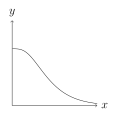
Show that $\mathrm{f}(x)$ has no turning points when $x>0,$ and
sketch $\mathrm{f}(x)$ for $x>0.$
Solution source
\begin{questionparts}
\item Notice that $f(x) = x - \tanh x$ has $f'(x) = 1-\textrm{sech}^2 x =  \tanh^2 x > 0$ so $f(x)$ is strictly increasing on $(0, \infty)$ and $f(0) = 0$ therefore $f(x)$ is positive for all $x$ positive
\item Let $f(x) = x\sinh x-2\cosh x+2$ then $f'(x) = \sinh x +x \cosh x - 2 \sinh x  = x \cosh x -\sinh x = \cosh x ( x - \tanh x) > 0$ by the first part. $f(0) = 0$ so $f(x)$ is positive for all $x$ positive.
\item Let $f(x) = 2x\cosh2x-3\sinh2x+4x$ then
\begin{align*}
f'(x) &= 2\cosh 2x +4x\sinh 2x - 6 \cosh 2x + 4 \\
&= 4( x\sinh 2x-\cosh 2x +1) \\
&= 4(x2\cosh x \sinh x -2\cosh^2x ) \\
&= 8 \cosh^2 x (x - \tanh x)
\end{align*}

Which is always positive when $x$ > 0, $f(0) = 0$ so $f(x) > 0$ for all positive $x$.
\end{questionparts}

Let $f(x) = \frac{x(\cosh x)^{\frac{1}{3}}}{\sinh x}$ then

\begin{align*}
f'(x) &= \frac{(\cosh x)^{\frac13}\sinh x+\frac13 x \cosh^{-\frac23} x \sinh^2 x - x(\cosh x)^{\frac13} \cosh x}{\sinh^2 x} \\
&= \frac{\cosh x \sinh x + \frac13 x \sinh^2 x - x \cosh^2 x}{\cosh x^{\frac23} x \sinh^2 x} \\
&= \frac{3\cosh x \sinh x + x( \sinh^2 x - 3 \cosh^2 x)}{3\cosh x^{\frac23} x \sinh^2 x} \\
&= \frac{\frac32 \sinh 2x + x( -2\cosh 2x - 2)}{3\cosh x^{\frac23} x \sinh^2 x} \\
&= \frac{3 \sinh 2x -4x\cosh 2x - 4x}{6\cosh x^{\frac23} x \sinh^2 x} \\
\end{align*}

which from the earlier part is always negative.

\begin{center}
    \begin{tikzpicture}
        \draw[->] (0,0) -- (0,3);
        \draw[->] (0,0) -- (3,0);

        \node at (3,0) [right] {$x$};
        \node at (0,3) [above] {$y$};

        \draw[domain = 0.01:3, samples=50, variable = \x]  plot ({\x},{2*3*\x*(cosh(3*\x)^(1/3))/sinh(3*\x)});

    \end{tikzpicture}
\end{center}