1988 Paper 1 Q1
Year: 1988
Paper: 1
Question Number: 1
Course: LFM Pure and Mechanics
Section: Exponentials and Logarithms
Difficulty: 1500.0
Banger: 1500.0
curve sketching
logarithms
stationary points
optimisation
number theory
exponentials and logarithms
integer solutions
Problem
Sketch the graph of the function \(\mathrm{h}\), where
\[
\mathrm{h}(x)=\frac{\ln x}{x},\qquad(x>0).
\]
Hence, or otherwise, find all pairs of distinct positive integers
\(m\) and \(n\) which satisfy the equation
\[
n^{m}=m^{n}.
\]
Solution
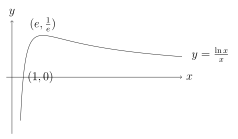
Rating Information
Difficulty Rating: 1500.0
Difficulty Comparisons: 0
Banger Rating: 1500.0
Banger Comparisons: 0
Show LaTeX source
Problem source
Sketch the graph of the function $\mathrm{h}$, where
\[
\mathrm{h}(x)=\frac{\ln x}{x},\qquad(x>0).
\]
Hence, or otherwise, find all pairs of distinct positive integers
$m$ and $n$ which satisfy the equation
\[
n^{m}=m^{n}.
\]
Solution source
\begin{center}
\begin{tikzpicture}[scale=2]
    \draw[->] (-.1, 0) -- (3, 0);
    \draw[->] (0,-1) -- (0,1);

    \node at (3,0) [right] {$x$};
    \node at (0,1) [above] {$y$};
    \node at (3.5,0.2) [above] {$y = \frac{\ln x}{x}$};
    \node at ({exp(1)/5},{2/exp(1)}) [above] {$(e, \frac1{e})$};
    \node at ({1/5},0) [below, right] {$(1,0)$};
    \draw[domain = 0.75:15, samples=180, variable = \x]  plot ({\x/5},{2*ln(\x)/\x});
\end{tikzpicture}
\end{center}

If $n^m = m^n \Rightarrow \frac{\ln m}{m} = \frac{\ln n}{n}$ so if $n < m$ we must have that $n < e \Rightarrow n = 1,2$. $n = 1$ has no solutions, so consider $n = 2$ which obviously has the corresponding solution $m=4$. Since $h(x)$ is decreasing for $x > e$ we know this is the only solution. Hence the only solution for distinct $m,n$ are $(m,n) = (2,4), (4,2)$