1989 Paper 2 Q3
Year: 1989
Paper: 2
Question Number: 3
Course: UFM Pure
Section: Hyperbolic functions
Difficulty: 1600.0
Banger: 1500.0
hyperbolic functions
complex numbers
ellipse
hyperbola
conformal mapping
parametric
orthogonal curves
curve sketching
Problem
The real numbers \(x\) and \(y\) are related to the real numbers \(u\) and \(v\) by
\[
2(u+\mathrm{i}v)=\mathrm{e}^{x+\mathrm{i}y}-\mathrm{e}^{-x-\mathrm{i}y}.
\]
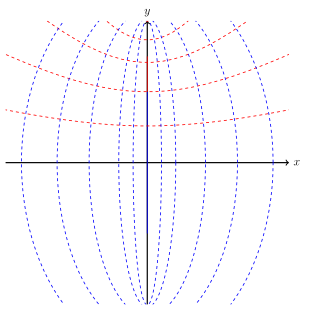
Show that the line in the \(x\)-\(y\) plane given by \(x=a\), where \(a\) is a positive constant, corresponds to the ellipse
\[
\left(\frac{u}{\sinh a}\right)^{2}+\left(\frac{v}{\cosh a}\right)^{2}=1
\]
in the \(u\)-\(v\) plane. Show also that the line given by \(y=b\), where \(b\) is a constant and \(0<\sin b<1,\) corresponds to one branch of a hyperbola in the \(u\)-\(v\) plane. Write down the \(u\) and \(v\) coordinates of one point of intersection of the ellipse and hyperbola branch, and show that the curves intersect at right-angles at this point.
Make a sketch of the \(u\)-\(v\) plane showing the ellipse, the hyperbola branch and the line segments corresponding to:
- \(x=0\);
- \(y=\frac{1}{2}\pi,\) \(\quad 0\leqslant x\leqslant a.\)
Solution
\begin{align*}
&& 2(u+iv) &= e^{a+iy} - e^{-a-iy} \\
&& &=(e^a \cos y - e^{-a} \cos y) + (e^a \sin y + e^{-a} \sin y)i \\
&&&= 2 \sinh a \cos y + 2\cosh a \sin y i\\
\Rightarrow && \frac{u}{\sinh a} &= \cos y \\
&& \frac{v}{\cosh a} &= \sin y \\
\Rightarrow && 1 &= \left(\frac{u}{\sinh a}\right)^{2}+\left(\frac{v}{\cosh a}\right)^{2}
\end{align*}
\begin{align*}
&& 2(u+iv) &= e^{x+ib} - e^{-x-ib} \\
&&&= 2\sinh x \cos b + 2\cosh x \sin b i \\
\Rightarrow && \frac{u}{\cos b} &= \sinh x \\
&& \frac{v}{\sin b} &= \cosh x \\
\Rightarrow && 1 &= \left (\frac{v}{\sin b} \right)^2 - \left (\frac{u}{\cos b} \right)^2
\end{align*}
Therefore all the points lie of a hyperbola, and since \(\frac{v}{\sin b} > 0 \Rightarrow v > 0\) it's one branch of the hyperbola. (And all points on it are reachable as \(x\) varies from \(-\infty < x < \infty\).
\begin{align*}
2(u+iv) &= e^{a+ib} - e^{-a-ib} \\
&= 2 \sinh a \cos b + 2 \cosh a \sin b i
\end{align*}
so we can take \(u = \sinh a \cos b, v = \cosh a \sin b\).
\begin{align*}
\frac{\d }{\d u} && 0 &= \frac{2 u}{\sinh^2 a} + \frac{2v}{\cosh^2 a} \frac{\d v}{\d u} \\
\Rightarrow && \frac{\d v}{\d u} &= -\frac{u}{v} \coth^2 a \\
\\ && \frac{\d v}{\d u} \rvert_{(u,v)} &= -\frac{\sinh a \cos b}{\cosh a \sin b} \coth^2 a \\
&&&= -\cot b \coth a
\\
\frac{\d }{\d u} && 0 &= \frac{2 v}{\sin^2 b} \frac{\d v}{\d u} - \frac{2u}{\cos^2 b} \\
\Rightarrow && \frac{\d v}{\d u} &= \frac{u}{v} \tan^2 b \\
&& \frac{\d v}{\d u} \rvert_{(u,v)} &= \frac{\sinh a \cos b}{\cosh a \sin b} \tan^2 b \\
&&&= \tanh a \tan b
\end{align*}
Therefore they are negative reciprocals and hence perpendicular.
Rating Information
Difficulty Rating: 1600.0
Difficulty Comparisons: 0
Banger Rating: 1500.0
Banger Comparisons: 0
Show LaTeX source
Problem source
The real numbers $x$ and $y$ are related to the real numbers $u$ and $v$ by
	\[
	2(u+\mathrm{i}v)=\mathrm{e}^{x+\mathrm{i}y}-\mathrm{e}^{-x-\mathrm{i}y}.
	\]
	Show that the line in the $x$-$y$ plane given by $x=a$, where $a$ is a positive constant, corresponds to the ellipse
	\[
	\left(\frac{u}{\sinh a}\right)^{2}+\left(\frac{v}{\cosh a}\right)^{2}=1
	\]
	in the $u$-$v$ plane. Show also that the line given by $y=b$, where $b$ is a constant and $0<\sin b<1,$ corresponds to one branch of a hyperbola in the $u$-$v$ plane. Write down the $u$ and $v$ coordinates of one point of intersection of the ellipse and hyperbola branch, and show that the curves intersect at right-angles at this point.
	Make a sketch of the $u$-$v$ plane showing the ellipse, the hyperbola branch and the line segments corresponding to:
\begin{questionparts}
\item $x=0$;
\item $y=\frac{1}{2}\pi,$ $\quad 0\leqslant x\leqslant a.$
\end{questionparts}
Solution source
\begin{align*}
&& 2(u+iv) &= e^{a+iy} - e^{-a-iy} \\
&& &=(e^a \cos y - e^{-a} \cos y) + (e^a \sin y + e^{-a} \sin y)i \\
&&&= 2 \sinh a \cos y + 2\cosh a  \sin y i\\
\Rightarrow && \frac{u}{\sinh a} &= \cos y \\
&& \frac{v}{\cosh a} &= \sin y \\
\Rightarrow && 1 &= \left(\frac{u}{\sinh a}\right)^{2}+\left(\frac{v}{\cosh a}\right)^{2}
\end{align*}

\begin{align*}
&& 2(u+iv) &= e^{x+ib} - e^{-x-ib} \\
&&&= 2\sinh x \cos b + 2\cosh x \sin b i \\
\Rightarrow && \frac{u}{\cos b} &= \sinh x \\
&& \frac{v}{\sin b} &= \cosh x \\
\Rightarrow && 1 &= \left (\frac{v}{\sin b} \right)^2 - \left (\frac{u}{\cos b} \right)^2
\end{align*}

Therefore all the points lie of a hyperbola, and since $\frac{v}{\sin b} > 0 \Rightarrow v > 0$ it's one branch of the hyperbola. (And all points on it are reachable as $x$ varies from $-\infty < x < \infty$.

\begin{align*}
2(u+iv) &= e^{a+ib} - e^{-a-ib} \\
&= 2 \sinh a \cos b + 2 \cosh a \sin b i
\end{align*}

so we can take $u = \sinh a \cos b, v = \cosh a \sin b$.

\begin{align*}
\frac{\d }{\d u} && 0 &= \frac{2 u}{\sinh^2 a} + \frac{2v}{\cosh^2 a} \frac{\d v}{\d u} \\
\Rightarrow && \frac{\d v}{\d u} &= -\frac{u}{v} \coth^2 a \\
\\ && \frac{\d v}{\d u} \rvert_{(u,v)} &= -\frac{\sinh a \cos b}{\cosh a \sin b} \coth^2 a \\
&&&= -\cot b \coth a
\\
\frac{\d }{\d u} && 0 &= \frac{2 v}{\sin^2 b} \frac{\d v}{\d u} - \frac{2u}{\cos^2 b} \\
\Rightarrow && \frac{\d v}{\d u} &= \frac{u}{v} \tan^2 b \\
&& \frac{\d v}{\d u} \rvert_{(u,v)} &= \frac{\sinh a \cos b}{\cosh a \sin b} \tan^2 b \\
&&&= \tanh a \tan b
\end{align*}

Therefore they are negative reciprocals and hence perpendicular.


\begin{center}
    \begin{tikzpicture}
    \def\functionf(#1){2*(#1)*((#1)^2 - 5)/((#1)^2-4)};
    \def\xl{-2};
    \def\xu{2};
    \def\yl{-2};
    \def\yu{2};

    % Calculate scaling factors to make the plot square
    \pgfmathsetmacro{\xrange}{\xu-\xl}
    \pgfmathsetmacro{\yrange}{\yu-\yl}
    \pgfmathsetmacro{\xscale}{10/\xrange}
    \pgfmathsetmacro{\yscale}{10/\yrange}

    % Define the styles for the axes and grid
    \tikzset{
        axis/.style={very thick, ->},
        grid/.style={thin, gray!30},
        x=\xscale cm,
        y=\yscale cm
    }


    % Set up axes
    \draw[axis] (\xl,0) -- (\xu,0) node[right] {$x$};
    \draw[axis] (0,\yl) -- (0,\yu) node[above] {$y$};

    % Define the bounding region with clip
    \begin{scope}
        % You can modify these values to change your plotting region
        \clip (\xl,\yl) rectangle (\xu,\yu);

        % Draw a grid (optional)
        % \draw[grid] (-5,-3) grid (5,3);

        \draw[thick, blue, smooth] (0,-1) -- (0, 1);
        \draw[thick, red, smooth] (0,1) -- (0, 1.5);

         \foreach \i in {15, 30, 45, 60, 85} {
            \draw[thick, red, dashed, domain=-5:5, samples=100]
                plot ({(exp(\x)-exp(-\x) )* cos(\i)},{(exp(\x)+exp(-\x))*sin(\i)});
            }
        \foreach \i in {.1, .2, .4, .6, .8} {
            \draw[thick, blue, dashed, domain=0:360, samples=100]
                plot ({(exp(\i)-exp(-\i) )* cos(\x)},{(exp(\i)+exp(-\i))*sin(\x)});
            }
    \end{scope}


    \end{tikzpicture}
\end{center}