Problems
Filters
219 problems found
1991 Paper 1 Q2
Frosty the snowman is made from two uniform spherical snowballs, of initial radii \(2R\) and \(3R.\) The smaller (which is his head) stands on top of the larger. As each snowball melts, its volume decreases at a rate which is directly proportional to its surface area, the constant of proportionality being the same for both snowballs. During melting each snowball remains spherical and uniform. When Frosty is half his initial height, find the ratio of his volume to his initial volume. If \(V\) and \(S\) denote his total volume and surface area respectively, find the maximum value of \(\dfrac{\mathrm{d}V}{\mathrm{d}S}\) up to the moment when his head disappears.
Solution: \(V_h = \frac43 \pi r_h^3, S_h = 4 \pi r_h^2\) \(\frac{\d V_h}{\d t} = -k4\pi r_h^2 \Rightarrow 4\pi r_h^2 \frac{\d r_h}{\d t} = -k 4\pi r_h^2 \Rightarrow \frac{\d r_h}{\d t} = -k\) Therefore \(r_h = 2R - kt, r_b = 3R - kt\). The height will halve when \(2kt = \frac{5}{2}R \Rightarrow kt = \frac{5}{4}R\) and the two sections will have radii \(\frac{3}{4}R\) and \(\frac{7}{4}R\) and the ratio of the volumes will be: \begin{align*} \frac{\frac{3^3}{4^3}+\frac{7^3}{4^3}}{2^3+3^3} = \frac{37}{224} \end{align*} \begin{align*} && \frac{\d V}{\d t} &= -4\pi k(r_h^2+r_b^2) \\ && \frac{\d S}{\d t} &= -8\pi k (r_h+r_b) \\ \Rightarrow && \frac{\d V}{\d S} &= \frac{r_h^2 + r_b^2}{2(r_h+r_b)} \\ &&&= \frac{(2R-kt)^2+(3R-kt)^2}{2(5R-2kt)} \\ &&&= \frac{13R^2-10Rkt+2k^2t^2}{2(5R-2kt)} \\ &&&= \frac{13R^2-10Rs + 2s^2}{2(5R-2s)} \end{align*} Where \(s = kt\) and \(0 \leq s \leq 2R\). We can maximise this but differentiating wrt to \(s\). \begin{align*} \Rightarrow && &= \frac{(-10R+4s)(10R-4s)+4(13R^2-10Rs+2s^2)}{4(5R-2s)^2} \\ &&&= \frac{-48R^2+40Rs-8s^2}{4(5R-2s)^2} \\ &&&= \frac{-8(s-2R)(s-3R)}{4(5R-2s)^2} \\ &&&<0 \end{align*} Therefore it is largest when \(s = 0\), ie \(\frac{13R^2}{10R} = \frac{13}{10}R\)
1991 Paper 1 Q4
\(\ \)
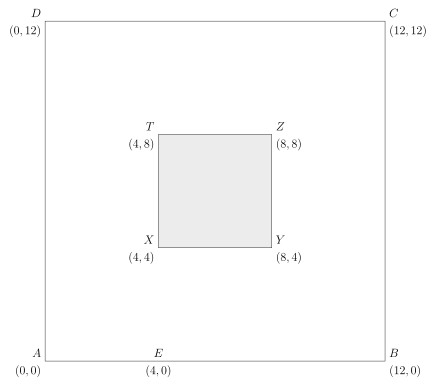
- as small as possible,
- as large as possible.
Solution:
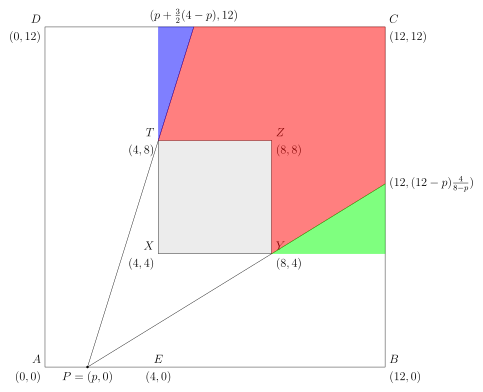
- Since the area not visible is increasing as \(p\) increases, we would like \(p\) to be as large as possible, ie \(p = 4\).
- Similarly, he can see the most when \(p =0\)
1991 Paper 1 Q12
\(\ \)\vspace{-1.5cm} \noindent
1991 Paper 2 Q1
Let \(\mathrm{h}(x)=ax^{2}+bx+c,\) where \(a,b\) and \(c\) are constants, and \(a\neq0\). Give a condition which \(a,b\) and \(c\) must satisfy in order that \(\mathrm{h}(x)\) can be written in the form \[ a(x+k)^{2},\tag{*} \] where \(k\) is a constant. If \(\mathrm{f}(x)=3x^{2}+4x\) and \(\mathrm{g}(x)=x^{2}-2\), find the two constant values of \(\lambda\) such that \(\mathrm{f}(x)+\lambda\mathrm{g}(x)\) can be written in the form \((*)\). Hence, or otherwise, find constants \(A,B,C,D,m\) and \(n\) such that \begin{alignat*}{1} \mathrm{f}(x) & =A(x+m)^{2}+B(x+n)^{2}\\ \mathrm{g}(x) & =C(x+m)^{2}+D(x+n)^{2}. \end{alignat*} If \(\mathrm{f}(x)=3x^{2}+4x\) and \(\mathrm{g}(x)=x^{2}+\alpha\) and it is given by that there is only one value of \(\lambda\) for which \(\mathrm{f}(x)+\lambda\mathrm{g}(x)\) can be written in the form \((*)\), find \(\alpha\).
Solution: For \(h(x)\) to be written in this form \(b^2=4ac\). Suppose \(f(x) = 3x^2+4x\), \(g(x) = x^2-2\). then, \begin{align*} && f(x) + \lambda g(x) &= (3+\lambda)x^2+4x - 2 \lambda \\ \Rightarrow && 0 &= 16 + 8(3+\lambda) \lambda \\ \Rightarrow && 0 &= 2+ 3 \lambda + \lambda^2 \\ &&&= (\lambda +1)(\lambda + 2) \\ \Rightarrow && \lambda &= -1 , -2 \\ \end{align*} \begin{align*} && f(x) - g(x) &= 2(x+1)^2 \\ && f(x) -2g(x) &= (x+2)^2 \\ \Rightarrow && g(x) &= 2(x+1)^2 - (x+2)^2 \\ && f(x) &= 4(x+1)^2 - (x+2)^2 \end{align*} Suppose \(f(x) = 3x^2+4x, g(x) = x^2 + \alpha\), then \begin{align*} && f(x) + \lambda g(x) &= (3+\lambda)x^2+4x+\lambda \alpha \\ \Rightarrow && 0 &= 16 -2\lambda \alpha(\lambda + 3) \\ && 0 &= \alpha \lambda^2 +3\lambda-8 \\ \Rightarrow && 0 &= 9 +32 \alpha \\ \Rightarrow && \alpha &= -\frac{9}{32} \end{align*}
1991 Paper 2 Q11
The Ruritanian army is supplied with shells which may explode at any time in flight but not before the shell reaches its maximum height. The effect of the explosion on any observer depends only on the distance between the exploding shell and the observer (and decreases with distance). Ruritanian guns fire the shells with fixed muzzle speed, and it is the policy of the gunners to fire the shell at an angle of elevation which minimises the possible damages to themselves (assuming the ground is level) - i.e. they aim so that the point on the descending trajectory that is nearest to them is as far away as possible. With that intention, they choose the angle of elevation that minimises the damage to themselves if the shell explodes at its maximum height. What angle do they choose? Does the shell then get any nearer to the gunners during its descent?
1991 Paper 2 Q16
Each time it rains over the Cabbibo dam, a volume \(V\) of water is deposited, almost instanetaneously, in the reservoir. Each day (midnight to midnight) water flows from the reservoir at a constant rate \(u\) units of volume per day. An engineer, if present, may choose to alter the value of \(u\) at any midnight.
- Suppose that it rains at most once in any day, that there is a probability \(p\) that it will rain on any given day and that, if it does, the rain is equally likely to fall at any time in the 24 hours (i.e. the time at which the rain falls is a random variable uniform on the interval \([0,24]\)). The engineers decides to take two days' holiday starting at midnight. If at this time the volume of water in the reservoir is \(V\) below the top of the dam, find an expression for \(u\) such that the probability of overflow in the two days is \(Q\), where \(Q < p^{2}.\)
- For the engineer's summer holidays, which last 18 days, the reservoir is drained to a volume \(kV\) below the top of the dam and the rate of outflow \(u\) is set to zero. The engineer wants to drain off as little as possible, consistent with the requirement that the probability that the dam will overflow is less than \(\frac{1}{10}.\) In the case \(p=\frac{1}{3},\) find by means of a suitable approximation the required value of \(k\).
- Suppose instead that it may rain at most once before noon and at most once after noon each day, that the probability of rain in any given half-day is \(\frac{1}{6}\) and that it is equally likely to rain at any time in each half-day. Is the required value of \(k\) lower or higher?
Solution:
- It cannot overflow on the first day, since it is already \(V\) below the top. The only way it can overflow is if it rains both days. This will occur with probability \(p^2\). The probability it overflows therefore is the probability that bad timing hampers us, ie \(V - u(1+t_2) > 0\) where \(t_2\) is the timing of the rain on day 2 (as a fraction of a day). Ie \(t_2 < \frac{V}{u}-1\). Therefore \begin{align*} && Q &= p^2 \left (\frac{V}{u} - 1 \right) \\ \Rightarrow && u &= \frac{Vp^2}{p^2+Q} \end{align*}
- The probability the reservoir overflows during this \(18\) days is \(\mathbb{P}(\text{rains more than }k\text{ times})\). The number of times it rains (\(X\)) is \(B(18, \tfrac13)\), since \(18 \cdot \tfrac13 = 6 > 5\) a normal approximation is reasonable, ie \(X \approx N(6, 4)\). We wish to find \(k\) such that \(\mathbb{P}( X > k + 0.5) < \tfrac1{10}\) therefore \(k \approx 1.28 \cdot 2 + 6 - 0.5 \approx 8.1\) so they should set \(k\) to \(9\)
- In this case we have \(B(36, \tfrac16)\) approximated by \(B(6, 5)\) which has a larger standard deviation, therefore we need to choose a larger value for \(k\). [It turns out to actually be the same, but there's no reason to be able to expect students without a calculator to establish this]
1991 Paper 3 Q13
A smooth particle \(P_{1}\) is projected from a point \(O\) on the horizontal floor of a room with has a horizontal ceiling at a height \(h\) above the floor. The speed of projection is \(\sqrt{8gh}\) and the direction of projection makes an acute angle \(\alpha\) with the horizontal. The particle strikes the ceiling and rebounds, the impact being perfectly elastic. Show that for this to happen \(\alpha\) must be at least \(\frac{1}{6}\pi\) and that the range on the floor is then \[ 8h\cos\alpha\left(2\sin\alpha-\sqrt{4\sin^{2}\alpha-1}\right). \] Another particle \(P_{2}\) is projected from \(O\) with the same velocity as \(P_{1}\) but its impact with the ceiling is perfectly inelastic. Find the difference \(D\) between the ranges of \(P_{1}\) and \(P_{2}\) on the floor and show that, as \(\alpha\) varies, \(D\) has a maximum value when \(\alpha=\frac{1}{4}\pi.\)
1990 Paper 1 Q1
\(\,\)
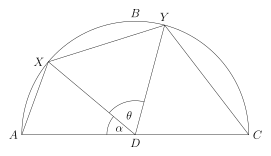
Solution: The area for \(\alpha\) fixed is \(\frac12 r^2 \sin \alpha + \frac12 r^2 \sin \theta + \frac12 r^2 \sin (\pi - \theta - \alpha)\) So we wish to maximise \(V = \sin \theta + \sin(\pi - \theta-\alpha)\) \begin{align*} && V &= \sin \theta + \sin(\pi - \theta-\alpha)\\ &&&= 2\sin \l \frac{\pi-\alpha}2\r\cos \l \frac{2\theta + \alpha - \pi}{2}\r \end{align*} The largest \(\cos\) can be is \(1\) when \(\displaystyle 2\theta + \alpha - \pi = 0 \Rightarrow \theta = \frac{\pi-\alpha}2\). (ie we split the remaining area exactly in half). We are now trying to maximise \(W = \sin \alpha + 2 \sin \frac{\pi - \alpha}2\) ie \begin{align*} && W &= \sin \alpha + 2 \cos \frac{\alpha}{2} \\ \Rightarrow && \frac{\d W}{\d \alpha} &= \cos \alpha-\sin \frac{\alpha}{2} \\ &&&= 1-2 \sin^2 \frac{\alpha}{2} - \sin \frac{\alpha}{2} \\ &&&= (1+\sin \frac{\alpha}{2})(1-2\sin \frac{\alpha}{2}) \end{align*} Therefore \(\frac{\alpha}{2} = -\frac{3\pi}{2}, \frac{\alpha}{2} = \frac{\pi}{6}, \frac{5\pi}{6} \Rightarrow \alpha = -3\pi, \frac{\pi}{3}, \frac{5\pi}{3}\). The only turning point in our range is \(\frac{\pi}{3}\). This is obvious a a maximum by symmetry or checking the end points, but we could also check the second derivative \(\frac{\d^2 W}{\d \alpha^2} = -\sin \frac{\pi}{3}-\cos \frac{\pi}{3} < 0\) so we have a maximum. Therefore the largest possible area is: \(\displaystyle \frac{3\sqrt{3}}{4}r^2\)
1990 Paper 1 Q9
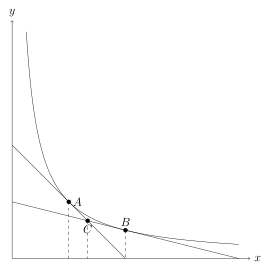
Let \(A\) and \(B\) be the points \((1,1)\) and \((b,1/b)\) respectively, where \(b>1\). The tangents at \(A\) and \(B\) to the curve \(y=1/x\) intersect at \(C\). Find the coordinates of \(C\). Let \(A',B'\) and \(C'\) denote the projections of \(A,B\) and \(C\), respectively, to the \(x\)-axis. Obtain an expression for the sum of the areas of the quadrilaterals \(ACC'A'\) and \(CBB'C'\). Hence or otherwise prove that, for \(z>0\), \[ \frac{2z}{2+z}\leqslant\ln\left(1+z\right)\leqslant z. \]
Solution:
1990 Paper 1 Q10
In a certain race, runners run 5\(\,\)km in a straight line to a fixed point and then turn and run back to the starting point. A steady wind of 3\(\,\text{ms}^{-1}\) is blowing from the start to the turning point. At steady racing pace, a certain runner expends energy at a constant rate of 300\(\,\)W. Two resistive forces act. One is of constant magnitude \(50\,\text{N}\). The other, arising from air resistance, is of magnitude \(2w\,\mathrm{N}\), where \(w\,\text{ms}^{-1}\) is the runner's speed relative to the air. Give a careful argument to derive formulae from which the runner's steady speed in each half of the race may be found. Calculate, to the nearest second, the time the runner will take for the whole race. \textit{Effects due to acceleration and deceleration at the start and turn may be ignored.} The runner may use alternative tactics, expending the same total energy during the race as a whole, but applying different constant powers, \(x_{1}\,\)W in the outward trip, and \(x_{2}\,\)W on the return trip. Prove that, with the wind as above, if the outward and return speeds are \(v_{1}\,\)ms\(^{-1}\) and \(v_{2}\,\)ms\(^{-1}\) respectively, then \(v_{1}+v_{2}\) is independent of the choices for \(x_{1}\) and \(x_{2}\). Hence show that these alternative tactics allow the runner to run the whole race approximately 15 seconds faster.
Solution: Note that \(P = Fv\). Since he is running at a steady pace, we can say that \(F\) must be equal to the resistive forces (as net force is \(0\)). Therefore \(F = 50 + 2(v+3)\) on the way out. ie, \(300 = (2v + 56)v \Rightarrow 150 = v^2 + 28v \Rightarrow v = \sqrt{346}-14\) On the way back, \(F = 50 + 2(v-3)\), ie \(300 = (2v+44)v \Rightarrow 150 = v^2 +22v \Rightarrow v = \sqrt{271}-11\) Therefore the total time will be \(\frac{5000}{\sqrt{346}-150} + \frac{5000}{\sqrt{271}-11} \approx 2002\), or 33 minutes, 22 seconds. Very respectable! The total energy in this first run is \(E = Pt = 2002 \cdot 300\). Now suppose we apply two different powers as in the question, then we must have: \begin{align*} && x_1 &= 2v_1^2 + 56v_1 \\ && x_2 &= 2v_2^2 + 44v_2 \\ && E &= x_1 \frac{5000}{v_1} + x_2 \frac{5000}{v_2} \\ &&&= 5000 \left ( \frac{x_1}{v_1} + \frac{x_2}{v_2} \right) \\ \Rightarrow && \frac{x_1}{v_1} &= 2v_1 + 56 \\ && \frac{x_2}{v_2} &= 2v_2 + 44 \\ \Rightarrow && \frac{E}{5000} &= 2(v_1+v_2) + 100 \\ \Rightarrow && v_1+v_2 &\text{ is independent of the choices for }x_i \end{align*} We wish to minimize \begin{align*} && \frac{5000}{v_1} + \frac{5000}{v_2} &\underbrace{\geq}_{AM-HM} 10\,000 \cdot \frac{2}{v_1+v_2} \\ &&&= 10\,000 \cdot \frac{2}{\sqrt{346}-14+\sqrt{271}-11} \\ &&&\approx 1987 \end{align*} ie they can go 15 seconds quicker with better strategy.
1990 Paper 1 Q12
\(\,\)
Solution:
1990 Paper 1 Q14
A bag contains 5 white balls, 3 red balls and 2 black balls. In the game of Blackball, a player draws a ball at random from the bag, looks at it and replaces it. If he has drawn a white ball, he scores one point, while for a red ball he scores two points, these scores being added to his total score before he drew the ball. If he has drawn a black ball, the game is over and his final score is zero. After drawing a red or white ball, he can either decide to stop, when his final score for the game is the total so far, or he may elect to draw another ball. The starting score is zero. Juggins' strategy is to continue drawing until either he draws a black ball (when of course he must stop, with final score zero), or until he has drawn three (non-black) balls, when he elects to stop. Find the probability that in any game he achieves a final score of zero by employing this strategy. Find also his expected final score. Muggins has so far scored \(N\) points, and is deciding whether to draw another ball. Find the expected score if another ball is drawn, and suggest a strategy to achieve the greatest possible average final score in each game.
Solution: The probability Juggin's has a non-zero score is the probability he never draws a black ball in his three goes. This is \((1-\frac15)^3 = \frac{64}{125}\). Let's consider the \(\frac{61}{125}\) probability world where he never draws a black ball. In this conditional probability space, he has \(\frac{5}{8}\) chances of pulling out white balls and \(\frac38\) or pulling out red. His expected score per pull is \(\frac58 \cdot 1 + \frac38 \cdot 2 = \frac{11}{8}\). Therefore his expected score in this universe is \(\frac{33}8\) and his expected score is \(\frac{33}{8} \cdot \frac{61}{125} = \frac{2013}{1000} = 2.013\) . The expected score after drawing another ball is \(( N + 1)\frac{5}{10} + (N+2) \frac{3}{10} + 0 \cdot \frac{2}{10} = \frac{8}{10}N + \frac{11}{10}\). A sensible strategy would be to only draw if \(\frac{8}{10}N + \frac{11}{10} > N \Rightarrow N < \frac{11}{2}\), ie keep drawing until \(N \geq 6\) or we bust out. [The expected score for this strategy is: \begin{array}{ccc} \text{score} & \text{route} & \text{count} & \text{prob} \\ \hline 6 & \text{6 1s} & 1 & \left ( \frac12 \right)^6 \\ 6 & \text{4 1s, 1 2} & 5 & 5 \cdot \left ( \frac12 \right)^4 \cdot \frac{3}{10} \\ 6 & \text{2 1s, 2 2s} & 6 & 6 \cdot \left ( \frac12 \right)^2 \cdot \left ( \frac{3}{10} \right)^2 \\ 6 & \text{3 2s} & 1 & 1 \cdot \left ( \frac{3}{10} \right)^3 \\ 7 & \text{5 1s, 1 2} & 1 &\left ( \frac12 \right)^5 \cdot \frac{3}{10} \\ 7 & \text{3 1s, 2 2s} & 4 & 4\cdot \left ( \frac12 \right)^3 \cdot \left ( \frac{3}{10} \right)^2 \\ 7 & \text{1 1, 3 2s} & 3 & 3\cdot \left ( \frac12 \right) \cdot \left ( \frac{3}{10} \right)^3 \\ \end{array} For an expected value of \(\frac{2171}{8000} \cdot 6 + \frac{759}{8000} \cdot 7 = \frac{18\,339}{8000} = 2.29 \quad (3\text{ s.f.})\)]
1990 Paper 3 Q2
The distinct points \(O\,(0,0,0),\) \(A\,(a^{3},a^{2},a),\) \(B\,(b^{3},b^{2},b)\) and \(C\,(c^{3},c^{2},c)\) lie in 3-dimensional space.
- Prove that the lines \(OA\) and \(BC\) do not intersect.
- Given that \(a\) and \(b\) can vary with \(ab=1,\) show that \(\angle AOB\) can take any value in the interval \(0<\angle AOB<\frac{1}{2}\pi\), but no others.
Solution:
- The line \(OA\) is \(\lambda \begin{pmatrix} a^3 \\ a^2 \\ a \end{pmatrix}\). The line \(BC\) is \(\begin{pmatrix} b^3 \\ b^2 \\ b \end{pmatrix} + \mu \begin{pmatrix} c^3-b^3 \\ c^2-b^2 \\ c-b \end{pmatrix}\). If these lies are concurrent then there would be \(\mu\) and \(\lambda\) such that they are equal, and in particular, \begin{align*} && \frac{b^2 + \mu(c^2-b^2)}{b + \mu (c-b)} &= \frac{b^3 + \mu(c^3-b^3)}{b^2 + \mu (c^2-b^2)} \\ \Leftrightarrow && (b^2 + \mu(c^2-b^2))^2 &= (b+\mu(c-b))(b^3+\mu(c^3-b^3)) \\ && b^4 +2\mu b^2 (c^2-b^2) + \mu^2 (c^2-b^2) &= b^4 + \mu(c-b)b^3 + \mu b(c^3-b^3) + \mu^2 (c-b)(c^3-b^3) \\ \Leftrightarrow && 2\mu b^2 (c+b) + \mu^2(c-b)(c+b)^2 &= \mu (b^3 + b(c^2+bc+b^2)) + \mu^2 (c^3-b^3) \\ && \mu = 0 & \Rightarrow a = b \\ \Leftrightarrow && b^2c - bc^2 &= \mu (c^3-b^3-(c-b)(c+b)^2) \\ \Leftrightarrow && bc(b-c) &= \mu (c-b)(c^2+bc+b^2-c^2-2bc-b^2) \\ \Leftrightarrow && bc &= \mu (bc) \\ \Leftrightarrow && \mu &= 1 \\ && \mu = -1 & \Rightarrow a = c \end{align*} Therefore there are no solutions.
- \begin{align*} \cos \angle AOB &= \frac{ab+a^2b^2+a^3b^3}{\sqrt{a^2+a^4+a^6}\sqrt{b^2+b^4+b^6}} \\ &= \frac{3}{\sqrt{1 + a^2 + a^4} \sqrt{1 + b^2 + b^4}} \\ &> 0 \end{align*} Therefore the angle satisfies \(\angle AOB < \tfrac12 \pi\). We cannot achieve \(0\), since that would require \(a = b = 1\), therefore it falls in the range \(0 < \angle AOB < \tfrac12 \pi\)
1990 Paper 3 Q13
A particle \(P\) is projected, from the lowest point, along the smooth inside surface of a fixed sphere with centre \(O\). It leaves the surface when \(OP\) makes an angle \(\theta\) with the upward vertical. Find the smallest angle that must be exceeded by \(\theta\) to ensure that \(P\) will strike the surface below the level of \(O\). You may find it helpful to find the time at which the particle strikes the sphere.
Solution:

1989 Paper 1 Q3
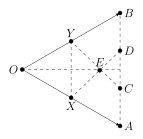
In the triangle \(OAB,\) \(\overrightarrow{OA}=\mathbf{a},\) \(\overrightarrow{OB}=\mathbf{b}\) and \(OA=OB=1\). Points \(C\) and \(D\) trisect \(AB\) (i.e. \(AC=CD=DB=\frac{1}{3}AB\)). \(X\) and \(Y\) lie on the line-segments \(OA\) and \(OB\) respectively, in such a way that \(CY\) and \(DX\) are perpendicular, and \(OX+OY=1\). Denoting \(OX\) by \(x\), obtain a condition relating \(x\) and \(\mathbf{a\cdot b}\), and prove that \[ \frac{8}{17}\leqslant\mathbf{a\cdot b}\leqslant1. \] If the angle \(AOB\) is as large as possible, determine the distance \(OE,\) where \(E\) is the point of intersection of \(CY\) and \(DX\).
Solution: