1991 Paper 1 Q4
Year: 1991
Paper: 1
Question Number: 4
Course: LFM Pure
Section: Differentiation
Difficulty: 1500.0
Banger: 1500.0
Problem
\(\ \)
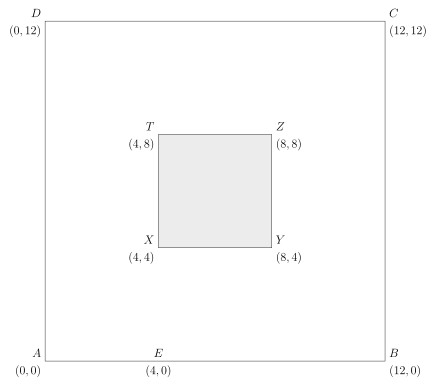 The above diagram is a plan of a prison compound. The outer square \(ABCD\) represents the walls of the compound (whose height may be neglected), while the inner square \(XYZT\) is the Black Tower, a solid stone structure. A guard patrols along segment \(AE\) of the walls, for a distance of up to 4 units from \(A\). Determine the distance from \(A\) of points at which the area of the courtyard that he can see is
- as small as possible,
- as large as possible.
Solution
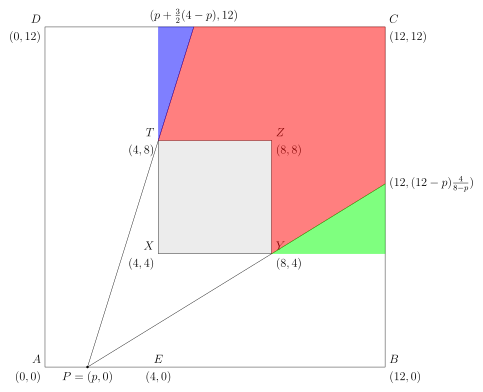
- Since the area not visible is increasing as \(p\) increases, we would like \(p\) to be as large as possible, ie \(p = 4\).
- Similarly, he can see the most when \(p =0\)
Rating Information
Difficulty Rating: 1500.0
Difficulty Comparisons: 0
Banger Rating: 1500.0
Banger Comparisons: 0
Show LaTeX source
Problem source
$\ $
 \begin{center}
\begin{tikzpicture}[scale=1]
    % Shaded area with lightgray fill
    \fill[color=lightgray, opacity=0.3] (4,4) rectangle (8,8);

    % Square ABCD
    \draw (0,0) rectangle (12,12);

    % Inner square TXYZ
    \draw (4,4) rectangle (8,8);

    % Labels for corners of outer square
    \node[above left] at (0,12) {$D$};
    \node[above left] at (0,0) {$A$};
    \node[above right] at (12,0) {$B$};
    \node[above right] at (12,12) {$C$};
    \node[above] at (4,0) {$E$};

    % Coordinates labels
    \node[below left] at (0,0) {$(0,0)$};
    \node[below right] at (12,0) {$(12,0)$};
    \node[below] at (4,0) {$(4,0)$};
    \node[below left] at (0,12) {$(0,12)$};
    \node[below right] at (12,12) {$(12,12)$};

    % Inner square labels
    \node[above left] at (4,4) {$X$};
    \node[above right] at (8,4) {$Y$};
    \node[above left] at (4,8) {$T$};
    \node[above right] at (8,8) {$Z$};

    % Inner coordinates labels
    \node[below left] at (4,4) {$(4,4)$};
    \node[below right] at (8,4) {$(8,4)$};
    \node[below right] at (8,8) {$(8,8)$};
    \node[below left] at (4,8) {$(4,8)$};
\end{tikzpicture}\end{center}
The above diagram is a plan of a prison compound. The outer square $ABCD$ represents the walls of the compound (whose height may be neglected), while the inner square $XYZT$ is the Black Tower, a solid stone structure. A guard patrols along segment $AE$ of the walls, for a distance of up to 4 units from $A$. Determine the distance from $A$ of points at which the area of the courtyard that he can see is
\begin{questionparts}
\item  as small as possible,
\item as large as possible.
\end{questionparts}
[$\textbf{Hint. }$It is suggested that you express the area he \textit{cannot
}see in terms of $p$, his distance from $A$.]
Solution source
 \begin{center}
\begin{tikzpicture}[scale=1]
    % Shaded area with lightgray fill
    \fill[color=lightgray, opacity=0.3] (4,4) rectangle (8,8);

    % Square ABCD
    \draw (0,0) rectangle (12,12);

    % Inner square TXYZ
    \draw (4,4) rectangle (8,8);

    \coordinate (P) at (1.5, 0);

    % Labels for corners of outer square
    \node[above left] at (0,12) {$D$};
    \node[above left] at (0,0) {$A$};
    \node[above right] at (12,0) {$B$};
    \node[above right] at (12,12) {$C$};
    \node[above] at (4,0) {$E$};

    % Coordinates labels
    \node[below left] at (0,0) {$(0,0)$};
    \node[below right] at (12,0) {$(12,0)$};
    \node[below] at (4,0) {$(4,0)$};
    \node[below left] at (0,12) {$(0,12)$};
    \node[below right] at (12,12) {$(12,12)$};

    % Inner square labels
    \node[above left] at (4,4) {$X$};
    \node[above right] at (8,4) {$Y$};
    \node[above left] at (4,8) {$T$};
    \node[above right] at (8,8) {$Z$};

    % Inner coordinates labels
    \node[below left] at (4,4) {$(4,4)$};
    \node[below right] at (8,4) {$(8,4)$};
    \node[below right] at (8,8) {$(8,8)$};
    \node[below left] at (4,8) {$(4,8)$};


    \filldraw (P) circle (1pt) node [below] {$P = (p,0)$};

    \draw (P) -- (4,8) -- ({1.5+3/2*2.5}, 12);

    \node[above] at ({1.5+3/2*2.5}, 12) {$(p+\tfrac32(4-p),12)$};
    \node[right] at (12,{(12-1.5)*4/(8-1.5)}) {$(12,(12-p) \frac{4}{8-p})$};

    \draw (P) -- (8,4)-- (12,{(12-1.5)*4/(8-1.5)});

    \filldraw[red, opacity=0.5] (12,{(12-1.5)*4/(8-1.5)}) -- (8,4) -- (8,8) -- (4,8) -- ({1.5+3/2*2.5}, 12) -- (12,12) -- cycle;

    \filldraw[blue, opacity=0.5] (4,8) -- (4,12) -- ({1.5+3/2*2.5}, 12) -- cycle;
    \filldraw[green, opacity=0.5] (8,4) -- (12,4) -- (12,{(12-1.5)*4/(8-1.5)}) -- cycle;


\end{tikzpicture}\end{center}

The area he cannot see is
\begin{align*}
&&A &=  \underbrace{8^2}_{\text{everywhere above}(4,4)} - \underbrace{4^2}_{\text{inner square}} - \underbrace{\frac12 \cdot 4 \cdot (\frac32(4-p)+p - 4)}_{\text{blue triangle}} - \underbrace{\frac12 \cdot 4 \cdot \frac{4(12-p)}{8-p}}_{\text{green triangle}} \\
&&&= 48 - 3(4-p)-2(p-4) - \frac{8(12-p)}{8-p} \\
&&&= 36-5p-\frac{32}{8-p} \\
\\
\Rightarrow && \frac{\d A}{\d p} &= -5 + \frac{32}{(8-p)^2} \\
&&&> 0 \text{ if } 0 \leq p \leq 4
\end{align*}

\begin{questionparts}
\item Since the area not visible is increasing as $p$ increases, we would like $p$ to be as large as possible, ie $p = 4$.
\item Similarly, he can see the most when $p =0$
\end{questionparts}