1990 Paper 1 Q1
Year: 1990
Paper: 1
Question Number: 1
Course: LFM Pure
Section: Trigonometry 2
Difficulty: 1500.0
Banger: 1500.0
trigonometry
optimisation
area
semicircle
angle in semicircle
double angle formula
quadrilateral
maximisation
Problem
\(\,\)
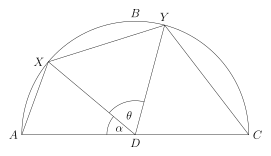 In the above diagram, \(ABCD\) represents a semicircular window of fixed radius \(r\) and centre \(D\), and \(AXYC\) is a quadrilateral blind. If \(\angle XDY=\alpha\) is fixed and \(\angle ADX=\theta\) is
variable, determine the value of \(\theta\) which gives the blind \(maximum\) area.
If now \(\alpha\) is allowed to vary but \(r\) remains fixed, find the maximum possible area of the blind.
In the above diagram, \(ABCD\) represents a semicircular window of fixed radius \(r\) and centre \(D\), and \(AXYC\) is a quadrilateral blind. If \(\angle XDY=\alpha\) is fixed and \(\angle ADX=\theta\) is
variable, determine the value of \(\theta\) which gives the blind \(maximum\) area.
If now \(\alpha\) is allowed to vary but \(r\) remains fixed, find the maximum possible area of the blind.
Solution
The area for \(\alpha\) fixed is \(\frac12 r^2 \sin \alpha + \frac12 r^2 \sin \theta + \frac12 r^2 \sin (\pi - \theta - \alpha)\)
So we wish to maximise \(V = \sin \theta + \sin(\pi - \theta-\alpha)\)
\begin{align*}
&& V &= \sin \theta + \sin(\pi - \theta-\alpha)\\
&&&= 2\sin \l \frac{\pi-\alpha}2\r\cos \l \frac{2\theta + \alpha - \pi}{2}\r
\end{align*}
The largest \(\cos\) can be is \(1\) when \(\displaystyle 2\theta + \alpha - \pi = 0 \Rightarrow \theta = \frac{\pi-\alpha}2\). (ie we split the remaining area exactly in half).
We are now trying to maximise \(W = \sin \alpha + 2 \sin \frac{\pi - \alpha}2\) ie
\begin{align*}
&& W &= \sin \alpha + 2 \cos \frac{\alpha}{2} \\
\Rightarrow && \frac{\d W}{\d \alpha} &= \cos \alpha-\sin \frac{\alpha}{2} \\
&&&= 1-2 \sin^2 \frac{\alpha}{2} - \sin \frac{\alpha}{2} \\
&&&= (1+\sin \frac{\alpha}{2})(1-2\sin \frac{\alpha}{2})
\end{align*}
Therefore \(\frac{\alpha}{2} = -\frac{3\pi}{2}, \frac{\alpha}{2} = \frac{\pi}{6}, \frac{5\pi}{6} \Rightarrow \alpha = -3\pi, \frac{\pi}{3}, \frac{5\pi}{3}\). The only turning point in our range is \(\frac{\pi}{3}\). This is obvious a a maximum by symmetry or checking the end points, but we could also check the second derivative \(\frac{\d^2 W}{\d \alpha^2} = -\sin \frac{\pi}{3}-\cos \frac{\pi}{3} < 0\) so we have a maximum.
Therefore the largest possible area is: \(\displaystyle \frac{3\sqrt{3}}{4}r^2\)
Rating Information
Difficulty Rating: 1500.0
Difficulty Comparisons: 0
Banger Rating: 1500.0
Banger Comparisons: 0
Show LaTeX source
Problem source
$\,$
\begin{center}
\begin{tikzpicture}[scale=2]
    % Semicircle
    \def\r{2};
    \coordinate (D) at (0,0);
    \coordinate (A) at (-\r,0);
    \coordinate (B) at (0,\r);
    \coordinate (C) at (\r,0);
    \coordinate (X) at ({\r*cos(140)},{\r*sin(140)});
    \coordinate (Y) at ({\r*cos(75)},{\r*sin(75)});

    \draw (C) arc (0:180:\r);

    % Horizontal line
    \draw (A) -- (X) -- (Y) -- (C) -- (D) -- (Y) -- (X) -- (D) -- (A);

    % Labels
    \pic [draw, angle radius=1cm, "$\alpha$"] {angle = X--D--A};
    \pic [draw, angle radius=1.2cm, "$\theta$"] {angle = Y--D--X};
    \node at (Y) [right, above] {$Y$};
    \node at (X) [left] {$X$};
    \node at (B) [above] {$B$};
    \node at (A) [below, left] {$A$};
    \node at (D) [below] {$D$};
    \node at (C) [below, right] {$C$};
\end{tikzpicture}\end{center}
In the above diagram, $ABCD$ represents a semicircular window of fixed radius $r$ and centre $D$, and $AXYC$ is a quadrilateral blind. If $\angle XDY=\alpha$ is fixed and $\angle ADX=\theta$ is
variable, determine the value of $\theta$ which gives the blind $\textbf{maximum}$ area.
If now $\alpha$ is allowed to vary but $r$ remains fixed, find the maximum possible area of the blind.
Solution source
The area for $\alpha$ fixed is $\frac12 r^2 \sin \alpha + \frac12 r^2 \sin \theta + \frac12 r^2 \sin (\pi - \theta - \alpha)$

So we wish to maximise $V = \sin \theta + \sin(\pi - \theta-\alpha)$

\begin{align*}
&& V &= \sin \theta + \sin(\pi - \theta-\alpha)\\
&&&= 2\sin \l \frac{\pi-\alpha}2\r\cos \l \frac{2\theta + \alpha - \pi}{2}\r
\end{align*}

The largest $\cos$ can be is $1$ when $\displaystyle 2\theta + \alpha - \pi = 0 \Rightarrow \theta = \frac{\pi-\alpha}2$. (ie we split the remaining area exactly in half).

We are now trying to maximise $W = \sin \alpha + 2 \sin \frac{\pi - \alpha}2$ ie

\begin{align*}
&& W &= \sin \alpha + 2 \cos \frac{\alpha}{2} \\
\Rightarrow && \frac{\d W}{\d \alpha} &= \cos \alpha-\sin \frac{\alpha}{2} \\
&&&= 1-2 \sin^2 \frac{\alpha}{2} - \sin \frac{\alpha}{2} \\
&&&= (1+\sin \frac{\alpha}{2})(1-2\sin \frac{\alpha}{2})
\end{align*}

Therefore $\frac{\alpha}{2} = -\frac{3\pi}{2}, \frac{\alpha}{2} = \frac{\pi}{6}, \frac{5\pi}{6} \Rightarrow \alpha = -3\pi, \frac{\pi}{3}, \frac{5\pi}{3}$. The only turning point in our range is $\frac{\pi}{3}$. This is obvious a a maximum by symmetry or checking the end points, but we could also check the second derivative $\frac{\d^2 W}{\d \alpha^2} = -\sin \frac{\pi}{3}-\cos \frac{\pi}{3} < 0$ so we have a maximum.

Therefore the largest possible area is: $\displaystyle \frac{3\sqrt{3}}{4}r^2$