1990 Paper 1 Q12
Year: 1990
Paper: 1
Question Number: 12
Course: UFM Mechanics
Section: Work, energy and Power 2
Difficulty: 1516.0
Banger: 1484.0
energy conservation
elastic spring
Hooke's law
equilibrium
potential energy
modulus of elasticity
trigonometry
optimisation
Problem
\(\,\)
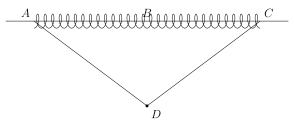 In the above diagram, \(ABC\) represents a light spring of natural length \(2l\) and modulus of elasticity \(\lambda,\) which is coiled round a smooth fixed horizontal rod. \(B\) is the midpoint of \(AC.\)
The two ends of a light inelastic string of length \(2l\) are attached to the spring at \(A\) and \(C\). A particle of mass \(m\) is fixed to the string at \(D\), the midpoint of the string. The system can be in equilibrium with the angle \(CAD\) equal to \(\pi/6.\) Show that
\[
mg=\lambda\left(\frac{2}{\sqrt{3}}-1\right).
\]
Write the length \(AC\) as \(2xl\), obtain an expression for the potential energy of the system as a function of \(x\).
The particle is held at \(B\), and the spring is restored to its natural length \(2l.\) The particle is then released and falls vertically.
Obtain an equation satisfied by \(x\) when the particle next comes to rest. Verify numerically that a possible solution for \(x\) is approximately \(0.66.\)
In the above diagram, \(ABC\) represents a light spring of natural length \(2l\) and modulus of elasticity \(\lambda,\) which is coiled round a smooth fixed horizontal rod. \(B\) is the midpoint of \(AC.\)
The two ends of a light inelastic string of length \(2l\) are attached to the spring at \(A\) and \(C\). A particle of mass \(m\) is fixed to the string at \(D\), the midpoint of the string. The system can be in equilibrium with the angle \(CAD\) equal to \(\pi/6.\) Show that
\[
mg=\lambda\left(\frac{2}{\sqrt{3}}-1\right).
\]
Write the length \(AC\) as \(2xl\), obtain an expression for the potential energy of the system as a function of \(x\).
The particle is held at \(B\), and the spring is restored to its natural length \(2l.\) The particle is then released and falls vertically.
Obtain an equation satisfied by \(x\) when the particle next comes to rest. Verify numerically that a possible solution for \(x\) is approximately \(0.66.\)
Solution
Rating Information
Difficulty Rating: 1516.0
Difficulty Comparisons: 1
Banger Rating: 1484.0
Banger Comparisons: 1
Show LaTeX source
Problem source
$\,$
\begin{center}
\begin{tikzpicture}[scale=1.0]
    % Define coordinates
    \coordinate (A) at (-2, 3);
    \coordinate (B) at (2, 3);
    \coordinate (C) at (6, 3);
    \coordinate (D) at (2, 0);

    % Draw lines
    \draw[line width=0.5pt] (D) -- (C);
    \draw[line width=0.5pt] (A) -- (D);
    \draw[line width=0.5pt] (A) -- (-3, 3);
    \draw[line width=0.5pt] (A) -- (C);
    \draw[line width=0.5pt] (C) -- (7, 3);

    % Draw the coil/spring decoration
    \draw[line width=0.5pt, domain=0:360*30, samples=2000, variable=\t]
        plot ({\t/(360*30)*8 -2 +0.1*sin(\t)}, {3-0.25*cos(\t))});

    % Add labels
    \node[above left] at (A) {$A$};
    \node[above] at (B) {$B$};
    \node[above right] at (C) {$C$};
    \node[below right] at (D) {$D$};

    % Add the filled dot at D
    \fill (D) circle (1.5pt);

\end{tikzpicture}
\end{center}
In the above diagram, $ABC$ represents a light spring of natural length $2l$ and modulus of elasticity $\lambda,$ which is coiled round a smooth fixed horizontal rod. $B$ is the midpoint of $AC.$
The two ends of a light inelastic string of length $2l$ are attached to the spring at $A$ and $C$. A particle of mass $m$ is fixed to the string at $D$, the midpoint of the string. The system can be in equilibrium with the angle $CAD$ equal to $\pi/6.$ Show that
\[
mg=\lambda\left(\frac{2}{\sqrt{3}}-1\right).
\]
Write the length $AC$ as $2xl$, obtain an expression for the potential energy of the system as a function of $x$.
The particle is held at $B$, and the spring is restored to its natural length $2l.$ The particle is then released and falls vertically.
Obtain an equation satisfied by $x$ when the particle next comes to rest. Verify numerically that a possible solution for $x$ is approximately $0.66.$
Solution source
\begin{center}
\begin{tikzpicture}[scale=1.0]
    % Define coordinates
    \coordinate (A) at (-2, 3);
    \coordinate (B) at (2, 3);
    \coordinate (C) at (6, 3);
    \coordinate (D) at (2, 0);

    % Draw lines
    \draw[line width=0.5pt] (D) -- (C);
    \draw[line width=0.5pt] (A) -- (D);
    \draw[line width=0.5pt] (A) -- (-3, 3);
    \draw[line width=0.5pt] (A) -- (C);
    \draw[line width=0.5pt] (C) -- (7, 3);


    % Add labels
    \node[above left] at (A) {$A$};
    \node[above] at (B) {$B$};
    \node[above right] at (C) {$C$};
    \node[below right] at (D) {$D$};

    % Add the filled dot at D
    \fill (D) circle (1.5pt);

    \draw[-latex, blue, ultra thick] (D) -- ($(A)!0.7!(D)$) node[left] {$T_1$};
    \draw[-latex, blue, ultra thick] (D) -- ($(C)!0.7!(D)$) node[right] {$T_1$};
    \draw[-latex, blue, ultra thick] (D) -- ++(0,-1.5) node[left] {$mg$};

    \draw[-latex, red, ultra thick] (A) -- ($(A)!0.3!(D)$) node[left] {$T_1$};
    \draw[-latex, red, ultra thick] (A) -- ($(A)!-0.3!(B)$) node[left] {$T_2$};
    \draw[-latex, red, ultra thick] (A) -- ++(0,0.7) node[left] {$N$};

    \draw[-latex, red, ultra thick] (C) -- ($(C)!0.3!(D)$) node[left] {$T_1$};
    \draw[-latex, red, ultra thick] (C) -- ($(C)!-0.3!(B)$) node[left] {$T_2$};
    \draw[-latex, red, ultra thick] (C) -- ++(0,0.7) node[left] {$N$};

    \pic [draw, angle radius=0.8cm, "$\pi/6$"] {angle = D--A--C};


\end{tikzpicture}
\end{center}

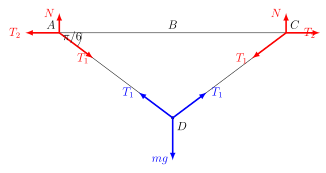
$|AB| = l \cos \tfrac{\pi}{6} = \frac{\sqrt{3}}{2}l$ therefore $|AC| = \sqrt{3}l$ and the compression is $(2l - \sqrt{3}l)$ and so $T_2 = \frac{\lambda}{2l} (2l - \sqrt{3}l) = \frac12\lambda(2- \sqrt{3})$

\begin{align*}
\text{N2}(\rightarrow, A): && T_1 \cos \tfrac{\pi}{6} - T_2 &= 0 \\
\Rightarrow && T_1 &= \frac12 \frac{2\lambda(2-\sqrt{3})}{\sqrt{3}} \\
&&&=  \lambda \left ( \frac{2}{\sqrt{3}} - 1 \right) \\
\\
\text{N2}(\uparrow, D): && 2T_1 \cos \frac{\pi}{3} - mg &= 0 \\
\Rightarrow && mg &= \lambda \left ( \frac{2}{\sqrt{3}} - 1 \right)
\end{align*}

Suppose $|AC| = 2xl$, then:

\begin{array}{c|c}
\text{energy} & \\ \hline
\text{GPE} & -mg \sqrt{l^2 - x^2l^2} \\
\text{EPE} & \frac12 \frac{\lambda (2l - 2lx)^2}{2l} \\
\text{KE} & \frac12 m v^2
\end{array}

Therefore

\[ E = \frac12 mv^2 + \lambda l (1-x)^2-mgl \sqrt{1-x^2}\]

Initially, $E = 0 + 0 + 0 = 0$. When the particle first comes to rest:

\begin{align*}
\text{COE}: && 0 &= E \\
&&&= \lambda l^2 (1-x)^2 - mgl \sqrt{1-x^2} \\
&&&= \lambda l (1-x)^2 - l \lambda \left ( \frac{2}{\sqrt{3}} - 1 \right) \sqrt{1-x^2}  \\
\Rightarrow && (1-x)^2 &= \sqrt{1-x^2} \left ( \frac{2}{\sqrt{3}} - 1 \right) \\
\Rightarrow  && (1-x)^2(1-x^2)^{-1/2} &= \left ( \frac{2}{\sqrt{3}} - 1 \right) \\
\Rightarrow && (1-2x+x^2)(1+\frac12 x^2+\cdots) &= \left ( \frac{2}{\sqrt{3}} - 1 \right) \\
\end{align*}

If $x = \frac23$ then $(1-x)^2(1-x^2)^{-1/2} = \frac19 \cdot \left ( \frac{5}{9} \right)^{-1/2} = \frac{\sqrt{5}}{15}$
If $2\sqrt{3}-3 \approx \frac{\sqrt{5}}5$ we're done.