1989 Paper 1 Q3
Year: 1989
Paper: 1
Question Number: 3
Course: LFM Pure and Mechanics
Section: Vectors
Difficulty: 1516.0
Banger: 1516.0
vectors
scalar product
geometric proof
triangle
perpendicular
inequality
optimisation
intersection point
Problem
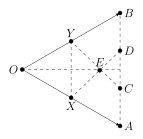
In the triangle \(OAB,\) \(\overrightarrow{OA}=\mathbf{a},\) \(\overrightarrow{OB}=\mathbf{b}\)
and \(OA=OB=1\). Points \(C\) and \(D\) trisect \(AB\) (i.e. \(AC=CD=DB=\frac{1}{3}AB\)).
\(X\) and \(Y\) lie on the line-segments \(OA\) and \(OB\) respectively, in such a way that \(CY\) and \(DX\) are perpendicular, and \(OX+OY=1\).
Denoting \(OX\) by \(x\), obtain a condition relating \(x\) and \(\mathbf{a\cdot b}\), and prove that
\[
\frac{8}{17}\leqslant\mathbf{a\cdot b}\leqslant1.
\]
If the angle \(AOB\) is as large as possible, determine the distance \(OE,\) where \(E\) is the point of intersection of \(CY\) and \(DX\).
Solution
Rating Information
Difficulty Rating: 1516.0
Difficulty Comparisons: 1
Banger Rating: 1516.0
Banger Comparisons: 1
Show LaTeX source
Problem source
In the triangle $OAB,$ $\overrightarrow{OA}=\mathbf{a},$ $\overrightarrow{OB}=\mathbf{b}$
and $OA=OB=1$. Points $C$ and $D$ trisect $AB$ (i.e. $AC=CD=DB=\frac{1}{3}AB$).
$X$ and $Y$ lie on the line-segments $OA$ and $OB$ respectively, in such a way that $CY$ and $DX$ are perpendicular, and $OX+OY=1$.
Denoting $OX$ by $x$, obtain a condition relating $x$ and $\mathbf{a\cdot b}$, and prove that
\[
\frac{8}{17}\leqslant\mathbf{a\cdot b}\leqslant1.
\]
If the angle $AOB$ is as large as possible, determine the distance $OE,$ where $E$ is the point of intersection of $CY$ and $DX$.
Solution source
\begin{center}
    \begin{tikzpicture}[scale=2]
        \def\ad{-30};
        \def\bd{30};
        \def\r{2};
        \def\k{0.5};
        \coordinate (O) at (0,0);
        \coordinate (A) at ({\r*cos(\ad)}, {\r*sin(\ad)});
        \coordinate (B) at ({\r*cos(\bd)}, {\r*sin(\bd)});

        \coordinate (C) at ($(A)!{1/3}!(B)$);
        \coordinate (D) at ($(A)!{2/3}!(B)$);

        \coordinate (X) at ($(O)!{\k}!(A)$);
        \coordinate (Y) at ($(O)!{1-\k}!(B)$);

        \coordinate (E) at ($(X)!{7/12}!(D)$);

        \filldraw (O) circle (1pt);
        \filldraw (A) circle (1pt);
        \filldraw (B) circle (1pt);
        \filldraw (C) circle (1pt);
        \filldraw (D) circle (1pt);
        \filldraw (X) circle (1pt);
        \filldraw (Y) circle (1pt);
        \filldraw (E) circle (1pt);

        \draw[-latex] (O) -- (A);
        \draw[-latex] (O) -- (B);
        \draw[dashed] (A) -- (B);

        \draw[dashed] (O) -- ($(A)!0.5!(B)$);
        \draw[dashed] (X) -- (Y);


        \node at (O) [left] {$O$};
        \node at (A) [right] {$A$};
        \node at (B) [right] {$B$};
        \node at (C) [right] {$C$};
        \node at (D) [right] {$D$};
        \node at (X) [below] {$X$};
        \node at (Y) [above] {$Y$};
        \node at (E) [above] {$E$};

        \draw[dashed] (C) -- (Y);
        \draw[dashed] (D) -- (X);
        % \node at (A) {$A$};


    \end{tikzpicture}
\end{center}

Denoting $\overrightarrow{OY}$ by $\mathbf{y}$ and $\overrightarrow{OC}$ by $\mathbf{c}$ etc, we have:

\begin{align*}
\mathbf{c} &= \frac23 \mathbf{a} + \frac13 \mathbf{b} \\
\mathbf{d} &= \frac13 \mathbf{a} + \frac23 \mathbf{b} \\
\mathbf{x} &= \lambda \mathbf{a} \\
\mathbf{y} &= (1-\lambda) \mathbf{b} \\
0 &= (\mathbf{d}-\mathbf{x}) \cdot (\mathbf{c} - \mathbf{y}) \\
&=((\frac13 -\lambda)\mathbf{a} + \frac23 \mathbf{b})\cdot(\frac23 \mathbf{a} + (\frac13-1+\lambda) \mathbf{b} ) \\
&= \frac{2}{3} \cdot (\frac13-\lambda) +\frac23 \cdot(\lambda - \frac23)+(\frac{4}{9}+(\frac13-\lambda)(-\frac23+\lambda))\mathbf{a}\cdot\mathbf{b} \\
&= -\frac{2}{9} + (\frac{4}{9} - \frac{2}{9}+\lambda-\lambda^2)\mathbf{a}\cdot \mathbf{b} \\
&= - \frac{2}{9} + (\frac{2}{9} + \lambda - \lambda^2)\mathbf{a}\cdot \mathbf{b} \\
\mathbf{a}\cdot \mathbf{b} &= \frac{2/9}{2/9+\lambda - \lambda^2}
\end{align*}

Since $0 \leq \lambda - \lambda^2 \leq \frac14$, $\frac{\frac29}{\frac29+\frac14} = \frac8{17} \leq \mathbf{a}\cdot\mathbf{b} \leq 1$

If $\angle AOB$ is as large as possible, $\mathbf{a}\cdot\mathbf{b}$ is as small as possible, ie $\lambda = \frac12$ and $\mathbf{a}\cdot \mathbf{b}  = \frac{8}{17}$

First notice that the length $OM$ to the midpoint of $AB$ is $\sqrt{\frac14 (\mathbf{a}+\mathbf{b})\cdot(\mathbf{a}+\mathbf{b})} = \sqrt{\frac14 (2 + 2\mathbf{a}\cdot \mathbf{b})} = \sqrt{\frac12 + \frac4{17}} = \sqrt{\frac{25}{34}} = \frac{5}{\sqrt{34}}$

Notice that $XYE$ and $DCE$ are similar triangles, and so the heights satisfy $\frac{h_1}{h_2} = \frac{\frac12}{\frac13} = \frac32$.

Therefore the length $OE$ is $\frac12 \frac{5}{\sqrt{34}} + \frac{3}{5} \frac12 \frac{5}{\sqrt{34}} = \frac{8}{10} \frac{5}{\sqrt{34}} = \frac{4}{\sqrt{34}}$