Problems
Filters
8 problems found
2017 Paper 2 Q9
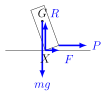
Two identical rough cylinders of radius \(r\) and weight \(W\) rest, not touching each other but a negligible distance apart, on a horizontal floor. A thin flat rough plank of width \(2a\), where \(a < r\), and weight \(kW\) rests symmetrically and horizontally on the cylinders, with its length parallel to the axes of the cylinders and its faces horizontal. A vertical cross-section is shown in the diagram below.
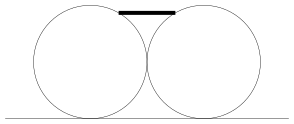
- Let \(F\) be the frictional force between one cylinder and the floor, and let \(R\) be the normal reaction between the plank and one cylinder. Show that \[ R\sin\theta = F(1+\cos\theta)\,, \] where \(\theta\) is the acute angle between the plank and the tangent to the cylinder at the point of contact. Deduce that \(2\sin\theta \le 1+\cos\theta\,\).
- Show that \[ N= \left( 1+\frac2 k\right)\left(\frac{1+\cos\theta}{\sin\theta} \right) F \,, \] where \(N\) is the normal reaction between the floor and one cylinder. Write down the condition that the cylinder does not slip on the floor and show that it is satisfied with no extra restrictions on \(\theta\).
- Show that \(\sin\theta\le\frac45\,\) and hence that \(r\le5a\,\).
Solution:
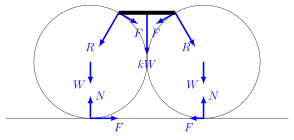
- \(\,\) \begin{align*} \text{N2}(\rightarrow, \text{ one cylinder}): && F\cos \theta + F - R \sin \theta &= 0 \\ \Rightarrow && F(1+\cos \theta) &= R \sin \theta \\ && F \leq \tfrac12 R \\ \Rightarrow && R \sin \theta &\leq \frac12 R(1+\cos \theta) \\ \Rightarrow && 2 \sin \theta &\leq 1 + \cos \theta \end{align*}
- \(\,\) \begin{align*} \text{N2}(\uparrow, \text{system}): && 2N-(k+2)W &= 0 \\ \Rightarrow && W &= \left ( \frac{2}{k+2} \right)N \\ \text{N2}(\uparrow, \text{one cylinder}): && N - W - R\cos \theta -F\sin \theta &= 0 \\ \Rightarrow && N - \left ( \frac{2}{k+2} \right)N - F \left ( \frac{1+\cos \theta}{\sin \theta} \right) \cos \theta - F \sin \theta &= 0 \\ \Rightarrow && \left ( \frac{k}{k+2} \right)N &= \left ( \frac{\cos \theta + \cos^2 \theta + \sin^2 \theta}{\sin \theta} \right) F\\ \Rightarrow && N &= \left ( 1 + \frac2{k} \right) \left ( \frac{\cos \theta + 1}{\sin \theta} \right) F \end{align*} The cylinder does not slip if \(F \leq \tfrac12 N\), ie \begin{align*} && N &\leq \left ( 1 + \frac2{k} \right) \left ( \frac{\cos \theta + 1}{\sin \theta} \right) \frac12 N \\ \Rightarrow && 2\sin \theta &\leq \left ( 1 + \frac2{k} \right) \left ( \cos \theta + 1 \right) \end{align*} but since \(2 \sin \theta \leq (1 + \cos \theta)\) and \((1+\frac2k) > 1\) this inequality is obviously satisfied.
- We can notice that \(2\sin \theta = 1 + \cos \theta\) is satisfied by a \(3-4-5\) triangle, where \(\sin \theta = 4/5, \cos \theta = 3/5\) and hence if \(\sin \theta \leq \frac45\) the condition must hold.
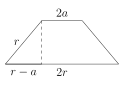
So \(\sin \theta = \frac{r-a}{r} \leq \frac45 \Rightarrow 5r-5a \leq 4r \Rightarrow r \leq 5a\)
2008 Paper 1 Q11
A straight uniform rod has mass \(m\). Its ends \(P_1\) and \(P_2\) are attached to small light rings that are constrained to move on a rough rigid circular wire with centre \(O\) fixed in a vertical plane, and the angle \(P_1OP_2\) is a right angle. The rod rests with \(P_1\) lower than \(P_2\), and with both ends lower than \(O\). The coefficient of friction between each of the rings and the wire is \(\mu\). Given that the rod is in limiting equilibrium (i.e. \ on the point of slipping at both ends), show that \[ \tan \alpha = \frac{1-2\mu -\mu^2}{1+2\mu -\mu^2}\,, \] where \(\alpha\) is the angle between \(P_1O\) and the vertical (\(0<\alpha<45^\circ\)). Let \(\theta\) be the acute angle between the rod and the horizontal. Show that \(\theta =2\lambda\), where \(\lambda \) is defined by \(\tan \lambda= \mu\) and \(0<\lambda<22.5^\circ\).
2007 Paper 2 Q10
A solid figure is composed of a uniform solid cylinder of density \(\rho\) and a uniform solid hemisphere of density \(3\rho\). The cylinder has circular cross-section, with radius \(r\), and height \(3r\), and the hemisphere has radius \(r\). The flat face of the hemisphere is joined to one end of the cylinder, so that their centres coincide. The figure is held in equilibrium by a force \(P\) so that one point of its flat base is in contact with a rough horizontal plane and its base is inclined at an angle \(\alpha\) to the horizontal. The force \(P\) is horizontal and acts through the highest point of the base. The coefficient of friction between the solid and the plane is \(\mu\). Show that \[\mu \ge \left\vert \tfrac98 -\tfrac12 \cot\alpha\right\vert\,. \]
Solution: The centre of mass of the sphere will be at \((0, \frac{3}{2}r)\) and the centre of mass of the hemisphere will be at \((0, 3r + \frac38r)\), their masses will be \(3\pi r^3 \cdot \rho \) and \(\frac23 \pi r^3 \cdot 3\rho \), meaning the center of mass will be \(\frac{\frac92r + \frac{27}{8} \cdot 2r}{3 + 2} = \frac{45/4}{5}r = \frac{9}{4}r\) above the center of the base.
2005 Paper 2 Q9
Two particles, \(A\) and \(B\), of masses \(m\) and \(2m\), respectively, are placed on a line of greatest slope, \(\ell\), of a rough inclined plane which makes an angle of \(30^{\circ}\) with the horizontal. The coefficient of friction between \(A\) and the plane is \(\frac16\sqrt{3}\) and the coefficient of friction between \(B\) and the plane is \(\frac13 \sqrt{3}\). The particles are at rest with \(B\) higher up \(\ell\) than \(A\) and are connected by a light inextensible string which is taut. A force \(P\) is applied to \(B\).
- Show that the least magnitude of \(P\) for which the two particles move upwards along \(\ell\) is \(\frac{11}8 \sqrt{3}\, mg\) and give, in this case, the direction in which \(P\) acts.
- Find the least magnitude of \(P\) for which the particles do not slip downwards along~\(\ell\).
2002 Paper 3 Q10
A light hollow cylinder of radius \(a\) can rotate freely about its axis of symmetry, which is fixed and horizontal. A particle of mass \(m\) is fixed to the cylinder, and a second particle, also of mass \(m\), moves on the rough inside surface of the cylinder. Initially, the cylinder is at rest, with the fixed particle on the same horizontal level as its axis and the second particle at rest vertically below this axis. The system is then released. Show that, if \(\theta\) is the angle through which the cylinder has rotated, then \[ \ddot{\theta} = {g \over 2a} \l \cos \theta - \sin \theta \r \,, \] provided that the second particle does not slip. Given that the coefficient of friction is \( (3 + \sqrt{3})/6\), show that the second particle starts to slip when the cylinder has rotated through \(60^\circ\).
1996 Paper 3 Q10
Two rough solid circular cylinders, of equal radius and length and of uniform density, lie side by side on a rough plane inclined at an angle \(\alpha\) to the horizontal, where \(0<\alpha<\pi/2\). Their axes are horizontal and they touch along their entire length. The weight of the upper cylinder is \(W_1\) and the coefficient of friction between it and the plane is \(\mu_1\). The corresponding quantities for the lower cylinder are \(W_2\) and \(\mu_2\) respectively and the coefficient of friction between the two cylinders is \(\mu\). Show that for equilibrium to be possible:
- \(W_1\ge W_2\);
- \(\mu\geqslant\dfrac{W_1+W_2}{W_1-W_2}\);
- \(\mu_{1}\geqslant\left(\dfrac{2W_{1}\cot\alpha}{W_{1}+W_{2}}-1\right)^{-1}\,.\)
Solution:
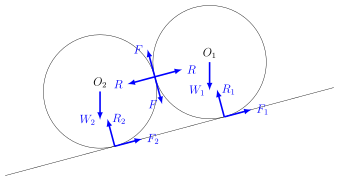
- \begin{align*} \overset{\curvearrowright}{O_2}: && 0 &= F_2 - F \\ \Rightarrow && F_2 &= F \\ \overset{\curvearrowright}{O_1}: && 0 &= F_1- F \\ \Rightarrow && F_1 &= F \\ \text{N2}(\swarrow, 2): && 0 &= R+W_2\sin\alpha -F \tag{1}\\ \text{N2}(\swarrow, 1): && 0 &= W_1\sin\alpha -F-R\tag{2}\\ \Rightarrow && W_1 \sin \alpha-R &= W_2 \sin \alpha+R \\ \Rightarrow && W_1 &\geq W_2 \end{align*}
- \begin{align*} (1)+(2)\Rightarrow && F &= \frac12 \sin \alpha (W_1 + W_2) \\ (1)-(2) \Rightarrow && R &= \frac12 \sin \alpha (W_1-W_2) \\ \Rightarrow && \frac{F}{R} &= \frac{W_1+W_2}{W_1-W_2} \\ \underbrace{\Rightarrow}_{F \leq \mu R} && \mu &\geq \frac{W_1+W_2}{W_1-W_2}\\ \end{align*}
- \begin{align*} \text{N2}(\nwarrow, 1): && 0 &= F+R_1-W_1\cos \alpha \\ \Rightarrow && R_1 &= W_1\cos \alpha - F \\ &&&= W_1 \cos \alpha - \frac12 \sin \alpha (W_1 + W_2) \\ \Rightarrow && \frac{R_1}{F_1} &= \frac{R_1}{F} \\ &&&= \frac{W_1 \cos \alpha - \frac12 \sin \alpha (W_1 + W_2)}{\frac12 \sin \alpha (W_1 + W_2) } \\ &&&= \frac{2W_1 \cot \alpha}{W_1+W_2} - 1 \\ \Rightarrow && \mu_1 & \geq \left ( \frac{2W_1 \cot \alpha}{W_1+W_2} - 1 \right)^{-1} \end{align*}
1991 Paper 3 Q11
1990 Paper 1 Q13
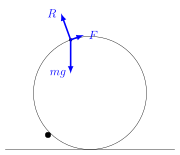
A rough circular cylinder of mass \(M\) and radius \(a\) rests on a rough horizontal plane. The curved surface of the cylinder is in contact with a smooth rail, parallel to the axis of the cylinder, which touches the cylinder at a height \(a/2\) above the plane. Initially the cylinder is held at rest. A particle of mass \(m\) rests in equilibrium on the cylinder, and the normal reaction of the cylinder on the particle makes an angle of \(\theta\) with the upward vertical. The particle is on the same side of the centre of the cylinder as the rail. The coefficient of friction between the cylinder and the particle and between the cylinder and the plane are both \(\mu\). Obtain the condition on \(\theta\) for the particle to rest in equilibrium. Show that, if the cylinder is released, equilibrium of both particle and cylinder is possible provided another inequality involving \(\mu\) and \(\theta\) (which should be found explicitly) is satisfied. Determine the largest possible value of \(\theta\) for equilibrium, if \(m=7M\) and \(\mu=0.75\).
Solution: