Problems
Filters
45 problems found
2025 Paper 3 Q3
Let \(f(x)\) be defined and positive for \(x > 0\). Let \(a\) and \(b\) be real numbers with \(0 < a < b\) and define the points \(A = (a, f(a))\) and \(B = (b, -f(b))\). Let \(X = (m,0)\) be the point of intersection of line \(AB\) with the \(x\)-axis.
- Find an expression for \(m\) in terms of \(a\), \(b\), \(f(a)\) and \(f(b)\).
- Show that, if \(f(x) = \sqrt{x}\), then \(m = \sqrt{ab}\). Find, in terms of \(n\), \(a\) function \(f(x)\) such that \(m = \frac{a^{n+1} + b^{n+1}}{a^n + b^n}\).
- Let \(g_1(x)\) and \(g_2(x)\) be defined and positive for \(x > 0\). Let \(m = M_1\) when \(f(x) = g_1(x)\) and let \(m = M_2\) when \(f(x) = g_2(x)\). Show that if \(\frac{g_1(x)}{g_2(x)}\) is a decreasing function then \(M_1 > M_2\). Hence show that $$\frac{a+b}{2} > \sqrt{ab} > \frac{2ab}{a+b}$$
- Let \(p\) and \(c\) be chosen so that the curve \(y = p(c-x)^3\) passes through both \(A\) and \(B\). Show that $$\frac{c-a}{b-c} = \left(\frac{f(a)}{f(b)}\right)^{1/3}$$ and hence determine \(c\) in terms of \(a\), \(b\), \(f(a)\) and \(f(b)\). Show that if \(f\) is a decreasing function, then \(c < m\).
Solution:
- The line \(AB\) has equation: \begin{align*} && \frac{y+f(b)}{x-b} &= \frac{f(a)+f(b)}{a-b} \\ \Rightarrow && \frac{f(b)}{m-b} &= \frac{f(a)+f(b)}{a-b} \\ \Rightarrow && m &= \frac{a-b}{f(a)+f(b)}f(b) + b \\ &&&= \frac{af(b)+bf(a)}{f(a)+f(b)} \end{align*}
- Suppose \(f(x) = \sqrt{x}\) then \begin{align*} m &= \frac{a\sqrt{b}+b\sqrt{a}}{\sqrt{a}+\sqrt{b}} \\ &= \frac{\sqrt{ab}(\sqrt{a}+\sqrt{b})}{\sqrt{a}+\sqrt{b}} \\ &= \sqrt{ab} \end{align*} Suppose \(f(x) = x^{-n}\) then \begin{align*} m &= \frac{a b^{-n}+ba^{-n}}{a^{-n}+b^{-n}} \\ &= \frac{a^{n+1}+b^{n+1}}{b^n + a^n} \\ \end{align*}
- Without loss of generality, we can scale \(g_1(x)\) and \(g_2(x)\) so that \(g_1(a) = g_2(a)\) and \(m\) won't change for either of them. Then since \(\frac{g_1(b)}{g_2(b)} < 1\) (this function is decreasing) our line connecting \((a,g_i(a))\) and \((b,-g_i(b))\) must interect the axis first for \(g_2\), in particular \(M_1 > M_2\). Suppose \(g_1(x) =1, g_2(x) = \sqrt{x}, g_3(x) = x^{-1}\), the notice that \(\frac{g_1(x)}{g_2(x)} =\frac{g_2(x)}{g_3(x)}= x^{-1/2}\) are decreasing, therefore: \begin{align*} \frac{a+b}{1+1} &> \sqrt{ab} > \frac{1+1}{a^{-1}+b^{-1}} \\ \frac{a+b}{2} &> \sqrt{ab} > \frac{2ab}{a+b} \\ \end{align*}
- We must have: \begin{align*} && p(c-a)^3 &= f(a) \\ && p(c-b)^3 &= -f(b) \\ \Rightarrow &&\left ( \frac{c-a}{c-b} \right)^3 &= -\frac{f(a)}{f(b)} \\ \Rightarrow && \frac{c-a}{b-c} &= \left (\frac{f(a)}{f(b)} \right)^{\tfrac13} \\ \Rightarrow && c-a &= \left (\frac{f(a)}{f(b)} \right)^{\tfrac13}(b-c)\\ \Rightarrow && c \left (1 + \left (\frac{f(a)}{f(b)} \right)^{\tfrac13} \right) &= \left (\frac{f(a)}{f(b)} \right)^{\tfrac13}b + a \\ \Rightarrow && c &= \frac{\left (\frac{f(a)}{f(b)} \right)^{\tfrac13}b + a}{1 + \left (\frac{f(a)}{f(b)} \right)^{\tfrac13}} \\ &&&= \frac{b[f(a)]^\tfrac13+a[f(b)]^\tfrac13}{[f(a)]^\tfrac13+[f(b)]^\tfrac13} \end{align*} We have that \(\frac{c-a}{b-c} = \left (\frac{f(a)}{f(b)} \right)^{\tfrac13} \) and \(\frac{m-a}{b-c} = \frac{f(a)}{f(b)}\). Since \(f\) is decreasing, \(\frac{f(a)}{f(b)} > 1\) and so \(\left (\frac{f(a)}{f(b)} \right)^{\tfrac13} < \frac{f(a)}{f(b)}\), therefore \(m > c\).
2019 Paper 3 Q1
The coordinates of a particle at time \(t\) are \(x\) and \(y\). For \(t \geq 0\), they satisfy the pair of coupled differential equations \[ \begin{cases} \dot{x} &= -x -ky \\ \dot{y} &= x - y \end{cases}\] where \(k\) is a constant. When \(t = 0\), \(x = 1\) and \(y = 0\).
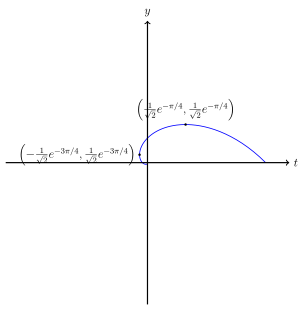
- Let \(k = 1\). Find \(x\) and \(y\) in terms of \(t\) and sketch \(y\) as a function of \(t\). Sketch the path of the particle in the \(x\)-\(y\) plane, giving the coordinates of the point at which \(y\) is greatest and the coordinates of the point at which \(x\) is least.
- Instead, let \(k = 0\). Find \(x\) and \(y\) in terms of \(t\) and sketch the path of the particle in the \(x\)-\(y\) plane.
Solution:
- Let \(k = 1\), then
\begin{align*}
\dot{x} &= - x - y \\
\dot{y} &= x - y \\
\dot{x}-\dot{y} &= -2x \\
\ddot{x} &= -\dot{x}-\dot{y} \\
&= -\dot{x} - (\dot{x}+2x) \\
&= -2\dot{x}- 2x \\
\dot{x}+\dot{y} &= -2y \\
\ddot{y} &= \dot{x}-\dot{y} \\
&= -2y-2\dot{y}
\end{align*}
So we have an auxiliary equation for \(x\) and \(y\) which is \(\lambda^2 + 2 \lambda+2 = 0 \Rightarrow \lambda = -1 \pm i\).
Therefore \(x = Ae^{-t} \cos t + B e^{-t} \sin t, y = Ce^{-t}\cos t + De^{-t} \sin t\). We also must have that, \(A = 1, C = 0\), so \(x = e^{-t} \cos t + Be^{-t} \sin t\) and \(y = De^{-t} \sin x\).
\begin{align*}
\dot{y} &= -De^{-t} \sin t +De^{-t} \cos t \\
&= e^{-t} \cos x + Be^{-t} \sin t- De^{-t} \sin t \\
\end{align*}
therefore \(B = 0, D = 1\) and \(x = e^{-t} \cos t, y = e^{-t} \sin t\)
\begin{align*} y &= e^{-t} \sin t \\ \dot{y} &= -e^{-t} \sin t + e^{-t} \cos t \\ \dot{x} &= e^{-t} \cos t -e^{-t} \sin t \end{align*}

- \begin{align*}
\dot{x} = -x \\
\dot{y} = x-y
\end{align*}
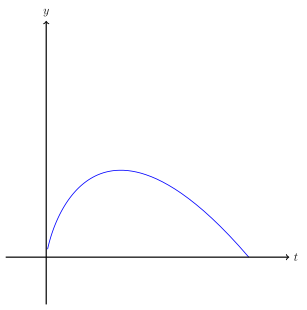
So \(x = e^{-t}\). \(\dot{y} + y = e^{-t}\) so \(y = (t+B)e^{-t}\) and so \(y =te^{-t}\).
2018 Paper 3 Q4
The point \(P(a\sec \theta, b\tan \theta )\) lies on the hyperbola \[ \dfrac{x^{2}}{a^{2}}-\dfrac{y^{2}}{b^{2}}=1\,, \] where \(a>b>0\,\). Show that the equation of the tangent to the hyperbola at \(P\) can be written as \[ bx- ay \sin\theta = ab \cos\theta \,. \]
- This tangent meets the lines \(\dfrac x a = \dfrac yb\) and \(\dfrac x a =- \dfrac y b\) at \(S\) and \(T\), respectively. How is the mid-point of \(ST\) related to \(P\)?
- The point \(Q(a\sec \phi, b\tan \phi)\) also lies on the hyperbola and the tangents to the hyperbola at \(P\) and \(Q\) are perpendicular. These two tangents intersect at \((x,y)\). Obtain expressions for \(x^2\) and \(y^2\) in terms of \(a\), \(\theta\) and \(\phi\). Hence, or otherwise, show that \(x^2+y^2 = a^2 -b^2\).
Solution: Note that \begin{align*} && \frac{\d a \sec \theta}{\d \theta} &= a \sec \theta \tan \theta \\ && \frac{\d b \tan \theta}{\d \theta} &= b \sec^2 \theta \\ \Rightarrow && \frac{\d y}{\d x} &= \frac{b \sec^2 \theta}{a \sec \theta \tan \theta} \\ &&&= \frac{b}{a} \frac{1}{\sin \theta} \\ \Rightarrow && \frac{y-b \tan \theta}{x - a \sec \theta} &= \frac{b}{a} \frac{1}{\sin \theta} \\ \Rightarrow && a \sin \theta y - ab \tan \theta \sin \theta &= bx -ab \sec \theta \\ \Rightarrow && bx-ay\sin \theta &= ab \sec x (1 - \sin ^2 \theta) \\ &&&= ab \cos \theta \end{align*}
- \begin{align*} S: &&& \begin{cases} bx-ay &= 0 \\ bx-ay \sin \theta &= ab \cos \theta \end{cases} \\ \Rightarrow && ay(1-\sin \theta) &= ab \cos \theta \\ \Rightarrow && y &= \frac{b \cos \theta}{1-\sin \theta} \\ &&x &=\frac{a\cos \theta}{1-\sin \theta} \\ T: &&& \begin{cases} bx+ay &= 0 \\ bx-ay \sin \theta &= ab \cos \theta \end{cases} \\ \Rightarrow && ay(1+\sin \theta) &= -ab \cos \theta \\ \Rightarrow && y &= \frac{-b \cos \theta}{1+\sin \theta} \\ &&x &=\frac{a\cos \theta}{1+\sin \theta} \\ M: && x &= \frac{a \cos \theta}{2} \frac{2}{1-\sin^2 \theta} \\ &&&= a \sec \theta \\ && y &= \frac{b \cos \theta}{2} \frac{2 \sin \theta}{1-\sin^2 \theta} \\ &&&= b \tan \theta \end{align*} The midpoint of \(ST\) is the same as \(P\).
- The tangents are perpendicular, therefore \(\frac{b}{a} \cosec \theta = - \frac{a}{b} \sin \phi\), ie \(b^2 = -a^2 \sin \phi \sin \theta\) The will intersect at: \begin{align*} &&& \begin{cases} bx - ay \sin \theta &= ab \cos \theta \\ bx - ay \sin \phi &= ab \cos \phi \end{cases} \\ \Rightarrow && ay ( \sin \theta - \sin \phi) &= ab(\cos \phi - \cos \theta) \\ \Rightarrow && y &= \frac{b(\cos \phi - \cos \theta)}{(\sin \theta - \sin \phi)} \\ && y^2 &= \frac{-a^2 \sin \phi \sin \theta (\cos\phi - \cos \theta)^2}{(\sin \theta - \sin \phi)^2} \\ \Rightarrow && bx(\sin \phi - \sin \theta) &= ab(\cos \theta \sin \phi - \cos \phi \sin \theta) \\ \Rightarrow && x &= \frac{a(\cos \theta \sin \phi - \cos \phi \sin \theta)}{\sin \phi - \sin \theta} \\ &&&= \frac{a^2(\cos \theta \sin \phi - \cos \phi \sin \theta)^2}{(\sin \phi - \sin \theta)^2} \end{align*} Therefore \begin{align*} && x^2+y^2 &= \frac{a^2}{(\sin \phi - \sin \theta)^2} \l (\cos \theta \sin \phi- \cos \phi \sin \theta)^2 - \sin \phi \sin \theta (\cos\phi - \cos \theta)^2 \r \\ &&&= \frac{a^2}{(\sin \phi - \sin \theta)^2} \l (\sin \phi - \sin \theta)(\cos^2 \theta \sin \phi - \sin \theta \cos^2 \phi) \r \\ &&&=a^2-b^2 \end{align*}
2017 Paper 1 Q3
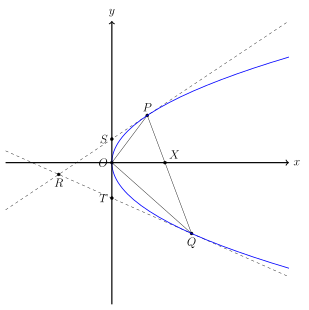
The points \(P(ap^2, 2ap)\) and \(Q(aq^2, 2aq)\), where \(p>0\) and \(q<0\), lie on the curve \(C\) with equation $$y^2= 4ax\,,$$ where \(a>0\,\). Show that the equation of the tangent to \(C\) at \(P\) is $$y= \frac 1 p \, x +ap\,.$$ The tangents to the curve at \(P\) and at \(Q \) meet at \(R\). These tangents meet the \(y\)-axis at \(S\) and \(T\) respectively, and \(O\) is the origin. Prove that the area of triangle \(OPQ\) is twice the area of triangle \(RST\).
Solution: \begin{align*} && 2yy' &= 4a \\ \Rightarrow && y' &= \frac{2a}{y} = \frac{2a}{2ap} = \frac1p \\ \Rightarrow && \frac{y-2ap}{x-ap^2} &= \frac1p \\ \Rightarrow && y &= \frac1p x +ap \end{align*} The other tangent will be \(y = \frac1qx+aq\) \begin{align*} &&& \begin{cases} py-x &= ap^2 \\ qy - x &= aq^2 \end{cases} \\ \Rightarrow && y(p-q) &= a(p^2-q^2) \\ \Rightarrow && y &= a(p+q) \\ && x &= apq \end{align*} Therefore \(R(apq, a(p+q)), S(0, ap), T(0, aq)\).
2016 Paper 3 Q2
The distinct points \(P(ap^2 , 2ap)\), \(Q(aq^2 , 2aq)\) and \(R(ar^2,2ar)\) lie on the parabola \(y^2 = 4ax\), where \(a>0\). The points are such that the normal to the parabola at \(Q\) and the normal to the parabola at \(R\) both pass through \(P\).
- Show that \(q^2 +qp + 2 = 0\).
- Show that \(QR\) passes through a certain point that is independent of the choice of \(P\).
- Let \(T\) be the point of intersection of \(OP\) and \(QR\), where \(O\) is the coordinate origin. Show that \(T\) lies on a line that is independent of the choice of \(P\). Show further that the distance from the \(x\)-axis to \(T\) is less than \(\dfrac {\;a}{\sqrt2}\,\).
Solution:
- \begin{align*} && 2y \frac{\d y}{\d x} &= 4a \\ \Rightarrow && \frac{\d y}{\d x} &= \frac{2a}{y} \end{align*} Therefore we must have \begin{align*} && \underbrace{-\frac{2aq}{2a}}_{\text{gradient of normal}} &= \underbrace{\frac{2ap-2aq}{ap^2-aq^2}}_{\Delta y / \Delta x} \\ \Rightarrow && -q &= \frac{2}{p+q} \\ && 0 &= 2 + pq+q^2 \end{align*}
- We must have that \(q,r\) are the two roots of \(x^2+px+2 = 0\) \(QR\) has the equation: \begin{align*} && \frac{y-2aq}{x-aq^2} &= \frac{2ar-2aq}{ar^2-aq^2} \\ \Rightarrow && \frac{y-2aq}{x-aq^2} &= \frac{2}{r+q} \\ \Rightarrow && y &= \frac{2}{q+r}(x-aq^2) +2aq \\ && y &= -\frac{2}{p}x+2a\left(q-\frac{q^2}{q+r} \right) \\ &&y&= -\frac{2}{p}x+2a \frac{qr}{q+r} \\ && y &= -\frac{2}{p}x - 2a \frac{2}{p} \\ && y & = -\frac{2}{p}(x+2a) \end{align*} Therefore the point \((-2a,0)\) lies on all such lines.
- \(OP\) has equation \(y = \frac{2}{p} x\) \begin{align*} && y &= \frac{2}{p} x \\ && y & = -\frac{2}{p}(x+2a) \\ && 2y &= -\frac{4a}{p} \\ \Rightarrow && y &= -\frac{2a}{p} \\ && x &= -a \end{align*} Therefore \(T\left (-a, -\frac{2a}{p} \right)\) always lies on the line \(x = -a\) The distance to the \(x\)-axis from \(T\) is \(\frac{2a}{|p|}\). We need to show that \(p\) can't be too small. Specifically \(x^2+px+2 = 0\) must have \(2\) real roots, ie \(\Delta = p^2-8 \geq 0 \Rightarrow |p| \geq 2\sqrt{2}\), ie \(\frac{2a}{|p|} \leq \frac{2a}{2\sqrt{2}} = \frac{a}{\sqrt{2}}\) as required.
2015 Paper 1 Q9
A short-barrelled machine gun stands on horizontal ground. The gun fires bullets, from ground level, at speed \(u\) continuously from \(t=0\) to \(t= \dfrac{\pi}{ 6\lambda}\), where \(\lambda\) is a positive constant, but does not fire outside this time period. During this time period, the angle of elevation \(\alpha\) of the barrel decreases from \(\frac13\pi\) to \(\frac16\pi\) and is given at time \(t\) by \[ \alpha =\tfrac13 \pi - \lambda t\,. \] Let \(k = \dfrac{g}{2\lambda u}\). Show that, in the case \(\frac12 \le k \le \frac12 \sqrt3\), the last bullet to hit the ground does so\\[2pt] at a distance \[ \frac{ 2 k u^2 \sqrt{1-k^2}}{g} \] from the gun. What is the corresponding result if \(k<\frac12\)?
Solution: The bullet fired at time \(t\) will hit the ground at time \(t+\frac{2u \sin (\frac13\pi - \lambda t)}{g}\). To find the last time a bullet hits the ground, we can differentiate, noting that \begin{align*} && T(t) &= t + \frac{2u \sin \alpha}{g} \\ \Rightarrow && T'(t) &= 1 - \frac{2u\lambda}{g} \cos \alpha \\ && T''(t) &= \frac{2u \lambda^2}{g} \sin \alpha > 0 \end{align*} If \(k = \frac{g}{2\lambda u} \in [\frac12, \frac12\sqrt{3}]\) then notice that this turning point is always achieved, and will be a maximum. It will be when \(\cos \alpha = k, \sin \alpha = \sqrt{1-k^2}\). The distance will be \(u \cos \alpha \cdot \frac{2 u \sin \alpha}{g} = \frac{2ku^2\sqrt{1-k^2}}{g}\). If \(k < \frac12\) then the last bullet to hit the ground will be the last bullet fired, ie \(\frac{2u^2 \sin \frac16\pi \cos \frac16\pi}{g} = \frac{u^2 \sin \frac13 \pi}{g} = \frac{\sqrt{3}u^2}{2g}\)
2014 Paper 1 Q8
Let \(L_a\) denote the line joining the points \((a,0)\) and \((0, 1-a)\), where \(0< a < 1\). The line \(L_b\) is defined similarly.
- Determine the point of intersection of \(L_a\) and \(L_b\), where \(a\ne b\).
- Show that this point of intersection, in the limit as \(b\to a\), lies on the curve \(C\) given by \[ y=(1-\sqrt x)^2\, \ \ \ \ (0< x < 1)\,. \]
- Show that every tangent to \(C\) is of the form \(L_a\) for some \(a\).
Solution:
- \(L_a : \frac{y}{x-a} = \frac{1-a-0}{0-a} = \frac{a-1}{a} \Rightarrow ay+(1-a)x = a(1-a)\) \begin{align*} && ay + (1-a)x &= a(1-a) \\ && by + (1-b)x &= b(1-b) \\ \Rightarrow && aby + b(1-a)x &= ba(1-a) \\ && aby + a(1-b)x &= ab(1-b) \\ \Rightarrow && (b-a)x &= ab(b-a) \\ \Rightarrow && x &= ab \\ && y &= \frac{a-1}{a} \cdot a(b-1) \\ &&&= (1-a)(1-b) \end{align*}
- As \(a \to b\), \(x \to a^2, y \to 1-2a+a^2 =(1-a)^2 = (1-\sqrt{x})^2\)
- \(\frac{\d y}{\d x} = 2(1-\sqrt{x})\cdot \left (-\tfrac12 \frac{1}{\sqrt{x}} \right) = 1 - \frac{1}{\sqrt{x}}\). Therefore the tangent when \(x = c^2, y = (1-c)^2\) is \begin{align*} && \frac{y-(1-c)^2}{x-c^2} &= 1 - \frac{1}{c} \\ \Rightarrow && cy + (1-c)x &= c(c-1)+c(1-c)^2 \\ &&&= c(1-c) \end{align*} Which is an equation of the form \(L_c\)
2014 Paper 1 Q9
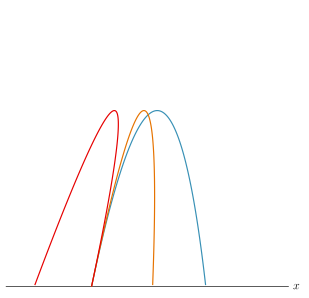
A particle of mass \(m\) is projected due east at speed \(U\) from a point on horizontal ground at an angle \(\theta\) above the horizontal, where \(0 < \theta < 90^\circ\). In addition to the gravitational force \(mg\), it experiences a horizontal force of magnitude \(mkg\), where \(k\) is a positive constant, acting due west in the plane of motion of the particle. Determine expressions in terms of \(U\), \(\theta\) and \(g\) for the time, \(T_H\), at which the particle reaches its greatest height and the time, \(T_L \), at which it lands. Let \(T = U\cos\theta /(kg)\). By considering the relative magnitudes of \(T_H\), \(T_L \) and \(T\), or otherwise, sketch the trajectory of the particle in the cases \(k\tan\theta<\frac12\), \(\frac12 < k\tan\theta<1\), and \(k\tan\theta>1\). What happens when \(k\tan\theta =1\)?
Solution: \begin{align*} && v_{\uparrow} &= U\sin \theta - g t \\ \Rightarrow && T_H &= \frac{U \sin \theta}{g} \\ \\ && s_{\uparrow} &= U \sin \theta t - \frac12 g t^2 \\ \Rightarrow && 0 &= U\sin \theta T_L - \frac12 g T_L^2 \\ && T_L &= \frac{2 U \sin \theta}{g} \end{align*} \(T = U\cos \theta / (kg)\) is the point when the particle's horizontal motion is reversed.
2014 Paper 3 Q3
- The line \(L\) has equation \(y=mx+c\), where \(m > 0\) and \(c > 0\). Show that, in the case \(mc > a > 0\), the shortest distance between \(L\) and the parabola \(y^2=4ax\) is \[ \frac{mc-a}{m\sqrt{m^2+1}}\,.\] What is the shortest distance in the case that \(mc\le a\)?
- Find the shortest distance between the point \((p,0)\), where \(p > 0\), and the parabola \(y^2=4ax\), where \(a > 0\), in the different cases that arise according to the value of \(p/a\). [You may wish to use the parametric coordinates \((at^2, 2at)\) of points on the parabola.] Hence find the shortest distance between the circle \((x-p)^2 + y^2 =b^2\), where \(p > 0\) and \(b > 0\), and the parabola \(y^2=4ax\), where \(a > 0\), in the different cases that arise according to the values of \(p\), \(a\) and \(b\).
Solution:
- Suppose we have the shortest distance between the two curves, and the path between the points is not a normal to both curves. Then we could shift the endpoints to reduce the distance. (Assuming we're not at a point of intersection). Therefore, the normal to the curves must be the same (or in other words) the gradients of the curves must be the same. ie we are at a point where \(2y y' = 4a\) we must have \(y' = m\), so \(y = \frac{2a}{m}\) and \(x = \frac{a}{m^2}\) and the distance from this point to the line \(y=mx+c\) is \(\frac{|m \frac{a}{m^2} - \frac{2a}{m}+c|}{\sqrt{m^2+1}} = \frac{|mc-a|}{m\sqrt{m^2+1}} = \frac{mc-a}{m\sqrt{m^2+1}}\). If \(mc \leq a\) then we find \(\frac{a-mc}{m\sqrt{m^2+1}}\) However, we must check that the two curves do not intersect (otherwise the closest distace is \(0\)). ie we need to check if \((mx+c)^2 = 4ax\) has any solutions, this quadratic has discriminant \((2mc-4a)^2 - 4 \cdot m^2 \cdot c^2 = 16a^2-16amc = 16a(a-mc)\) which is clearly greater than \(0\) when \(a \geq mc\). Therefore the shortest distance in this case is \(0\).
- The distance squared between the point \((p,0)\) and a point of the form \((at^2,2at)\) is \(D^2 = (at^2-p)^2+4a^2t^2 = a^2t^4+(4a^2-2ap)t^2+p^2\) \begin{align*} && \frac{D^2}{a^2} &= t^4 + 2\left(2-\frac{p}{a}\right)t^2 + \frac{p^2}{a^2} \\ &&&= \left (t^2 - \left (\frac{p}{a}-2 \right)\right)^2 + \frac{p^2}{a^2} - \left (2-\frac{p}{a} \right)^2 \\ &&&= \left (t^2 - \left (\frac{p}{a}-2 \right)\right)^2 +\frac{4p}{a} -4 \\ \end{align*} Therefore if \(2 \leq \frac{p}{a}\) then we can find a \(t\) such that we attain the minimum for \(D^2/a^2\) of \(\frac{4p}{a}-4\) and so \(D = \sqrt{4pa-4a^2} = 2\sqrt{a(p-a)}\) . If not the smallest value will be when \(t = 0\) and we will have \(|p|\) Now consider all the lines joining points on the parabola to the centre of the circle. The shortest distance from the parabola to the circle will be normal to the circle and therefore will also be a line through the center. Therefore we need only consider the shortest distance from \((p,0)\) to the parabola \(-b\). Case 1: If \(p \geq 2a\) we have \(2\sqrt{a(p-a)} - b\) or \(0\) if \(b \geq 2\sqrt{a(p-a)}\) Case 2: If \(p < 2a\) we have \(p-b\) or \(0\) if \(b \geq p\)
2013 Paper 2 Q4
The line passing through the point \((a,0)\) with gradient \(b\) intersects the circle of unit radius centred at the origin at \(P\) and \(Q\), and \(M\) is the midpoint of the chord \(PQ\). Find the coordinates of \(M\) in terms of \(a\) and \(b\).
- Suppose \(b\) is fixed and positive. As \(a\) varies, \(M\) traces out a curve (the locus of \(M\)). Show that \(x=- by\) on this curve. Given that \(a\) varies with \(-1\le a \le 1\), show that the locus is a line segment of length \(2b/(1+b^2)^\frac12\). Give a sketch showing the locus and the unit circle.
- Find the locus of \(M\) in the following cases, giving in each case its cartesian equation, describing it geometrically and sketching it in relation to the unit circle:
- \(a\) is fixed with \(0 < a < 1\), and \(b\) varies with \(-\infty < b < \infty\);
- \(ab=1\), and \(b\) varies with \(0< b\le1\).
Solution: \begin{align*} && y &= bx-ba \\ && 1 &= x^2 + y^2 \\ \Rightarrow && 1 &= x^2 + b^2(x-a)^2 \\ \Rightarrow && 0 &= (1+b^2)x^2-2ab^2x+b^2a^2-1 \end{align*} This will have roots which sum to \(\frac{2ab^2}{1+b^2}\), therefore \(M = \left ( \frac{ab^2}{1+b^2}, \frac{ab^3}{1+b^2}-ba \right)=\left ( \frac{ab^2}{1+b^2}, \frac{-ba}{1+b^2} \right)\)
- Since \(b\) is fixed so is \(\frac{b}{1+b^2} = t\) and all the points are \((bta, -ta)\), ie \(x = -by\). If \(a \in [-1,1]\) we are ranging on the points \((bt, -t)\) to \((-bt, t)\) which is a distance of \begin{align*}
&& d &= \sqrt{(bt+bt)^2+(-2t)^2} \\
&&&= \sqrt{4(b^2+1)t^2} \\
&&&=2 \sqrt{(b^2+1)\frac{b^2}{(b^2+1)^2}} \\
&&&= \frac{2b}{\sqrt{b^2+1}}
\end{align*}

- If \(a\) is fixed we have \(\left ( \frac{ab^2}{1+b^2}, -\frac{ba}{1+b^2} \right)\)
\begin{align*}
&& \frac{x}{y} &= - b \\
\Rightarrow && y &= \frac{a\frac{x}{y}}{1 + \frac{x^2}{y^2}} \\
\Rightarrow && y^2 \left ( 1 + \frac{x^2}{y^2} \right) &= ax \\
\Rightarrow && x^2-ax + y^2 &= 0 \\
\Rightarrow && \left (x - \frac{a}{2} \right)^2 + y^2 &= \frac{a^2}{4}
\end{align*}
Therefore we will end up with a circle centre \((\tfrac{a}{2}, 0)\) going through the origin.

- If \(ab = 1\), we have \(\left ( \frac{b}{1+b^2}, -\frac{1}{1+b^2} \right)\)
\begin{align*}
&& \frac{x}{y} &= -b \\
\Rightarrow && y &= -\frac{1}{1+\frac{x^2}{y^2}} \\
\Rightarrow && y + \frac{x^2}{y} &= - 1 \\
\Rightarrow && y^2 +y+ x^2 &= 0 \\
\Rightarrow && \left ( y + \frac12 \right)^2 + x^2 &= \frac14
\end{align*}

- If \(a\) is fixed we have \(\left ( \frac{ab^2}{1+b^2}, -\frac{ba}{1+b^2} \right)\)
\begin{align*}
&& \frac{x}{y} &= - b \\
\Rightarrow && y &= \frac{a\frac{x}{y}}{1 + \frac{x^2}{y^2}} \\
\Rightarrow && y^2 \left ( 1 + \frac{x^2}{y^2} \right) &= ax \\
\Rightarrow && x^2-ax + y^2 &= 0 \\
\Rightarrow && \left (x - \frac{a}{2} \right)^2 + y^2 &= \frac{a^2}{4}
\end{align*}
Therefore we will end up with a circle centre \((\tfrac{a}{2}, 0)\) going through the origin.
2012 Paper 1 Q4
The curve \(C\) has equation \(xy = \frac12\). The tangents to \(C\) at the distinct points \(P\big(p, \frac1{2p}\big)\) and \(Q\big(q, \frac1{2q}\big)\) where \(p\) and \(q\) are positive, intersect at \(T\) and the normals to \(C\) at these points intersect at \(N\). Show that \(T\) is the point \[ \left( \frac{2pq}{p+q}\,,\, \frac 1 {p+q}\right)\!. \] In the case \(pq=\frac12\), find the coordinates of \(N\). Show (in this case) that \(T\) and \(N\) lie on the line \(y=x\) and are such that the product of their distances from the origin is constant.
Solution: \begin{align*} && \frac{\d y}{\d x} &= -\frac1{2x^2} \\ \Rightarrow && \frac{y - \frac{1}{2p}}{x - p} &= - \frac{1}{2p^2} \\ \Rightarrow && y - \frac1{2p} &= -\frac{1}{2p^2}x +\frac1{2p} \\ \Rightarrow && y +\frac{1}{2p^2}x &= \frac1p \\ \Rightarrow && 2p^2 y + x &= 2p\\ \Rightarrow && 2q^2 y + x &= 2q \\ \Rightarrow && (p^2-q^2)y &= p-q \\ \Rightarrow && y &= \frac{1}{p+q} \\ && x &= \frac{2pq}{p+q} \end{align*} \begin{align*} \text{normal}: && \frac{y-\frac1{2p}}{x-p} &= 2p^2 \\ \Rightarrow && y - \frac1{2p} &= 2p^2x - 2p^3 \\ \Rightarrow && 2py -4p^3x &= 1-4p^4 \\ \Rightarrow && 2qy -4q^3x &= 1-4q^4 \\ pq = \tfrac12: && y - 2p^2 x &= q-2p^3 \\ && y - 2q^2 x &= p-2q^3 \\ \Rightarrow && (2q^2-2p^2)x &= q-p +2q^3-2p^3 \\ &&&= (q-p)(q+p+2q^2+1+2p^2) \\ \Rightarrow && x &= \frac{1+2(p^2+q^2)+1}{2(p+q)} \\ &&&= \frac{1+2(p^2+q^2+2pq-1)+1}{2(p+q)} \\ &&&= p+q\\ && y &= 2p^2 \left ( p+q \right) + q - 2p^3 \\ &&&= p+q \end{align*} So \(N(p+q, p+q)\) and \(T\left (\frac{1}{p+q}, \frac{1}{p+q} \right)\), so both points lie on \(y = x\). \[ OT \cdot ON = \frac{\sqrt{2}}{p+q} \cdot (p+q)\sqrt{2} = 2 \] which is clearly constant.
2011 Paper 1 Q4
The distinct points \(P\) and \(Q\), with coordinates \((ap^2,2ap)\) and \((aq^2,2aq)\) respectively, lie on the curve \(y^2=4ax\). The tangents to the curve at \(P\) and \(Q\) meet at the point \(T\). Show that \(T\) has coordinates \(\big(apq, a(p+q)\big)\). You may assume that \(p\ne0\) and \(q\ne0\). The point \(F\) has coordinates \((a,0)\) and \(\phi\) is the angle \(TFP\). Show that \[ \cos\phi = \frac{pq+1}{\sqrt{(p^2+1)(q^2+1)}\ } \] and deduce that the line \(FT\) bisects the angle \(PFQ\).
Solution: The tangent at \((at^2, 2at)\) can be found \begin{align*} && \frac{\d y}{\d x} &= \frac{\dot{y}}{\dot{x}} \\ &&&= \frac{2a}{2at} = \frac1t \\ \Rightarrow && \frac{y-2at}{x-at^2} &= \frac1t \\ \Rightarrow && ty -x &= at^2 \\ \\ PT: && py - x &= ap^2 \\ QT: && qy - x &= aq^2 \\ \Rightarrow && (p-q)y &= a(p^2-q^2) \\ \Rightarrow && y &= a(p+q) \\ && x &= aq(p+q) - aq^2 \\ &&&= apq \end{align*} By the cosine rule: \begin{align*} && TP^2 &= FT^2 + FP^2 - 2 \cdot FT \cdot FP \cdot \cos \phi \\ && (apq - ap^2)^2 + (a(p+q)-2ap)^2 &= (a-apq)^2+(a(p+q))^2 + \\ &&&\quad + (a-ap^2) + (2ap)^2 - 2 \cdot FT \cdot FP \cdot \cos \phi \\ \Rightarrow && a^2p^2(q-p)^2 + a^2(q-p)^2 &= a^2(1-pq)^2+a^2(p+q)^2 + \\ &&&\quad + a^2(1-p^2)^2+4a^2p^2 - 2 \cdot FT \cdot FP \cdot \cos \phi \\ && a^2(p^2+1)(q-p)^2 &= a^2(1+p^2)(1+q^2) + a^2(1+p^2)^2 + \\ &&&\quad - 2 \cdot a^2(1+p^2)\sqrt{(1+p^2)(1+q^2)} \cos \phi \\ \Rightarrow && \cos \phi &= \frac{a^2(1+p^2)(2+q^2+p^2-(q-p)^2)}{2 a^2 (1+p^2)\sqrt{(1+p^2)(1+q^2)}} \\ &&&= \frac{1+pq}{\sqrt{(1+p^2)(1+q^2)}} \end{align*} As required. Notice that by symmetry, \(\cos \angle TFQ = \frac{1+qp}{\sqrt{(1+q^2)(1+p^2)}} = \cos \phi\). Therefore they have the same angle and \(FT\) bisects \(PFQ\)
2011 Paper 3 Q5
A movable point \(P\) has cartesian coordinates \((x,y)\), where \(x\) and \(y\) are functions of \(t\). The polar coordinates of \(P\) with respect to the origin \(O\) are \(r\) and \(\theta\). Starting with the expression \[ \tfrac12 \int r^2 \, \d \theta \] for the area swept out by \(OP\), obtain the equivalent expression \[ \tfrac12 \int \left( x\frac{\d y}{\d t} - y \frac{\d x}{\d t}\right)\d t \,. \tag{\(*\)} \] The ends of a thin straight rod \(AB\) lie on a closed convex curve \(\cal C\). The point \(P\) on the rod is a fixed distance \(a\) from \(A\) and a fixed distance \(b\) from \(B\). The angle between \(AB\) and the positive \(x\) direction is \(t\). As \(A\) and \(B\) move anticlockwise round \(\cal C\), the angle \(t\) increases from \(0\) to \(2\pi\) and \(P\) traces a closed convex curve \(\cal D\) inside \(\cal C\), with the origin \(O\) lying inside \(\cal D\), as shown in the diagram.
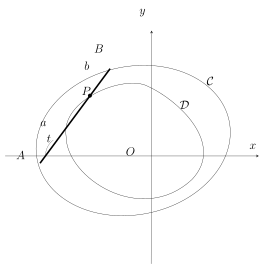
Solution: \begin{align*} && \tan \theta &= y/x \\ \Rightarrow && \sec^2 \theta \frac{\d \theta}{\d t} &= \frac{x \frac{\d y}{\d t} - y \frac{\d x}{\d t}}{x^2} \\ \Rightarrow && \frac{\d \theta}{\d t} &=\left (x \frac{\d y}{\d t} - y \frac{\d x}{\d t} \right) \frac{\cos^2 \theta}{x^2} \\ &&&=\left (x \frac{\d y}{\d t} - y \frac{\d x}{\d t} \right) \frac{\cos^2 \theta}{r^2 \cos^2 \theta } \\ &&&=\left (x \frac{\d y}{\d t} - y \frac{\d x}{\d t} \right) \frac{1}{r^2 } \\ && \tfrac12 \int r^2 \, \d \theta &= \tfrac12 \int \left (x \frac{\d y}{\d t} - y \frac{\d x}{\d t} \right) \d t \end{align*} \(A = (x - a \cos t, y - a \sin t), B = (x + b \cos t , y + b \sin t)\) \begin{align*} && [A] &= \tfrac12 \int_0^{2\pi} \left ((x-a \cos t) \frac{\d (y-a \sin t)}{\d t} - (y-a \sin t) \frac{\d (x-a \cos t)}{\d t} \right) \d t \\ &&&= \tfrac12 \int_0^{2\pi} \left ((x - a \cos t) \left ( \frac{\d y}{\d t} - a \cos t \right) - (y - a \sin t) \left ( \frac{\d x}{\d t} + a \sin t \right)\right) \d t \\ &&&= \tfrac12 \int_0^{2\pi} \left ( x \frac{\d y}{\d t} - y \frac{\d x}{\d t} - a \cos t \frac{\d y}{\d t}-ax \cos t +a^2 \cos^2 t + a \sin t \frac{\d x}{\d t}-y a \sin t + a^2 \sin^2 t \right) \d t \\ &&&= \tfrac12 \int_0^{2\pi} \left ( \underbrace{x \frac{\d y}{\d t} - y \frac{\d x}{\d t}}_{[P]}-a\left ((x + \frac{\d y}{\d x}) \cos t + (y - \frac{\d x}{\d t}) \sin t \right) + \underbrace{a^2}_{\pi a^2} \right) \d t \\ &&&= [P] + \pi a^2 - af \end{align*} \begin{align*} && [B] &= \tfrac12 \int_0^{2\pi} \left ((x+b \cos t) \frac{\d (y+b \sin t)}{\d t} - (y+b \sin t) \frac{\d (x+b \cos t)}{\d t} \right) \d t \\ &&&= \tfrac12 \int_0^{2\pi} \left ((x+b \cos t) (\frac{\d y}{\d t} + b \cos t) - (y+b \sin t)(\frac{\d x}{\d t} - b \sin t) \right) \d t \\ &&&= \tfrac12 \int_0^{2\pi} \left (x \frac{\d y}{\d t} - y \frac{\d x}{\d t} + b^2 + b(\cos t (x + \frac{\d y}{\d t}) +(y - \frac{\d x}{\d t})\sin t\right) \d t \\ &&&= [P] + \pi b^2 + b f \end{align*} Since \(A\) and \(B\) trace out the same area, we must have \(\pi a^2 - af = \pi b^2 + bf \Rightarrow \pi (a^2-b^2) = f(b+a) \Rightarrow f = \pi (a-b)\). In particular the area inbetween is \([A] - [P] = \pi a^2 - a \pi (a-b)\)
2011 Paper 3 Q8
The complex numbers \(z\) and \(w\) are related by \[ w= \frac{1+\mathrm{i}z}{\mathrm{i}+z}\,. \] Let \(z=x+\mathrm{i}y\) and \(w=u+\mathrm{i}v\), where \(x\), \(y\), \(u\) and \(v\) are real. Express \(u\) and \(v\) in terms of \(x\) and \(y\).
- By setting \(x=\tan(\theta/2)\), or otherwise, show that if the locus of \(z\) is the real axis \(y=0\), \(-\infty < x < \infty\), then the locus of \(w\) is the circle \(u^2+v^2=1\) with one point omitted.
- Find the locus of \(w\) when the locus of \(z\) is the line segment \(y=0\), \(-1 < x < 1\,\).
- Find the locus of \(w\) when the locus of \(z\) is the line segment \(x=0\), \(-1 < y < 1\,\).
- Find the locus of \(w\) when the locus of \(z\) is the line \(y=1\), \(-\infty < x < \infty\,\).
Solution: \begin{align*} w &= \frac{1+iz}{i+z} \\ &= \frac{1-y+ix}{x+i(1+y)} \\ &= \frac{((1-y)+ix)(x-i(1+y))}{x^2+(1+y)^2} \\ &= \frac{x(1-y)+x(1+y)}{x^2+(1+y)^2}+\frac{x^2+y^2-1}{x^2+(1+y)^2}i \\ &= \frac{2x}{x^2+(y+1)^2}+\frac{x^2+y^2-1}{x^2+(1+y)^2}i \end{align*} Therefore \(u = \frac{2x}{x^2+(y+1)^2}, v = \frac{x^2+y^2-1}{x^2+(1+y)^2}\)
- Suppose \(z = \tan(\theta/2) = t\) then \(u = \frac{2t}{t^2+1} = \sin \theta, v = \frac{t^2-1}{t^2+1} = \cos \theta\), ie \(u+iv\) is the unit circle, where \(-\frac{\pi}{2} < \theta/2 < \frac{\pi}{2}\) or \(-\pi < \theta < \pi\), ie excluding the point \((\sin \pi, \cos \pi) = (0,1)\).
- When \(-1 < x < 1\) we have \(-\frac{\pi}{4} < \frac{\theta}{2} < \frac{\pi}{4}\) ie \(-\frac{\pi}{2} < \theta < \frac{\pi}{2}\), ie the lower half of the unit circle.
- When \(x = 0, -1 < y < 1\) we have \(u = 0, v = \frac{y^2-1}{(1+y)^2}\) which is the negative imaginary axis.
- We have \(u = \frac{2t}{t^2+4}, v = \frac{t^2}{t^2+4}\), ie \(u^2 + v^2 = v\), ie \(u^2+(v-\frac12)^2 = \frac12^2\), so a circle centre \(\frac12i\) radius \(\frac12\), missing out \((0,1)\)
2010 Paper 1 Q10
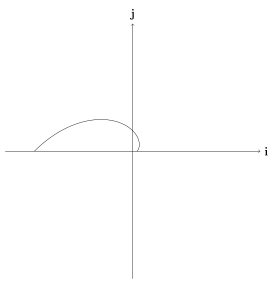
A particle \(P\) moves so that, at time \(t\), its displacement \( \bf r \) from a fixed origin is given by \[ {\bf r} =\left( \e^{t}\cos t \right) {\bf i}+ \left(\e^t \sin t\right) {\bf j}\,.\] Show that the velocity of the particle always makes an angle of \(\frac{\pi}{4}\) with the particle's displacement, and that the acceleration of the particle is always perpendicular to its displacement. Sketch the path of the particle for \(0\le t \le \pi\). A second particle \(Q\) moves on the same path, passing through each point on the path a fixed time \(T\) after \(P\) does. Show that the distance between \(P\) and \(Q\) is proportional to \(\e^{t}\).
Solution: \begin{align*} && {\bf r} &=\left( \e^{t}\cos t \right) {\bf i}+ \left(\e^t \sin t\right) {\bf j} \\ \Rightarrow && \dot{\bf r} &= \left( \e^{t}\cos t -\e^t \sin t\right) {\bf i}+ \left(\e^t \sin t+\e^t \cos t\right) {\bf j} \\ \Rightarrow && \mathbf{r}\cdot\dot{ \mathbf{r}} &= e^{2t}(\cos^2 t - \sin t \cos t) + e^{2t}(\sin^2 t+ \sin t \cos t) \\ &&&= e^{2t} (\cos^2 t + \sin ^2 t)\\ &&&= e^{2t} \\ \\ && | {\bf r}| &= e^{t} \\ && |{\bf \dot{r}}| &= e^t \sqrt{(\cos t - \sin t)^2 + (\sin t + \cos t)^2} \\ &&&= e^t \sqrt{2 \cos^2 t + 2 \sin^2 t} \\ &&&= \sqrt{2} e^t \\ \\ \Rightarrow && \frac{\mathbf{r}\cdot\dot{ \mathbf{r}}}{ |{\bf {r}}| |{\bf \dot{r}}|} &= \frac{e^{2t}}{\sqrt{2}e^te^t} \\ &&&= \frac{1}{\sqrt{2}} \end{align*} Therefore the angle between the velocity and displacement is \(\frac{\pi}{4}\). \begin{align*} && \ddot{\bf{r}} &= \left( \e^{t}(\cos t - \sin t) - \e^t (\sin t + \cos t)\right) {\bf i}+ \left(\e^t (\sin t + \cos t) + \e^t(\cos t - \sin t)\right) {\bf j} \\ &&&= \left ( -2\e^{t} \sin t \right) {\bf i}+ \left ( 2\e^{t} \cos t \right) {\bf j} \\ \Rightarrow && {\bf r} \cdot \ddot{\bf{r}} &= 2e^{2t} \left ( -\sin t \cos t + \sin t \cos t \right) \\ &&&= 0 \end{align*} Therefore the acceleration is perpendicular.